
Cedar Raised Bed Kit: What to Check Before You Buy

Bloomcabin · Raised-bed guides
Cedar Raised Bed Kit: What to Check Before You Buy
A cedar raised bed kit can suit a vegetable or flower bed if the supplier identifies the timber and finish, documents the intended use and shows how the walls and base are assembled. If the listing cannot answer those questions, don’t buy on the strength of the word ‘cedar’.
Verify the timber
For a cedar raised bed kit, get the species, grade, finish and intended use in writing for the exact model.
Read the build details
Read the assembly drawing alongside the board thickness and fastener list. Check how long sides are supported.
Check the footprint and base
Measure the outside fit and inside planting space separately, then find out where water will go.
Set a buying threshold
If the supplier cannot confirm a detail essential to your crops or site, wait for an answer before ordering.
When you compare listings for a cedar raised bed kit, start with what you need the bed to do. An open frame for salad leaves on prepared soil and a bed that must hold growing medium on paving can look similar in a photo, but they have different requirements at the base. In either case, you need to know whether the cedar description covers the whole frame or just selected parts.
Use the specification and assembly manual together. The specification tells you what you are ordering; the manual shows how those parts are meant to work together. Between them, you should be able to answer three questions before paying: what exactly will arrive, does the supplier describe it as suitable for your intended planting and surface, and can you set it up and maintain it as directed?
01
Find out what ‘cedar’ covers on the parts list
The first question about a cedar raised bed kit is not just ‘Is it cedar?’ but ‘Which parts are cedar, and what exactly is specified?’ Ask for the timber species and any stated grade or selection standard, plus a list of the components it applies to. Wall boards, corner pieces, caps and any internal supports need not be made of the same material. If a listing describes cedar sides but says nothing about the corners, record the corners as unknown rather than assuming they match.
For a cedar raised bed kit sold as untreated, ask whether that description applies to all the wood supplied and whether a separate finish has been applied. For a coated or treated kit, ask what was applied, to which faces or parts, and what the instructions say about contact with growing media. If photos show a coloured finish but the description does not identify it, get clarification rather than trying to identify it by appearance.
For salad leaves, herbs or other edible crops, ask whether that exact cedar raised bed kit is intended for food growing as supplied, or only when set up in a particular way. Ask for the relevant technical sheet or written product guidance. A description such as ‘for outdoor use’ answers a different question. A vague reply does not prove that the kit is unsuitable, but it leaves you without the information you need to choose it for that job.

02
Judge the wall as a system, not by board thickness alone
Read the board thickness alongside the assembly drawing for the cedar raised bed kit. Thickness tells you how much material there is at a cross-section, but it does not tell you how a long side is held in place. Look at where the ends of the boards sit, how far each section runs between supports and what joins any two sections end to end. A tall wall and a long uninterrupted side are reasons to look closely at the drawing, not reasons to guess a strength rating.
If the cedar raised bed kit comes in several lengths or heights, request the drawing for the version you intend to order. Check whether the longer version calls for extra posts, joints or braces and whether those parts are included. Find out if the layout is fixed: the fact that boards fit together in the supplied rectangle does not establish that they can be stacked higher or rearranged.
Ask for the fastener type and material, and check whether the supplier specifies different fixings for different joints. The useful question is not whether an alternative screw is labelled for outdoor use, but whether it is approved for this timber and connection. If you plan to rest a heavy object on the rim or use it as a seat, look for an explicit statement from the maker covering that use. Do not infer it from the width of a cap board or a gallery photo.

03
Use the manual to check the delivery and build
Lay out the cedar raised bed kit where it will be filled and match what arrived to the parts list. Check board lengths, joints and supplied fixings against the instructions before starting. Put aside any split board at a fixing point or component that does not match the drawing, and ask the supplier how to proceed. This is easier to resolve while the kit is empty than after the walls are holding growing medium.
Follow the order in the manual, including any directions on surface preparation, pilot holes and when to tighten the fixings. On a cedar raised bed kit with similar-looking parts, use the drawing to identify which face and end go where. If a joint will not seat, check the orientation and hardware before forcing it. Do not trim a board, drill a fresh fixing point or add a brace to work around a mismatch unless the supplier confirms the change.
Before filling the cedar raised bed kit, confirm that all specified supports are installed, the joints are seated and the frame sits as the instructions require. Check the base at this stage: an extra sheet slid under the frame to stop soil spreading can change the intended drainage. If anything is still unclear, leave the bed empty until you have the answer.

04
Measure what you can plant and what you can reach
Measure the space the cedar raised bed kit will occupy at its widest points, including any projecting posts or caps, then use the internal measurements for planting. The outside dimension answers ‘Will it fit?’ The inside dimension answers ‘How much room is there to plant?’ Neither tells you whether you can work comfortably from the path. Mark the footprint and stand where you will actually tend the bed. Try reaching the far side of a narrow bed with access on one side only, or the centre if you can work from both sides. Plan to work from the path rather than standing on the growing medium.
Keep wall height separate from fill depth and total rooting depth. If you leave a gap below the rim, that space does not count as growing medium. An open-bottom cedar raised bed kit over suitable soil may allow roots to grow below the frame, but do not count that depth if the ground underneath is compacted, obstructed or otherwise unsuitable. Where the base prevents root access to the ground, judge the crop against the usable depth inside the bed.
Take that measurement to the seed packet or local growing guidance for the varieties you want. If you are buying a narrow kit for a single strip of salad leaves, check the usable width against the planting layout you have in mind. If you also want to grow a crop that needs more depth, check it separately. One crop fitting the bed is not evidence that the other will.

05
Trace the route water will take at your site
Walk the site after rain before committing to a position for an open-bottom cedar raised bed kit. Note where water collects and whether the spot drains into the ground or receives run-off from a path. An open base gives water a route out of the growing medium only if the site beneath or around it can take that water. If the proposed spot regularly holds standing water, do not assume that putting a timber frame over it addresses the problem.
On paving, ask whether the cedar raised bed kit is designed for hardstanding and how the manufacturer expects it to retain the growing medium while letting water escape. Verify where that water can go without leaving a regular puddle on a path or discharging against a wall. For a balcony or other suspended surface, do not treat a frame’s footprint or an empty kit weight as a load check for a filled bed.
Confirm the lining arrangement before you buy a sheet or cut anything to size. Ask whether the maker specifies side lining, a base layer or neither, and whether any drainage openings must remain clear. Plan watering access too: a raised bed can dry out faster, so make sure you can bring water to it easily and check the medium rather than setting a watering schedule by the calendar.

06
Plan for inspection and replacement, not just the first season
Get the care instructions for the cedar raised bed kit before deciding what to apply to the wood. Ask whether the finish needs renewal, which products the maker permits, and whether the directions differ for the outside, the rim and surfaces facing the growing medium. Do not assume that a treatment recommended for the outside is also suitable on the soil-facing side. If the maker specifies no finish, do not add one solely because another timber product uses it.
Save the parts list and material description for the cedar raised bed kit somewhere you can find them again. When you check the bed, look at the exposed corners, board ends and fixing points, not just the broad faces. A change in appearance is a different question from a board pulling away at a joint, a split spreading from a screw or a long side changing shape. If a joint moves or a board starts to pull free, ask how to take pressure off the wall and make the repair before trying to tighten or dismantle it while filled.
If long-term repair matters, ask how you would replace one board or fastener in the cedar raised bed kit. Check whether the components can be replaced individually and whether the affected bay would need to be emptied. A clear route to finding a compatible part is more useful for planning upkeep than an unqualified promise that the timber will last.

07
Compare two listings against the same planting job
Hypothetical worked example: a gardener wants salad leaves in a narrow strip beside a path, with access from the path side. One cedar raised bed kit is advertised as 120 × 65 cm externally with walls 30 cm high. Suppose the supplier confirms an unobstructed rectangular planting space of 114 × 59 cm and a planned fill level 4 cm below the rim. The planting area is 1.14 × 0.59 = 0.6726 m², or about 0.67 m². The fill depth within the frame is 26 cm, not 30 cm. Those numbers describe the assumed kit only; reach, crop spacing and any rooting depth below it still need checking.
Suppose a second cedar raised bed kit has the same advertised outside dimensions and thicker boards but no internal measurements, parts drawing or finish details. The first supplier identifies the species, grade, finish and fasteners, and confirms that the stated build is intended for edible crops on prepared soil. If the first kit also passes the gardener’s reach and drainage checks, it is the better-documented choice for that site. The second might still be suitable, but thicker boards do not resolve the missing information about planting space, joints or finish.
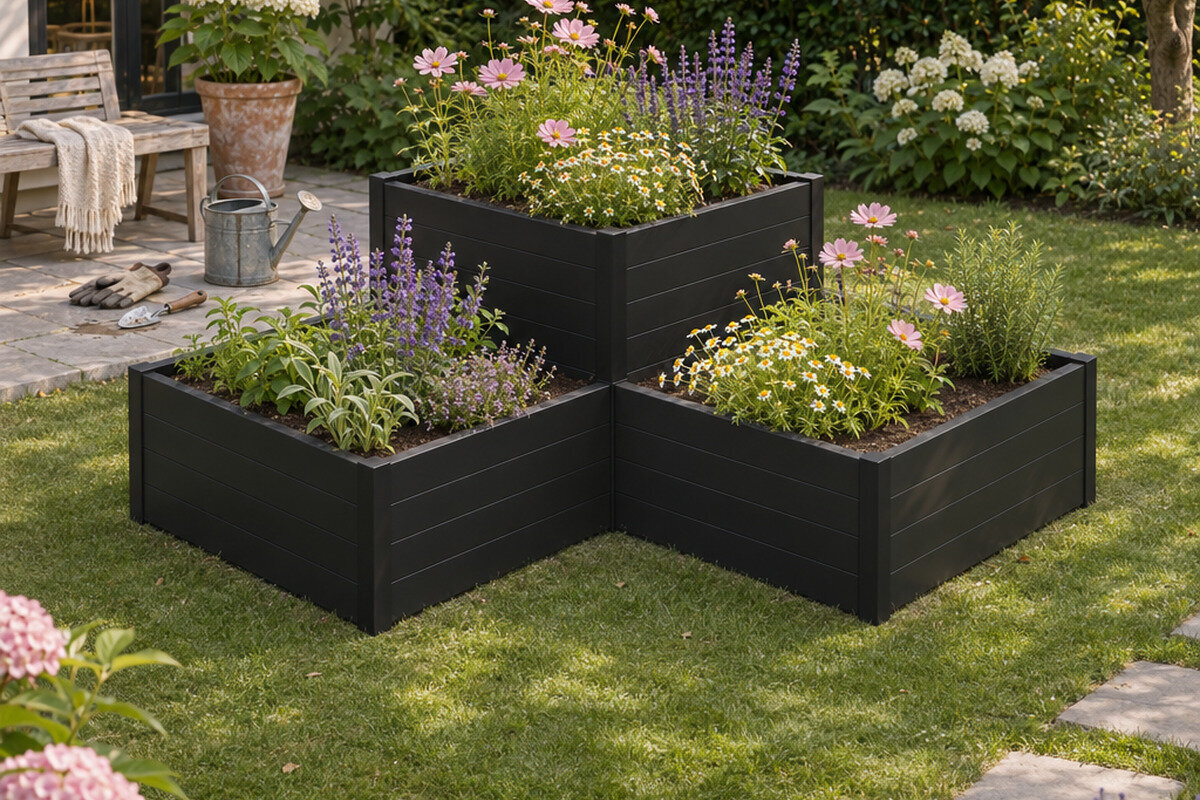
If you are open to a different material, compare what the product sheet says about each component rather than treating a timber trim as equivalent to a cedar raised bed kit. For example, Bloomcabin’s Ascending Triple Accoya Raised Bed uses 20 mm thick Accoya boards for the top 10 cm of each compartment, with aluminium wall panels below and aluminium posts and T connectors. It is an open-base design, not a cedar kit. Use that comparison to ask the same questions of both designs: what forms the walls, what holds them together and what ground is the base meant to sit on?

Questions readers ask
Is a cedar raised bed kit suitable for growing vegetables?
Potentially. Ask for written confirmation that the exact kit, including its stated finish and any liner in the recommended configuration, is intended for growing edible crops. That confirms the supplier’s stated use, not independent testing. Separately check that the planting space, usable depth and base suit the vegetables you want to grow.
Does a cedar raised bed kit need a liner?
Not by default. Check whether the instructions require, permit or rule out a liner. A side lining and a sheet laid across the base do different jobs: a sheet across the base changes the route water can take. Ask which faces, if any, should be covered and how drainage is meant to work. A liner is not a substitute for finding out what the boards are made of or how they were finished.
What if the delivered boards or screws differ from the parts list?
Stop before altering parts or filling the bed. Note the model and any component markings, photograph the discrepancy and ask the supplier to identify the parts in writing. If the boards differ from the specification, ask whether the original material and intended-use statements still apply. For different screws, confirm compatibility with the joints and timber rather than fitting them on the basis that they look similar.
Buy the specification, not just the name
Choose a cedar raised bed kit only once you can match its written material specification and assembly instructions to the planting job. Keep those documents for the delivery check and future repairs. If a detail essential to your crops or site remains unknown, ask before ordering rather than trying to solve it after filling.
Find a raised bed for your plan
Compare layouts and check the dimensions on the product page.
