
Can You Install a Ceiling Fan Under a Pergola?
Pergola planning guide
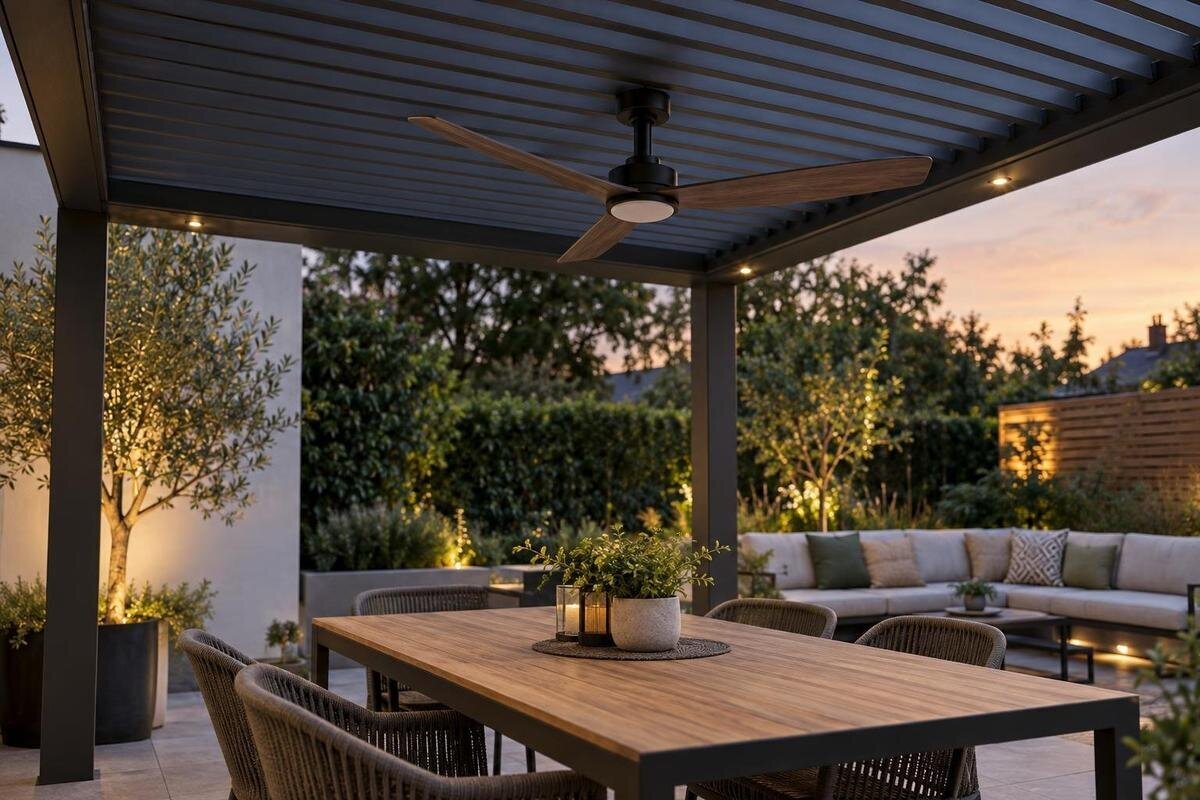
Fitting a ceiling fan beneath a pergola is a question of compatibility, not just airflow. The exact structure must permit a moving suspended load at a documented fixing point; the fan and its components must suit the real outdoor exposure; and the blades, mounting height, roof movement and electrical provision must all fit the site. A pergola that looks sturdy or keeps off some rain is not, by itself, evidence of compatibility. This guide sets out what to verify with the pergola supplier, fan manufacturer and a qualified electrician before you order or alter anything.

01
A ceiling fan needs approval as a complete installation
A ceiling fan beneath a pergola can work in principle, but it is not a standard fitting simply because a frame spans the seating area. Compatibility belongs to the exact combination of structure, fan and installation point. The pergola must permit the fan’s operating load at that point; the fan must be suitable for its real outdoor exposure; and the mounting height, blade clearances, roof movement and electrical provision must follow the relevant instructions. These are separate checks. An outdoor-rated fan on an unapproved beam is still not a safe match, and a suitable support does not make an indoor fan weather-suitable.
Start by recording the pergola’s exact model and configuration, the fan model and the intended position. Ask the pergola supplier or manufacturer whether that combination and mounting arrangement are approved there, rather than asking only whether a fan is possible. The Bloomcabin Pergola is a useful identifier for a product enquiry, but its name alone does not confirm a fan mounting point, allowed load or included accessory. Include any proposed changes to the roof, support or services in the enquiry. A positive answer for another version, fitting or position cannot automatically be transferred to yours.
The pergola must support the fan’s dynamic load
Fan weight is only the starting figure. The motor and rotating blades create movement and vibration as the fan starts, changes speed and stops; the bracket transfers those forces into the supporting member. A suspended fitting can also put leverage on its fixing, so the question is not the same as setting a light object on top of a beam. The actual demand depends on the fan, mount and supporting structure. A visual inspection, hand test or rough comparison of listed weights cannot establish suitability. Nor should you infer capacity from a beam that feels rigid, from the number of screws used for another fitting, or from someone else’s installation.
Ask for approval that applies to a ceiling fan as a moving suspended load, at the specific fixing point and with the proposed bracket. Any relevant capacity information must address the fan, its mount and the way the load reaches the pergola; a figure for a different component or purpose is not enough. If the supplied documents do not cover that combination, ask a suitably qualified structural professional to assess the actual design information rather than estimating it yourself. For the Bloomcabin Bioclimatic Aluminum Pergola, as for any model, the exact configuration matters: the product category does not establish dynamic-load capacity. Written confirmation should make clear what has been assessed.
02
Choose a fixed, documented mounting point
Identify the member that would actually carry the fan before choosing its position. A fascia, decorative trim, thin roof panel or convenient-looking crosspiece may not be a structural support, even if it is close to the main frame. An adjustable louvre or slat is not a fixed mounting point. Do not fasten a ceiling fan to a moving component unless the manufacturer explicitly approves that exact arrangement. Look for a fixing point named in a manual, drawing or written approval; do not treat appearance, thickness or easy access as evidence. Ask how the load would pass from the bracket into the pergola’s frame.
Approval needs to cover the interface as well as the frame: the mounting bracket, fixing method, position and any required adapter or reinforcement. A universal fan bracket that fits, a clamp around a beam or extra screws are not proof that the structure can carry the fan. Drilling or clamping can also affect the finish, drainage or moving parts, depending on the construction, so ask before altering it. An added support is not a shortcut unless its design and connection are documented for the exact assembly. If you are considering the Bloomcabin Lean-To Pergola, ask which approved member, if any, can support the proposed fan; do not assume a wall-side connection is an overhead-fan fixing.
Match the fan to the pergola’s actual exposure
A roof changes how much rain reaches a fitting; it does not turn an open-sided pergola into an indoor room. Rain can arrive at an angle, damp air and condensation can persist, and wind may expose parts of the fan that seem sheltered when the roof is closed. Think about the location during normal use, including relevant roof positions and the conditions described in the pergola and fan instructions. Do not select a fan merely because the seating area feels dry in fair weather or a sales description calls it outdoor without explaining the permitted exposure.
Check the exact fan manual and product marking for the location in which it may be installed, then compare that with the pergola’s real exposure. Terms such as covered, damp and wet can describe different conditions in product instructions; use the manufacturer’s definitions rather than guessing from the roof above. The outdoor suitability of a motor does not automatically establish that its receiver, controls, canopy, suspension parts, fasteners and electrical connections are equally suitable. Whether the project uses the bioclimatic aluminium model or another pergola, the roof type does not give the fan an outdoor rating by itself. Ask the electrician to consider the complete assembly.

03
Measure blade clearance and usable headroom
Make a measured plan of the complete rotating blade circle, not just the fan’s centre point. Record the distance from the blade tips to posts, beams, walls, screens, curtains, lights and other nearby fittings; check each side, since an off-centre position can leave one blade close to an obstruction. Use the clearances in the fan’s own instructions. For a proposed Bloomcabin Pergola model, mark the intended centre on the actual layout of the installed configuration and measure the surrounding space. A catalogue title or generic illustration cannot supply those site measurements.
Check vertical space as carefully as the blade circle. Measure from the mounting surface to the blade plane and to the lowest part of the complete fitting, then compare those figures with the fan’s stated minimum mounting height and clearances. Consider standing people, chairs, people rising from seats and regular access routes; furniture may occupy more space when someone pulls a chair out. A fan that clears a seated person may still interfere with someone walking past. Do not use a rule of thumb from an indoor room or another fan in place of the stated requirements. If all clearances cannot be achieved, revise the position or reconsider that fan.
Allow for roof movement and nearby fittings
If the pergola roof or another overhead element moves, check its full operating travel against the fan, bracket and blades. A position that appears clear with the roof open may be obstructed when it closes, tilts or reaches a position used for maintenance. The fan must not foul a louvre, retractable panel, screen or moving mechanism, and it must not prevent the roof reaching its intended positions. For Bloomcabin’s bioclimatic aluminium pergola, confirm the exact roof arrangement and movement for the chosen configuration rather than assuming it from the category name.
Account for more than blade collision. A bracket, fitting or proposed cable route must not block drainage paths or maintenance access, or leave components in a place where roof runoff reaches them contrary to their instructions. Nearby lights, heaters, screens and doors also affect where a fan can go; check each product’s stated clearances rather than inventing a universal spacing between equipment. If a roof or control mechanism moves, the supplier and electrician should check the complete arrangement throughout its operation. A single open-roof position is not a complete clearance check.
04
Have a qualified electrician plan the supply
Have a qualified electrician assess the proposed fan and site before committing to a layout or installation. They can check whether the supply and controls are suitable for the particular fan and outdoor setting, and plan an arrangement that works with the pergola’s construction and any moving parts. Include existing outdoor equipment and the intended way of controlling the fan, rather than treating its motor as an isolated purchase. Keep circuit design, cable selection, connections and protective measures with the electrician; this guide is not a wiring procedure.
Give the electrician the fan’s exact manual and product details, the pergola model and configuration, a marked plan, photographs of the proposed fixing point, and notes on roof travel and likely rain exposure. Naming Bloomcabin’s regular pergola in the brief helps identify the structure, but does not show that a fan supply or cable route is included or approved. Ask the pergola supplier and electrician to work from the same proposed position, so the electrical plan does not conflict with the fan instructions or moving components. Do not assume a temporary power arrangement or indoor control is suitable for permanent outdoor use.
Set expectations for airflow in an open-sided space
An outdoor ceiling fan moves air; it does not lower the outside air temperature. Under an open-sided pergola, some airflow will disperse beyond the covered footprint, and natural wind can change what people feel at a table or seating area. An indoor room-area recommendation is therefore a poor substitute for guidance about the exact fan in an open setting. Check that the fan maker permits the intended location and look for performance information relevant to that use. Treat a claim about moving air across a whole outdoor area as something to verify, not an automatic result of fitting a fan.
Decide what the fan is meant to do before choosing its position: provide noticeable air movement over one seating zone, or serve a larger shared area? Draw the furniture and regular walking routes, then consider where people will be rather than centring the blades in the pergola by habit. A wall-mounted arrangement such as Bloomcabin’s lean-to model does not establish how air will circulate across a particular terrace; nearby walls, open sides and wind exposure all matter. Ask the fan supplier how its stated performance applies to the planned setting, and avoid promising uniform airflow where site conditions vary.

05
What a model-specific approval should cover
A useful written enquiry includes both product identities and the proposed installation, not just a photograph of a pergola. Give the pergola’s model and configuration, roof type and operating positions; the fan’s exact model, weight and mounting instructions; and a measured sketch of the intended location. Ask the pergola manufacturer or supplier to confirm that the named fixing point and mounting method are permitted for that fan’s operating load. Ask what documentation supports the answer and whether an approved accessory or structural assessment is required. General reassurance that the frame is strong enough does not resolve those specific points.
Keep the response with the relevant manuals and have the electrician work from the same plan. A complete decision should settle four questions: can the structure carry the moving load there, is the complete fan assembly suitable for the exposure, are the blade and roof clearances sufficient in every relevant position, and can the electrical installation be planned safely? If the pergola supplier and fan maker give conflicting instructions, ask them to resolve the issue rather than choosing the more convenient answer. An unanswered question is a reason to pause, not implied permission. Recheck if you change the fan, bracket, position or roof configuration.
Alternatives when an overhead fan cannot be approved
If the proposed ceiling fan cannot be approved, reconsider how you want to use the seating area before looking for another fitting. Is air movement needed at a dining table, beside a lounge chair or across several separate seats? A more focused requirement may make it easier to assess an alternative without attaching equipment to the pergola. If you investigate a freestanding outdoor fan, check its permitted exposure, stability requirements and operating clearances in its own instructions. Include its footprint in the furniture plan: the base and any trailing lead must not obstruct chair movement, doors or regular walking routes. Ask the electrician about a suitable supply rather than treating portability as proof of electrical suitability.
You can also review the seating position and how existing openings are used. Where the pergola has adjustable screens or roof elements, discuss their intended operation with the supplier; opening them may change airflow, shade and rain exposure together. Moving a table towards an open side is a layout option to assess, not a promise of consistent cooling. If the overhead position remains important, ask whether a documented alternative support design is available and establish what assessment it requires before purchasing a fan. Compare the practical consequences of each option, including space, weather exposure and maintenance access, rather than replacing one unverified installation with another.
Frequently asked questions
Can I fit a ceiling fan under any pergola?
No. The exact pergola and mounting point must be approved for the fan’s operating load, the fan must suit the site’s outdoor exposure, and clearances and electrical arrangements must be suitable. Appearance alone cannot establish any of these.
Can I attach a fan to an adjustable louvre or roof panel?
Not unless the pergola manufacturer explicitly approves that exact mounting arrangement. A moving louvre or panel is not a fixed support by default, and its travel must not conflict with the fan or bracket.
Does a pergola roof make an indoor fan suitable?
No. An open-sided roof may reduce direct rain but cannot establish that a fan or its controls are rated for the location. Check the fan’s instructions against the actual exposure, including wind-driven rain and damp conditions.
How much clearance does a pergola fan need?
There is no single figure that suits every fan and pergola. Measure the blade path and mounting height, then use the clearances in the exact fan manual. Check posts, walls, fittings, people and every relevant roof position.
What information should I give the supplier and electrician?
Provide the pergola model and configuration, the fan model and manual, the proposed fixing point, a measured plan and details of roof movement and exposure. Ask for mounting approval tied to that combination, then have a qualified electrician assess the supply and controls.
Whether a ceiling fan can go beneath a pergola is a model-specific decision, not a judgement based on appearance or shelter alone. Confirm the mounting approval, outdoor suitability, clearances and electrical plan for the exact combination. When those checks all agree, the fan can be considered on its documented terms; when evidence is missing, pausing is safer than improvising a support or assuming a covered position is suitable.
