
Composite Raised Garden Bed Kits: How to Check Material and Fit

Bloomcabin · Raised-bed guides
Composite Raised Garden Bed Kits: How to Check Material and Fit
Composite raised garden bed kits can be a good fit if the maker documents what the panels contain, how the walls are supported and where the assembled bed can be used. For edible crops, look for written confirmation that the exact model is intended for growing food and for the proposed contact with your growing medium.
Identify the panel
For composite raised garden bed kits, ask what the panels contain and what is in contact with the growing medium.
Check the whole kit
Match the parts list to the drawing for your chosen length and wall height. Check which supports are supplied.
Check the base first
Confirm the intended surface and drainage route before working out how much growing medium to buy.
Measure what you can use
Use internal measurements and usable fill depth. The advertised footprint and wall height serve different purposes.
Start with three documents: the panel specification, the parts list and the installation manual for the size you want. Together they should tell you what faces the soil, what holds the walls in place and what you must provide yourself. If the seller provides only a board data sheet, you still need to check what the complete kit is designed to do.
This guide uses a narrow herb and salad bed to show how to compare composite raised garden bed kits when the listings look alike but the documentation differs. The Bloomcabin models included for comparison are listed as Classic aluminium or Accoya fusion, not as composite kits.
01
Find out what the panels are made from
The word ‘composite’ does not tell you whether two listings describe the same panel. For composite raised garden bed kits described as wood–plastic composite, start by asking for the wood or fibre component, the plastic type and any declared proportions. Request the material grade or product code, details of any treatment or coating, and the panel thickness and profile. If the maker specifies a timber species, record it; if the filler is described only as wood fibre, do not infer a species from the finish.
Next, establish what touches the growing medium. Check the inside face, the panel ends and any other components in direct contact with the fill. For composite raised garden bed kits intended for herbs, salad leaves or other edible crops, ask the supplier to confirm in writing that the exact model is intended for edible growing and for the proposed soil contact. ‘For outdoor use’ does not answer either question.
Keep composition and suitability separate in your notes. A data sheet may identify the panel without saying whether the kit is intended for edible growing. Conversely, a use statement does not fill in missing material details. Lack of documentation is not proof of a hazard, but it is a reason not to assume the kit meets a requirement you cannot verify.
- If composite raised garden bed kits are sold as ‘recycled’, ask which component that describes and whether the material specification identifies it.
- If a panel has a coating or cap, ask which faces and edges are covered and whether the maker allows cutting or drilling.

02
Compare the wall design and what comes in the box
Compare composite raised garden bed kits as complete wall systems, not as samples of board. Record whether the profile is solid or hollow, how the ends fit into the posts and where the long sides are supported. For a hollow panel, ask what a quoted thickness measures: the overall profile or the material at its outer wall. Neither figure on its own tells you what the assembled wall is designed to hold.
The longer and taller options in a range may use different support layouts. Check the drawing for the exact size you want: where are the joins, what supports them, and what fill height do the instructions permit? Soil pushes against the walls, so the supported span between joints matters more to your decision than the overall length in the listing. Do not use a drawing for the shortest configuration to judge the longest one.
Get an itemised parts list for the composite raised garden bed kits on your shortlist. Match the panels, posts, fixings and any specified braces, clips or end pieces to the drawing. Verify the required fixing type and material, and distinguish included parts from extras. If the list calls for a brace but the seller cannot say whether it is in the box, settle that before ordering rather than improvising when the bed is half assembled.
- For stackable composite raised garden bed kits, ask whether the chosen number of courses is an approved configuration and what extra parts it requires.

03
Check reach, rooting depth and where water will go
Before comparing composite raised garden bed kits by size, mark out the outside dimensions on the ground. Leave room for projecting posts and for any installation clearance the maker specifies. Try reaching the farthest planting point from the side you will actually use. A bed against a fence will be worked differently from one you can walk around. Plan a firm route to the bed and to water, and leave enough path space to tend it without stepping on the growing area.
Check the base on the drawing, not just the product photo. Open-bottom composite raised garden bed kits intended for prepared ground rely on the conditions beneath them: no floor does not mean good drainage. If water already collects there, resolve the site problem or consider another location. On paving, ask the maker how the exact assembly retains the medium and where water is meant to go. Do not assume a liner can turn a ground-only frame into a patio planter.
Wall height is not the same as rooting depth. On suitable ground, roots may be able to extend below an open frame; on paving they cannot. Check the planned fill level and what lies below it against the seed packet or local planting guidance. Once you have resolved the base and depth, select a peat-free growing medium suited to the crop and the way the bed will be used.
- When comparing composite raised garden bed kits for the same site, record outside footprint, inside planting dimensions, wall height and usable fill depth separately.

04
Read the manual before you commit to the kit
Download the manual for the exact model before ordering. The instructions for composite raised garden bed kits should make clear what surface to prepare, which way the panels face, how joints are secured and when any braces go in. Check whether the directions call for tools you do not have or for access to a side that will be against a fence. If the installation is impractical in the space you have, find out before taking delivery.
On arrival, check the parcel contents against the parts list and identify any damage or missing pieces before putting the frame together. Assemble it in the maker’s sequence. If a panel binds in a post or the holes do not line up, first check the part numbers, orientation and base preparation. Do not widen holes, swap fixings or force the joint to fit unless the maker specifically directs you to do so.
Some instructions for composite raised garden bed kits may specify clearance at panel ends or fastening details that allow for movement. Use the dimensions and method in that manual rather than borrowing a gap from decking instructions. If something is still unclear once the frame is up, leave it empty while you check. A missing support or blocked water outlet is much easier to put right before there is growing medium against the walls.
- Before filling composite raised garden bed kits, check the panel orientation, seated joints, specified supports and drainage route against the manual.

05
Find out how the kit can be cleaned and repaired
Compare the care instructions for composite raised garden bed kits before relying on a ‘low-maintenance’ description. Look for approved cleaning methods for the panel face, coating and fixings. Ask what to do if the surface is damaged or a joint starts to move. A product that needs no routine recoating still needs checks on its connections and drainage; the two are separate questions.
During ordinary garden work, look for a joint that has opened, a wall that has changed shape or an outlet that is blocked. If you notice movement, do not assume that tightening a fixing or adding a screw is the remedy. Check the manual and ask the supplier what to do before making changes or adding more fill. Keep the parts list and model code with the care instructions so you can describe what has moved.
When comparing composite raised garden bed kits, ask whether a single panel or connector can be ordered and whether changing it requires emptying the bed. That answer helps distinguish a repair you could manage from one that involves lifting plants and removing the fill. Do not infer spare-part availability or service life from the material name.

06
Worked example: two kits with the same footprint
Hypothetical example: A gardener wants salad leaves and herbs in a narrow bed along a path on prepared ground. Two composite raised garden bed kits are advertised at 120 × 60 cm. For this example, assume both fit the marked-out site, the gardener can reach across from the path, and the crop guidance and ground conditions have been checked. The question is whether either kit is documented well enough to order.
Kit A is advertised with ‘composite boards’, but the seller sends a decking sheet rather than a manual for the assembled bed. The sheet does not establish the permitted wall span, supplied supports or use in direct contact with growing medium for edible crops. Kit B has a model-specific parts list and wall drawing, identifies its panel material and confirms in writing that the supplied configuration is intended for the gardener’s site and edible planting. If the assembly and care directions are workable, Kit B goes on the shortlist. Kit A stays off until the missing information is supplied.
The listing dimensions are not enough to calculate fill for either of these hypothetical composite raised garden bed kits. Suppose Kit B has clear internal dimensions of 112 × 52 cm, a usable fill depth of 22 cm and no internal parts taking up appreciable space. The rectangular fill is 1.12 × 0.52 × 0.22 m, or about 0.128 m³ (128 litres). That estimates the fill to the assumed level, not the total space available to roots. If the internal measurements or fill depth turn out to differ, redo the calculation before ordering.

07
Compare aluminium and timber-top alternatives on the same terms
If the reason you are looking at composite raised garden bed kits is the size or modular layout rather than the panel material itself, use the same checklist to compare other constructions. The Narrow Aluminium Raised Bed 100×50×20cm is Classic aluminium, with aluminium wall panels and corner posts. It has one planting compartment, a nominal footprint of 100 × 50 cm and 20 cm walls. It is supplied unassembled and has no floor panel: the base is open to prepared ground.
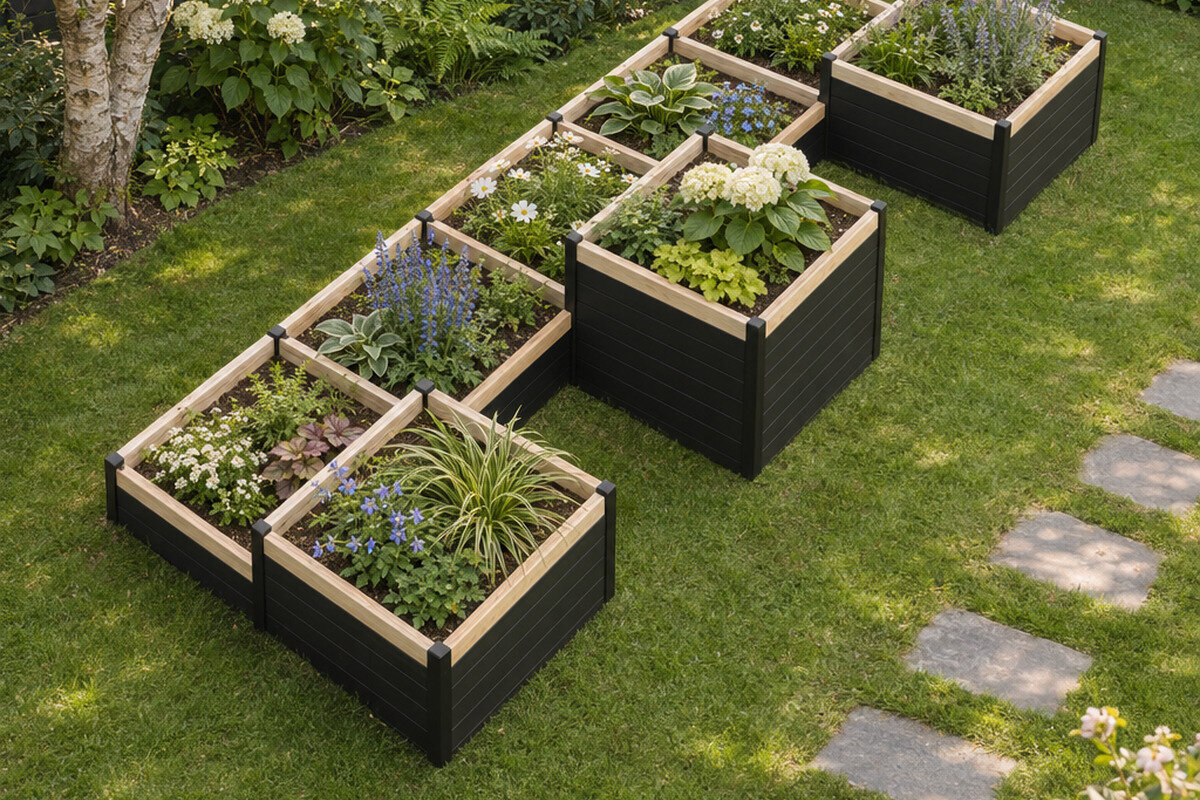
The Ascending Triple Accoya Raised Bed is Accoya fusion. Its three compartments have wall heights of 30, 50 and 80 cm. On the outer walls, the top 10 cm of each compartment is Accoya, with aluminium panels below; the corner posts and T connectors are aluminium. The Accoya boards are 2 cm thick. That describes separate timber and metal components, not a composite panel or an all-timber wall.
Neither model is listed as one of Bloomcabin’s composite raised garden bed kits; they are comparisons for readers who are open to aluminium or a timber-and-aluminium construction. If composite panels are a requirement, keep them on your checklist and rule out non-composite alternatives. If the requirement is really a specific layout or care routine, compare that directly rather than expecting the material label to tell you which bed fits.

Questions readers ask
Are composite raised garden bed kits suitable for growing vegetables?
Some may be intended for that use, but the material name is not enough to tell. Ask for written guidance for the exact model covering edible crops and direct contact between the growing medium and the supplied panels. Check whether that guidance requires a specific liner or other installation detail. If the supplier cannot confirm the use, leave it off your shortlist for vegetables.
Can composite raised garden bed kits go on paving?
Only choose a kit for paving if the manufacturer documents that installation and explains how the growing medium is retained and where water drains. If the surface is a balcony or raised deck, the kit instructions alone do not establish that the structure can support the filled bed.
Can I extend a kit or replace just one panel?
Ask whether the maker supplies a compatible extension or replacement for your exact model. A matching colour or panel length does not show that the profile, fixings or support layout are the same. Keep the model code and parts list so you can identify the correct component later.
Decide what you need to know before paying
Shortlist composite raised garden bed kits only when you can match the panel and fixings to a documented configuration, confirm the intended use and explain how the bed will drain at your site. If a key answer is missing, ask for it in writing before you buy.
Find a raised bed for your plan
Compare layouts and check the dimensions on the product page.
