
Composting Garden Bed: How to Choose and Apply Compost

Bloomcabin · Raised-bed guides
Composting Garden Bed: How to Choose and Apply Compost
For a composting garden bed, use finished compost only where it has a clear job. Check what’s already in the bed and what you plan to grow, then use relevant soil-test advice and the product directions to decide whether to apply it, how much to use and whether to leave it on the surface or mix it in.
Identify the job
Give the composting garden bed a reason for each addition; buying another bag is not the starting point.
Check maturity and purpose
Check that the material is ready to use and labelled for the planned application.
Read results in context
Use test results for the soil sampled and the question the test actually answers.
Treat the right area
Measure only the area that needs treatment, then calculate from an applicable rate.
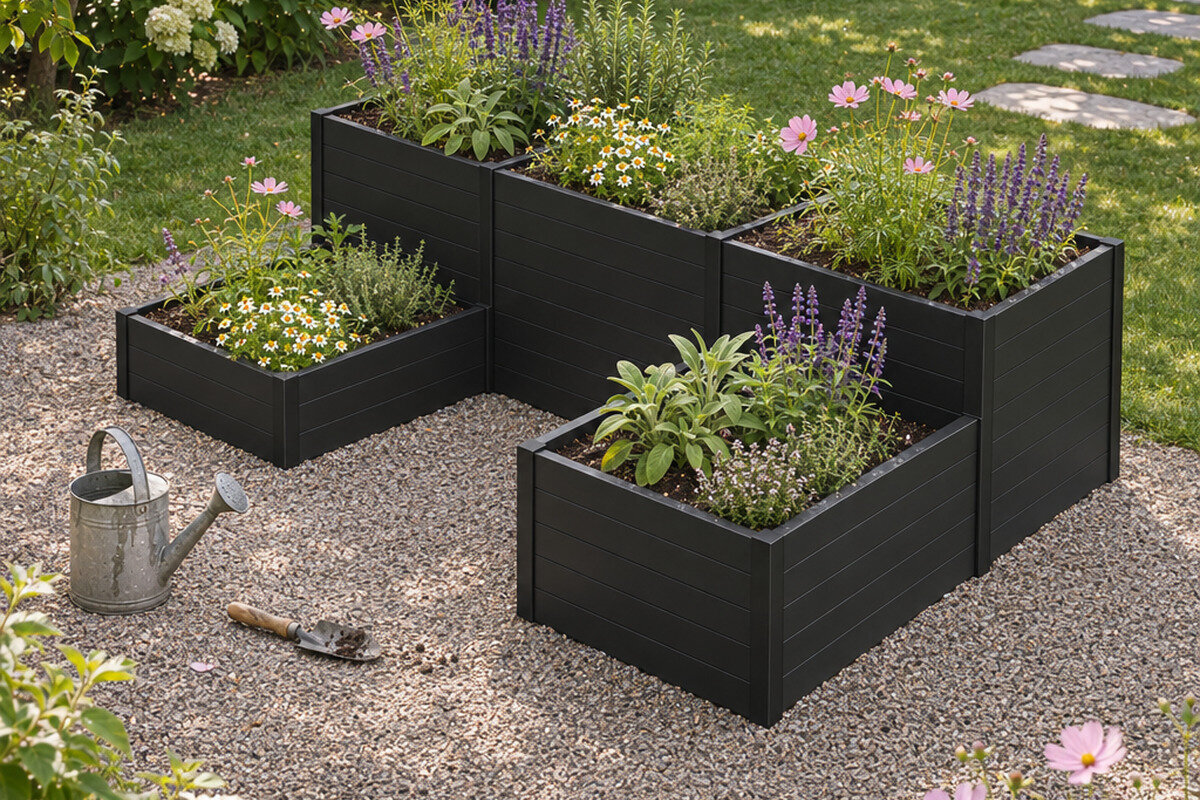
Here, a composting garden bed means a planted bed you improve with finished compost, not a place to break down fresh scraps among growing roots. The illustrated Bloomcabin frames are ground-standing planting beds, not examples of beds with composting chambers.
Start with the patch you’re actually preparing. One end might still have the medium you filled it with last season while the other has already had a top-up. You can make a different decision for each end. The aim is to work out what belongs in the soil now, including when the right amount is none.
01
Decide whether to improve the soil, restore the level or feed
On a composting garden bed, start with the problem you want to solve. A low surface is a question about fill level. A crop that has stopped growing well is a question about growing conditions. Neither tells you by itself that the soil needs compost. Write down where the problem occurs and what has changed since the last crop. If only one end is affected, compare what went into each end and how you’ve been watering before buying enough material to treat both.
If the bed is empty, choose a peat-free growing medium intended for filling it and suited to the plants you’re putting in. Peat-free products vary in structure, moisture retention and nutrients. Look for an explicit peat-free statement rather than relying on broad packaging claims. A bag sold as a soil improver is not necessarily suitable as the entire fill for a composting garden bed. Where a filled bed is simply below the level you want, check what medium is already in it and choose a compatible top-up rather than assuming the missing volume should all be compost.
A composting garden bed may need neither extra fill nor a soil improver. If your concern is feeding a crop, first check what the existing medium or earlier additions already supply. Where a relevant assessment calls for a particular nutrient, choose a feed only if its directions and the crop guidance fit that need. A general amendment is not automatically the answer to a specific feeding question.

02
Sample the soil you actually plan to amend
Before sampling a composting garden bed, sketch the growing area and note what went into each section. Mark any strip that was topped up with a different mix, where you’ve already fed a crop and which areas you want to sow next. Even a rough note such as ‘fresh fill at the path end, older soil by the fence’ is useful. If you don’t know what went in, record that rather than guessing.
Ask the laboratory whether it tests your type of soil or growing medium, which properties it measures and how to collect the sample. If you are wondering about organic matter, check whether the service measures it; a pH result answers a different question. For a composting garden bed with two distinct mixes or a patch that behaves differently, ask whether to submit separate samples. Let the laboratory specify sampling depth, number of samples and how to prepare them. If you want a reading of the bed before amendment, collect the sample before adding anything.
Read the interpretation, not just the figures. A report can help you decide what to do about the sampled soil; it does not describe a bag of medium you might blend in later. Keep the report beside your sketch so that advice for one area doesn’t become a rule for the whole composting garden bed. If the lab flags an issue but does not recommend compost, don’t turn that finding into a volume to order. Ask which action, if any, suits the planned crop.

03
Check that the compost is finished and fit for the application
For a composting garden bed, make two separate checks: is the material finished, and is it suitable for the way you intend to use it? Look for a stated use, such as improving existing soil or dressing its surface, and for directions that match that use. A product can be ready for one job without being the right choice for another. If the description says the material needs further processing, or the seller cannot clarify whether it is ready to apply, leave it out of the planting soil.
If you make your own compost, check the batch you’re about to use, not just how long it has been in the heap. If obvious pieces of recently added waste remain mixed through it or the material is clearly still breaking down, set it aside rather than working it around roots. Don’t assume that sifting the batch or waiting until a particular date makes it suitable for the composting garden bed. If you’re unsure, use material whose readiness and purpose you can establish, or postpone the application.
Read the directions before choosing where to spread it. If you want to dress the surface of a planted composting garden bed but the directions only cover mixing the material into vacant soil, don’t improvise a surface rate. Choose a product intended for that job, check with the supplier or wait until the bed is clear. Make the same check for any feed you plan to use alongside it so that each input has a distinct purpose.

04
Convert the directions into an amount for your patch
Set the application rate before calculating the order. For a composting garden bed, use directions that match the product, the soil and the method you’ve chosen, alongside any relevant advice from the soil assessment. If directions give a range, don’t choose the upper end simply because the material is on hand. Check what the range refers to and whether you have enough information to choose within it. Where the advice is unclear or conflicts with the product directions, check before applying.
Measure the soil surface you intend to treat. On a rectangular patch, multiply the measured length by the measured width to find the area in square metres. In a framed composting garden bed, take the measurements inside the frame and leave out paths and any patches you’re skipping. If a label gives litres per square metre, multiply that rate by the area. If it specifies an even surface depth instead, convert the depth to metres, multiply by the area to get cubic metres, then multiply by 1,000 for litres.
Keep the units attached to your notes. A label that gives a rate by weight can’t be turned into litres from the bed dimensions alone; measure in the stated units or ask the supplier for a product-specific conversion. And if the directions give a depth to mix into, don’t use that figure as the thickness of a surface layer. One tells you how far to incorporate the material; the other would tell you how much material to spread.

05
Apply before planting or dress the surface as directed
Work back from the next sowing or planting date for your composting garden bed. Use the seed packet or plant instructions and local UK growing guidance to judge that date, then check when the product is meant to go on. If the directions call for preparation before planting, do the job while the patch is clear and allow for any interval they specify. There’s no need to pick a single application date for the whole garden if different patches will be planted at different times.
On vacant soil, measure out the full amount before you start. If it’s hard to judge even coverage by eye, divide both the patch and the material into equal portions. Spread each portion over its own area and mix it in only if the directions call for incorporation. Work from the path where you can, keeping your feet off the soil to avoid compacting it. This is particularly useful when only the far end of the composting garden bed needs treating.
In a planted composting garden bed, use a surface dressing only where it suits the product and crop. Work around established plants without disturbing their roots, follow any clearance instructions and don’t heap spare material around stems or over seedlings. If the required application would mean disturbing plants you still intend to harvest, mark that patch for later. You can leave it untreated for now without changing the plan for the rest of the bed.

06
Stop at the planned amount and record what went on
Before adding anything else to a composting garden bed, check for overlap. If the medium already contains added nutrients, or you used a feed recently, don’t stack products simply because each is labelled for garden use. Repeated additions can supply nutrients the bed does not need. Extra material can also raise the surface beyond the level you intended or cover plants that should remain clear. Neither is a reason to use up the rest of an open bag.
Keep a record brief enough that you’ll use it: date, product, amount, treated area and reason for applying. A note on the bed sketch is more useful than a receipt that only shows what you bought. For a composting garden bed with a treated and untreated end, mark the boundary so that a later top-up doesn’t double up on one patch. Store any remainder as directed or find another suitable use for it rather than spreading it out to empty the bag.
If a crop looks worse after an application, pause further feeding while you work out what happened. Check the quantity, placement and timing against the directions, and note whether the symptoms coincide with the treated area. That comparison is worth sharing with the supplier or a gardening adviser, but it doesn’t establish the cause. Avoid trying to correct an uncertain problem with a different amendment.

07
Worked example: calculate a dressing for one end only
Hypothetical worked example: you measure a composting garden bed that is 2.40 m long and 0.75 m wide inside the frame. The final 0.80 m of its length was recently topped up with a suitable medium and you have no reason to amend it. You’re preparing the older, vacant section for the next crop. That leaves 2.40 m − 0.80 m = 1.60 m to treat, giving a surface area of 1.60 m × 0.75 m = 1.20 m².
For the calculation only, suppose the chosen finished product’s directions and the soil assessment support 15 litres per square metre for that application. The older section takes 1.20 m² × 15 litres per square metre = 18 litres. Applying the same rate over the whole 1.80 m² would take 27 litres, so treating only the older section avoids using 9 litres where there is no reason to add it. The assumed rate is not a recommendation for another product, crop or bed.
Before spreading, mark the boundary and set aside the measured 18 litres. If you divide the older section into two equal lengths to help spread the material evenly, set out 9 litres for each half. Record the treated length and leave the other end of the composting garden bed alone. If the actual directions don’t support the assumed rate or the assessment gives no reason to amend the soil, change the plan rather than adopting the example’s figures.

Questions readers ask
Can I use an unfinished batch in a composting garden bed?
Keep material that is still breaking down out of the planting soil while you establish whether it is ready. For a bought product, check that it is ready for the intended application rather than for further composting. For an uncertain home batch, leave it to finish and seek guidance rather than testing it around a crop you want to keep.
Does a composting garden bed need a top-up every year?
No. Review what the bed was filled with, what you added last time and what you plan to grow next. If you cannot name a job that a fresh application would do, leave it out for now. A falling soil level and a suspected nutrient shortage are different problems.
Can I use a soil-test recommendation for one patch across the whole bed?
Only if the result and recommendation apply to the whole area. Where different mixes or feeding histories meet, ask the laboratory whether the zones should be sampled separately. If you only tested one patch, don’t assume the same recommendation applies next door.
Make each addition earn its place
For your composting garden bed, note the job, the patch and the reason for applying anything. If those are clear, measure what you need and follow the directions. If they aren’t, leave the bed as it is while you find out what it needs.
Find a raised bed for your plan
Compare layouts and check the dimensions on the product page.
