
Corrugated metal garden beds: what to check before you buy

Bloomcabin · Raised-bed guides
Corrugated metal garden beds: what to check before you buy
Corrugated metal garden beds can work for flowers or vegetables if the maker documents the exact bed for that use and its design suits your site. The ribs alone tell you nothing about the coating, the way the walls are supported or where excess water will go.
Read past the profile
The ribs describe the panel shape, not its metal, coating or suitability for edible crops.
Get the spec in writing
Shortlist corrugated metal garden beds only when the supplier can identify the material, finish, panel thickness and correct fixings.
Measure what matters
Check the outside fit, inside planting space and usable soil depth separately.
Plan the drainage route
Before filling corrugated metal garden beds, check that the base suits the surface and that water has a clear way out.
If you’re choosing corrugated metal garden beds for a UK garden, start with a brief you can put to a supplier: what you want to grow, where the bed will stand and which sides you can reach. A narrow salad bed beside a path and a deeper bed on paving raise different questions, even if the panels look alike.
Use the product specification and assembly instructions together. The specification should identify what is in contact with the growing medium; the instructions should show how the frame goes together and which surfaces it is meant for. If either leaves a question that affects your choice, settle it before ordering.
01
Read the ribs as a shape, not a specification
The folds in corrugated metal garden beds give a sheet stiffness in some directions, but the rib pattern does not tell you how the assembled wall will behave. The panels must work with their joins, corners and any supports specified for that particular layout. A short panel held at both ends is a different proposition from a long side made from several joined sheets. A photograph of either is not a structural specification.
When comparing corrugated metal garden beds, check the instructions for the exact length, height and layout you want. Look at how long sides are joined and whether the parts list includes everything shown in the assembly diagram. Pay attention to the rim and panel ends too: a folded edge or fitted trim is a different detail from a cut edge left exposed beside a path. Check what is actually supplied rather than relying on the styling of a display photo.
The useful distinction is between a panel and a soil-retaining system. A supplier may give a detailed specification for a sheet sold for roofing or cladding without saying anything about its use to retain growing medium. For corrugated metal garden beds, look for documentation that covers the finished bed, not merely a sheet that resembles one of its components.

02
Ask for the soil-facing specification
Create a record for each set of corrugated metal garden beds you shortlist. Save the model details, the installation sheet and any written answer about your intended use. If you want to grow food, ask whether the finished bed is intended for edible crops with growing medium against the inside face, or whether that use depends on following additional instructions.
For corrugated metal garden beds made from reclaimed sheets, the same questions still apply. If you cannot trace the previous use, coating or repairs, a photograph or a clean-looking surface will not settle those questions. Likewise, do not assume a new sheet with a trade description is suitable for edible growing. Set it aside for that project if the relevant details cannot be confirmed.
If a seller advertises corrugated metal garden beds in several finishes, make sure its answer covers the one you plan to order. A claim about a different finish, a generic reference to outdoor use or a verbal assurance that the bed ‘won’t rust’ does not answer the question about the soil-facing surface.
- Metal: ask for the base metal and its grade or product designation. A finish name is not a metal specification.
- Coating: identify the treatment or finish on the inside face as well as the outside. Ask about soil contact and any restrictions or liner requirements.
- Thickness: ask for the stated panel thickness and whether that figure includes the coating, so you can compare like with like.
- Fixings and instructions: confirm which fasteners and edge pieces are supplied, what replacements are compatible, and which instructions apply to the exact model.

03
Measure the strip, the reach and the fill
Measure the site before comparing corrugated metal garden beds. The outside measurement tells you whether the frame fits; the inside measurement tells you what you can plant. Check whether projecting rims or fixings are included in the stated footprint. From your planned path, test whether you can reach the far side without standing in the bed. Check the working height and route to water while you are there.
Worked example — hypothetical: you have a 2.20 m by 0.75 m strip beside a path for salad leaves. Assume a candidate bed measures 2.00 m by 0.60 m at its widest points and has 30 cm walls. Centred on the strip, it leaves 10 cm at each end and 7.5 cm on either side. Those are fitting clearances, not access paths. You would work from the existing path, so test the reach from there and check whether the assembly instructions need more space behind the frame.
Suppose the same bed has a measured internal area of about 1.90 m by 0.50 m and you intend to fill it to 25 cm. Using that internal rectangle as an approximation gives 1.90 × 0.50 × 0.25 = 0.2375 m³, or about 238 litres, before allowing for the ribs. That is an estimate of added medium, not total rooting depth. When sizing corrugated metal garden beds for a crop, consider the ground beneath an open base separately and check the seed packet or local growing guidance.

04
Trace the water from the soil to the site
For open-bottomed corrugated metal garden beds on soil, inspect the proposed spot after rain if you can. If water already collects there, do not assume an open base will solve the problem. Decide whether you can prepare the ground as the instructions require or move to a better-drained site. Check that the surface can be made level without improvising supports beneath individual panels.
If you want corrugated metal garden beds on paving, ask whether the exact model is meant for a hard surface and how it keeps growing medium in while letting water escape. Trace where that water would go rather than letting it run towards a doorway or across a frequently used path. If you are considering a balcony, deck or other raised surface, confirm that the surface can take the filled weight before buying. A kit’s external dimensions and an empty display photo are not load information.
Choose a peat-free growing medium for the plants and the way the bed will be used. Think about how the medium holds water as well as how the bed drains. Raised soil can dry faster, so keep watering convenient and check moisture rather than adopting a fixed schedule. If the instructions call for a liner, check how it is fitted around drainage openings before any medium goes in.

05
Check what assembly demands before the kit arrives
Get the assembly instructions for corrugated metal garden beds before ordering if access is tight. Find out which tools you need, how many people the maker recommends and whether you need to get at both faces of a joint. For a bed in a narrow gap, confirm whether the frame must be built in place or can be assembled elsewhere and moved empty. That can rule out a kit that otherwise fits on paper.
When unpacking, check panels, trims and fixings against the parts list. Wear suitable hand protection and handle unfinished edges with care. Follow the maker’s sequence for joining panels, fitting any supports and tightening the fixings. Do not assume you can shorten a side, drill extra holes or substitute screws: ask the maker whether the change is permitted and what it means for edge protection and assembly.
Before filling corrugated metal garden beds, walk around the frame. Check it sits as the instructions show, required supports and edge pieces are fitted, and no joint is being forced into alignment. Confirm that any required fixing to the site is in place. Resolve a missing component, damaged edge or mismatched hole while the frame is empty, when you can still reach both sides easily.

06
Decide whether you can inspect and maintain the finish
To compare the upkeep of corrugated metal garden beds, look for written guidance on cleaning, scratches and replacement parts for the exact finish and fasteners. Ask what to do if a panel arrives chipped or if there is damage at a cut edge. If touch-up is permitted, confirm what the maker specifies and whether the advice applies to the soil-facing side as well as the outside.
Once the bed is in use, look for changes at the places you checked before filling: joints that have opened, loose trim, new sharp edges, coating damage or a side that has moved. A quick look when you clear a crop or refresh the bed can make changes easier to spot. If a wall or joint is visibly shifting, seek the maker’s advice before adding more medium or trying to tighten the frame under load.
Do not compare corrugated metal garden beds on an assumed lifespan. One finish may have clear care instructions and separately available replacement parts, while another listing may not explain how to deal with damage at all. Compare what is documented, including whether you can reach the parts you may need to inspect once the bed sits against a boundary.

07
Compare documented alternatives on the same terms
Compare corrugated metal garden beds with alternatives that fit the same space and serve the same crop. For each one, note what is verified about the material, inside planting dimensions, working height, base and installation surface. Then compare the whole setup cost, including any required site preparation or fittings not supplied. A cheaper frame is not necessarily a cheaper installation.
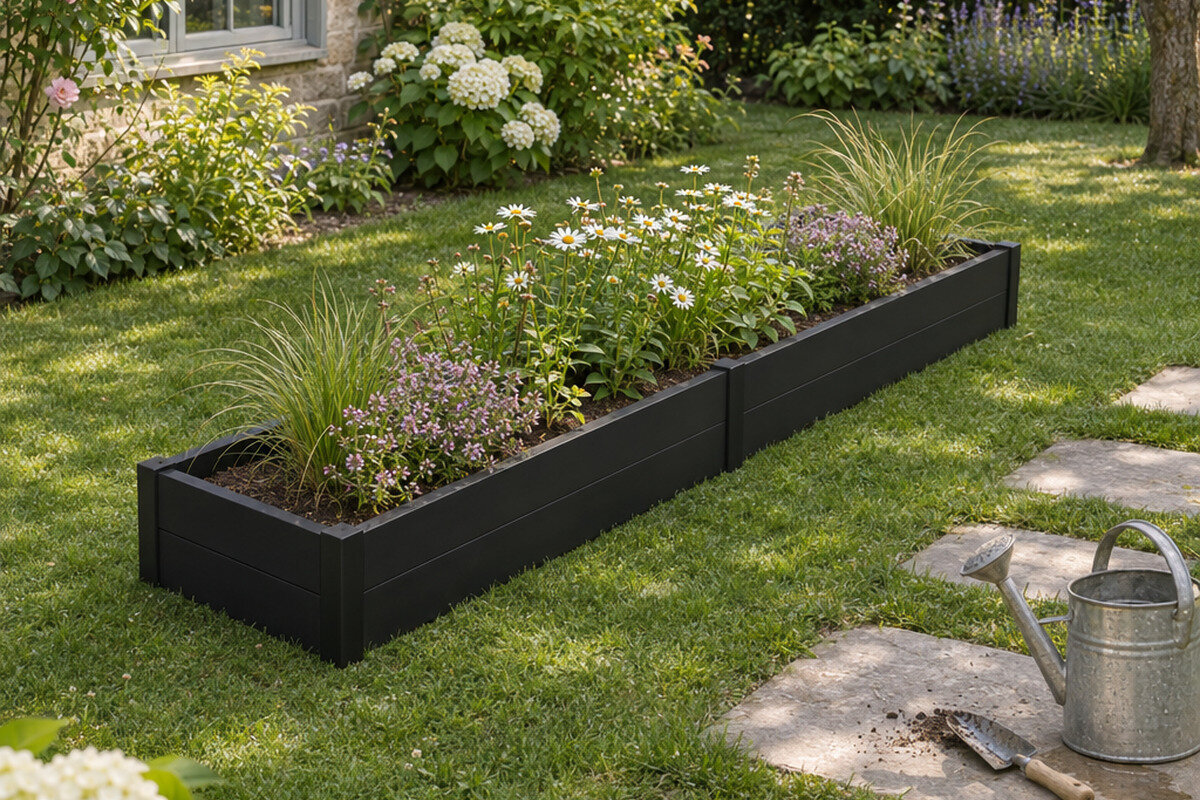
Bloomcabin’s Narrow Aluminium Raised Bed 100×50×30cm is one comparison point for a short planting strip. It has aluminium wall panels and corner posts, a nominal 100 × 50 cm footprint, 30 cm walls and an open base for prepared ground. Those facts help you assess the layout and site, but the panel profile is not confirmed as corrugated. Use it as an aluminium alternative, not as an example of corrugated construction.
If corrugated metal garden beds are your preference but the quotes you have do not identify the inside finish or confirm the intended use, leave those options off the shortlist until you get an answer. The same standard applies to alternatives: for timber, verify the species and treatment; for mixed-material walls, check which material actually meets the growing medium. Let the documented fit decide, not the material name alone.

Questions readers ask
Are corrugated metal garden beds suitable for growing vegetables?
They can be. Look for written confirmation that the exact model is intended for growing edible crops, alongside a specification that identifies its metal and finish. Follow any conditions about soil contact, liners or modifications. A description such as ‘galvanised’ tells you something about the finish, but it is not a statement about intended use.
Can I line corrugated metal garden beds if the panel coating is unknown?
Do not use a liner as a substitute for identifying the panel or confirming its suitability. If the maker specifies a liner for a documented bed, follow its instructions, including how to keep drainage working. If the panel’s origin or finish is unknown, choose a documented alternative for edible crops.
Is a taller wall the same as more usable rooting depth?
No. Measure from the planned soil surface, not the rim. On a hard surface, roots cannot extend through the paving. On prepared ground, an open base may give roots more room if the soil below is suitable. Use seed instructions or local growing guidance to decide what your crop needs.
Buy the specification, not just the shape
Shortlist corrugated metal garden beds only once you can match the metal and finish to the crop, the assembled frame to the available space, and the base to the site. If a crucial detail is missing, ask about that exact model or choose a better-documented alternative.
Find a raised bed for your plan
Compare layouts and check the dimensions on the product page.
