
DIY raised garden bed from pallets: cut list and build steps

Bloomcabin · Raised-bed guides
DIY raised garden bed from pallets: cut list and build steps
Build a DIY raised garden bed from pallets by dismantling sound, traceable boards and screwing them to corner blocks and midpoint stakes. The plan below makes a 120 × 90 cm frame, 30 cm high, with an open bottom that sits directly on prepared ground.
Check the wood first
For a DIY raised garden bed from pallets, reject boards with unknown history, visible contamination or damage at the joints.
Measure before cutting
The worked plan measures 120 × 90 cm outside, with walls 30 cm high. Recalculate the cuts if your boards differ.
Support the walls
Join both courses to four corner blocks and support each long wall at its midpoint.
Inspect before filling
Check the empty frame and its drainage, then measure inside it to estimate how much growing medium you need.
Start your DIY raised garden bed from pallets with the longest sound boards you can recover, not the outside measurements of the pallet. The worked plan gives you four long cuts and four short ones. If your boards are thinner, shorter or narrower than assumed, adjust the sketch before cutting the first piece.
This is a low bed for a garden site with suitable soil underneath and access along both long sides. It has no floor to carry the fill and no legs. Choose the spot, check what you can reach from the path and confirm that the ground can take the supports before you buy fasteners or growing medium.
01
Salvage boards you can actually build with
Use individual boards for this DIY raised garden bed from pallets. Whole pallets bring gaps and bulky bearers into a design that needs close-fitting walls and a clear base. Dismantling the pallets lets you select the sound sections and place the joints where you can inspect them.
Set each pallet on a stable surface and dismantle it with a suitable tool. Wear appropriate eye and hand protection, pull out old nails and check both faces and edges for metal before sawing. Set aside boards that split during removal or have soft patches. A board with damage at a planned fixing point is not a useful saving: trim back to sound timber if you can still make the cut, or reject the piece.
Sort the boards for your DIY raised garden bed from pallets into long-wall and end-wall candidates before committing to a size. Measure the straight, sound portion, not the original length. An uncut board exactly 120 cm long only supplies a 120 cm piece if both ends are already usable.
- Get permission to take the pallets and ask whoever supplied them what they carried and how the timber was treated. For an edible bed, leave out timber whose history or suitability you cannot establish.
- Reject boards with paint, oily residues or unexplained stains. A mark on a pallet does not tell you whether it was later exposed to spills; lining the bed does not establish that the wood is suitable.

02
Draw the footprint, wall height and support positions
Hypothetical worked example: draw a DIY raised garden bed from pallets with an outside footprint of 120 × 90 cm and no floor. Assume straight boards 2 cm thick and 15 cm high. On the top view, draw the two 120 cm walls first. Fit each end between them: 90 − 2 − 2 = 86 cm. The inner rectangle before allowing for supports is 116 × 86 cm. In the sketch, both outer diagonals measure 150 cm from corner to corner.
If you change the board thickness, recalculate rather than marking out from the old cut list. Measure both long boards at the ends where they meet the short walls. Check the course heights too: uneven edges can leave gaps where the boards meet, even when the combined height looks right on paper.
Lay out your DIY raised garden bed from pallets where you can work from both long sides. The centre is about 45 cm in from either outer edge; try that reach beside the marked footprint without stepping inside. Leave room for a firm path and for carrying tools and water. If only one side is accessible, narrow the plan before cutting.
- Top view: 120 × 90 cm outside, with the 86 cm end boards captured between the long walls. Place one block inside each corner and one stake inside the midpoint of each long wall, 60 cm from either outer end.
- Side view: two 15 cm courses give a 30 cm wall. Mark a starting fill line 3 cm below the rim, giving about 27 cm of fill above level ground.

03
Make the cutting, shopping and tool lists
Lay out the parts for your DIY raised garden bed from pallets before buying screws. The corner blocks must have room for fixings from two directions, and the stakes must give both courses a sound fixing face. For the fill calculation below, assume all six supports have a 5 × 5 cm footprint inside the bed. That is a drawing assumption, not a minimum post size or an assurance of strength.
The provisional screw allowance for this DIY raised garden bed from pallets is 40 plus spares: two at each end of eight boards gives 32, and two at the midpoint of each of the four long boards gives another eight. Use that count only if the chosen screw supplier’s instructions and the actual timber allow that pattern. Verify outdoor and timber compatibility, screw penetration into the support, pilot holes and distances from ends and edges. Mark the fixings on adjacent faces at different heights so the screws do not meet inside the block. If the pattern does not fit, change the support or fixing detail before drilling.
- Walls: four 120 cm boards and four 86 cm boards, all 15 cm high and nominally 2 cm thick. That is 8.24 m of finished board length, excluding trim, saw cuts and rejected sections.
- Supports: four sound corner blocks cut to 30 cm, plus two long-wall stakes suitable for ground contact. Allow for the 30 cm wall and the embedment needed in your ground when choosing stake length.
- Tools: tape measure, pencil, square, spirit level, clamps, pallet dismantling tool, nail puller, saw, drill/driver and bits, and a suitable tool for installing the stakes. Use the protective equipment specified for each tool.

04
Prepare the ground and keep the base open
This DIY raised garden bed from pallets has no base panel. Choose ground that can receive water from the bed without persistent pooling, and check that the underlying soil is suitable for the intended use. Clear the footprint, mark the four corners and level the strip under each wall so the frame is not bridging hollows or perched on loose scraps. Check the footprint again before assembling.
Keep the bottom open rather than laying an impermeable sheet underneath. If you need to retain growing medium at the sides, close poorly fitting board edges first. Use a permeable side liner only if it is suitable for contact with your growing medium and you have checked how water can leave the bed. If the site calls for isolation from suspect ground, set this plan aside rather than assuming a liner solves the problem.
The long-wall stakes depend on firm ground and enough embedment to resist movement. Check for buried services before driving stakes or digging. There is no universal embedment or load rating for a DIY raised garden bed from pallets: very soft ground, a slope or shallow ground over an obstruction calls for a different spot or a site-specific support detail. Paving, decking and balconies need a separate design that deals with soil retention, drainage and the filled weight; do not copy this staked layout onto them.

05
Assemble the two courses in order
Assemble the DIY raised garden bed from pallets at its final spot so you can check the way each wall meets the ground before securing the midpoint stakes. Have someone hold the long walls upright while you fit the first end if you cannot support them steadily with clamps.
The corner blocks join the four walls; the stakes shorten the unsupported stretches of the long boards. In this DIY raised garden bed from pallets, the two courses meet edge to edge but are fixed independently to the supports. If one course has a gap or a loose end, correct that board rather than counting on the course above or below to hold it.
- 1. Mark and cut four long boards and four end boards. Lay each wall out in two courses to check its length, height and fit before drilling. Smooth sharp cut edges and remove any remaining protruding hardware.
- 2. Make both long walls. Lay each pair of boards flat, place a corner block on the inner face at each end and clamp the pieces with their ends flush. Fasten each board to both blocks using the checked screw pattern.
- 3. Stand the long walls on the prepared ground and clamp the lower end boards between them. Fit the upper end boards, then compare the outer diagonals. Adjust the frame until both match and the ends sit flush. Fasten the end boards into the corner blocks, not into the end grain of the long boards.
- 4. Fit a stake inside the midpoint of each long wall. Once the stakes are firm and correctly positioned, fasten both courses to each stake from the outside. Do not pull a bowed wall into place by tightening screws against a stake that is out of line.
- 5. Recheck square, level and wall contact with the ground. Inspect both faces of the joints for splitting and screw tips. Replace damaged pieces or remake a poor joint before moving on.

06
Calculate fill from the finished inside dimensions
Measure the completed DIY raised garden bed from pallets before ordering the growing medium. For the hypothetical frame, the inside rectangle is 1.16 × 0.86 m, or 0.9976 m². The four corner blocks and two stakes, each occupying 0.05 × 0.05 m in plan, take up 0.015 m² altogether. That leaves about 0.983 m² of planting area, assuming all six pieces occupy their full footprint inside the walls.
At a fill depth of 0.27 m, that area takes about 0.265 m³, or 265 litres. This is a geometric estimate for level ground, before settlement. Measure to your chosen fill line at several points and allow for the supports you actually used. The 30 cm wall height is not the total rooting depth: roots can extend into suitable soil beneath the open bed.
For a DIY raised garden bed from pallets intended for vegetables or herbs, choose a peat-free growing medium labelled for the intended use and plants. Check whether it is meant to be used alone or blended; a bag sold as a soil improver is not necessarily a complete fill. Use the product directions and seed instructions rather than a fixed recipe.

07
Inspect the empty frame, then fill evenly
Walk round the empty DIY raised garden bed from pallets before opening the growing medium. Light hand pressure can reveal movement in a loose joint, but it does not show what the frame will hold when the soil is wet. If a stake shifts, a board is already bowing or the ground has settled under a wall, stop and address the cause.
Once the checks are complete, add the medium in shallow layers across the whole DIY raised garden bed from pallets rather than piling it against one wall. Stop if a joint opens, a stake moves or a board bows noticeably; remove enough fill to take pressure off before investigating. Fill only to the marked line. Check the walls again after the soil has been wetted and as the timber weathers. The frame is a soil retainer, not a seat or a step.
- At each corner, check that both courses are secure, with no split around a fixing, screw tip or sharp edge.
- Along both long walls, check that the midpoint stakes are firm and that neither board moves independently at its fixings.
- At ground level, check for rocking, unsupported gaps and any obstruction to drainage. If water pools in the footprint, resolve that before filling.
- From the path, check that you can reach the middle and bring water to the bed without stepping into it.

Questions readers ask
How many pallets do I need for a DIY raised garden bed from pallets?
Count usable boards, not pallets. This plan needs four unbroken 120 cm pieces and four 86 cm pieces, all 15 cm high after preparation. Several pallets may still leave you short if their boards are narrow, damaged or too short to trim square. Check the longest cuts first and make the frame smaller if the stock cannot supply them.
Can I use narrower boards for a DIY raised garden bed from pallets?
Yes, but redraw the courses and update the cut list and fastener allowance. Three courses of 10 cm boards still make a 30 cm wall, but you now need six long boards and six end boards. Make sure every course can be fixed to its supports without crowding the screw holes. If that is not possible, revise the height or choose wider boards.
Is this the same as building a bed with pallet collars?
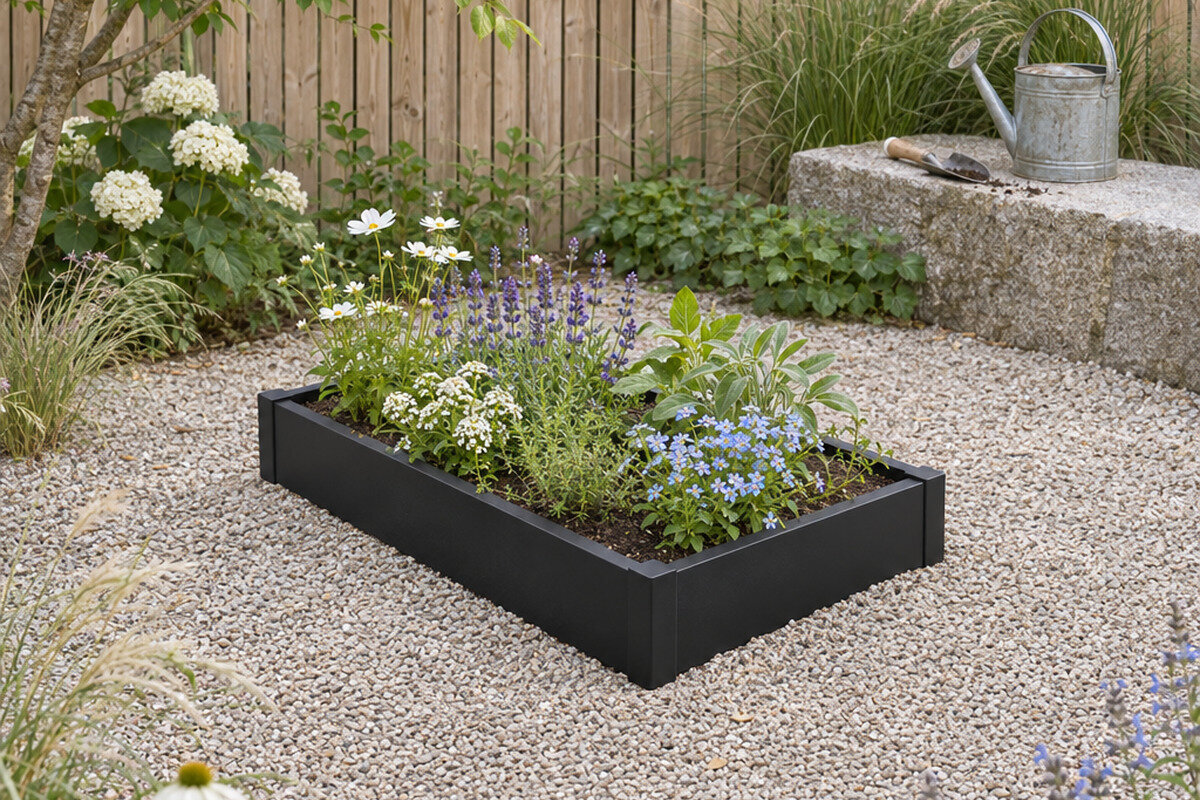
No. A pallet collar is a separate hinged frame made to fit a pallet. This method joins individual reclaimed boards to corner blocks and stakes. The Bloomcabin frames shown alongside the guide are raised-bed kits with their own components and assembly instructions, not pallet collars or examples of the pallet-board joints.
Let the boards set the final size
A DIY raised garden bed from pallets is worth resizing if that gives you unbroken boards and better joints. Check the timber, support and drainage first; the finished inside dimensions can then tell you what to buy for the fill.
Find a raised bed for your plan
Compare layouts and check the dimensions on the product page.
