
Drainage for raised beds on concrete: find the fault before replacing the soil

Bloomcabin · Raised-bed guides
Drainage for raised beds on concrete: find the fault before replacing the soil
To improve drainage for raised beds on concrete, check where the water stops before changing the fill. Clear a blocked exit first, make sure runoff can leave the slab, and replace growing medium only if it is still part of the problem.
Follow the water
Drainage for raised beds on concrete requires water to pass through the fill, exit the bed and leave the slab.
Identify the restriction
Surface puddles, a wet base and runoff pooling outside the frame call for different checks.
Repair the outlet first
Clear a confirmed blockage or resolve ponding on the slab before paying for new growing medium.
Measure before ordering
Use internal dimensions and the planned fill depth to work out how many litres to buy.
If your bed stays soggy after rain, the soil may be taking up water slowly, the frame may be trapping water at its base, or the slab may be holding runoff beside the bed. These faults can look similar from above, but they need different repairs.
This guide to drainage for raised beds on concrete focuses on open-bottom beds that stand on the slab, not planters on legs. Start with what you can see from outside the frame, then inspect the fill. If you do need to replace some or all of it, measure the space and check what the bag contains before buying.
01
Find where the water stops
Start at the outside edge after rain or normal watering. For drainage for raised beds on concrete, trace three stages: water entering the fill, leaving at the base and travelling across the slab. A puddle beyond the frame tells you some water got out, but not that it has a clear onward route. If that puddle reaches back to the frame, check the slab for a dip or raised lip before assuming the soil is at fault.
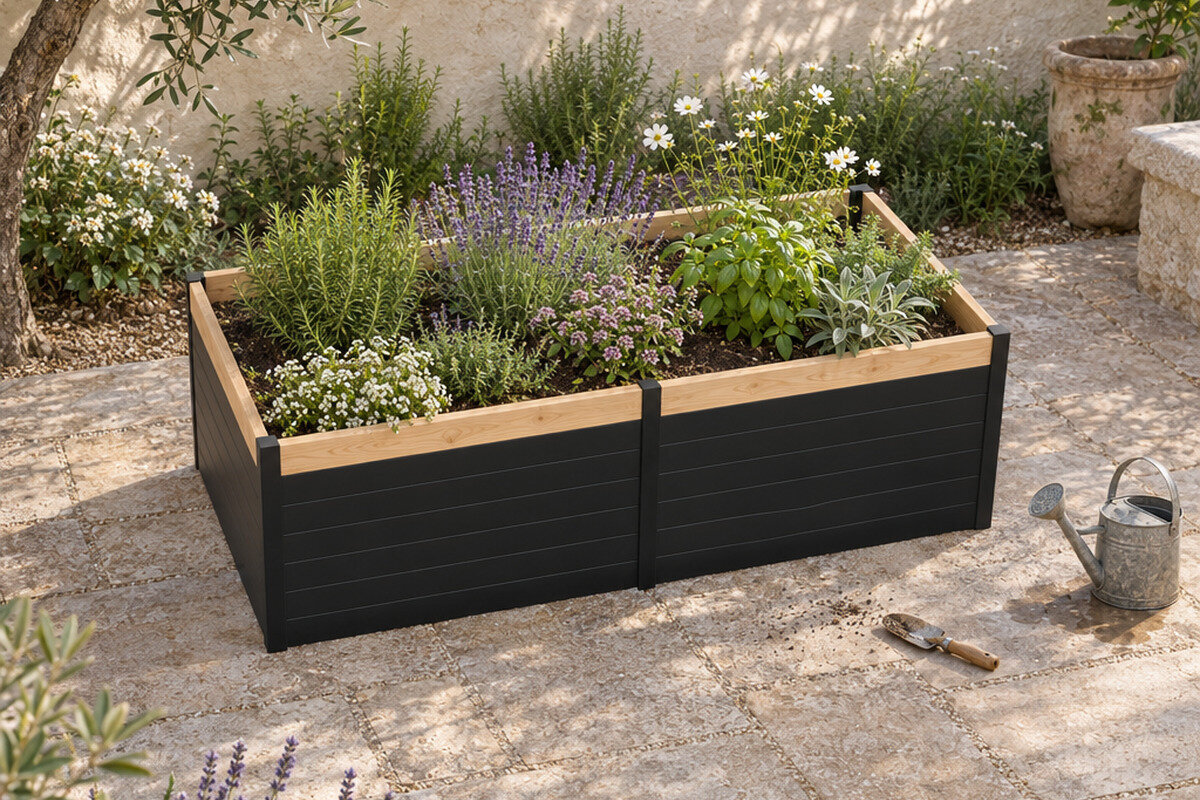
Check what the bed actually stands on. The Bloomcabin Narrow Aluminium Raised Bed 100×50×30cm, for example, has a nominal footprint of 100 × 50 cm, 30 cm walls and no floor panel. On prepared ground, the open base faces soil; on concrete, it faces the slab. That specification does not tell you whether your installation provides a usable outlet. Confirm what the manufacturer permits on a hard surface before altering how the frame sits.
If you can safely reach the exposed slab beside the bed, pour a small amount of water there and watch where it goes. This tests the onward route at that spot, not whether water can get through the fill or out from under the frame. When assessing drainage for raised beds on concrete, keep those observations separate. A dry strip farther down the patio tells you little if a lip prevents runoff from reaching it.

02
Compare the wet patch with the rest of the bed
Do not add test water to a saturated bed. After ordinary rain, check the surface and, if you can avoid disturbing roots, use a hand trowel to inspect a little fill lower down. Compare the wettest area with another spot. Record where you looked, how deep you checked and whether the material was damp or had visible free water. A dry-looking surface can hide a wet lower layer.
If the fill is not saturated, a measured comparison can help diagnose drainage for raised beds on concrete. For example, mark two similar bare patches about 30 cm across, one near the problem area and one farther away. If they start at a similar moisture level, apply 500 ml slowly to each using the same method. Note whether water stands on either patch, disappears into the fill or runs sideways. Record how long any surface puddle remains and check the corresponding edges for runoff, without adding more water just to make it appear.
The amount is an example for comparing patches, not a pass mark or a watering recommendation. If one patch puddles and the other takes up water, inspect the slower patch for crusting or compaction. If both take up water but the lower fill is persistently wet, inspect the base. No visible runoff from a small pour does not prove a blockage: the fill may have held the water. Treat these checks as clues to drainage for raised beds on concrete, not as a measured drainage rate.

03
Check for a crust or a dense layer in the fill
Take a little fill from the surface and from lower down at both a problem spot and a comparison spot. Keep the samples separate and note how wet they are. Look for a thin crust on top, a firm layer that resists the trowel or a visibly different layer at the base. A wet handful that clumps does not establish the soil texture or prove the root zone needs replacing. What matters is where the dense layer is and whether it lines up with the watering observations.
For drainage for raised beds on concrete, a surface crust and a dense lower layer call for different work. Where the symptom is confined to bare surface soil, gently loosen a small patch without damaging roots and compare it with an untouched patch at the next watering. Keep feet out of the bed so that inspecting or working it does not add to the compaction. If the lower fill is dense in several places, a surface repair alone will not address what you found.
Before replacing lower fill, establish that water can leave the base. A blocked exit can keep otherwise suitable medium wet, so dampness alone is not a reason to change the mix. The useful distinction for drainage for raised beds on concrete is between fill that admits water slowly and fill that stays wet because the water below has nowhere to go. Both faults can be present; fix the exit first, then check what persists.

04
Clear the exit before changing the mix
Begin with the obstruction you can actually see. For drainage for raised beds on concrete, clearing a bed edge and correcting a slab that holds water are two different repairs. If you cannot tell whether the frame can be installed with a clear outlet at that location, ask the manufacturer about the installation and seek site-specific advice if the slab itself is the problem.
Once the route is accessible, use a small pour of water to check it in the assembled position before putting all the fill back. Look at both the exit and the point where the runoff ends up. That check can confirm the route is clear at the time of inspection, but drainage for raised beds on concrete still needs checking after refilling: soil or a displaced liner can obstruct the same exit again.
- Clear leaves, loose sediment or other accessible debris from the existing exit. If a liner appears to cover it, check the instructions before adjusting anything: a soil-retaining layer must not close off the water route.
- If the obstruction is behind the frame, remove enough fill to inspect it safely, following the assembly instructions. Do not lever up a loaded frame, drill new outlets or wedge it onto improvised supports.
- If water exits the bed but stays in a dip in the concrete, reassess where it can go. If there is no suitable destination, resolve that before refilling, or move the emptied bed to a suitable position. Do not redirect runoff towards a building, across a regularly used path or onto neighbouring property.

05
Choose replacement fill by intended use and composition
Once the outlet works, decide how much fill actually needs changing. If the problem is localised, keep the medium that behaves well and repair the affected area. If it is dense throughout and remains slow to take up water after the outlet repair, consider replacing more of it. For drainage for raised beds on concrete, a new mix is worth buying only if it addresses a problem you found in the fill.
Compare the intended use and composition on the bag or technical sheet. Look for a peat-free growing medium intended for the type of planting you have in mind. Check whether it is sold as a ready-to-use fill or as an ingredient to mix with other material. If the label lists ingredients such as loam, bark or coir, note which are actually declared and whether proportions are given. An ingredient list does not tell you on its own how the finished mix will behave in your bed. If the directions are unclear, confirm whether it can be used as the main growing medium before ordering.
For drainage for raised beds on concrete, do not trade away rooting depth for an unneeded gravel layer. Gravel cannot open a blocked exit or change the fall of the slab. Use the available space for a suitable growing medium, keeping the intended water route clear as you refill. Check seed packets and local growing guidance for depth and moisture needs rather than assuming a single mix or fill depth suits every crop.

06
Work out how many litres to buy
Measure the actual internal length and width of a rectangular bed, then measure the intended depth of growing medium from its base to the fill line. In a bed on a slab, do not count soil below the frame as extra rooting depth. Allow for any space taken up by the approved base arrangement. For drainage for raised beds on concrete, measure after checking the outlet so that the volume calculation reflects the bed you will actually refill.
Hypothetical worked example: an emptied, straight-sided bed measures 0.96 m by 0.46 m internally. There is 29 cm between the surface supporting the fill and the rim, and the gardener plans 25 cm of growing medium, leaving 4 cm of headspace. Assume the base takes up no additional volume and the depth is uniform. The estimate is 0.96 × 0.46 × 0.25 = 0.1104 m³, or 110.4 litres. If the chosen ready-to-use medium comes in 40-litre bags, three bags supply 120 litres, about 9.6 litres more than the geometric estimate before settling.
Those are example measurements, not the internal dimensions of a Bloomcabin model. If only one area needs replacement, measure the area and average depth of the material removed rather than ordering for the entire bed. When repairing drainage for raised beds on concrete, fill to the planned line without pressing the mix down to use up a bag. Keep any surplus for topping up if the level settles.

07
Retest the fault you set out to fix
Recheck the same spots after ordinary watering or rain, noting the starting moisture and how much water was applied if you know it. Look for the symptom you set out to fix. If surface puddling has eased but water now collects against the slab edge, the fill may have improved while the onward route still needs attention. If the slab clears but one patch repeatedly puddles, go back to the fill in that patch.
A useful result for drainage for raised beds on concrete is that excess water can leave without persistent pooling, while the growing medium retains moisture for the plants. You do not need to see runoff every time you water. Raised soil can dry faster than soil at ground level, so check moisture beneath the surface and adjust to the crop and the weather rather than watering to a fixed timetable.
Keep a short record of the original symptom, the repair and what happened afterwards. If drainage for raised beds on concrete worsens again, check the outlet for fresh debris or displaced material before changing the mix a second time. Where standing water comes back at the same spot outside the bed, revisit the slab route rather than adding an amendment to the soil.

Questions readers ask
Does an open-bottom bed need drainage holes if it sits on concrete?
An open-bottom frame has no floor panel to drill. Drainage for raised beds on concrete depends on a suitable exit at the base and somewhere for the water to go afterwards. If the frame and slab leave no workable route, check the approved installation options or use a different position rather than drilling the frame.
Will a gravel layer fix a soggy bed?
Not if the outlet is blocked or the slab holds the runoff. Gravel uses space that could otherwise hold growing medium, but it does not give water a way off the slab. When troubleshooting drainage for raised beds on concrete, check where the water stops before buying anything to put under the soil.
Do I need to empty the whole bed to find the fault?
Not always. Start outside the frame and inspect the lowest accessible edge. For drainage for raised beds on concrete, clearing an external obstruction may reveal the fault without disturbing the fill. If the lower medium remains wet, you may need to uncover a small section of the base. Do not move or dismantle a loaded frame; follow its instructions.
Fix the restriction you can verify
The order matters for drainage for raised beds on concrete: trace the water, clear or resolve the exit, then check the fill again. If the medium still needs replacing, buy for the space you have measured and compare the same spots after refilling.
Find a raised bed for your plan
Compare layouts and check the dimensions on the product page.
