
Elevated planter box on wheels: choosing, setting up and moving it

Bloomcabin · Raised-bed guides
Elevated planter box on wheels: choosing, setting up and moving it
Choose an elevated planter box on wheels only if you can comfortably reach the plants and the supplier confirms how the assembled unit should be parked and moved on your surface. If filled movement is not documented, put it in its final position while empty and verify that it can hold the intended load before planting.
Check both load limits
An elevated planter box on wheels may be rated to hold more weight while parked than it can carry while rolling. Check both limits before buying.
Try the working height
Measure from the side you will actually use. A comfortable rim height is little help if you cannot reach the plants or the brakes.
Check the whole route
Check the route as well as the parking spot. Paving joints, gravel and thresholds can change whether a move is permitted.
Set up before filling
Test the brakes and drainage in the final position before adding compost. Include retained water when assessing the filled load.
Start with one decision: do you need to roll an elevated planter box on wheels after planting, or do you just want to position it easily before filling? Moving it once across a patio is a different job from wheeling it aside every week to clear a doorway. Decide which job matters before you compare models.
Then check the two sides of the design separately. Measure the box for comfortable tending and enough rooting space. Assess the base, brakes and drainage for the spot where it will stand, and check the whole route if you intend to move it. Where a listing is unclear, give the supplier your surface, route and planned load and ask for the applicable instructions.
01
Choose a working height you can actually use
An elevated planter box on wheels has a planting container and a base that holds its contents above ground. The raised working surface can reduce the need to bend, but higher is not necessarily better. Ask for the assembled rim height, the height and depth of any clear space underneath, and the internal width of the planting box. A shelf or crossbar can restrict a seated approach even if the rim itself is at a comfortable height.
Try the dimensions at home before ordering. Mark the proposed rim height and use a clear table or worktop to gauge how far you can comfortably reach while seated or standing. Allow for the rim itself and for the growing surface sitting below it. If the box will back onto a wall, check whether you can reach the far edge from the front. Leave space to bring a watering can alongside and check that you can reach the brakes without leaning on the planter. Do not assume a listing that says ‘accessible’ accounts for your approach or reach.
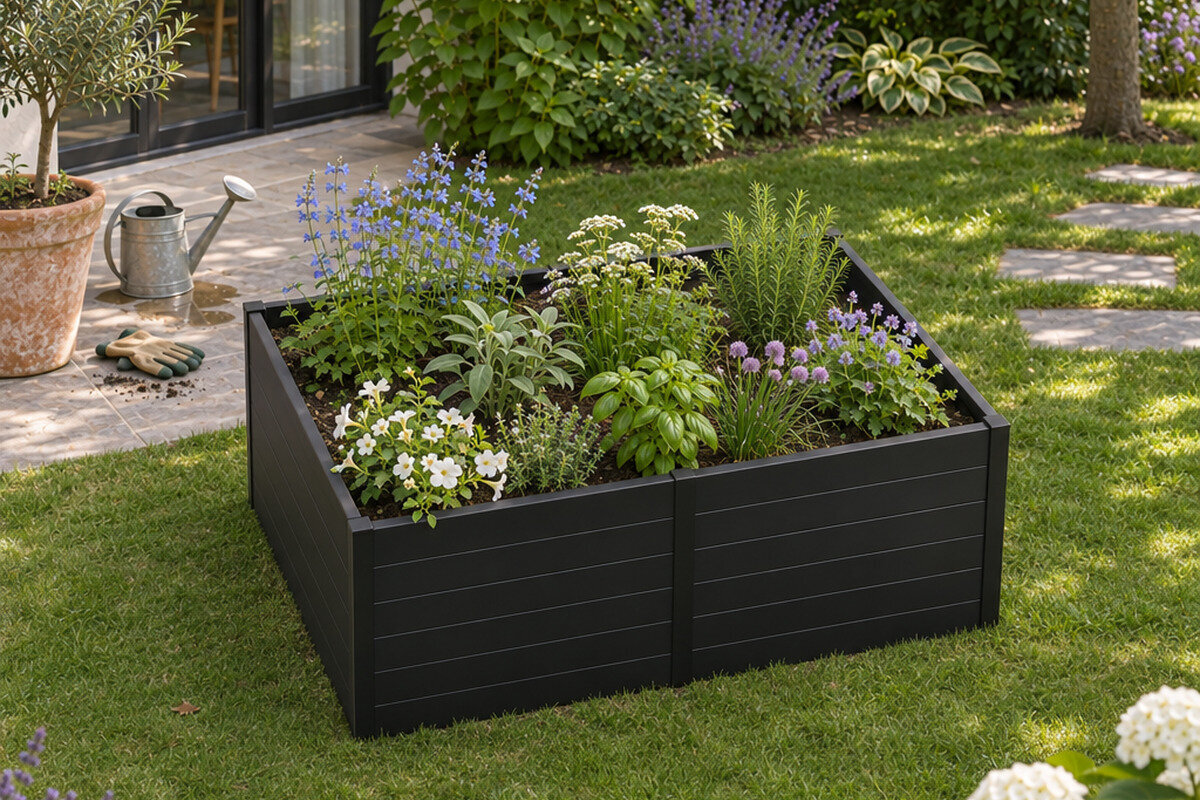
If you want an elevated planter box on wheels, distinguish it from the raised beds illustrated here. For example, the Narrow Aluminium Raised Bed 100×50×20cm is open to prepared ground and has no floor panel; its 20 cm wall height is not an elevated working height. It is an option for a fixed planting strip, not a wheeled alternative.

02
Walk the route and inspect the parking spot
Measure the route an elevated planter box on wheels would actually take, including the turn out of its parking spot. Use the widest assembled dimensions, allowing for castors as they swivel and for any handles or other projections. Mark the footprint with tape or cardboard and check the turn, not just the straight gap through a gate. Leave a separate working space so you do not need to move the box every time you water or harvest.
On a patio, note whether the route is over smooth, level concrete or across paving slabs with wide joints, raised edges or a fall for drainage. A castor that rolls freely on a smooth patch may catch at a joint. Loose gravel and soft lawn can impede wheels, and a doorway threshold is a change in level even if the paving on each side is flat. Tell the supplier what is on your route rather than asking whether the planter is simply ‘suitable for outdoors’. If the surface or obstacle is not covered by the instructions, do not try to force a filled unit across it.
Pick a level parking position permitted by the supplier, with access to water and space to operate the brakes. If the elevated planter box on wheels will go on decking or a balcony, check that the supporting surface can take the filled unit, including the load at its wheel contact points. The planter’s own rating does not tell you what the surface can support.

03
Read the load rating and brake specification together
Ask for the supplier’s rating for the complete assembled elevated planter box on wheels, not just a figure for an individual castor. Confirm whether each limit refers to the contents alone or the total weight including the planter. Then ask which limit applies when parked and which applies when rolling, and what surface, fill level and load distribution the instructions require. A stationary rating is not permission to move the same load.
When comparing ratings, account for the growing medium when wet, the plants, any retained water not already included in the wet-medium figure, and anything attached to or carried by the box. Include the empty unit’s weight if the limit is for the total. Litres tell you how much space the medium occupies, not how much a filled box weighs. Use weight information for the actual medium and setup; if you cannot establish the planned load, do not rely on a guess to justify moving it.
Check how the elevated planter box on wheels is meant to stop and stay parked. Identify which castors have brakes, whether they lock wheel rotation only or also prevent swivelling, and how you can reach them at the chosen spot. A brake does not level a rocking frame or make a slope suitable. If the unit rocks, creeps or fails to stay put with the brakes applied as instructed, do not fill or use it until the cause has been resolved.

04
Assemble and commission the planter while it is empty
Assemble the elevated planter box on wheels near its final position, following the instructions for the base, supports, castors and liner where supplied. Check that the wheels are fitted in the specified positions and that the fasteners are secure as directed. Use the approved handling points to position the unit empty. Check that it rolls, turns and parks as expected on the permitted route. An easy empty move shows that the route is usable in that condition, not that it is suitable for a full planter.
Once parked, engage the specified brakes and check that the frame sits steadily, without using your body weight to test it. Check where the drainage outlets discharge. If the instructions allow it, run a little water through the empty container to see whether it drains where you expect. Keep the outlets clear, and use a collection arrangement only if it is compatible with the design. Do not let runoff cross a regular walking route or collect around the wheels.
Move a filled elevated planter box on wheels only if the supplier permits it and you can verify the load and route. Clear the route first, then follow the specified method for releasing the brakes, moving and parking. If a wheel catches or the frame shifts, stop rather than lifting an end or pushing harder. Where filled movement is not permitted, unload the planter as instructed and reposition it empty before refilling.

05
Buy compost and plants for the space inside the box
Before buying compost for an elevated planter box on wheels, confirm the internal length and width at the usable fill level. Rooting depth is the depth of growing medium available to roots, measured from its surface to the base of the planting space. Do not count the height of the legs, space above the fill line or space below a false bottom. A deep-looking box can offer less root space than its outside dimensions suggest.
Choose a peat-free growing medium labelled for container use and suitable for what you want to grow. Check the seed packet or plant label against the usable depth and planting area. If you want salad leaves and herbs, for example, start with varieties whose container requirements fit the box rather than trying to squeeze in everything you use in the kitchen. Plan for mature size, not the size at planting, and position taller plants so they do not unnecessarily shade shorter ones. Use seed instructions and local UK growing guidance to decide when to sow or plant out.
An elevated planter box on wheels can be useful even if it stays parked for the season. Pick a position that suits the plants’ light needs without depending on daily moves. Keep trailing growth clear of the castors and brake pedals, and check moisture before watering rather than following a fixed schedule. After watering, check that any runoff is going where you planned.

06
Worked example: the patio planter that can park but not roll when full
Hypothetical worked example: you want an elevated planter box on wheels for salad leaves on a level concrete patio. You would like to roll it aside to clean, but could leave it planted in one position if needed. Assume the supplier permits use on that surface and confirms a rectangular internal space measuring 80 cm by 40 cm, with 25 cm of usable fill depth and nothing occupying that space. The planned fill volume is 0.8 m × 0.4 m × 0.25 m = 0.08 m³, or 80 litres. Those are example dimensions, not Bloomcabin specifications.
Assume the supplier gives total-weight limits of 80 kg when parked and 60 kg while rolling. For this example only, assume the empty planter weighs 12 kg, the medium at its planned wet weight adds 48 kg, and plants and attachments add 5 kg, with no separate water reservoir. That makes 65 kg in total: 15 kg below the stationary limit but 5 kg above the moving limit. The 48 kg figure is an assumption for this example, not a conversion you can apply to 80 litres of any compost.
The decision is to position the elevated planter box on wheels empty, apply the brakes and fill it where it will stay, provided the other access, surface and drainage checks are satisfied. If rolling it aside while planted is essential, rule out this setup. Compare a smaller planting box that still meets the crop and reach requirements, or look for a model explicitly rated to move the verified load on that patio.

07
Keep the movement decision with the planter
Before filling an elevated planter box on wheels, record its parking position, the approved route, the applicable ratings and whether it can move only when empty. Keep that information with the instructions so someone else does not mistake the wheels for permission to rearrange a planted patio. If you cannot confirm the stationary rating, stop before filling; if only the moving rating is missing, plan to leave it parked once planted.
In use, check the outlets for obstructions and keep the ground around the castors clear. Follow the supplier’s inspection instructions for the frame, wheel fixings and brakes, especially before a planned move. Reassess the weight if you top up the growing medium or add a support or other attachment. Do not lean on the rim or hang equipment from it unless the supplier permits that use.
If an elevated planter box on wheels starts to rock, a brake no longer holds or a wheel binds, keep it parked and stop using it until you can follow the supplier’s advice. The same applies if a change to the patio introduces a lip or a slope on the route. Recheck the new conditions before moving the planter rather than relying on the fact that it rolled easily last time.

Questions readers ask
Can I move an elevated planter box on wheels just after watering?
Only if the supplier permits filled movement and the total weight, including the water still in the planter, is within the moving limit. Check the route too: even if the weight is acceptable, runoff may make a normally suitable surface slippery. If you cannot verify the load or conditions, leave it parked.
Can I turn an open-bottom raised bed into an elevated planter box on wheels?
Do not assume so. An open-bottom frame sits on prepared ground; a mobile planter needs a base, supports and castor fixings designed to carry the contents together. The illustrated Bloomcabin models have no floor panel or specified wheeled base. Their dimensions do not establish the capacity of a conversion.
What if the listing gives a load rating but says nothing about moving the planter?
Ask whether the figure applies while parked, while rolling or both, and whether it refers to contents alone or the whole unit. Until the supplier confirms filled movement, plan to position it empty. Before filling, verify that the documented stationary rating covers the intended load.
Buy for how you will use it
A well-chosen elevated planter box on wheels should be comfortable to tend without having to move it. If you also need to roll it while planted, make documented filled movement on your route a buying requirement, not something to try after setup.
Find a raised bed for your plan
Compare layouts and check the dimensions on the product page.
