
A Fabric-Roof Pergola or an Aluminium Louvred Pergola?
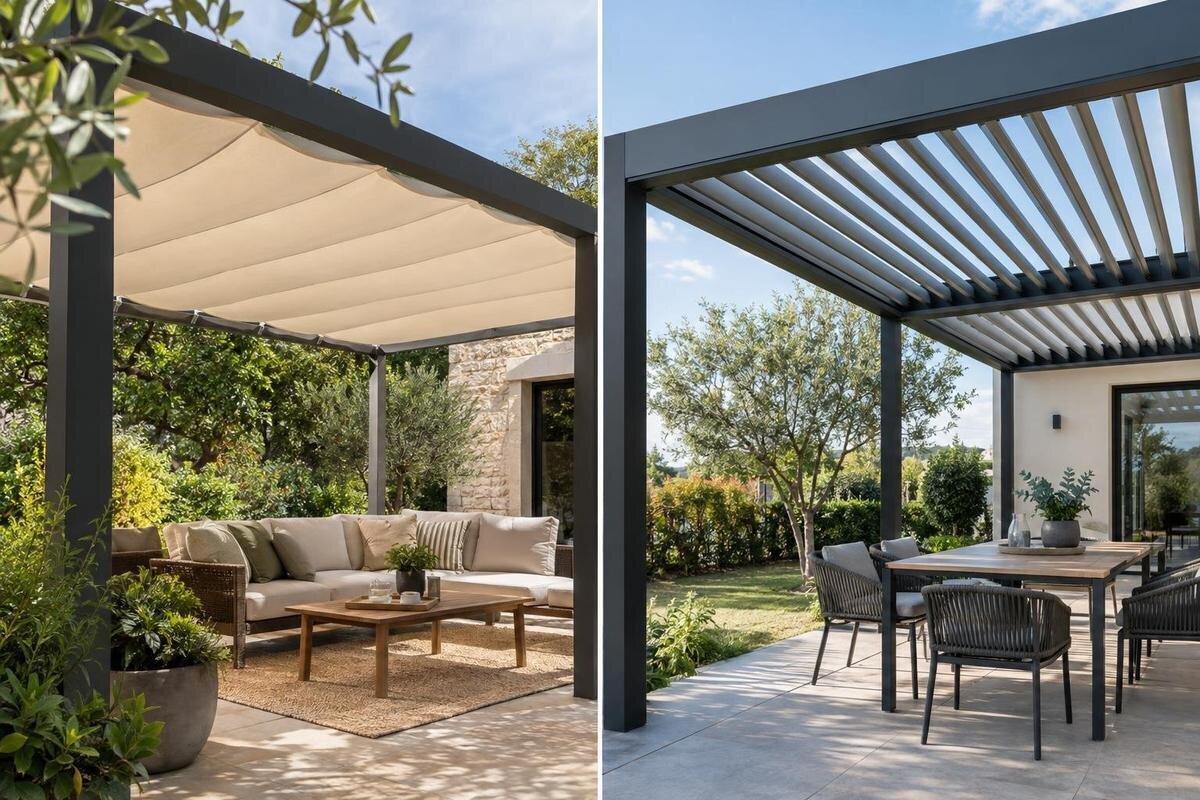
Pergola roof choices
A fabric-roof pergola and an aluminium louvred pergola do not manage shade in the same way. Fabric may stay fixed, be removed or be drawn back, while louvres change angle. The useful comparison is about movement, care and the model-specific limits for rain, wind and seasonal use—not material labels alone.

How the two roofs move
Fabric and aluminium louvres change the roof in different ways. A fabric canopy may be fixed, removable or drawn back along a track; which applies depends on the individual system. A conventional louvred roof turns its blades between positions, altering the gaps and angle overhead. Do not assume that louvres retract completely or that fabric rolls into a compact stack: movement drawings should show what remains over the seating area in each position. Depending on the mechanism, a partly drawn canopy may leave only part of the span uncovered, while angled louvres may still sit across the opening. The Bloomcabin Bioclimatic Aluminum Pergola listing is an aluminium product reference, but its model name alone does not establish the precise controls or weather limits.
That distinction changes daily use. A retractable canopy can expose more sky if its travel allows it; fixed fabric remains overhead. Adjustable louvres can vary direct sun and airflow by changing blade angle, but the blades may still occupy the roof opening. A pergola roof does not enclose the sides, so wind and low-angle rain can reach the space. Decide whether you want shade that stays in place, a canopy that moves away, or a roof whose angle can be adjusted. Also consider whether you expect to change its position occasionally or several times a day.
What to check on a fabric roof
Fabric roofs use different mechanisms. A permanently tensioned cover has no user-operated opening; a detachable canopy must be removed as a separate task; a sliding or retractable cover needs a guide and somewhere for the material to gather. Some systems allow intermediate positions, while others are designed for particular open and closed positions. Look for a diagram showing the canopy’s full travel, not just a photograph of it deployed. Confirm whether removal is intended for routine use or only for maintenance, and whether a partly open position is permitted. Those details affect how realistic it is to change the cover each day. For a detachable canopy, consider the handling involved between taking it down and putting it away. Ask how many people the instructions require and whether furniture needs to be moved first. Compare that task with operating a sliding cover: both may uncover the seating area, but they involve different routines.
Check what supplies the movement before comparing convenience. Depending on the model, operation may be manual or motorised; neither should be assumed. Ask where the handle or control sits, how much clear space the canopy needs to travel, and whether operation is practical with furniture in place. The structure’s attachment is a separate choice from its roof: the Bloomcabin Lean-To Pergola is identified as wall-mounted, which says nothing by itself about the canopy mechanism. For a fabric-roof candidate, use that product’s own instructions to confirm how the cover is secured and where it rests when open.
How louvres are adjusted
Louvred systems vary in operation too. The blades may be adjusted by hand or by a powered system, and the available positions, range of movement and control location belong to the specific model. A label such as bioclimatic does not by itself prove that a roof has a motor, remote, weather sensor or automated response. Check the diagram and operating manual, then compare the movement you want: a small change in angle to shift the shade is different from creating larger gaps between the blades. The bioclimatic aluminium pergola product page is a useful model reference, not evidence for controls that are not specified.
When viewing a demonstration, focus on whether the blades move as expected, how they stop and whether the control is reachable from the intended seating area or doorway. Ask whether adjustment is continuous or limited to set positions, and whether any opening remains at the available stops. Never force a mechanism that feels obstructed. If operation requires a motor, verify what is included in the exact configuration and what the supplier specifies for its controls. A photograph of open or closed blades cannot answer those questions.
Rain protection depends on the whole roof
Rain cover is a property of the complete design, not a material name. Some fabric covers are intended mainly for shade; others may be specified for rain. Water behaviour depends on the textile, seams, tension, roof slope and drainage arrangements. Ask for the manufacturer’s wording and the conditions it describes, including how water is directed away and whether a particular roof position is required. Do not treat a water-repellent description as a guarantee that the area beneath will stay dry. For a retractable cover, establish whether it is intended to remain deployed in the rain.
With louvres, a closed position may direct water into gutters or drainage paths designed for that model, but closure alone does not prove the terrace will stay dry. Check where runoff exits, whether the system specifies seals or overlaps, and what its guidance says about wind-driven rain and water at the perimeter. Rain can reach the sides of an open structure even when the roof is closed. A model-level drawing or manual is more useful than a broad claim such as rain protection. If a dry seating area is essential, ask what conditions the claim covers and how water leaves the roof.

Wind exposure changes the operating limits
Wind guidance is model-specific. A deployed fabric roof can present a broad surface, while louvres present blades in different positions; the frame and fixings matter as well. Do not assume that a retracted canopy or open louvres are automatically safe in a gust, or that a closed roof is necessarily safer. Look for the manufacturer’s stated wind limits and instructions on which positions are permitted or need to be secured. These details also matter when you will leave the pergola unattended. Avoid relying on an unspecified sensor or a general rule taken from another model.
Exposure around the proposed site affects what to ask: an open garden, a sheltered courtyard and a position beside a tall wall experience wind differently. Explain the setting to the supplier or installer, and check that the proposed support and fixing arrangement is appropriate for it. The wall-mounted Bloomcabin pergola listing identifies a format, not the suitability of a particular house wall or a wind rating. A qualified installer can assess the actual structure and fixing requirements. Do not choose a roof solely by its fabric or metal.
Care for fabric and louvred roofs
Fabric maintenance starts with the care instructions for the exact textile. Confirm how to remove leaves and dirt, which cleaning products are permitted, whether the cover can be taken off, and whether it must be dry before storage or retraction. Do not assume that outdoor fabric tolerates a pressure washer, bleach or any household cleaner. Check seams, hems, tension points and any track or guide as the manufacturer directs. If the cover is fixed above the frame, consider how you will reach the surfaces that need cleaning. Ask whether debris should be cleared before moving the fabric. Separate the cleaning task from the access arrangements: a simple cleaning method is less convenient if the relevant surface is difficult to reach. Ask which parts can be cleaned from below and which require removal or professional access. Include the space needed to handle a detached cover in your maintenance plan.
Louvres need a different care plan. Dust, leaves and other debris may collect on blades, joints or drainage channels, so ask how these areas should be cleaned and whether components need periodic inspection. Follow the manual for pivot points, seals and moving parts; do not add lubricant or use abrasive tools unless the manufacturer permits it. Compare what can be reached easily and whether any maintenance requires a service visit. It is also worth checking whether the manufacturer identifies replacement fabric, mechanisms or individual roof components, since repair options can matter more over time than the effort involved in routine cleaning.
Plan for seasonal use and storage
Think through the whole year before settling on fabric. A removable or retractable canopy may let you change the amount of cover, but the manufacturer’s instructions determine whether it can remain fitted in winter or should be stored at particular times. Ask how it is removed, where it can be stored and whether it needs to be dry first. A fixed cover, by contrast, stays overhead and may continue to shade the area when you would prefer more daylight. Seasonal removal is only an advantage if the process and storage space suit your household.
Louvres may offer a choice of blade position, but that does not establish a winter or storm setting. Check guidance for wind, snow, ice and prolonged absence rather than copying advice for a different model. Confirm whether drainage channels need clearing and how the roof should be positioned before the space is left unused; do not infer a load capacity from the fact that the blades close. The Bloomcabin Pergola listing states an area range of 97–258 sq ft. Use that as a broad listing range, then check the selected configuration’s drawings and the space you need for seasonal furniture or storage.
Check clearances around the pergola
Compare roof movement with the actual terrace plan. Mark the posts, wall line, doors, windows, vents, existing downpipes and furniture, then check them against the roof’s travel or the place where a retracted canopy gathers. With louvres, consider whether the control is reachable without moving a dining set and whether the open position gives the overhead space you expect. An opening roof does not create extra floor space, and a drawing of the frame alone may not show the clearance needed for its mechanism. Use an installation drawing for the exact variant rather than relying on a generic product photograph. Include chairs in their pulled-out positions, not only tucked beneath the table, and leave your usual route between the house and garden clear. This helps distinguish the overall covered footprint from the space you can comfortably use. Compare both roof options with the same furniture layout so the comparison remains fair.
Attachment and dimensions should be considered alongside the roof. A wall-mounted structure meets the house differently from a freestanding one, but neither description tells you what the canopy is made from. The Bloomcabin lean-to model page identifies a wall-mounted product format; it is not a dimensioned plan for your site. Check the chosen model’s footprint, projection, height and required clearances against measured doors and eaves. Where the pergola attaches to a building, ask a qualified installer to assess the proposed fixing surface and confirm the relevant details from the product drawings.

Compare the exact model specifications
For a fair shortlist, compare like with like: the covered footprint, height, mounting arrangement and any included side elements. Check how each supplier defines the area, since a stated roof area may not be the same as the clear space between posts. Then read the technical documents for canopy movement or blade positions, drainage routes, permitted operating conditions and care. Product titles and pictures identify a style but rarely answer every operational question. The Bloomcabin aluminium bioclimatic model page is one catalogue reference; use the documentation for the exact selected variant instead of assuming every version shares the same mechanism or weather guidance.
Write down what each supplier confirms about rain, wind, seasonal storage, operation, cleaning and repair, as well as what is included in the quoted price. Compare the complete arrangement, not just the canopy: frame, roof mechanism, any controls or accessories, delivery, assembly and installation may all affect the decision. Ask whether a fabric panel or moving component can be replaced and where maintenance instructions are supplied. Make sure the manual matches the model and configuration being considered. If a point cannot be verified in the product information, ask the manufacturer or installer rather than borrowing a feature from another pergola. Keep optional items separate from the base specification in your comparison. If one quotation includes a control or accessory and the other does not, record that difference before comparing totals. Where installation is quoted separately, establish which tasks are covered so that you are comparing equivalent packages rather than two different scopes of work.
Which roof fits your priorities?
Fabric is a sensible direction when the particular canopy offers the movement you want and its care and storage fit your routine. A louvred aluminium roof suits a different priority: changing the blade angle to manage light and airflow, provided the selected system has the controls you want and its rain and wind limits suit the site. Neither category guarantees lower maintenance, better weather cover or longer life across all models. The meaningful comparison is between two exact products, not fabric in the abstract against aluminium in the abstract.
State your main requirement in practical terms: shade that remains overhead, the ability to uncover the seating area, adjustable light, or a covered seating area with documented rain guidance. Then rule out any model whose movement, drainage, seasonal instructions or care would be awkward to live with. The regular Bloomcabin Pergola page is another product reference, but a general pergola listing is not a substitute for confirming the roof construction of the version under consideration. If two candidates still meet your needs, compare their day-to-day demands: the adjustments you would make during a meal, the cleaning you can manage and any seasonal handling. Give greater weight to the functions you expect to use regularly than to features that sound appealing but serve no clear purpose on your terrace.
Frequently asked questions
Does a fabric roof keep a terrace dry in the rain?
Not necessarily. Some fabrics are intended mainly for shade; others may be specified for rain, but seams, tension, roof slope, edges and drainage all affect performance. Check the exact cover’s written guidance and the conditions it describes. Rain can still reach an open-sided pergola, so textile type alone is not a waterproof guarantee.
Can a fabric pergola roof be retracted?
Only if the particular model is designed to retract. Fabric systems may be fixed, removable or sliding, with different open positions and storage instructions. Check the mechanism diagram, how far the canopy moves and when it may remain deployed. A fixed cover cannot be treated like a retractable one.
Are aluminium louvred pergolas motorised?
Some models are operated by hand and others use a motor; a product name or roof photograph does not confirm which. Check the exact configuration, control method and available blade positions. Do not assume that a motor, weather sensor or automated response is included because a pergola is described as bioclimatic.
Which roof is easier to maintain?
It depends on the material, mechanism and access. Fabric care may involve cleaning, checking seams or tracks, and storing the canopy if it is removable. Louvres may need cleaning around blades, joints and drainage paths. Compare the manufacturer’s care instructions and repair options rather than assuming either roof is maintenance-free.
How should I compare pergola roofs for changeable weather?
Start with the model-specific rain, wind and seasonal instructions, not a general climate label. Confirm the recommended roof positions, drainage arrangements and storage requirements. A pergola remains open at the sides unless separate elements are fitted, so the roof material alone cannot promise shelter in every condition.
A fabric roof is defined by what happens to the canopy; a louvred roof by how its blades adjust. Decide which movement you will actually use, then compare the exact model’s rain guidance, wind limits, care requirements and seasonal instructions. If rain cover is essential, check the conditions and drainage details rather than relying on a broad claim. If an open view matters, confirm how far the canopy retracts or what remains overhead when the louvres are open. That makes the choice about real use, not just material.
