
Flower Bed Planters: How to Choose, Set Up and Plant One

Bloomcabin · Raised-bed guides
Flower Bed Planters: How to Choose, Set Up and Plant One
Choose flower bed planters by checking three things first: where the bed will sit, whether you can reach every planting spot and what your flowers need at maturity. For a garden edge on prepared soil, an open-base raised bed is a good shortlist option. If you need to contain soil on paving, look for a planter with a base and suitable drainage instead.
Check the base
The open-base models in this guide sit on prepared ground. Choose a different design if you need to contain soil on paving.
Allow room to work
Mark out the frame and the working path before buying. Test your reach to the farthest planting spot.
Read the dimensions
Compare flower bed planters by nominal footprint, planting area and wall height. Measure inside before ordering fill.
Plan the display
Use mature spread, light and moisture needs to decide which flowers can share the bed.
Flower bed planters are useful when you want a contained display without planting directly into an existing border. A narrow frame can suit a short run of seasonal flowers beside a path; separate bays can help you manage different groups. Neither arrangement is worth choosing if you cannot reach the plants to water, deadhead or cut them.
This guide uses Bloomcabin's UK open-base raised beds to show what the listed measurements tell you and what to check on site. Start with a planting idea, mark out the frame and working space, and leave the order for growing medium until you know the usable dimensions.
01
Decide whether an open-base frame solves the problem
Flower bed planters are raised-sided spaces for growing flowers. The term can describe both open-base frames and containers with a bottom. The Bloomcabin examples in this guide are frames: they hold growing medium at the sides but have no floor panel and sit on prepared ground. They suit gardeners who want a defined display beside a path or lawn, or separate bays for flower groups they want to tend individually.
Before comparing flower bed planters, ask what a frame would improve. If an existing in-ground border is easy to reach and has suitable soil, extending it may be simpler than assembling and filling a bed. If you need to keep soil off paving, look for a bottomed planter designed for that surface. If you need to work seated with knee clearance, look for an elevated design that provides it rather than assuming a tall straight-sided frame will do.
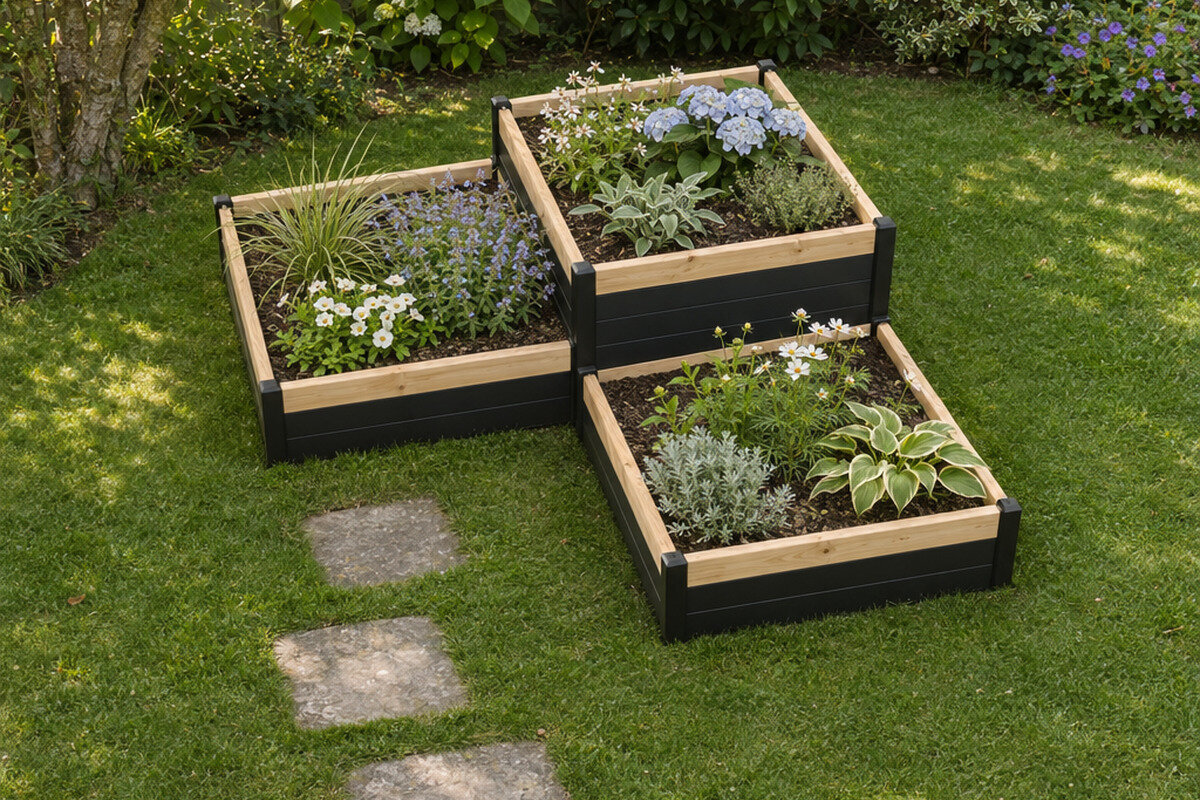
The flower bed planters pictured here include Classic aluminium frames and an Accoya fusion option. On the Ascending Triple Accoya Raised Bed, Accoya boards form the top 10 cm of each compartment wall, with aluminium panels below and aluminium posts and connectors. It is not an all-wood bed. Decide whether you want a single strip or separate bays before choosing a finish: that choice sets the space available for each group of flowers.

02
Test the site with a trowel and watering can
When siting flower bed planters, start with the flowers you want to grow. Look at the proposed spot at different times of day and note where a fence, hedge or building casts shade. Check plant labels before buying a mix: flowers with similar heights will not necessarily want the same light or moisture. If you have room for only one narrow bed, choose plants that share the conditions there rather than trying to reproduce several different growing environments.
Mark the bed corners and path edges with canes, string or temporary markers. From the route you will actually use, mimic reaching the farthest planting spot with a hand trowel or watering can. If you can touch the back edge but cannot work there comfortably, choose a narrower bed or leave another approach. Plan for mature foliage that might lean into the path, and keep a clear route for carrying bags to the bed before filling.
Keep working paths firm, and plan to tend the plants without stepping into the bed and compressing the soil. Flower bed planters are easier to look after if fetching water is straightforward. Walk the route to the tap before settling on a spot and check whether a hose or full watering can can reach the bed without snagging at a gate or blocking a shared route.

03
Separate the space it occupies from the space you can plant
When comparing flower bed planters, read the length and front-to-back measurement as the nominal footprint, and the height as the wall height. For example, the Narrow Aluminium Raised Bed 100×50×20cm and Narrow Aluminium Raised Bed 100×50×30cm both have a nominal 100 × 50 cm footprint, one compartment and a nominal planting area of 0.5 m². The extra 10 cm of wall on the second model does not give you more room to space plants across the bed.
Wider layouts show why the footprint alone is an unreliable guide to how much you can plant. The U-Shaped Aluminium Raised Bed 300×200×30cm has a nominal footprint of 300 × 200 cm, five nominal 100 × 100 cm planting bays and 5 m² of nominal planting area. The nominal 100 × 100 cm access notch occupies part of the overall rectangle. Compare flower bed planters using the actual arrangement of the bays and approaches, not just the dimensions of the rectangle around them.
For open-base flower bed planters, the soil surface need not reach the top of the wall. Roots may also be able to grow below the frame if the ground is suitable. Where there is compacted ground or an obstruction below, don't count that layer as usable rooting depth without checking it. If you are choosing a bed for a particular flower, check its rooting needs against both the planned depth of fill and the ground below.
- Use the nominal footprint to shortlist models; verify the assembled outside size if the fit is tight.
- Use the nominal planting area to compare growing space, then check clear internal measurements for spacing and fill.
- Treat wall height, soil fill depth and total rooting depth as three separate measurements.

04
Choose one strip or several bays you can tend
A single narrow bay is a sensible starting point for a display you will tend from one side, provided you can work at the back. Multi-bay flower bed planters are more useful when you have a reason to divide the display: for example, one bay for flowers you cut regularly and another for established perennials you want to leave undisturbed. Dividers organise the planting but do not give separate bays different amounts of sunlight or fix poor drainage underneath.
The Tall Triple Aluminium Raised Bed has a nominal 300 × 100 cm footprint, with three nominal 100 × 100 cm bays and wall heights of 80 cm, 50 cm and 80 cm from left to right. If approached from one long side, the taller bays still have the same nominal front-to-back dimension as the lower centre bay. Use the wall heights to think about hand position and bending, not as evidence that the far corners will be easier to reach.
With U-shaped flower bed planters, test access from inside the notch as well as from outside the arms. A nominal notch measurement is not a guarantee that you can turn there with the equipment you use. If reach is limited, try the proposed positions at the intended working height. A manageable job at the front edge can feel quite different when you have to reach past established plants.

05
Prepare the ground, assemble the frame and measure inside
Before assembling open-base flower bed planters, clear the marked footprint and check the ground on which the frame will sit. Look for roots, rubble and compacted patches that could limit usable soil below it. If the spot regularly holds standing water, investigate the drainage or choose another position rather than assuming the raised sides will solve it. Keep the prepared planting area separate from the route you use to bring in tools and fill.
The Bloomcabin flower bed planters shown here are supplied unassembled. Check the parts against the instructions for the exact model and follow its assembly sequence. For example, each long side of the Narrow Aluminium Raised Bed 200×50×60cm uses two 100 cm wall sections joined by an aluminium T connector. That detail does not establish the joint arrangement for other models. If the instructions do not cover your site or a part does not fit as shown, resolve that before filling.
Once the frame is in place, recheck the paths and measure the clear internal space. For a simple rectangular bay, estimate fill from the internal length, internal width and intended fill depth, all expressed in the same units. For flower bed planters with multiple bays, measure and estimate each bay separately, then add the volumes. Don't count a U-shaped access notch as soil space or assume bays of different heights will take the same amount.

06
Fill for the flowers, then plant for their mature size
Fill flower bed planters with a peat-free growing medium labelled for the intended use and suited to the flowers you are planting. Check what the packaging says about drainage, moisture retention and nutrients rather than adopting a fixed mix. Choose the fill depth and planting level before ordering: a volume calculated right up to the rim only makes sense if that is where the medium is meant to finish.
Set potted plants or markers in position before planting. In narrow flower bed planters, check the mature spread on each label against the clear width, especially beside a path. Leave room for plants you will need to reach for deadheading or cutting. Place taller flowers where their shade will not work against shorter neighbours that need good light. Use seed packets, plant labels and local UK growing guidance for sowing depth, spacing and planting dates.
After planting, check moisture in the growing medium as well as looking at the surface. Raised soil can dry faster, but a sunny end and a sheltered end of the same bed may not need watering at the same time. In flower bed planters with mixed displays, pay attention to newly planted gaps as well as established clumps. Adjust watering to what you find, and clear stems from paths or remove spent flowers where appropriate for the plant.

07
Worked example: a two-metre display with one working side
Hypothetical worked example: a gardener wants a narrow display of annual flowers along a boundary. The available strip is 230 cm long and 135 cm deep. Of the flower bed planters considered, the Narrow Aluminium Raised Bed 200×50×50cm is the shortlist choice: its nominal footprint is 200 × 50 cm, its nominal planting area is 1 m² and its wall height is 50 cm. On paper, the gardener allows 10 cm behind the frame, 50 cm for the frame and 75 cm for a front path. That uses all 135 cm, so they verify the outside size and test the route before buying. Centring the frame lengthwise leaves a nominal 15 cm at each end, not enough to count as a working approach.
The gardener expects to work entirely from the front, so they test whether they can reach the back at the planned height. For the fill calculation only, suppose the assembled interior measures 195 × 45 cm and the chosen fill depth is 45 cm. The estimated volume is 1.95 m × 0.45 m × 0.45 m, or about 0.395 m³ (395 litres). Those internal dimensions are illustrative, not product specifications. The actual order should be based on the measured bay, the intended soil level and the supplier's fill guidance.
The gardener then compares the mature spreads on two or three annual flower packets against that measured width. If two rows would crowd the bed or spill into the only working path, they use a single row of alternating groups instead. They follow local guidance on when to plant and check moisture at both ends after planting. That is the point of comparing flower bed planters before buying: the right choice leaves room to grow the flowers and to do the work they need.

Questions readers ask
Can flower bed planters go straight onto paving?
The Bloomcabin models described here are open at the bottom and specified for prepared ground. Do not treat them as patio containers or add an improvised floor. For paving, choose a planter specified for hard surfaces, with a base and suitable drainage. Check where water will run and, for decking or any load-limited surface, verify what it can support when the planter is full and wet.
Do taller flower bed planters give flowers more room to root?
A taller wall can hold a deeper layer of fill, but only the actual fill depth and the condition of the soil beneath tell you how much rooting space is available. A lower open-base bed over suitable ground may give roots room below the frame. Check the needs of the chosen flowers, the planned soil level and any obstruction beneath the bed.
Can I mix annual flowers and perennials in the same bed?
Yes, if they need similar light, moisture and soil conditions. Mark the permanent plants at their expected mature spread first. Use temporary gaps for annuals only where you can sow, water and remove them without disturbing the perennials. Reduce the number of annuals as those gaps close.
Make the final check before buying
Shortlist flower bed planters that fit the site and the flowers, then mark out your preferred frame and try the working route. Check the exact model's instructions, measure inside after assembly and use the flower labels to make your final spacing decisions.
Find a raised bed for your plan
Compare layouts and check the dimensions on the product page.
