
Fountain raised garden bed: what to buy and how to set it up

Bloomcabin · Raised-bed guides
Fountain raised garden bed: what to buy and how to set it up
If you want a fountain raised garden bed with moving water, look for a model that explicitly lists a fountain. The Bloomcabin UK beds covered here are open-base planting frames. Their specifications do not list a pump, reservoir or fountain attachment.
Check what is included
A fountain raised garden bed search does not tell you whether a water feature is included. Check the exact listing.
Plan two footprints
If you want water beside the planting, reserve room for both installations and for fountain servicing.
Measure usable space
Compare wall heights and planting bays, but verify internal measurements before buying fill.
Check the base
The documented frames have no floor panel and are supplied unassembled for setup on prepared ground.
A search for a fountain raised garden bed can lead to two different shopping tasks: finding a planter with a built-in water feature or choosing a bed to place beside a separate fountain. If you want both water and planting but cannot verify a combined product, plan two independent installations. That way you can choose the bed for planting and reach, and the fountain for its own site and servicing needs.
This guide compares documented Bloomcabin UK frames and shows how to check the space, select a layout, prepare the ground and estimate fill. If you want planting only, skip the fountain checks, but still leave room to reach, water and maintain the bed.
01
Decide what you expect to buy
Start with what you need the product to do. If your fountain raised garden bed needs to grow herbs beside a garden path, an open-base frame may be all you need. If moving water is part of the design, a frame beside an independently installed fountain is a different purchase from a planter sold with its own water feature. If the phrase came from a listing, use the full product name or model number to confirm what you are looking at.
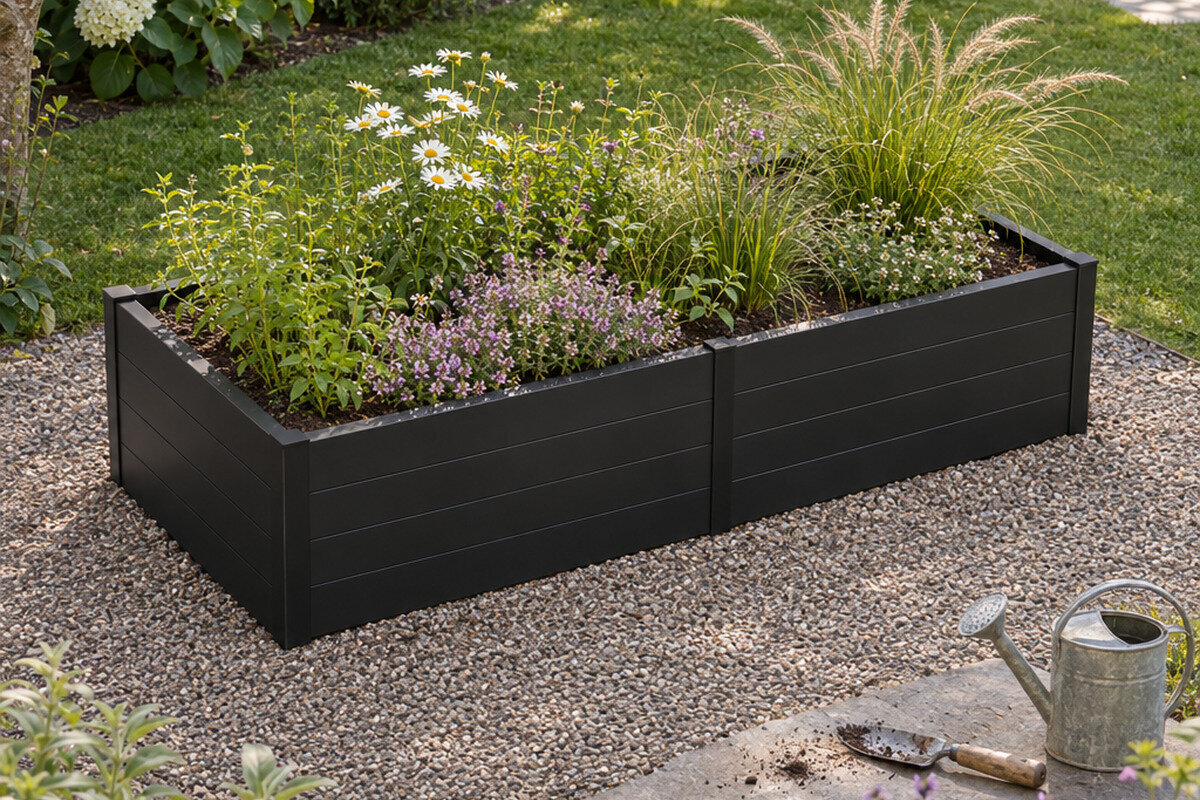
The Bloomcabin UK range discussed here provides planting frames: some have aluminium walls throughout, while the Accoya fusion example uses timber at the top of aluminium walls. The documented models have no floor panel and are supplied unassembled. They suit gardeners who have prepared ground and want to raise or organise their growing area. They are not documented as basins or as supports for water features.
If a fountain raised garden bed listing shows plants and moving water in the same picture, look for a parts list rather than relying on the image. The key distinction is whether the listing documents a combined unit or merely shows two things arranged together.
- For a planting-only purchase, check the frame, wall height, planting bays and base.
- For a separate fountain, check both footprints and leave a route to service the water feature without crossing the bed.
- For a combined product, ask for the parts list and instructions showing where the reservoir sits and which components are included.

02
Mark out the bed, the fountain and the paths
Draw the frame and fountain separately before committing to a site. If your fountain raised garden bed plan includes a standalone water feature, use that product’s stated dimensions and installation requirements. Mark its service side and the route you would use to reach it with tools. If you are working around an existing fountain, observe where water lands when it runs and whether the proposed route to the bed would stay usable.
Now mark the space you need to tend the planting. Stand where the path will be and test your reach at roughly the proposed working height. A wall or fountain on one side can turn a bed that looks accessible on paper into one you can tend only from the front. Keep feet out of the growing area to avoid compacting the soil. If you cannot comfortably reach the far edge from the available path, choose a narrower frame or move it.
Check the route for carrying fill and watering the bed, not just the space taken by the frame. For a fountain raised garden bed layout used from a seated position, test the approach and reach with the person who will garden there. A higher wall may bring the soil closer to hand, but it does not give a straight-sided frame the knee clearance of a suitable elevated planter.

03
Choose the width first, then the wall height
If your fountain raised garden bed search leads to a tight garden edge, compare the narrow Classic aluminium models first. The Narrow Aluminium Raised Bed 100×50×20cm and Narrow Aluminium Raised Bed 100×50×30cm each have one planting bay, a nominal footprint of 100 × 50 cm and a nominal planting area of 0.5 m². The wall heights are 20 cm and 30 cm respectively. These short strips are options to consider for herbs or salad leaves, depending on the site and the plants you choose.
The Narrow Aluminium Raised Bed 200×50×50cm and Narrow Aluminium Raised Bed 200×50×60cm double the nominal length without increasing the width. Each has a footprint of 200 × 50 cm and a nominal planting area of 1 m², with wall heights of 50 cm and 60 cm respectively. Both have one planting bay. Each long side uses two 100 cm wall sections joined by an aluminium T connector.
For a fountain raised garden bed plan, the footprint tells you how much nominal ground space to reserve, not how much soil to order. The wall height tells you the height of the frame, not where you will set the soil surface. Ask for the actual inside length and width if spacing is tight. For planting, consider both the planned fill depth and whether roots can use the ground below the open base. Do not treat that underlying ground as usable rooting space without checking its condition.

04
Use planting bays to shape the view, not to house the fountain
If the water feature is meant to be the focal point, decide whether the planting should run alongside it or frame the view. A single strip gives you one continuous planting area. The Tall Triple Aluminium Raised Bed instead has three nominal 100 × 100 cm bays in a 300 × 100 cm footprint. The left, centre and right wall heights are 80, 50 and 80 cm. If your fountain raised garden bed layout depends on keeping a clear view of the water, judge the height of the plants as well as the walls.
The Ascending Triple Accoya Raised Bed has the same nominal footprint and bay sizes, but its wall heights rise from 30 to 50 to 80 cm. The top 10 cm of each compartment uses Accoya boards above aluminium wall panels; the corner posts and T connectors are aluminium. Choose it if the stepped profile and timber band suit your design, not because you expect an all-wood frame.
The U-Shaped Aluminium Raised Bed 300×200×30cm fits five nominal 100 × 100 cm planting bays into a 300 × 200 cm footprint, with a nominal 100 × 100 cm access notch. All five bays have 30 cm walls. If you are considering this shape for a fountain raised garden bed, keep the notch available for tending the planting rather than counting it as a convenient space for the fountain. Check the real approach, including where you will stand to reach the rear bays.

05
Assemble the frame before filling and keep the installations separate
If you are setting up a fountain raised garden bed beside an existing feature, check the ground before unpacking the frame. Confirm that the proposed outline is on prepared ground and that the bed will not cover anything you need to inspect or service. Look at where water goes after rain or when the fountain is running. If the proposed planting area regularly receives runoff or collects standing water, address the site problem before filling the frame.
Read the instructions for the exact model. Lay out the panels, posts and any specified connectors, then follow the assembly sequence and site preparation requirements. Before filling, check that the frame sits as instructed, the bays and any access notch face the right way, and there is room to work around the bed. Do not carry over an anchoring method or a connector arrangement from a different model.
A fountain raised garden bed layout does not require the two items to share a structure. Follow the fountain’s own instructions for its base, servicing and any power requirements. The raised frames described here are not documented as waterproof or rated to carry fountain equipment. Do not drill the panels, hang equipment from them or use the frame to retain water without the manufacturer’s confirmation.

06
Buy fill for the planting space and water the crops independently
For a fountain raised garden bed on prepared ground, choose a peat-free growing medium labelled for the intended use and plants. Check what the product is meant to do: a material sold as a soil improver is not necessarily intended to be the whole fill. Where the ground below the frame is unsuitable for the roots of your chosen crop, reassess the available growing depth or select a different crop rather than relying on the open base to solve the problem.
Estimate fill from measured internal dimensions and planned fill depth. For a simple rectangular bay, multiply those three measurements in metres to get cubic metres, then multiply by 1,000 for litres. For a stepped or U-shaped layout, use the actual geometry and intended depth of each bay, or ask for model-specific guidance. The outside rectangle includes space that may not take fill, and the tallest wall does not set the depth of every bay.
Once the fountain raised garden bed is planted, use seed-packet directions and local UK growing guidance for sowing times, spacing and position. If water from the feature reaches one corner, do not use that corner to judge moisture across the whole bed. Check the growing medium where the plants are rooted, and water according to what you find. Raised soil can dry faster than soil at ground level, even when there is a fountain nearby.

07
Worked example: fit a planting strip beside an existing fountain
Hypothetical worked example: a gardener planning a fountain raised garden bed has a 220 × 80 cm strip of prepared ground beside a paved path. An existing fountain sits beyond one end and is serviced from another direction. The gardener has checked that splash does not reach the proposed bed or the working side of the path. They want a continuous planting strip for herbs and salad leaves, and can tend it from the path.
Both 200 × 50 cm narrow aluminium frames fit on nominal dimensions, leaving 20 cm of spare length and 30 cm of spare depth in total. Neither remainder is counted as a path. After testing their reach at both heights and checking the planned growing depth for their crops, the gardener chooses the 50 cm wall instead of the 60 cm wall. They do not need the extra height, and both frames offer the same nominal planting area. Before ordering, they confirm the actual fit and keep the fountain’s service route clear.
For the fill calculation, suppose the inside measures 1.90 × 0.45 m and the gardener plans a fill depth of 0.40 m. These are hypothetical measurements, not Bloomcabin specifications. The estimated volume is 1.90 × 0.45 × 0.40 = 0.342 m³, or 342 litres. The useful lesson for this fountain raised garden bed plan is that the outside space determines whether the frame fits, the inside space determines the fill estimate, and neither measurement tells you whether you can still service the fountain.

Questions readers ask
Does a fountain raised garden bed come with a pump?
The Bloomcabin frames described here have no documented pump or reservoir. If you find a listing that shows moving water, check its parts list and ask what comes with the exact model. A staged photo does not establish that a fountain is included.
Can I put a fountain raised garden bed on paving?
The Bloomcabin models covered here have no floor panel and are open to prepared ground. If paving is your only option, confirm whether the manufacturer supports that installation and how the base and drainage are meant to work. If you cannot confirm those details, choose a planter documented for the surface rather than improvising a floor.
Can I water vegetables with the fountain in a fountain raised garden bed?
Do not assume fountain water is suitable for edible crops or count it as irrigation. Use a separate watering supply for the bed unless the water system and its suitability for that purpose have been confirmed.
Buy the frame for the planting you want
Before buying a fountain raised garden bed, settle the water-feature question and check the exact model. For an open-base frame, confirm ground suitability, comfortable reach and actual planting dimensions before ordering fill. If the fountain is separate, keep its installation and servicing clear of the bed.
Find a raised bed for your plan
Compare layouts and check the dimensions on the product page.
