
Frost and Frozen Pergola Louvres: When Not to Operate the Roof
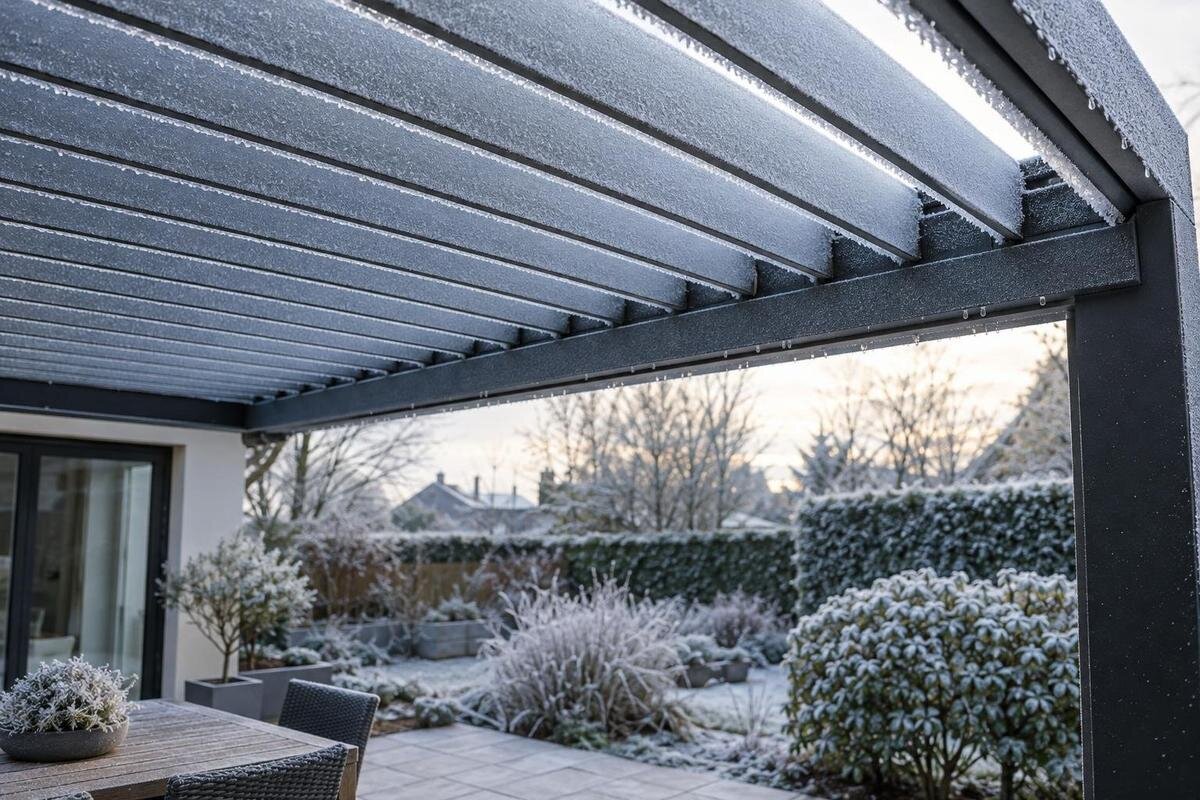
Pergola winter care
On a frosty morning, a louvred pergola roof may look ready to move while ice is still binding a pivot, linkage or water channel. If the blades hesitate, stop: repeated commands, pulling on a louvre or using an improvised manual release can turn a temporary freeze into a repair. The response should come from the instructions for the exact model and installed configuration, not from a rule borrowed from another roof. Leave the mechanism still, avoid testing it by force, and ask the manufacturer or a qualified service provider if the approved thaw or restart procedure is unclear.

01
How frost can bind louvres
Louvres do not move as isolated sheets: their travel depends on pivots and on whatever linkage or drive the model uses. Water left after rain, condensation, fog or thawing snow may freeze in a narrow clearance, bridge two adjoining surfaces or form around a pivot. Ice can also build at an edge where blades overlap. Even a thin bond may prevent movement that would feel free in warmer weather. The arrangement differs between roofs, so these are possible locations, not a map of every pergola. A white dusting on top is not the only concern; a joint can be iced even when the upper face looks mostly clear.
Freezing conditions can be patchy. One side may remain shaded while another receives winter sun; a surface can thaw, send water into a colder joint and then refreeze. Air temperature is therefore only part of the picture. A reading from a nearby weather station does not tell you whether ice remains in a particular roof joint, and sunshine on one blade does not establish the condition of the whole mechanism. This matters after a wet evening followed by overnight frost, as well as during a thaw interrupted by another cold spell. When comparing the Bloomcabin Bioclimatic Aluminum Pergola, ask for the winter operating guidance applicable to the proposed configuration. The product name alone does not establish a safe operating temperature or an ice limit. Look for instructions that distinguish cold-weather operation from the response to an already frozen mechanism: those are different situations, and permission to use a roof in cold weather is not permission to move seized parts.
Where ice can form
From a safe position on the ground, look for visible ice at blade edges, the ends of the roof, frame channels and any water outlet that is visible. These are examples, not a complete checklist: designs have different overlaps and drainage paths, and some parts cannot be inspected safely without access equipment. Do not stand on a chair, climb onto the structure or put a hand between blades to check whether a joint is free. A clear upper surface cannot rule out ice inside a pivot or behind an edge. Conversely, frost on a fixed frame may not be the part restricting movement. Treat what you can see as a clue, not a diagnosis.
The amount and location of moisture depend on exposure, shade and the roof’s surroundings. If a side screen, glazing or other enclosure is fitted, check guidance for that combination; an enclosure should not be assumed to prevent frost. Note where water was visible before freezing, whether one end stays shaded, and whether runoff from an adjoining structure reaches the pergola. These observations can help an installer identify what needs checking without you touching the mechanism. For a proposed Bloomcabin Lean-To Pergola, request a drainage diagram showing the intended route from the roof to the outlets. Ask the installer to explain how that route relates to the adjoining building and any enclosure options. Do not infer a drain position from a photograph or assume that a wet patch beneath the roof reveals where the blockage is. Water may have travelled before becoming visible.
02
Signs the roof should stay still
Visible ice on a louvre, pivot area or adjoining moving surface is a reason to postpone operation unless the manufacturer gives a specific procedure for those conditions. Other warning signs include blades that start and stop, uneven travel, a part that appears out of line, or movement that is slower or noisier than usual. A control that responds does not prove that the roof is free to move: the control and the mechanism are separate things. Do not use a brief test to decide whether the mechanism can overcome a suspected obstruction.
If the roof hesitates or stops part-way, stop rather than issuing another command to see whether it frees up. Note which area seemed affected, what the louvres did, and what the weather had been like. Separate what you observed from what you suspect: ‘one end stopped moving after overnight frost’ is more useful than diagnosing a failed drive without an inspection. Record whether rain or melting snow preceded the freeze and whether the unusual movement began immediately or after part of the normal travel. Do not recreate the fault to obtain a video. Use the precise name on your paperwork when reporting the symptoms; if yours is listed as Bloomcabin Pergola, include that name alongside any model reference or order number. Also mention whether this is the first occurrence or a repeat problem, so the service provider has a useful history rather than an isolated description.
What to do if the louvres stop moving
If you have already issued a command and the roof hesitates, stop using the controls. If the instructions describe a normal stop action for your controller, follow that procedure; do not try to reverse the movement to break the ice free. Keep people clear of the moving area, particularly beneath a partly open roof, and do not reach between the blades or into the frame. If the control does not respond as expected, do not keep pressing buttons or experiment with settings. The exact stopping and fault procedures depend on the installed system.
Leave the mechanism in place and make a note of the louvre position, the time, the weather and any sound or uneven movement. A photograph taken from a safe position may help explain what you saw, but do not climb or touch parts to get a closer view. If the installation has timers, sensors or another automatic control, consult its instructions for the approved way to prevent further movement commands while the problem is assessed. Do not alter wiring, disconnect components or experiment with control settings. If you cannot establish how to prevent another command safely, keep people clear and seek assistance. When contacting support about the bioclimatic pergola model, have the order details and controller information ready, together with any displayed message. Describe the roof’s current position so the provider can advise on the immediate situation. If the guide is missing or does not cover the fault, ask the manufacturer or a qualified service provider.

03
Why forcing or overriding the mechanism is risky
Ice acts as an obstruction, while the drive or linkage is designed to move parts through their intended travel. Pushing a blade or repeatedly commanding the drive may transfer force through connected components rather than clear the ice. That can strain or misalign a pivot, arm, gear or other part; the precise risk depends on the design. A mechanism that begins moving is not necessarily free of ice, either. It may travel unevenly or stop again as the obstruction shifts. Trying harder can turn a temporary weather problem into damage that needs inspection or repair.
Do not pull on individual louvres, insert a bar, loosen connections or use a manual release to overcome a frozen or seized mechanism. If a model provides a release for maintenance or loss of power, that does not make it a de-icing tool. A release may change how parts are restrained without removing the obstruction, so recognising a handle or release point is not enough to know that it is safe to use. Before buying the Lean-To Pergola model, ask which actions are intended for the owner and which require a service technician. In particular, establish whether any manual procedure is restricted to a freely moving roof and how the instructions identify those restrictions. Once parts have seized, leave them untouched rather than borrowing a procedure intended for another fault. Any subsequent intervention should follow the manufacturer’s guidance and be carried out by the appropriate person.
Thawing and restart conditions
Let the roof thaw naturally unless its instructions specify another method. Do not use a heat gun, open flame, hot water, salt, solvent, scraper or other de-icer unless that exact method is approved for the model. Heat and water can affect surfaces or seals, and water may run into a joint or channel and freeze again. Scraping can scratch a finish or catch on a moving edge. These methods can create a new problem without reaching ice hidden inside a pivot or linkage.
The disappearance of surface frost is not, by itself, proof that hidden ice has gone. Follow any thaw conditions, temperature limits or restart steps stated in the manufacturer’s instructions, rather than relying on a set number of hours or a guess based on the weather. Read the scope of each limit carefully: a statement about storage, materials or general outdoor use is not necessarily an operating limit for the moving roof. Similarly, an instruction to leave the mechanism still during freezing conditions does not explain how to restart after a fault. When requesting the user guide for the Bloomcabin Pergola model, ask where it addresses both situations. If the guidance does not say when operation may resume, seek clarification before testing. There is no useful universal waiting period to substitute for the condition of the actual mechanism and the instructions that apply to it.
04
Checks before using the roof again
Once the conditions in the instructions have been met, make a visual check from a safe position. Look for remaining ice or standing water, debris in a visible outlet, and any part that appears bent, shifted or out of place. Do not dismantle a cover, reach into a joint or inspect a drive by hand. If the manual identifies a user-accessible area for routine clearing, use only the method it describes. If anything looks damaged, or you cannot tell whether an obstruction remains, leave the roof still and arrange an inspection rather than using movement as a diagnostic test.
Resume operation only in the manner and conditions the manufacturer specifies. Keep clear of the travel area and watch for the expected movement from a safe position; do not cycle the louvres repeatedly to build confidence that they are free. If they hesitate, travel unevenly or make an unfamiliar sound, stop and follow the fault guidance. A recurring problem after thawing needs assessment rather than an assumption that every interruption is caused by frost. Tell the service provider whether anyone previously pushed a blade, used a release or attempted to remove ice, even if no damage was visible at the time. That history may affect what needs inspecting. For a service enquiry concerning Bloomcabin’s bioclimatic pergola, include the installed options and your earlier observations. Ask whether an inspection is required before further use and what confirmation you should receive after any repair or adjustment.
Snow, meltwater and drainage need separate checks
Snow on a roof raises a different question from ice binding a pivot: the permitted snow conditions and louvre position are model-specific. Do not assume that opening or closing the blades will make a frozen roof safe, and do not move them to shake snow off. Avoid climbing onto the structure or removing snow unless the manufacturer gives a safe, model-specific method. There is no universal snow or watertightness guarantee that applies to every louvred pergola, so use the stated limits for your exact roof rather than treating general winter advice as a rating.
When snow or frost melts, water needs to follow the route intended for that installation. Ice or debris may obstruct a channel or outlet, but forcing the louvres is not a way to clear it. Do not poke into a drain or pour water into the roof to test it unless the instructions say to do so. Use the drainage diagram and the approved maintenance method, if one is provided. For the Bloomcabin Lean-To Pergola drainage documents, ask the supplier to identify the relevant diagram and distinguish owner-accessible clearing points from concealed components requiring service. From the ground, note whether meltwater appears at the expected outlet or emerges elsewhere; do not dismantle anything to trace it. Keep people away from slippery patches or falling ice beneath the roof. Report unusual water escape separately from the movement fault, since restoring louvre travel does not establish that drainage is clear.

05
Prepare the pergola before the first frost
Before cold weather, keep the operating instructions somewhere accessible and record the exact model, control type and any fitted options. Find the sections covering frost or ice, operating limits, stopping the roof, restart conditions and fault reporting. If they do not address freezing, ask the supplier or manufacturer what to do before the next cold spell. A general guide for louvred roofs cannot fill in a model-specific limit or procedure. Keeping the documents together also makes it easier to give accurate information if the roof needs attention.
Follow the manufacturer’s routine maintenance guidance for visible drainage points and moving parts. Clear leaves or other debris only where the instructions identify a user-accessible area and give a suitable method. Do not add lubricant, adjust a linkage or apply a coating unless the exact instructions call for it. If screens, glazing or another enclosure form part of the installation, confirm that the combination is approved and find any separate winter-use guidance. An enclosure may change the surroundings of the roof, but it is not proof that the louvres are protected from ice.
What to confirm before buying a louvred pergola
Ask for the operating instructions for the exact model and configuration you are considering, not just a general product description. Find out whether they set conditions for operating in frost, what to do if ice forms, how to stop a roof that hesitates and when it may be restarted. Ask for the stated snow limits and the permitted response to snow as well. These answers help distinguish an actual operating procedure from a broad description of weather performance. Do not assume that two roofs with louvres have the same drive, clearances or winter instructions.
Also request the drainage diagram and guidance on routine clearing, fault reporting and service. If you plan to add side screens, glazing or another enclosure, confirm that the proposed combination is suitable for the model and ask whether it changes the operating or maintenance instructions. Make sure the response explains what you should not do as well as the approved steps: whether to leave the roof still, which controls to use, and when to call for help. Clear written guidance is more useful in a frost event than an assumption based on appearance or a generic claim about an outdoor roof.
Frequently asked questions
Can I operate the roof as soon as the visible frost has gone?
Not necessarily. Ice may remain in a shaded pivot, linkage or other part you cannot see. Follow the thaw and restart conditions in the instructions for your exact model; a clear surface alone does not confirm that the mechanism is free.
Can I pour warm water over a frozen louvre?
Do not do this unless the manufacturer explicitly approves it for your model. Water can run into joints or channels and freeze again, while heat or chemicals may affect surfaces and seals. Use only the specified thawing method.
What if I can hear the drive but the louvres do not move?
Stop using the controls and do not keep trying, reverse repeatedly or move the blades by hand. Record what happened and follow the fault guidance for the model. If it does not give a clear response, contact the supplier or a qualified service provider.
Should the louvres be left open or closed before frost?
There is no position that is right for every model and weather condition. Check the manufacturer’s instructions for frost, snow and drainage, and do not try to change the position if the mechanism may already be frozen.
Can I scrape off ice or use a de-icer?
Only use a product or method if the instructions for your exact pergola approve it. Scraping, salt, solvents and unapproved de-icers can damage surfaces or seals, and physical force can transfer strain to the moving parts.
Treat suspected ice as a reason to leave the louvres still, not as an obstacle to test with extra force. Let the instructions for the exact pergola set the thaw and restart conditions; if movement remains hesitant afterwards, treat it as a service issue rather than pushing harder.
