
Galvanized garden boxes: how to tell if they suit your site

Bloomcabin · Raised-bed guides
Galvanized garden boxes: how to tell if they suit your site
Galvanized garden boxes can be a good choice when the maker documents the intended planting use and the base suits the site. For vegetables or herbs, look for written confirmation for the exact model. For paving, check whether the box has a floor and where its outlets drain.
Check the intended use
Buy galvanized garden boxes for food growing only when the maker documents that use for the exact model.
Read beyond the finish
Ask for the steel grade, coating details, panel thickness and specified fixings before comparing kits.
Check the underside
An open-bottom frame and a drained planter can look alike but need different sites.
Protect the coating
Use the maker’s assembly and care instructions, especially if a panel arrives damaged.
Two galvanized garden boxes can look nearly identical in a listing, yet one may be an open frame for prepared ground and the other a planter built to contain soil on paving. The finish tells you something about the material, but it tells you little about what sits underneath, how the panels go together or whether the maker supports growing food in it.
Start with the product sheet and assembly manual, then check the box against the place you intend to use it. This guide shows what to look for in those documents, which measurements to take yourself and when a missing answer is a reason to choose a different model.
01
Check what the coating label actually tells you
Most listings for galvanized garden boxes use the term to describe steel with a zinc coating. The coating helps protect the underlying steel from corrosion, but the name does not tell you how the coating was applied, what finish is on the soil-facing side or how the maker expects you to care for it. A photograph of a shiny panel cannot answer those questions, and a broad claim such as ‘weather resistant’ does not confirm what the box is intended to hold.
Ask for a specification and instructions that name the exact model, including the version or finish if there is a choice. Check whether the maker describes it as a soil-filled planter rather than a decorative outer container. For herbs, salad leaves or other edible crops, look for explicit written confirmation of that use and any restrictions. A statement about the sheet material alone does not tell you whether the assembled box, with its other finishes and fittings, is intended for the same job.
Second-hand galvanized garden boxes need a different check. As well as identifying the original product, ask what it previously held and whether it has been painted, patched or altered. If you cannot establish its history or the composition of a repair, leave it off an edible-growing shortlist. A clean appearance does not fill either gap.
It helps to record two separate answers when you compare galvanized garden boxes: ‘What is it made from?’ and ‘What does the maker say I can use it for?’ A clear answer to one is not a substitute for the other.

02
Compare galvanized garden boxes panel by panel
When two galvanized garden boxes are sold at the same size, the panel construction can still differ. Compare the drawings as well as the headline dimensions. Check whether a long side is made from one panel or several, how the joints are supported and how the top edge is finished where you will reach over it. If you will assemble the box in a confined spot, check whether you need access to both sides of a fixing before choosing the position.
Panel thickness is useful for comparing specifications, but it does not give you a safe fill height or load rating. Follow the maker’s limits for that configuration. If the manual shows a support at a particular position, do not omit it to make room for a plant or because the empty panel looks firm. Check with the maker before using a different layout from the one shown.
If a listing for galvanized garden boxes describes more than one configuration, check which panels and fittings come with the exact option you are buying. If all you have is a product photo, ask for the parts list and assembly drawing before you order. Those documents are more useful than a picture for spotting a join in the middle of a long side or finding out whether there is a floor.
- Ask for the steel grade, galvanising method or coating designation, and any additional finish on either face.
- Find out whether the stated thickness refers to the steel sheet or the finished panel. Compare like with like.
- Check the supplied fasteners and any joins or supports shown in the model’s parts list. Ask what replacements the maker permits.

03
Measure the space you can plant and reach
The footprint of galvanized garden boxes tells you how much space to reserve, not necessarily how much soil surface you can plant. Check whether the listed measurements are nominal and ask for actual outside measurements if the fit is tight. A projecting rim can matter beside a gate, while an internal support can matter when you lay out rows. Ask for the clear internal dimensions rather than using the listed outside width for both decisions.
Mark the outside corners and the space you need to work with tape or string. Try opening any nearby gate and reaching across the marked width from the side you will actually use. Keep a separate route beside the box so you do not need to step into the growing area to reach the middle. If you garden seated, try the reach at the intended working height as well. Straight sides alone do not mean you can get close enough to work comfortably.
For galvanized garden boxes with a floor, ask how far the intended fill line sits above it. The wall height is not the usable growing depth if part of it is taken up by the base or headroom. For an open-bottom frame, check whether the ground beneath it is suitable for roots and how the maker says to prepare it. The soil below only adds rooting space if roots can actually grow into it. Match the usable depth to your intended crops rather than choosing by the height in the listing.

04
Catch assembly problems before the soil goes in
Before assembling galvanized garden boxes, read the instructions for the exact model and check which surface it is designed to stand on. Lay out the parts where you can identify them without dragging the panels across paving. Against the parts list, check the panels, fixings and any supports supplied. Look at the edges and corners while the panels are still easy to handle. If you find a sharp burr, damage to the coating or a distorted joint, ask the supplier what to do before putting the kit together.
Follow the specified order for joining panels and tightening fixings. If a hole does not line up, first check the orientation of both pieces and the assembly sequence. Do not enlarge it, force the joint or reach for a spare screw of similar size. The correct fixing and the way it sits against the panel are part of the design. If you cannot identify a part from the drawing, send the supplier a photo of the joint and the model details.
Inspect galvanized garden boxes before filling, while the inside faces and fixings are still visible. Check that the completed base and wall arrangement match the manual, that any specified supports are fitted and that drainage openings have not been obstructed during installation. If the box rocks or a joint will not close as shown, resolve it while the box is empty. Filling it is not a way to settle an assembly fault.

05
Trace the drainage route before choosing a base
For open-bottom galvanized garden boxes, the ground is part of the drainage arrangement. Check the maker’s preparation instructions and look at what happens at the site after rain. If water regularly sits where the frame will go, do not assume the walls will solve the problem. Likewise, placing an open frame on paving does not give it a floor that contains the growing medium. Choose a model designed for that setting rather than trying to turn the frame into a container.
For galvanized garden boxes with a floor, find out where the designed outlets discharge and whether you can keep them clear after installation. On paving, trace the water’s route before you settle on the position. An outlet may be easy to reach in a drawing but inaccessible against a wall, or discharge directly across a path. If the manual calls for clearance underneath or at the side, allow for it in your measurements. Do not drill extra holes or fit a liner without the maker’s approval; a liner can cover the very outlets you need.
Choose a peat-free growing medium suited to the crops and to the type of box. Look for guidance on the bag about its intended use rather than treating a drained container and a bed open to soil as interchangeable. Plan how you will get water to the box and check the medium as conditions change: raised soil can dry faster, but that is a reason to monitor it, not to water to a fixed timetable.

06
Know what to do if the coating or fixings are damaged
Keep the product specification and care instructions for your galvanized garden boxes. When you clear the box between crops or move something beside it, take the opportunity to check the exposed rim, joins and area around the outlets. Follow the maker’s inspection and cleaning guidance. If you find a loose fixing, a bowed panel or a new sharp edge, ask about the cause and the approved remedy rather than covering it up or trying to straighten the panel while it is loaded.
A damaged finish on galvanized garden boxes needs a model-specific answer. Note where the damage is, including whether it is on the face that touches the growing medium, and send a clear photo with the model and finish details. Ask whether the maker recommends leaving it, repairing it with an identified product or replacing the part. For an edible planting box, check that any proposed repair is compatible with that use. Do not assume a generic touch-up paint is suitable just because it is sold for metal.
When comparing options, give some weight to what happens after purchase. A seller who can identify a replacement fixing or explain how to deal with a damaged edge gives you something practical to act on. That is not a promise of longer service life. It means you are less likely to have to guess which parts or treatments belong on the box you own.

07
Worked example: two boxes fit the patio, but only one stays on the shortlist
Hypothetical worked example: Priya is comparing galvanized garden boxes for salad leaves on a paved strip 155 cm long and 110 cm wide. She wants to reach it from the front and has allowed a 10 cm gap behind it for her own access to an outlet, subject to the maker’s requirements. One candidate has assumed outside dimensions of 120 × 45 cm and walls 30 cm high. Placed lengthways, it leaves 35 cm spare along the length and 55 cm in front: 110 − 45 − 10 = 55 cm. Those are planning gaps, not proof that the position works. Priya tries the front gap with her watering can and checks she can still reach the outlet from the end.
Two listings for galvanized garden boxes could fit that same sketch. The first is an open-bottom frame specified for prepared ground, so Priya rules it out for this installation. The second has a floor and an outlet, and its maker documents use on paving and for edible crops. It stays on the shortlist while she checks the specified fill depth against her seed-packet guidance, confirms the site can take the filled planter and makes sure the drainage route stays off the walking line.
For contrast, Bloomcabin’s Narrow Aluminium Raised Bed 100×50×30cm has aluminium wall panels and corner posts, a nominal footprint of 100 × 50 cm and 30 cm walls. It is supplied unassembled and has no floor; it is open to prepared ground. It illustrates why a compact footprint doesn’t make a frame a patio container. If Priya moved the project to a suitable soil strip, this aluminium model would be a separate option to assess, not a galvanised version of the patio box.

Questions readers ask
Are galvanized garden boxes suitable for growing vegetables?
Choose a model whose maker explicitly lists it for growing edible crops and follow any conditions on use. A listing that says only ‘outdoor planter’ leaves that question unanswered. If the seller offers an assurance by email, ask them to identify the exact model and point you to the relevant product information.
Can galvanized garden boxes go on paving?
Only choose a model for paving if the maker supports that installation and explains how to contain the growing medium and drain excess water. Check the route the water will take and whether the site can support the filled planter. A box-shaped frame with no floor is not the same product as a patio planter.
Are the Bloomcabin examples galvanized garden boxes?
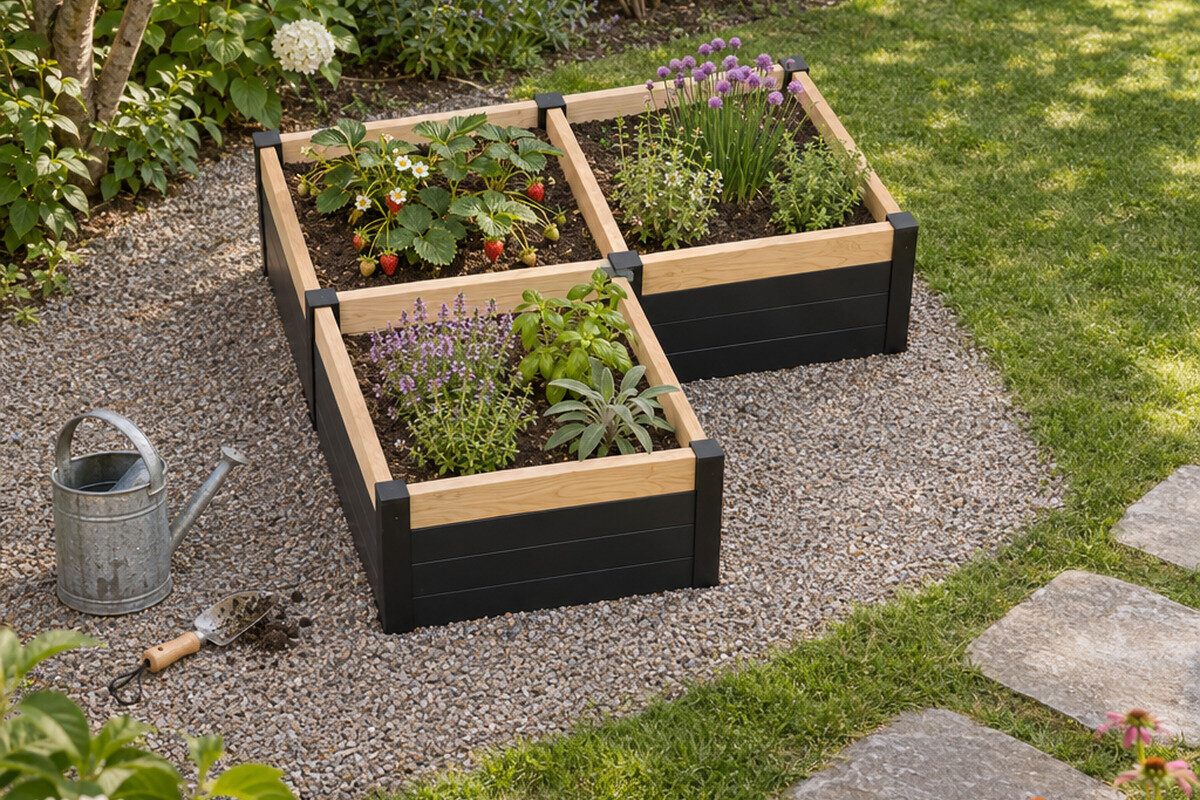
No. The Bloomcabin examples shown here are described as Classic aluminium or Accoya fusion. The fusion model uses aluminium panels below Accoya boards at the top of each compartment. Neither construction should be treated as evidence about the coating or care of a galvanised steel box.
Make the decision before you fill the box
Shortlist galvanized garden boxes only when the specification, instructions and site agree. If you cannot confirm the intended use, how the base drains or what to do about a damaged panel, ask before ordering or filling. It is much easier to change the model or location while the box is still empty.
Find a raised bed for your plan
Compare layouts and check the dimensions on the product page.
