
Garden bed with legs: how to choose, set up and use one

Bloomcabin · Raised-bed guides
Garden bed with legs: how to choose, set up and use one
Choose a garden bed with legs that you can reach comfortably, with enough usable depth for your crops and a clear route for excess water. Before buying or filling it, verify the exact model’s wet-load limit and check that the intended surface can support it.
Check the underside
A garden bed with legs needs a supported planting tray, not just tall walls.
Try the working position
Measure to the planned compost surface and try reaching the far side.
Measure root space
Match crops to usable depth below the fill line, not the advertised height.
Verify both limits
Confirm the planter’s wet-load limit and the site’s ability to support it separately.
If you want to grow salads or herbs on a patio without working at ground level, a garden bed with legs gives you a raised planting surface. But the model that looks right in a photo may be too wide to reach from one side, too shallow for your chosen crops or unsuitable for the spot where you want to put it.
Start with the person using the bed and the crops they want to grow. Then check the footprint, the drain outlet and the load before you order. That sequence makes it easier to rule out a poor fit while it is still a listing, rather than after you have assembled it and opened the compost.
01
Check what actually holds the compost above ground
A garden bed with legs has a planting tray or box that carries its contents above ground. A tall, open-bottom raised bed instead contains growing medium at ground level. For a patio installation, look at the underside in the assembly drawing: identify what holds the roots and wet compost, what supports the tray and where excess water leaves. A front-on photograph will not necessarily answer any of those questions.
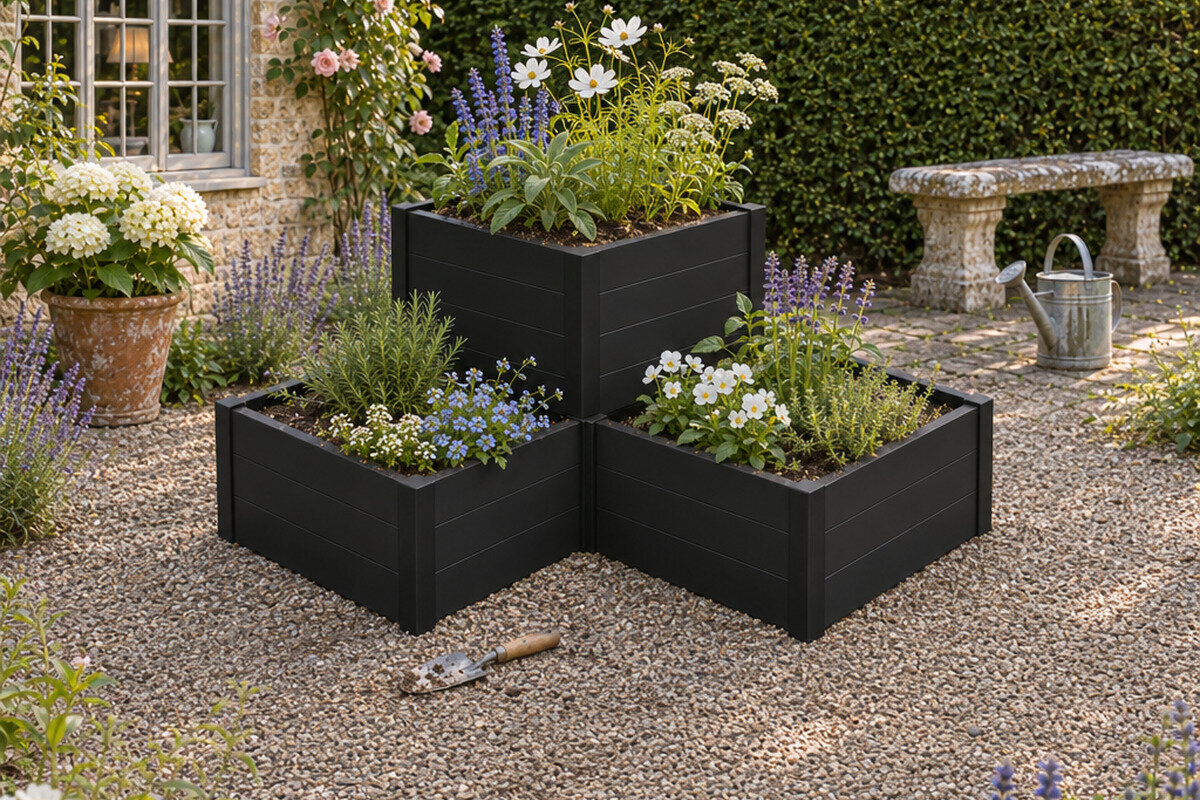
If you are comparing a garden bed with legs with the Bloomcabin raised-bed range shown here, treat the illustrated frames as ground-based alternatives. For example, the Narrow Aluminium Raised Bed 200×50×60cm is open to prepared ground and has no floor panel. Its 60 cm measurement is the wall height, not clearance underneath. It is a comparison for a ground-level growing strip, not a substitute for a supported tray on a patio.
When comparing timber and metal planters sold for outdoor use, look beyond the material named in the listing. Check what the floor and legs are made from, which maintenance the maker specifies, and whether a liner is required or supplied. For any garden bed with legs, ask for the assembly manual and load specification for the exact model. A specification for a similar-looking size or finish is not enough.

02
Try the height and reach before you buy
Measure a garden bed with legs against the job you will do most often, whether that is sowing, picking leaves or watering. Check both the height of the rim, which your arm must clear, and the height of the planned growing surface, which is where your hands will work. If the seller gives only overall height, ask where the recommended fill line sits below the rim.
Mark the footprint with tape and use a table or other stable surface to simulate the working height. Try reaching the far corner from the side you will actually use. If the back of a garden bed with legs will sit against a wall, it is no help that you could reach the middle from the back in a showroom. Compare a narrower tray or leave a usable path behind it rather than relying on leaning against the frame.
For a garden bed with legs intended for seated use, check the clearance to the lowest part of the tray or brace, the space between the legs and the room needed to approach and turn. An open-looking front does not guarantee knee clearance. Leave a firm access route and check that watering is practical from the planned working position. Keep the growing area within reach from the paths so there is no need to step into the bed.

03
Match the tray’s usable depth to the crops
The useful rooting depth of a garden bed with legs is the depth of growing medium between the planting surface and the inside floor, or above any false floor or insert required by the design. The air gap under the tray adds nothing to it. Ask for the internal dimensions and recommended fill level. External length and width help you judge the fit on the patio; internal length and width tell you how much planting space you have.
For a first planting, you might shortlist leaf lettuce and herbs, then check the seed packet and local growing guidance for the exact varieties, including spacing, sowing time, light and depth. Do not assume that a tray that suits your salad crop will also suit a long-rooted carrot. Mark out the mature spacing using the internal dimensions, and put crops you harvest often within your easiest reach.
If your preferred crop needs more depth than the garden bed with legs provides, choose a deeper model with a documented load limit or grow that crop elsewhere. Filling above the recommended line is not a workaround. Choose a peat-free growing medium labelled for the intended plants and container use, then check the bag or technical sheet for filling and watering instructions. A product described as natural is not necessarily peat-free.

04
Check the footing, drainage route and supporting surface
Mark the positions of the feet as well as the tray outline. For a garden bed with legs on paving, look for a firm position where the feet can bear as the instructions require. Watch for rocking slabs, joints under feet and changes in level across the footprint. A wobble in the empty frame is a reason to stop and resolve the footing or assembly, not something to settle by adding compost.
Ask where water exits a garden bed with legs and what clearance the outlet needs. Check where it will go after it leaves: a drain directly above a foot, a puddle across the approach or runoff towards a doorway can make an otherwise convenient spot unsuitable. Use only liners, fittings or collection arrangements that the manufacturer allows, and keep the specified outlets clear. Do not drill extra holes or plug existing ones to make the location work.
When a garden bed with legs is going on a deck, balcony or other suspended surface, check the supporting structure separately from the planter. Give a qualified person the proposed installed weight, the leg positions and the intended location. An average load calculated across the whole tray does not describe the load applied at the feet. If you cannot confirm the site’s suitability, choose a different location rather than assuming the bed’s rating covers the surface.

05
Get a written load limit and compare like with like
Before you order a garden bed with legs, get written confirmation of the applicable load limit for the complete assembled model. Ask whether it is a maximum contents load or a maximum total weight, whether it assumes an even fill, and what installation conditions apply. If the limit is stated only as a volume of compost, ask what medium and wet weight it allows. Litres tell you how much space there is to fill, not how many kilograms the frame can carry.
Make a load list for the garden bed with legs: growing medium at the relevant wet condition, plants, any retained water not already counted, and any approved accessories carried by the frame. Check the medium supplier’s data for a wet weight or wet bulk density applicable to the intended use. Do not use the weight of a dry bag as the working load. Include the empty planter when calculating the total weight on the supporting surface; for the frame comparison, use the manufacturer’s definition of its limit.
If you cannot confirm the relevant wet-weight figure or the meaning of the rating, do not fill. Ask the manufacturer for an approved medium and fill level, or choose a model with specifications you can check. Side panels that feel rigid or a tray that holds a few bags while dry do not verify the assembled bed’s capacity.

06
Worked decision: when the tray fits but the load does not
Hypothetical example: you want to grow leaf lettuce on a paved patio in a garden bed with legs. Assume the tray is rectangular inside, with straight sides measuring 100 cm by 40 cm and a permitted fill depth of 20 cm. The volume at the fill line is 100 × 40 × 20 = 80,000 cubic centimetres, or 80 litres. You have checked that the planned variety fits the usable depth and spacing, and that you can reach the back from the front.
Assume the manual for this hypothetical garden bed with legs gives a maximum evenly distributed contents load of 75 kg, excluding the empty frame. Suppose the selected medium’s data give a wet bulk density of 0.9 kg per litre for the relevant condition. The 80 litres would then weigh 72 kg. Allow another 4 kg for plants and approved accessories, with no separate water reservoir. That makes 76 kg of contents, which exceeds the limit by 1 kg. If the empty bed weighs 14 kg, the total on the patio would be 90 kg.
The decision is not to fill this model as planned, even if the paving can take the total weight. Check whether the maker approves a lighter medium that still suits the crop, or choose another planter and repeat the figures for that exact model. Simply cutting the fill depth could solve the weight problem but leave too little root space. These are example figures, not ratings for any illustrated product.

07
Set up empty, then check again as you fill and water
Assemble the garden bed with legs in its intended location, using the specified parts and sequence. Before filling, check that the floor is seated correctly, fixings and braces are in place, and each foot bears as intended. Stop if the frame rocks or parts do not align; do not substitute fixings, add improvised packing or make alterations to force it to fit. With the drainage components fitted, check that the outlets are unobstructed.
Fill the garden bed with legs evenly to the approved level and plant at the spacing you planned. Watch where the water goes during the first watering. If it backs up, crosses the path or pools around a foot, address the drainage before continuing. If a foot settles or the frame twists as you fill, stop adding weight and seek the maker’s guidance. An uneventful first fill is not proof that the published limit can be exceeded.
Check moisture in the growing medium rather than following a fixed watering timetable. Raised growing areas can dry quickly; base watering on the crop, the weather and what you find below the surface. As the season goes on, keep drainage outlets clear and recheck the feet and joints when you notice a change in level or movement. Before adding a crop support or other accessory, check compatibility and include its weight in the load calculation.

Questions readers ask
Can I put a garden bed with legs on decking or a balcony?
Only if the manufacturer allows that type of installation and someone qualified to assess the structure confirms it can take the total wet weight at the proposed foot positions. Check both before buying. The planter’s rating alone says nothing about the capacity of the deck or balcony.
Should I add gravel to improve drainage?
Do not add it by default. Gravel takes up planting depth and adds weight. Follow the planter’s instructions for the floor, liner and outlets, and check that water can leave the tray and flow away from the feet and access route.
Can I move a garden bed with legs after filling it?
Do not assume so. Check whether the manufacturer permits movement under load and what procedure it specifies. If there is no approved method for moving it filled, empty it first and follow the handling instructions. Recheck the footing, access and drainage at the new site.
Make the decision before the compost arrives
Buy a garden bed with legs only when the working position, crop depth, drainage and verified load all suit the same spot. If a seller cannot confirm a dimension or a load limit you need, hold off rather than planning to find out once the tray is full.
Find a raised bed for your plan
Compare layouts and check the dimensions on the product page.
