
Greenhouse grow lights: When you need them—and how to use them
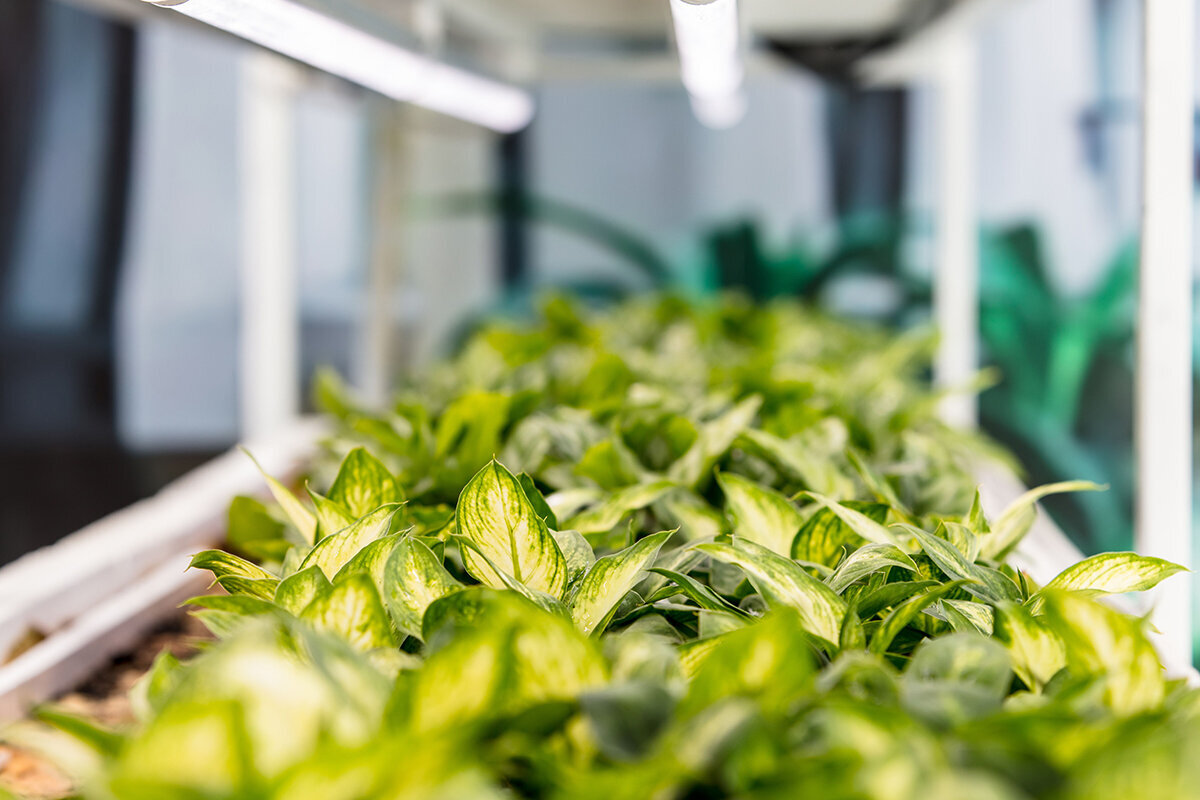
Bloomcabin field guide / measured light
Greenhouse grow lights:
When you need them—and how to use them
A greenhouse already gathers daylight. Supplementary lighting earns its place only when British winter, cloud, glazing or an ambitious crop calendar leaves plants measurably short of useful light.
For serious home gardeners across the United KingdomNatural dawn first. Supplementary light only where it matters.
01 / Begin with the question
Do your plants actually need more light?
The most useful grow light is not the brightest fitting. It solves a specific limitation without creating another problem involving heat, humidity, electricity use or plant timing.
A greenhouse improves the growing environment, but it does not manufacture daylight. In the United Kingdom, the quietest growing months combine short days, low sun angles and frequent cloud. Trees, neighbouring buildings, roof bars, dirty glazing, condensation and winter bubble insulation can reduce the usable light reaching leaves still further. Conversely, a clear greenhouse can receive ample sun in late spring and summer, when shading and ventilation may become more important than lighting. A structure that appears bright to us may nevertheless be too dim for early tomato plants or a closely spaced seedling bench.
Before buying equipment, observe the crop and separate insufficient light from other constraints. Light-starved seedlings may lean towards the clearest glazing, develop long internodes and produce pale, sparse growth. However, weak plants may also be too cold, crowded, wet, root-bound or underfed. Inspect the warmest and coldest parts of the greenhouse, check compost moisture below the surface and consider the sowing date. Adding a lamp above roots standing in cold, saturated compost is not a correction; it merely introduces cost, heat and another variable.
Start with a straightforward audit. Clean the glazing inside and out, clear gutters, remove avoidable shade and watch where structural shadows cross the staging on bright and overcast days. Check that temperature and airflow allow the crop to use extra energy. Around the December solstice, daylight is approximately seven and a half hours in London and six and a half in Edinburgh, but latitude alone does not trigger a need for LEDs. Local weather, orientation, glazing, crop stage and the outcome you want determine whether supplementary light has value.
“A greenhouse is not an indoor farm behind glass. Treat sunlight as the principal material and electricity as the finishing tool.”
Likely a light deficit Leggy seedlings, uneven growth below framing, slow winter salads or a crop programme beginning before natural daylight strengthens.
Check another cause first Cold compost, stagnant humid air, nutrient imbalance, root stress, crowding, pests or a variety poorly suited to the season.
Lighting may be optional Dormant overwintering plants or seasonal crops growing compactly and evenly in a clean, bright greenhouse.
Lighting is strategic Early seedling benches, propagation, winter salad leaves and demanding crops for which dependable timing has genuine value.
For a greenhouse organised around daylight, begin with orientation, unobstructed glazing, roof ventilation and adaptable shading. The Classic Aluminium Greenhouse provides a bright, composed foundation for this approach. A targeted shelf or securely mounted fitting can be incorporated into the working layout rather than improvised above plants. Lighting belongs within the complete growing system; it should never substitute for sound structure, ventilation and crop care.
02 / Vocabulary for clearer lighting decisions
Intensity × time = the light your crop receives
PPFD × hours
= DLI
= DLI
Plant-light marketing can make a simple relationship seem unnecessarily mysterious.PPFD describes the photosynthetic photons arriving at the crop canopy at a particular moment.DLI, or daily light integral, describes the total photosynthetic light accumulated over 24 hours, including daylight and supplementary electric light.
In practical terms, modest intensity delivered for an appropriate longer period can make a meaningful contribution, while a powerful lamp used briefly may produce a bright central patch rather than an even crop. Calculate fixture DLI as PPFD × 3,600 × lit hours ÷ 1,000,000. It is a planning tool, not a reason to run lights continuously.
- PAR
- The range of light generally measured for photosynthesis. It is more relevant to crop lighting than how bright a lamp looks to human eyes.
- PPF
- The total photosynthetic photon output leaving a fitting. Useful for comparison, but it does not show what reaches individual leaves.
- PPFD
- Photosynthetic photon flux density at the canopy, measured in µmol/m²/s. It varies with mounting height, beam spread and position across the bench.
- Photoperiod
- The daily duration of light and darkness. It can affect flowering independently of the total quantity of light the plant receives.
- Lumens and watts
- Lumens describe brightness for human vision; watts describe electrical input. Neither alone defines horticultural intensity at leaf level.
Illustrative supplementary DLI accumulation
100 × 10 h
3.6 mol/day
200 × 8 h
5.76 mol/day
300 × 12 h
12.96 mol/day
These are arithmetic examples, not crop prescriptions. Suitable DLI varies with species, cultivar, maturity, temperature and the quality or timing sought. The figures also represent only the fitting at its stated measurement point; natural daylight adds to the total. Begin with crop-specific guidance, then assess what your own greenhouse supplies before deciding how much electric light to add.
03 / Choose a form before chasing specifications
Select the fitting that suits the bench—not the boldest claim.
For most domestic greenhouses, horticultural LEDs provide a practical starting point. They are available in useful formats, and some systems offer efficient operation and dimming. A balanced white fitting is also comfortable to work beneath and allows easier inspection for pests, disease and changes in leaf colour. Whatever the spectrum, request evidence about canopy coverage, heat management and suitability for greenhouse conditions rather than relying on packaging language.
Propagation bars
Best above a narrow shelf, seed-tray area or compact propagation bench where the fitting can remain relatively close to small plants. Their shallow footprint favours controlled, local coverage over a broad, high-output canopy.
Ask for: canopy PPFD at the intended height, fitting dimensions, appropriate ingress protection and a secure way to raise the unit as seedlings grow.
Linear top lights
Useful above longer benches and orderly rows of leafy crops. Several bars can overlap to reduce bright centres and weak edges. This format suits a greenhouse in which uniform coverage matters as much as headline output.
Ask for: a credible PPFD map, recommended spacing, driver position, dimming compatibility, fitting efficiency and total electrical input.
High-output fittings
Appropriate for a defined high-light crop, a deeper canopy or meaningful winter supplementation across a larger area. More output demands closer attention to supporting structure, heat, glare, ventilation, wiring and edge fall-off.
Ask for: measured PPFD maps, electrical requirements, environmental rating, clearances, warranty conditions, installation instructions and heat-management guidance.
Do not buy by wattage alone. A fitting with a given electrical draw may perform well or poorly depending on its efficiency, optics, coverage area, mounting height and driver losses. Fixture-level PPF is likewise only a starting figure. The useful purchasing question is:what PPFD will the plants receive across this exact bench at this exact distance?
Keep the greenhouse adaptable. A dedicated propagation bench may justify a close-range fitting each spring while the remainder of the structure stays naturally lit. When planning how the growing area will develop, consider the layout possibilities of the Classic Aluminium Greenhouse as a foundation for integrating staging, timers, ventilation, irrigation and targeted lighting without allowing later additions to become a tangle of equipment.
04 / Mount for today’s canopy, not yesterday’s seedlings
Height changes the footprint.
Uniformity changes the result.
Raising a fitting generally spreads light over a larger area but reduces intensity at the canopy. Lowering it increases intensity directly beneath the source and can create a hot, narrow centre. The useful mounting distance is therefore a changing relationship between the fitting’s optics, bench width, crop density and the current height of the leaves.
Centre Strongest zone
Edges Lower output
Overlap Smoother coverage
Canopy Reset height
Use the manufacturer’s specified hanging range as the starting point, then verify distribution with an appropriate PAR meter or suitable borrowed sensor where possible. Take readings at the centre, halfway towards each edge and at the darkest expected position—not solely beneath the brightest point. A simple nine-point map across the bench is more revealing than one impressive measurement. If coverage is markedly uneven, raise the fitting slightly, improve overlap between units, narrow the growing zone or reduce plant density before extending operating hours. Remember that daylight contributes differently across the same area.
Seedlings require particular care. Light must be close and even enough to discourage stretching, but not so intense that upper leaves bleach, curl or stall. An adjustable hanging system makes measured corrections easier as plants rise. Recheck the distance after potting on and following any growth spurt. The installation manual governs the fitting; observed crop response informs the final adjustment.
05 / Timing is horticultural, not merely mechanical
Extend the day carefully. Protect the night deliberately.
Plants experience a 24-hour rhythm. Supplementary lighting can add photosynthetic energy, but it may also alter flowering if darkness is extended, shortened or interrupted without understanding the crop.
Seedlings
Leafy crops
Flower-sensitive
Seedlings: favour a consistent day followed by genuine darkness.
Leafy crops: supplement the dull period instead of lighting by habit.
Flowering crops: confirm photoperiod response before altering darkness.
Navy represents darkness, wheat natural daylight and amber supplementary periods. These are visual principles, not universal timer prescriptions. Crop-specific guidance, plant response and local daylight take precedence. Extending the morning or evening is normally easier to monitor than casually interrupting the middle of the night, particularly where flowering responses are unknown.
NovObserve
Dec–JanAssess
FebAdjust
MarReduce
Apr+Recheck
Watch daylight closely in northern and cloudy locations.
The deepest seasonal deficit is common, but never automatic.
Natural light returns unevenly across Britain.
Many benches now need less assistance.
Clean glazing and ventilation may matter more.
This seasonal rhythm is deliberately broad. A bright, clean greenhouse in coastal Sussex has a different winter proposition from a shaded garden in the Pennines, while Edinburgh has shorter midwinter days than London. Glazing material, roof bars, orientation, condensation, neighbouring buildings and deciduous trees all alter the starting point. A timer is excellent at repetition but poor at judgement: a schedule justified in January may waste electricity or disrupt plants by April. For a well-structured base that can respond to changing seasons, explore the Classic Aluminium Greenhouse and its adaptable layout.
06 / One greenhouse, three distinct objectives
Give supplementary light a precise job description.
Seedlings
Objective: compact, sturdy young plants timed for their next stage.
Use close, even light above a defined propagation bench. Check stem length, leaf colour and uniformity every few days. If seedlings stretch, first confirm fixture-to-canopy distance, temperature and actual intensity across the tray. Simply adding operating hours will not correct poor distribution, overcrowding or roots that remain too cold.
Leafy crops and herbs
Objective: dependable winter harvests with good quality.
Rocket, mizuna and cut-and-come-again salads can benefit from carefully managed supplementary light because the harvest is leaf-led and the canopy remains compact. Even coverage is generally more useful than one intense centre over a mixed bench. Avoid crowding, and reconsider irrigation as growth and drying rates change.
Fruiting crops
Objective: strong transplants, timely flowering and productive fruit development.
Tomatoes, peppers, cucumbers and aubergines are demanding for more than light. They also require sufficient warmth, rooting volume, water, nutrition, airflow and pollination management to convert extra energy into useful growth. Lighting alone cannot create a British summer in January.
Spectrum matters, but it is not a shortcut around intensity, distribution or duration. A balanced white horticultural LED can serve many domestic greenhouse tasks while making plant inspection straightforward. More specialised spectral strategies are genuine crop-steering tools, but they require crop-specific knowledge and a clear objective. Begin with useful light distributed across the canopy, a repeatable schedule and a dark period appropriate to the plant. Add complexity only when you can name the response you intend to change and have a reliable way to observe it.
07 / The hidden costs of a brighter bench
Light changes heat, humidity, leaf temperature and irrigation.
Every fitting adds heat. In a small glazed structure, that contribution may be welcome on a cold morning, yet become undesirable when the sun emerges later in the day. The driver and fitting still release energy into the greenhouse even when leaf-level radiant heat feels modest. Place a thermometer around canopy height instead of relying solely on a reading near the door or ridge, and observe the warmest and coolest positions before increasing output.
Stronger light can increase transpiration and make pots dry more quickly. This is not an instruction to water by a new fixed timetable. Check moisture at root level, lift pots where practical and observe the plants. In winter, increased top growth above cold, wet compost can still create root problems. Ventilation and gentle air movement help prevent stagnant, humid pockets around dense leaves.
Condensation deserves equal attention. A warmer, more active bench can change both watering demand and humidity patterns. Keep fittings clean, prevent avoidable drips onto crops and retain enough clearance to operate vents and tend the plants. The aim is not maximum ventilation regardless of conditions, but a stable and usable crop climate with a route for damp air to escape.
Dry service / schematic
Dry connection zone
Route cables high and supported. Keep drivers, plug connections, timers and junctions in a dry, accessible service position, following the manufacturer’s instructions. Protect cables from movement and prevent water travelling towards connections.
Keep the floor clear. Do not trail household extension leads through puddles, wet paths or places where pots, staging and tools may damage them. Use equipment and connections suitable for greenhouse conditions, maintain specified clearances and suspend fittings only from secure, approved mounting points. Never assume that lightweight glazing bars can carry an added load.
Electrical caution: A greenhouse combines water, condensation, metalwork and regular movement around staging. Electrical Safety First advises RCD protection for outdoor equipment and cables, plugs and connections suited to the conditions. Avoid indoor adaptors, damaged leads and joints near wet paths. A temporary extension lead is not permanent infrastructure; ask a competent electrician to provide fixed greenhouse power and comply with applicable local requirements whenever the installation is not straightforward.
08 / Make adjustments from evidence
Keep a simple record before expanding the lighting system.
The best first installation is often intentionally limited: one bench, one crop group, one measured schedule and enough patient observation to decide whether the electricity is earning its place.
Before changing the light
- Crop and stage
- Record species, variety, sowing date and current plant size.
- Natural conditions
- Note daylight, shade, glazing cleanliness, recent weather and the bench position.
- Symptoms
- Describe stretching, unevenness, pale foliage, slow growth or a delayed harvest.
- Environment
- Record canopy temperature, root-level moisture, condensation and airflow observations.
Two weeks later
- Light setting
- Record fitting height, operating hours, dimming level and measured PPFD where available.
- Plant response
- Compare leaf colour, internode length, branching, uniformity and progress towards harvest.
- Water response
- Note changes in compost drying and irrigation frequency.
- Energy use
- Use a safely installed energy meter where appropriate, then compare seven-day consumption, your electricity tariff and the crop outcome.
Keep adjustments calm, incremental and reversible. If upper leaves bleach, curl or show stress beneath a harsh centre, dim or raise the fitting and check temperature. If the bench is uneven, improve spacing or overlap before lengthening the day. When spring daylight strengthens and plants remain healthy, shorten the supplementary period and then switch it off. If a flowering-sensitive crop behaves unexpectedly, review crop-specific photoperiod guidance and protect uninterrupted darkness. Change one variable at a time and allow enough days for a meaningful response.
As the growing system becomes more sophisticated, make the physical space support it. Staging, shade, ventilation and irrigation should complement the lighting plan. The adaptable form of the Classic Aluminium Greenhouse offers a considered starting point. A successful greenhouse should remain safe, orderly and pleasant to tend even when every light is switched off.
Local FAQ / United Kingdom
Questions gardeners ask before installing greenhouse grow lights
Do I need grow lights in a UK greenhouse during winter?
Possibly, but not automatically. They are most useful when an actively growing crop faces a genuine seasonal deficit: early seed raising, propagation, winter salad production or a calendar requiring strong plants before natural light improves. Hardy seedlings waiting for spring or plants being held cool may need clean glazing, careful watering and airflow more urgently. Consider your latitude, local cloud, shade, glazing and root-zone temperature before adding light.
How many hours should greenhouse grow lights operate?
There is no dependable universal number. Base the operating period on the crop, existing daylight, canopy intensity and the need for darkness. A timer provides consistency, but its programme should change as spring advances. Begin with crop-specific guidance and the fitting manufacturer’s instructions, observe plant response and preserve a proper dark period rather than adopting a permanent 16-hour default.
Are full-spectrum white LEDs suitable for greenhouse growing?
Yes. A balanced white horticultural LED is practical for many home-greenhouse applications and makes routine inspection of leaf colour, pests and disease easier. However, “full spectrum” is not sufficient purchasing evidence. Confirm the PPFD distribution at a stated mounting height, intended coverage area, efficiency, power draw, dimming, heat management, ingress-protection rating and installation requirements.
Should greenhouse lights remain on during the night?
Usually, a predictable extension at dawn or dusk is more straightforward than interrupting the night. Plants need an intentional daily rhythm, and some flowering responses are sensitive to day length. Night interruption is a specialised crop-management technique rather than a casual way to accumulate extra hours. Use crop-specific guidance before changing darkness, and keep the daily schedule stable enough to assess results.
Can greenhouse lights use an extension lead?
A temporary lead should not become a permanent greenhouse electrical system. Water, condensation, metalwork, irrigation and foot traffic make the environment demanding. Electrical Safety First recommends RCD protection for outdoor equipment and weather-suitable plugs, cables and connections. Avoid indoor adaptors, trailing connectors, damaged leads and joints beside wet paths. For fixed power, a new circuit or any uncertain installation, use a competent electrician and follow the fitting instructions and applicable requirements.
Sources and further reading
Continue with authoritative, crop-specific guidance.
More from Bloomcabin: aluminium greenhouse FAQ · greenhouse design options · Bloomcabin greenhouses
- RHS guidance on artificial lighting for plants. Covers practical uses of artificial lighting and recognisable signs that plants may be receiving too much or too little light.
- RHS: how plants use light to grow. Explains seasonal changes in light strength and the ways plant growth responds to the available light.
- RHS advice for using a greenhouse in winter. Practical guidance on winter daylight, clean glazing, ventilation and reducing damp and grey mould.
- Met Office location-specific UK climate averages. Local records, including sunshine duration, for understanding how regional climate alters the natural lighting opportunity.
- Met Office December gardening and daylight advice. British midwinter context, including short-day differences between London and Edinburgh around the solstice.
- Electrical Safety First garden and outdoor electricity guidance. Advice on RCD protection and using outdoor electrical equipment, cables and connections safely around damp conditions.
- HSE answers to frequently asked electrical safety questions. Further guidance on electrical risk and RCD use in damp or outdoor locations.
