
Hanging garden bed: how to choose, fit and plant one

Bloomcabin · Raised-bed guides
Hanging garden bed: how to choose, fit and plant one
Choose a hanging garden bed only if you can confirm what will carry it when wet, reach it comfortably and drain it without creating a problem below. Buy a planter designed for the way it will hang, not an open-base raised bed adapted with hooks.
Choose a purpose-made planter
A hanging garden bed needs its own base and a mounting system designed for the way it will be supported.
Check the wet load first
Confirm the planter, fittings and supporting structure are suitable for the complete load when wet.
Measure inside and out
Measure the space available to roots, the distance the planter sticks out and the reach needed to tend it.
Follow the runoff
Plan where water will land and how you will clear an outlet or empty a tray from your normal working position.
A hanging garden bed is a self-contained planter held above ground by a wall mount, railing fitting or overhead support. It frees up floor space, but its base has to hold all the growing medium, and the crop can only root in the space the container provides. It works best when the planter is small enough to tend easily and you can check both the mount and the drainage from a comfortable position.
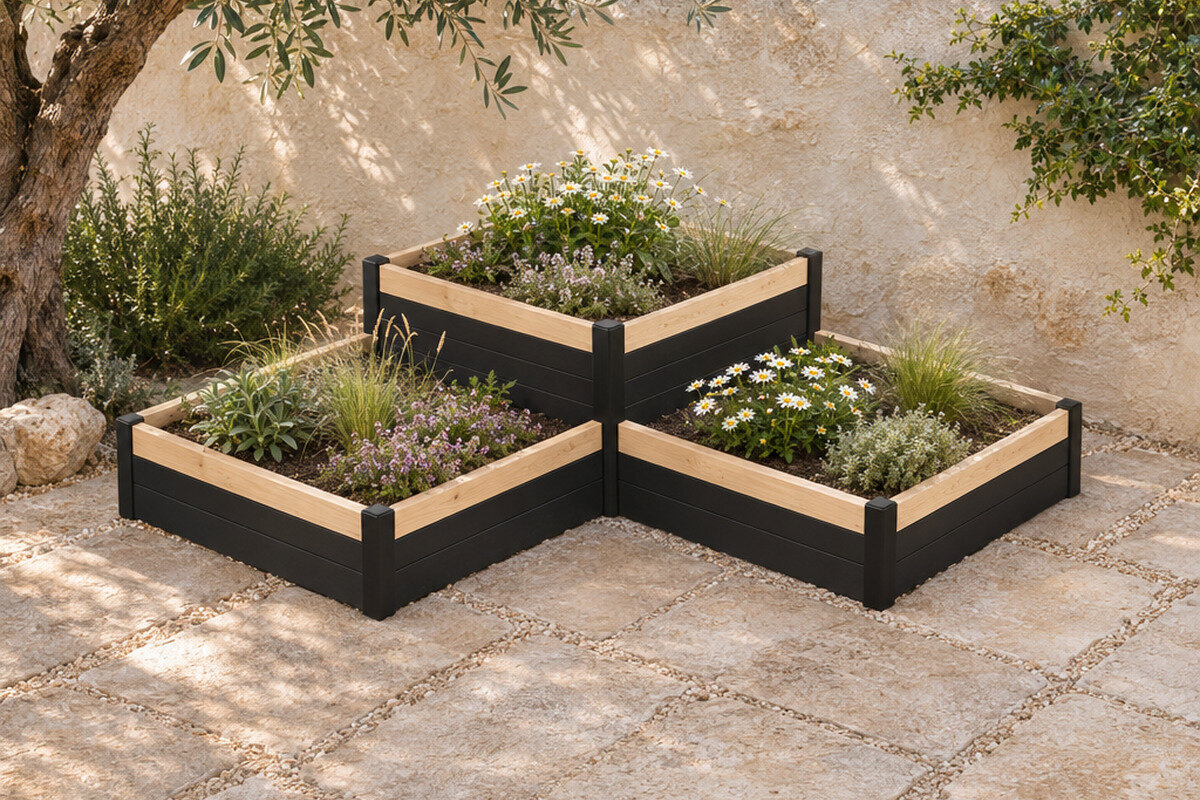
Start with one location and one crop. Check what can support the planter, then work out whether it gives the crop enough room without getting in your way. The Bloomcabin raised beds in the gallery are open-base, ground-standing alternatives for prepared ground. They are not examples of suspended planters, and their dimensions do not tell you anything about hanging capacity.
01
Choose what will carry the planter
A wall-mounted hanging garden bed usually takes the form of a trough held by brackets or a dedicated mounting rail. A railing planter is shaped or fitted to sit on a compatible rail, while an overhead planter hangs from a support above. These are different systems: a trough that accepts wall brackets is not necessarily designed to take rail hooks or suspension cords. Start with the support you can actually use, then shortlist planters specifically intended for that arrangement.
A hanging garden bed suits a modest crop you can tend from one position, such as a short row of picking lettuce beside a patio. It’s less useful if your plants need more root room than a trough offers or if the only place to hang it is over a busy route. Several small troughs let you separate crops with different needs, but they still share a load if they hang from the same rail or other support. If working height matters more than keeping the floor clear, consider a freestanding planter on legs instead.
If you wanted a hanging garden bed mainly to keep a narrow growing strip distinct from the path, check whether you have suitable soil beside it. The Narrow Aluminium Raised Bed 100×50×20cm is a ground-standing alternative with a nominal footprint of 100 × 50 cm, 20 cm walls and no floor panel. It needs prepared ground and is not a container you can lift and mount.

02
Measure root space, projection and reach separately
Measure the whole space a hanging garden bed will occupy, including fittings and the distance it projects from the wall or rail. Mark its proposed rim and front edge on the site. Open the nearby door or window fully, then walk past with the watering can you normally use. If the empty outline already gets in the way, the position won’t improve once leaves start sticking out. Check any clearance the maker calls for, including room to lift out an insert if the design has one.
For planting, ask for the internal length and width at the intended compost surface and the usable depth below it. The outside height of a hanging garden bed can include a raised rim, an insert or a water reservoir that adds no rooting space. A tapered trough can look broad at the top while narrowing sharply below. Compare the crop’s growing instructions with the actual space available, then use its final spacing to plan how many plants fit. Don’t treat the full depth of the shell as a rooting-depth figure.
Try the proposed rim height from where you’ll actually stand or sit. Can you see the compost surface, reach the back and pour water without lifting the can awkwardly? Could you check the drainage from a firm, clear position without reaching over a railing? A hanging garden bed that only works when you stand on a step or lean over an edge is a poor choice for a crop that needs regular attention.

03
Build up the wet load before buying
Before ordering a hanging garden bed, ask which mounting arrangement the maker supports, what any stated limit covers and which fittings are included. Check the complete load: the trough and its fittings, wet growing medium, plants and any water the design retains beyond what’s already counted in the medium. Litres tell you how much compost fits, not how much it will weigh when wet. If the maker gives a figure for the empty trough only, you haven’t yet established the load the wall, rail or overhead support needs to carry.
Compare materials using details that affect the installation, rather than assuming one material is always lighter or stronger. On a plastic or fabric hanging garden bed, check the empty weight and examine how the designated mounting points are formed. For metal, look at the outdoor care instructions for the container and fittings. For timber, find out whether an insert is required, whether it comes with the planter and how it drains. If you’re growing food, check that the container and any liner are intended for that use.
A bracket rating on its own does not tell you what an existing wall, railing or beam can carry. Nor can you add up individual fixing ratings to work out the capacity of the installation. Confirm the support and fixings for the actual location, including its exposure to wind, and get competent advice if you’re unsure. Check who can approve the fitting if you rent or share the building. If you cannot establish that the site and mounting system suit the proposed hanging garden bed, choose another location or a freestanding container.

04
Plan the runoff and fit the container empty
Stand at the proposed site and look below the hanging garden bed. Follow the likely path of water from the outlets to where it will land, then see where it would run from there. Reject a position that sends it across steps or onto a neighbour’s space. If the maker provides a drip tray, check that you can remove and empty it without spilling it into the route beneath. If the tray or reservoir can retain water, include that water in the load check rather than treating the accessory as weightless.
Fit the empty container using the instructions for that model and the confirmed supporting surface. Check the parts against the list and make sure any catches or retaining pieces sit as shown. Don’t drill extra holes or swap parts to make an incompatible mount fit. Once the hanging garden bed is fitted and checked, keep outlets clear as you add compost to the recommended fill line. At the first watering, watch where excess water emerges and lands. If it drains somewhere you hadn’t planned for, correct the setup before routine use. If the planter moves at its mount, stop using it and have the cause checked.

05
Start with a crop the trough can support
Choose a peat-free growing medium labelled for the container and the plants you intend to grow. Mixes differ in how they hold water, keep their structure and supply nutrients, so check the bag rather than using whatever is left over from another job. For a hanging garden bed, the choice also needs to fit the maker’s guidance on filling and load. Use the intended fill line when estimating how much to buy; you don’t need to buy enough to fill the shell to the rim if that isn’t how it is designed to work.
For a first crop in a narrow hanging garden bed, consider loose-leaf lettuce if the variety suits the light and usable depth. Lettuce seed can be sown about 1 cm deep, but follow the packet for the particular variety and its final spacing. Use a single row if the trough won’t take the required row spacing. Sow short batches in succession if you want leaves over a longer period rather than all at once. Prefer herbs? Basil suits a warm, sunny spot and a freely draining medium, so don’t assume it will suit the same position or watering routine as every other herb. Check the packet and local growing guidance for sowing times.

06
Make watering and mounting checks part of harvest
Tie moisture checks to something you already do, such as going out to pick leaves. Check the compost around the plants rather than watering to a fixed timetable. On a long hanging garden bed, compare both ends: one may be more sheltered than the other. Pay attention to the crop and the compost instructions, and look again after a change in weather instead of assuming rain has watered a trough tucked against a wall. If water isn’t coming out where expected, check for an obstruction or a full tray before watering again.
Put the plants you’ll pick most often where you can reach them without leaning on the hanging garden bed. If you sow in batches, keep the next sowing within reach as the first batch fills out. As part of ordinary care, look at the outlets, liner and mount as well as the leaves. Check again after severe weather or if you notice new movement, damaged parts or water collecting unexpectedly. Stop using the planter if the mount appears damaged or loose, and arrange for it to be dealt with safely rather than trying to steady or adjust a full trough from below.

07
Worked example: decide whether a wall trough fits a narrow patio
Hypothetical worked example: A gardener wants a hanging garden bed for picking lettuce beside a narrow patio, without putting a pot on the walking surface. There are 80 cm of clear wall beyond the door swing. A candidate wall trough is 62 cm long including its end fittings. Centred in that space, it leaves 18 cm in total, or 9 cm at each end. Those are measurements for this example, not recommended fitting clearances. The gardener checks the instructions and marks the front edge to see whether the installed trough would project too far into the walking route.
Assume the hanging garden bed has a rectangular planting cavity measuring 58 cm long by 18 cm wide, with 14 cm of compost at the intended fill line. The volume is 58 × 18 × 14 = 14,616 cubic centimetres, or about 14.6 litres. That’s a compost shopping estimate, not a recommended depth for lettuce. The gardener checks that the chosen variety suits the available depth and light, then lays out a single row using the packet’s final spacing instead of squeezing in a second row.
Now suppose the trough and fittings together weigh 3 kg, the intended quantity of wet medium and plants weighs 11 kg, and a tray can hold another 1 kg of water not already counted in the wet medium. That gives 3 + 11 + 1 = 15 kg in this hypothetical setup. None of those masses is a product specification, and 15 kg isn’t a fixing rating. The gardener establishes the real filled load and confirms the wall and mounting arrangement before buying. If the wall cannot be verified, or the tray can only be emptied onto the walkway, the hanging garden bed is ruled out even though it fits the wall on paper.

Questions readers ask
Can I put a hanging garden bed on a balcony railing?
Only if the planter is designed for that railing profile and the railing and mounting arrangement are confirmed suitable for the filled load and the site’s exposure. Check any permission you need, what’s below and where the water will go. A hook that slips over the rail does not establish that the installation is suitable.
How do I estimate compost for a trough that tapers?
Ask for the usable capacity at the recommended fill line, accounting for any insert or reservoir. Multiplying the dimensions at the rim by the fill depth would treat the base as if it were just as wide as the top. Use the stated capacity for buying compost, not as a figure for the wet load.
Can I turn a Bloomcabin raised bed into a hanging garden bed?
No. The raised beds in the gallery are open underneath and intended to stand on prepared ground. Their walls enclose the planting area but do not form a container that holds its contents when lifted. Do not add a floor, hooks or brackets to convert one.
Decide before you fill
Buy a hanging garden bed only when the support, rooting space, reach and runoff all work in the same spot. If one check fails, change the planter or the location before spending money on fittings and compost.
Find a raised bed for your plan
Compare layouts and check the dimensions on the product page.
