
Large raised bed planters: how to check size, reach and capacity

Bloomcabin · Raised-bed guides
Large raised bed planters: how to check size, reach and capacity
Compare large raised bed planters using three figures: the assembled footprint for fit, the clear internal area for growing space and the intended fill depth for capacity. A nominal size is useful for a first sketch, but it is not a soil-order measurement.
Fit
Use the nominal outline to shortlist large raised bed planters; verify assembled dimensions where clearance is tight.
Reach
Test how far you can reach at the intended wall height and from the sides you can actually use.
Depth
Wall height describes the frame. Fill depth describes the medium inside it.
Capacity
Multiply each bay’s usable area by its fill depth, then add the results and convert to litres.
If you are choosing between large raised bed planters for a particular spot, start with what could rule one out: a tight boundary, a path you cannot narrow or a bay you cannot reach across. A long frame may take up less width than you expect; a U-shaped frame may take up more room overall than its planting area suggests.
Do the fit check first, then estimate how much growing medium to buy. The worked examples below use clearly labelled hypothetical measurements. The Bloomcabin examples show what the listings actually tell you and which figures you still need to confirm.
01
Decode the size label before using its numbers
Read the named dimensions before comparing large raised bed planters. In a label such as 200 × 50 × 60 cm, the figures can describe length, width and height, but check the specification rather than assuming that order. A nominal footprint is the stated plan size for comparison. A maximum assembled external measurement tells you what must clear a fixed obstacle. An internal measurement tells you what growing space remains inside. They answer three different questions.
For the Narrow Aluminium Raised Bed 200×50×60cm, Bloomcabin lists a 200 × 50 cm nominal footprint and a 60 cm wall height. The long side runs 2 m; the frame projects a nominal 0.5 m across its width. Multiply those plan dimensions and you get 2 m × 0.5 m = 1 m², which matches the stated nominal planting area for its single bay. It does not establish that the clear soil surface measures exactly 1 m².
When comparing large raised bed planters for a space beside a fence or between two fixed edges, write down which direction each dimension runs. A 50 cm width is a horizontal measurement; it is not the depth of medium. Check a dimensioned drawing or ask for the maximum assembled length and width, including any posts or fittings that affect clearance. If you need to calculate fill as well, ask for the internal dimensions separately. Do not subtract an assumed panel thickness from the nominal width: the information needed to make that deduction is not given.

02
Subtract the access notch when comparing planting area
On large raised bed planters, the biggest rectangle you can draw around the frame may include empty space. The U-Shaped Aluminium Raised Bed 300×200×30cm has a nominal outline of 3 m × 2 m and five nominal 1 m × 1 m planting bays. The outline covers 6 m² on a sketch, but the nominal 1 m × 1 m notch accounts for 1 m² of that. The remaining 5 m² agrees with the stated nominal planting area. That is a check on the layout, not a measurement of the clear internal soil surface.
To compare large raised bed planters of different shapes, sketch the planting bays and mark where the dividers sit. Five bays totalling 5 m² on paper are not the same as a continuous 5 m² growing surface. If you want an uninterrupted row, check the actual length available within one bay rather than running the row across dividers. If two products have the same nominal area, the shape of that area can still decide which one fits your planting plan.
Treat gaps in large raised bed planters as access dimensions, not as spare planting area. The U-shaped model’s notch is nominally 100 × 100 cm, but that is not a verified assembled clearance. If you intend to work inside it, confirm the clear opening and usable space inside the notch. Then check the route into it: space surrounded by growing bays is only useful for access if you can approach it from your path.

03
Check path allowances and test reach at rim height
For large raised bed planters, add working space before deciding whether the outline fits. Hypothetical fit check: start with a nominal 3.00 × 2.00 m outline and allow 0.45 m beyond each end, 0.45 m behind it and 0.75 m in front. The resulting rectangle is 3.00 + 0.45 + 0.45 = 3.90 m long and 2.00 + 0.45 + 0.75 = 3.20 m deep. These are example allowances, not recommended path widths or a claim that any product fits exactly in that space.
Check the rectangle at the narrowest points, taking account of gates that swing into it, bends in the approach and anything that would interrupt a path. Mark it on the ground and try the turns and working positions you will need. If you use a wheelbarrow or mobility aid, test the route with it rather than guessing from the drawing. Consider whether the paths are firm and whether you can get water to the bed from the working side.
Reach can rule out large raised bed planters even when the paths fit. In a hypothetical 90 cm-wide planting bay you can work from both long sides, the centre lies 45 cm from either inner edge. If your working position is 5 cm back from that edge, the horizontal reach is 50 cm. With access from just one side, the equivalent distance to the far inner edge is 95 cm. These are distances to test, not ergonomic limits. Mock up the rim at the intended height and see whether you can reach without stepping on the soil.

04
Set the soil line before deciding what ‘deep’ means
When judging the depth of large raised bed planters, distinguish the top of the wall, the intended soil surface and the lower limit of usable rooting space. Wall height is the height of the side. Fill depth is measured vertically from the base level to the intended surface of the growing medium. With a level base and a level rim, a 50 cm wall and a soil surface 5 cm below the rim give 45 cm of fill. In that example, 45 cm is the number to use for estimating how much medium sits within the frame.
The Bloomcabin models discussed here are open to prepared ground and have no floor panel. In large raised bed planters with that construction, roots may extend below the frame if the underlying ground is suitable. Do not add a guessed amount of rooting depth below ground or treat wall height as a crop recommendation. Check the ground on site and use seed instructions and local planting guidance to judge whether the usable depth suits what you plan to grow.
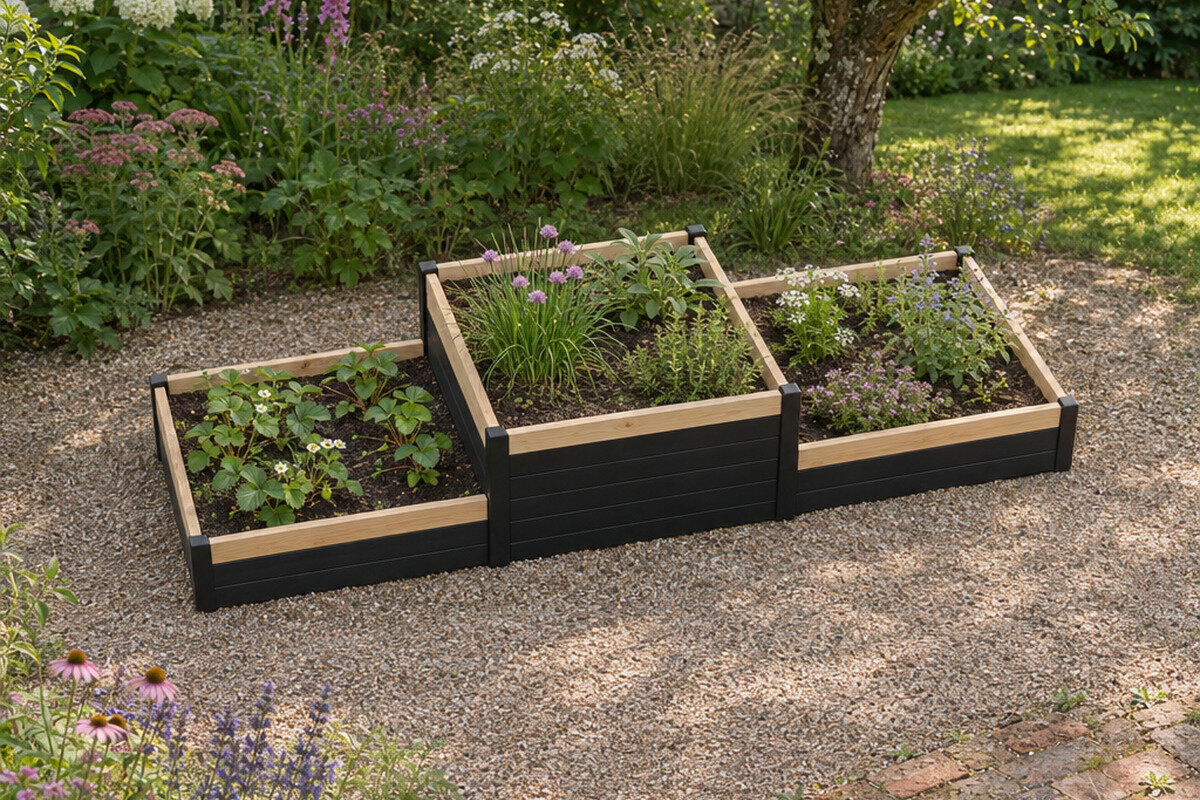
On stepped large raised bed planters, choose the fill level bay by bay. The Tall Triple Aluminium Raised Bed has nominal 100 × 100 cm bays, with walls of 80, 50 and 80 cm from left to right. The centre is not an 80 cm bay. Decide whether you want the same gap below each rim or the same fill depth in all three bays. The first choice gives different depths when the wall heights differ; the second must fit within the shortest walls.

05
Turn internal measurements into litres
To estimate how much medium large raised bed planters hold, work from the clear space inside the walls. For a straight-sided rectangular bay with a level base, usable internal length (m) × usable internal width (m) gives area (m²). Multiply by intended fill depth (m) to get volume (m³), then multiply by 1,000 for litres. If you measure in centimetres, divide each length by 100 before multiplying, or divide the final result in cubic centimetres by 1,000 to get litres.
Hypothetical single-bay calculation, not a product specification: suppose a bay measures 90 × 90 cm internally and you plan to fill it to 30 cm. Its internal area is 0.90 m × 0.90 m = 0.81 m². At 0.30 m deep, it takes 0.81 m² × 0.30 m = 0.243 m³, or 243 litres. Check it in centimetres: 90 × 90 × 30 = 243,000 cm³, which gives the same 243 litres.
When buying medium for large raised bed planters, keep the calculated volume separate from the quantity you can buy. If the hypothetical 243 litres were available only in 40-litre bags, six bags would contain 240 litres, which is 3 litres short. Seven bags would give 280 litres, or 37 litres above the estimate. If ordering loose, ask what volume increments are available and how the supplier states them. The geometry tells you how much space you intend to fill, not which medium is suitable. Choose a peat-free medium intended for your use and plants.

06
Add bay volumes, not the kit’s outside dimensions
For divided or U-shaped large raised bed planters, repeat the volume calculation for each bay and add the results. Never use the overall rectangle as the area of a complex kit: that counts any access notch and ignores the space taken up by dividers. Even when the nominal bays look identical, check which clear measurements apply to each one. If the intended soil level differs across the frame, record a separate fill depth for each bay.
Hypothetical stepped calculation, not a Bloomcabin capacity: assume three straight-sided bays each measure 90 × 90 cm internally. The two outer bays will have 65 cm of fill each, and the middle bay 35 cm. Each starts with 0.81 m² of usable area. The outer bays take 0.81 m² × 0.65 m = 0.5265 m³ each; the middle takes 0.81 m² × 0.35 m = 0.2835 m³. The total is 1.3365 m³, or 1,336.5 litres. As a cross-check, 0.81 × (0.65 + 0.35 + 0.65) gives the same result.
For large raised bed planters with unequal bays, the shortcut in that cross-check no longer works: you can only factor out the area when it is the same in all bays. Keep the individual figures until you have added them and round only when translating the total into a purchase quantity. Follow the actual assembly instructions; if a dimension or divider detail remains unclear, verify it rather than assuming you can change the layout to match your estimate.

07
Verify the measurements that could change your order
When shortlisting large raised bed planters, keep two sets of figures: one for the garden layout and one for the soil order. On the layout sketch, note the orientation, maximum assembled dimensions where known, clear access gaps and path allowances. On the fill sheet, note each bay’s internal length and width, intended fill depth and calculated volume. Mark each measurement as nominal, verified or still to be confirmed so that a first-pass sketch does not quietly become a buying specification.
Ask for the measurement that will decide whether a candidate stays on the shortlist. For fit, ask how wide the assembled frame is at its widest point. For access, ask how much clear width remains at the narrowest point of the notch. For the soil order, ask for the clear internal length and width of each bay. If those figures are unavailable before purchase, plan the order around measurements you can take after assembly rather than buying an exact quantity on the strength of a nominal number.
Comparing large raised bed planters this way also tells you which numbers can be approximate. If the garden has plenty of room, the nominal footprint may be enough for the first selection. If the frame must fit between fixed edges, a small difference may matter. If the proposed site is a hard surface rather than prepared ground, confirm that the model is suitable for that installation and get site-specific advice where needed. Litres measure volume; they do not establish filled weight or what the surface can support.

Questions readers ask
Is there a standard size for large raised bed planters?
Treat ‘large’ as a description, not a dimension. A long, narrow bed and a U-shaped bed can both be described that way but make very different demands on the space. Compare the assembled footprint, the shape of the growing area and the sides you can actually work from.
Can I use the listed planting area to estimate how much medium to buy?
Only if you know what the area represents. For a straight-sided compartment, actual internal area multiplied by intended fill depth gives the geometric fill volume. If large raised bed planters list only a nominal area, use it to compare layouts, not as a verified basis for a final order.
Does an open base add to the fill capacity of large raised bed planters?
Not when you are counting only the medium held above ground. Suitable ground below may add rooting space, but its depth does not belong in the above-ground volume calculation. If your site preparation involves removing and replacing underlying soil, estimate that quantity separately.
Measure the space first and the bays second
Before ordering large raised bed planters, mark out the footprint and test the reach. Then use the clear dimensions and intended fill depth of each bay to work out the litres. Browse Bloomcabin’s UK raised beds with those two checks in hand, and verify any missing measurement that could change your choice.
Find a raised bed for your plan
Compare layouts and check the dimensions on the product page.
