
LED Strips or Spotlights Under a Pergola?
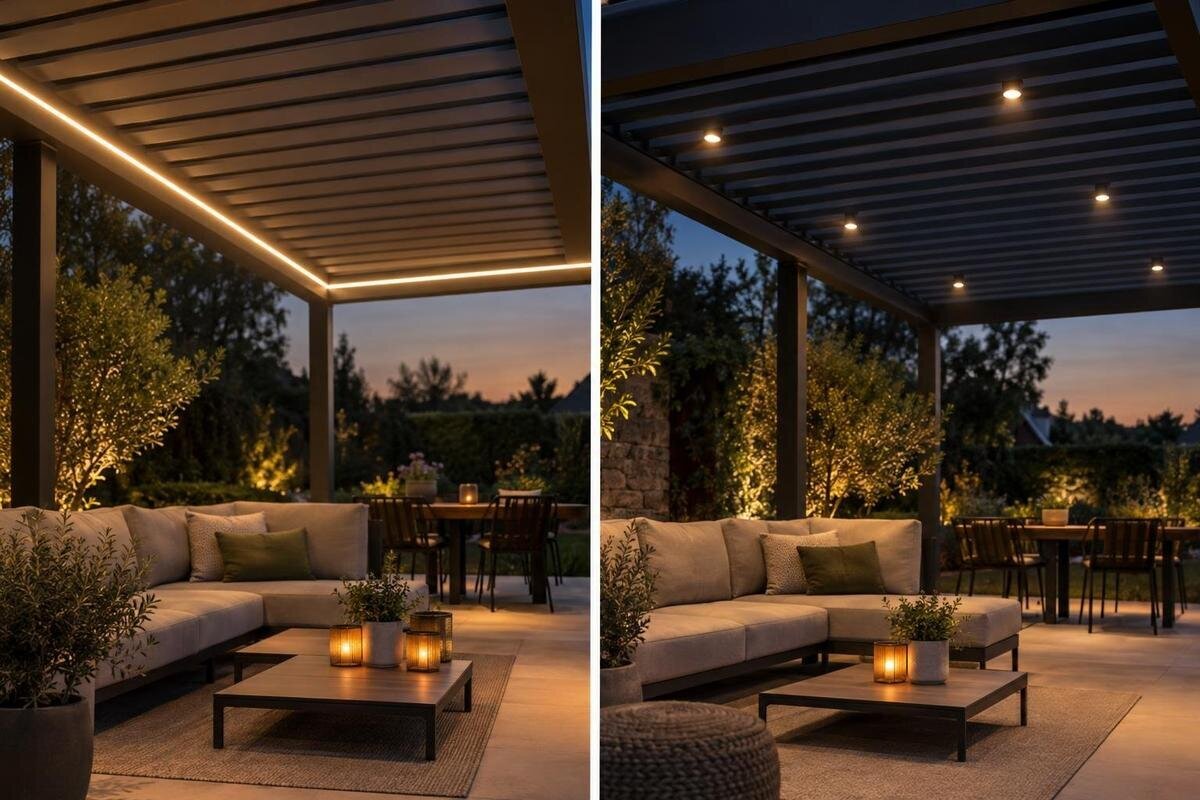
Pergola lighting
Choosing between LED strips and spotlights under a pergola comes down to the light pattern you want, the positions the structure actually supports and how each fitting can be serviced later. A strip creates a linear source; spotlights create separate beams. Those descriptions alone do not tell you whether a table will be evenly lit, whether a source will cause glare from a seat or whether a failed component can be replaced. Compare model-specific drawings and fixture documents before deciding.

What to verify 1
Confirm the fixture positions your pergola supports
Begin with the pergola, not with a strip length or a preferred number of spotlights. Ask for a current drawing or written specification showing the permitted fixture positions for the exact frame and roof configuration you are considering. It should identify which fitting each position is designed to accept and show its relationship to beams, roof members, moving elements or covers. A photograph may show a light, but it cannot establish that every frame in a range accepts it. If the supported positions are not documented, you do not yet have a fair comparison: an attractive layout is not necessarily an approved one.
For example, the Bloomcabin Pergola product page identifies a product, but its name or images cannot confirm strip channels, spotlight cut-outs, cable routes or mounting approval. Ask the seller or manufacturer to confirm those points against the exact configuration and fixture manual, including any limits on the fitting type or position. Keep that confirmation with the lighting plan; it can prevent an assumption at quote stage becoming a drilling or retrofitting question later. Compare the light patterns only after establishing that both proposed positions are supported.
How LED strips spread light
An LED strip places a row of light sources along a line, so its effect tends to read as a continuous run rather than a series of separate points. In a supported channel or other documented mounting, that may spread light along a beam or edge; it does not guarantee even illumination below. The result depends on the strip’s output and optics, any diffuser, its orientation, the distance from a surface and the colour or reflectance of nearby materials. A strip aimed towards a pale wall may brighten that surface more than the table beneath it; a directly visible run may show individual LED points rather than a smooth line. Check the data for the proposed fitting, not just the general label.
Plan the run against the actual layout: does it continue over the seats, stop short at a joint, turn at a corner or leave a break where the structure changes? These are questions about the documented system, not reasons to splice, cut or reposition a strip yourself. For a configuration enquiry about the Bloomcabin Bioclimatic Aluminum Pergola, request a drawing of the complete proposed run, including its ends and any breaks. Ask whether separate lengths will appear continuous when illuminated and whether their output is consistent. A short sample can help you judge the appearance of the source, but it cannot demonstrate coverage along the whole pergola.
What to verify 2
How spotlights shape the light
A spotlight sends light from a defined location into a beam. Depending on the fitting’s optics and aim, several beams can overlap across a table, while a single beam may create a brighter pool with less illumination between it and the next fitting. Beam angle, output, mounting direction and spacing all matter; the word spotlight does not establish any of them. Nor does a larger number of fittings automatically mean better coverage. Look for information about the exact spotlight and permitted position, including any stated beam distribution, rather than assuming that a fitting sold for a different structure will behave or mount in the same way.
Mark the intended table, seats and walking route on a plan, then ask how each approved spotlight directs light towards them. Establish whether its direction is fixed or adjustable: a drawing that assumes adjustable aiming is misleading if the quoted fitting has a fixed orientation. For the Bloomcabin Lean-To Pergola, include the adjoining wall in your configuration enquiry so the proposed beams can be assessed against both the furniture and that surface. Light falling mainly on the wall may look attractive without adequately lighting the table. Request the beam information for the quoted fitting and assess it at the proposed mounting height, rather than judging its spread from a close-up demonstration.
Compare coverage over the areas you use
Compare coverage where you will actually use the pergola, rather than counting emitters or judging a product photograph. Draw in the table, chairs, doorway and route people take between them. A long strip can follow one area while missing a table offset from it; spotlights can target separate zones but leave gaps between beams. Furniture, screens and structural members can interrupt light and create shadows. Ask for the proposed fitting positions to appear on the same plan as those objects, then compare the distribution across each activity area, not only the brightest patch. Consider whether the pattern changes when the furniture is moved.
Where the supplier can demonstrate the exact fitting, view the result from seated and standing positions. Note where light falls on faces, food, doorways and other surfaces you need to see. Keep the comparison fair by using the same table location and roof configuration for each option. Photographs taken with different exposure settings can make two arrangements look equally bright even when their usable light differs. When discussing lighting for the Bloomcabin Pergola, ask for a proposal showing the coverage of the specified fittings across your layout. If distribution data is available, use it alongside the plan. Distinguish measured or calculated information from an illustrative rendering, and identify any areas the proposal leaves uncertain.
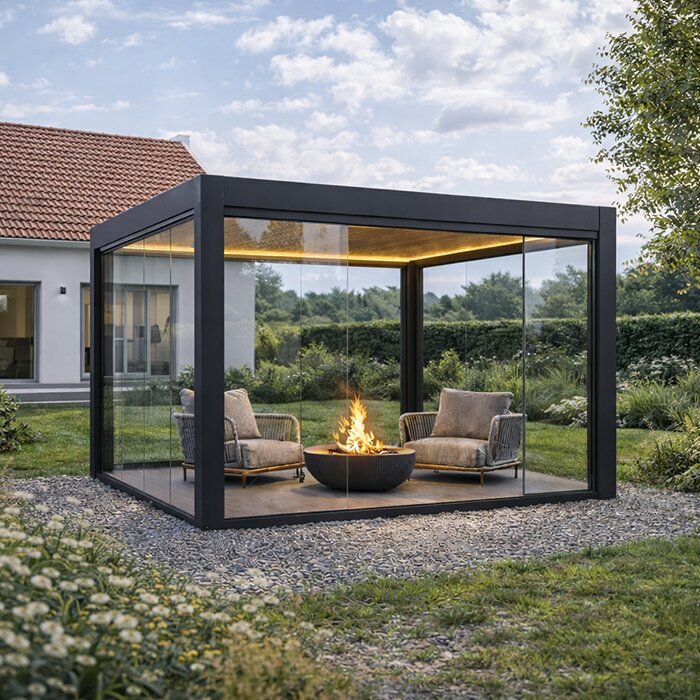
What to verify 3
Check glare from seated and standing positions
Glare depends on where a bright source sits in your view, not simply on whether the fitting is a strip or a spotlight. An exposed strip can present a long bright line; a spotlight can appear as a small, intense point. Either may be comfortable when its source is screened by a compatible fitting or falls outside normal sightlines, and either can be distracting if visible from a chair. Check from the actual seated positions, then repeat the check while standing and walking through the space. Consider reflections in the table, glazing or other shiny surfaces as well as direct views of the LEDs.
Mark eye-level sightlines on the lighting plan, including seats that face along a lit beam or towards a row of spots. Ask whether the documented fitting includes a diffuser, baffle or other glare-control feature, and whether that feature is approved for the proposed source. Do not assume an extra cover can be fitted without affecting the unit. Dimming, if offered and compatible, can adjust perceived brightness, but it cannot make an exposed source disappear. Use the same viewing positions to compare both options; looking directly upwards from beneath the roof is not enough.
Check moving parts and outdoor exposure
If the chosen pergola has a roof or louvres that move, confirm whether the proposed fixture position remains clear throughout their movement and whether the manufacturer permits mounting on that particular member. The answer may differ between fixed and moving roof configurations, so do not transfer a lighting sketch from one type to another. A photograph of a strip beside a louvre does not establish approval. Check the manufacturer’s position drawings alongside the fixture manual, and ask for confirmation for the exact parts, orientation and operating configuration. If the roof position changes, establish whether the documented arrangement remains suitable in each state.
Exposure also depends on the structure and the fitting’s location. Check the fitting’s stated outdoor suitability for that precise position and the conditions described in the pergola and light manuals, including any roof position relevant to rain exposure. A light, its connectors and its driver may have different requirements; the rating of one component does not establish suitability for the complete arrangement. In an enquiry about the Bloomcabin bioclimatic pergola, ask the supplier to identify all components included in the lighting proposal and where each is intended to sit. A qualified electrician should review their suitability together, including the proposed controls, rather than assessing only the visible strip or spotlight.
What to verify 4
Find out what can be replaced
LED strip describes a light format, not how it is repaired. One design may allow a specified section or separate component to be changed; another may require replacement of a longer assembly. Before buying, ask whether the replaceable part is the strip, a segment, a connector, a driver or the full fitting, and whether it has its own reference in the product documents. Check whether the source is accessible in its installed position and whether replacement is an approved service task. Do not cut, join or substitute strip sections on the assumption that a similar appearance or apparent electrical match makes them compatible.
Spotlights vary too: a fitting may use a replaceable lamp, an integrated light source or a replaceable module, and the method is specific to the model. Ask which component would be changed after a fault and what must be removed to reach it. For a lighting quotation alongside the Bloomcabin pergola model, request the exact fitting name, part numbers and documented compatible replacements, including whether the driver is separate. Also ask whether a single failed light can be replaced independently or whether other components must be changed with it. A replacement that fits physically may differ in output or beam pattern, so compatibility should cover the lighting result as well as the connection.
Plan access for future servicing
A replaceable part is useful only if someone can reach it without damaging or dismantling an unrelated component. Ask the provider to mark the service route for the strip, spotlight and driver on the installation drawing. Find out whether access requires removal of a cover, trim or structural element, and whether that affects a moving roof part or weather protection. The answer can change with the mounting point: a fitting that is easy to reach before installation may be awkward once it sits above a beam or behind a screen. Establish what access will remain after the work is complete and who is expected to carry out any service.
Request handover information recording the fitting model, its approved location, relevant manuals and any replacement parts or service contacts confirmed by the supplier. For a proposed installation on the Bioclimatic Aluminum Pergola, ask for the access drawing to form part of that record. It should distinguish routine access to lighting components from work that involves the pergola itself. Find out whether a failed driver can be reached separately from the light source and whether several lights share it; that affects how a fault may interrupt use. The installer or electrician should confirm safe access and isolation arrangements. Keep these records with the pergola documents so a future service provider can identify the system without relying on photographs.
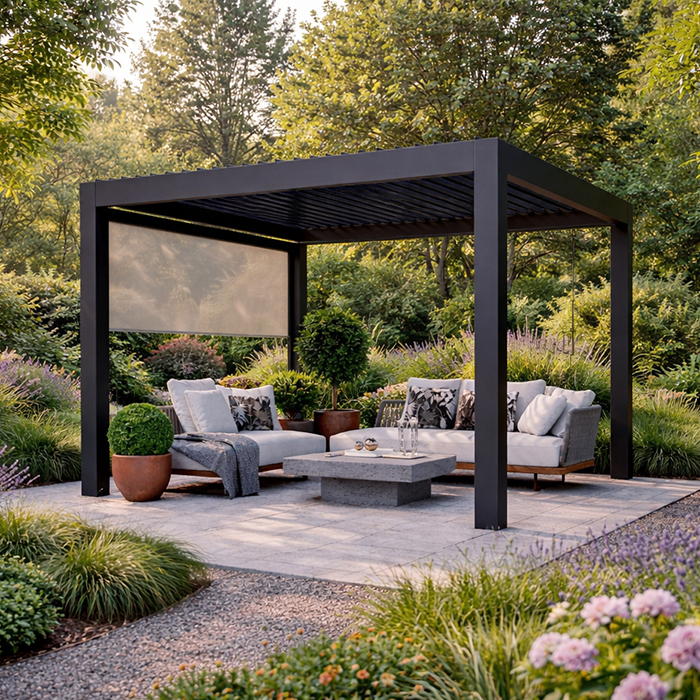
What to verify 5
Compare the same evidence for both options
Ask for the strip and spotlight proposals to use the same pergola configuration, layout and intended seating. Compare four points in one document: supported mounting locations, light distribution across named areas, source visibility from normal eye positions, and the parts and access needed for replacement. Add the exact fitting identifier, its relevant manual and its stated outdoor suitability for the proposed position. If dimming or separate control matters to you, record whether the fittings and controls are documented as compatible. This prevents an impressive rendering for one option being weighed against a bare fitting description for the other.
Keep evidence separate from preference. You may prefer the clean line of a strip or the defined pools of spots, but appearance does not establish coverage or serviceability. Compare the scope of the two quotations as well: does each include the required drivers, compatible controls, mounting accessories and installation work, or are some items excluded? For the Bloomcabin wall-mounted pergola, ask the supplier to distinguish the pergola configuration from the proposed lighting package so you can see exactly what is being offered. Record unresolved items beside the relevant option instead of assuming they are included. Have a qualified electrician review electrical compatibility and supply planning before treating either proposal as complete.
Choose the pattern that fits the documented layout
A strip is a sensible candidate when the manufacturer documents a suitable continuous position and its light reaches the areas you use without remaining in direct view. It is less convincing if it leaves long unlit sections, cannot be serviced as proposed or only fits a position that conflicts with the roof configuration. Spotlights are candidates when their supported positions and beam patterns cover separate areas without exposing bright points to seated users. They are a weaker fit if the plan shows obvious gaps, unwanted bright pools or difficult access. These are comparisons of likely outcomes, not a universal rule about which technology is better.
If both options meet those checks, choose the light pattern you prefer and consider which replacement method you are willing to maintain. If neither does, ask whether the supplier can document another compatible arrangement, or defer the lighting choice until the pergola configuration is confirmed. Do not buy a generic strip or spotlight on the assumption that it can later be fixed to a beam, louvre or wall. The final choice should be a particular fitting in a particular supported position, with its coverage, glare and service route understood before electrical work is planned.
Frequently asked questions
Which gives the most even light under a pergola?
Neither does so automatically. A strip creates a linear source and may cover a long supported run, but its light can favour nearby surfaces or leave gaps. Spotlights can overlap or create separate pools depending on their beam, spacing and aim. Compare the exact fittings on a layout showing the same table and roof position.
Are LED strips less likely to cause glare than spotlights?
Not necessarily. An exposed strip can appear as a bright line, while a spotlight can appear as a bright point. Check both from the seats and walking routes you actually use, including reflections from glazing or shiny surfaces. A diffuser or other glare-control feature should be specified for, and compatible with, the fitting.
Can I attach either type of light to any pergola beam?
No. The manufacturer’s documents need to support the position for the exact pergola and fitting. A beam that looks convenient in a photograph is not proof that it is suitable for mounting. Confirm the proposed position and electrical compatibility before ordering or planning any alterations.
Which type of light is easier to replace?
That depends on the particular system, not whether it is a strip or a spotlight. Ask whether the strip, a section, the spotlight source, the driver or the whole fitting would need replacing after a fault. Check the part references, compatible replacements and access route for the installed position.
Can lights be mounted on moving louvres?
Only if the manufacturer explicitly documents the fitting and position for that moving component and its full range of movement. Do not infer approval from a photograph. Ask the supplier to confirm the arrangement for the exact model; have a qualified professional resolve mounting questions and a qualified electrician review electrical compatibility.
The strongest choice is not determined by the fitting label. A strip can create a linear spread and spotlights can direct separate beams, but mounting support, optics, sightlines and access decide how those patterns work under your pergola. Compare the documented positions, check coverage and glare from normal viewing points, and find out what can be replaced. Once those details are clear, choosing between a continuous line and separate pools becomes a practical design preference rather than a guess.
