
Is a Louvred Pergola Watertight in Heavy Rain?
Pergola rain performance
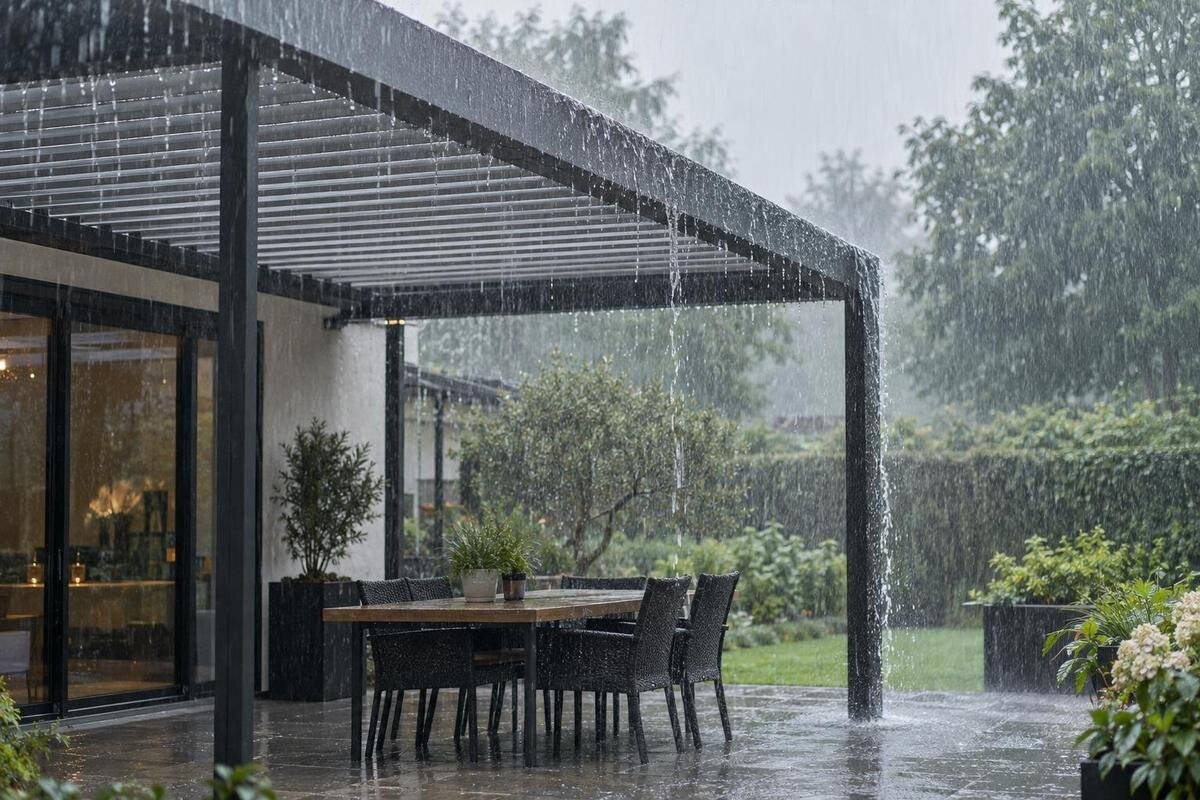
A louvred pergola can provide useful shelter in rain, but “watertight in heavy rain” needs a defined test behind it. Closing the roof does not, by itself, tell you whether the blade joints resist water, how quickly collected rain drains or what happens when wind drives water in at the sides. Performance depends on the precise roof design, its documented operating conditions, the installation and any screens or walls fitted. This guide explains how to assess rain-test evidence and drainage drawings, and where a covered roof stops being the same as an enclosed dry room.
What “watertight” means for a louvred roof
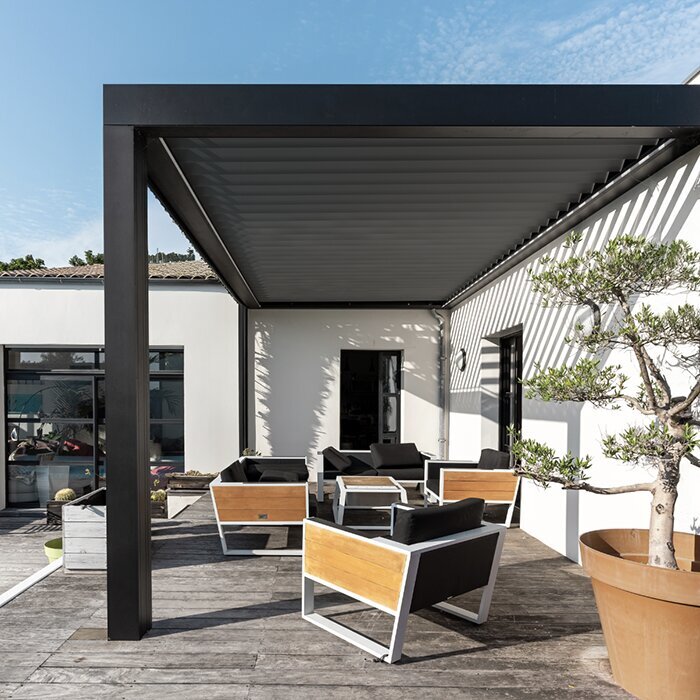
Treat “watertight” as a claim with a boundary. Does it mean that water falling vertically on the roof stays above a defined area while the louvres are fully closed, or that the whole space remains dry, including at its perimeter? A roof test can answer the first question for one stated arrangement; it cannot automatically describe an open-sided pergola in every direction of rain. “Heavy rain” also needs a rate and duration: the phrase alone says neither how much water was applied nor for how long. Any acceptable amount of seepage matters too, particularly if you expect the space to protect belongings rather than simply provide overhead cover.
In a louvred roof, movable blades meet along joints and at their ends. Some designs use shaped overlaps or seals and channel water away; the exact arrangement is model-specific, so do not assume every closed roof forms a continuous sealed plane. Ask what the manufacturer means by “no leakage”, where water was checked and whether the result applies to the exact roof and configuration you are considering. The Bloomcabin Lean-To Pergola page identifies a product, but its name alone is not evidence of a heavy-rain limit; request model-specific performance information before relying on such a claim.
What a useful rain test should tell you
Useful evidence identifies the model and roof configuration, confirms whether the louvres were fully closed, and describes rainfall rate, duration and wind conditions. It should also say how water entry was observed, what counted as failure and whether the test used the roof alone or fitted side panels. Ask whether outlets and drainage components were installed as in the documented arrangement. A controlled observation can be useful, but its scope has to be clear before you compare it with another roof or apply it to your site. It is also reasonable to ask who carried it out and whether the setup was controlled.
The words “heavy rain” are not a test method. A report may not represent prolonged rain, gusts or every angle of exposure, and different suppliers may use the phrase for different conditions. Look for a written technical sheet or test record with a date, model identification and stated exclusions; check whether it covers the size and accessories being offered. A current drawing is useful alongside a written result because an earlier roof detail may not describe the product now being quoted. If a reply gives only a general assurance, treat missing conditions as unknown rather than proof of performance in harsher weather.
How closed louvres direct water
With the louvres closed, water behaviour depends on blade profile, overlap, end details, seals and the way the blades meet the frame. Depending on the design, the blades may shed water towards a side channel or into a surrounding frame; joints and pivot points are details to check in drawings and controlled observations. Intermediate blade angles can leave more direct openings, so do not assume a partly open roof gives the same rain protection as the specified closed position. Follow the exact model’s instructions for the position intended during rain, and check whether they say to close the roof before rainfall begins.
When enquiring about the Bloomcabin Bioclimatic Aluminum Pergola, request a section drawing showing blade-to-blade and blade-to-frame details, alongside evidence from an observation made with the roof in its stated rain position. The drawing should help you distinguish surfaces intended to shed water from joints intended to restrict its entry. Ask how water reaching the ends of the blades joins the next part of the drainage route, and whether the assessment included those junctions. If the roof is tested in only one position, confirm that the result applies to the position you will actually use. Photographs can show the overall layout, but they rarely reveal the complete joint detail or whether a seal is correctly seated. A close-up image is therefore useful context, not a substitute for a drawing and a documented result.
Follow the roof drainage route
A rain-shedding roof needs somewhere to send the water. Depending on its design, channels may sit in the blades, supporting beams, posts or a combination of parts. Do not presume that a channel is present, where it terminates or whether water exits at one or several points. Ask for a drainage diagram for the exact model, with a clear route from the roof to the discharge point. It should show what happens at corners and make the outlet arrangement understandable, rather than leaving you to infer it from a general illustration.
The final discharge matters as much as the route beneath the roof. An outlet that releases water beside a doorway, against a wall or into a low spot may cause problems even if water has travelled through the intended channel. When discussing the Bloomcabin Pergola drainage arrangement, ask the supplier to identify the proposed outlets on a plan of your site. Include nearby doors, walls and existing drains so the installer can assess where the discharged water will go. Confirm whether connection to other site drainage is part of the arrangement or needs separate planning; do not assume it is automatic. Also ask how outlets remain accessible for inspection once furniture or side panels are in place. A drawing that stops at the base of a post leaves an important practical question unanswered: what happens to the water after it leaves the pergola?
Wind-driven rain can enter at the sides
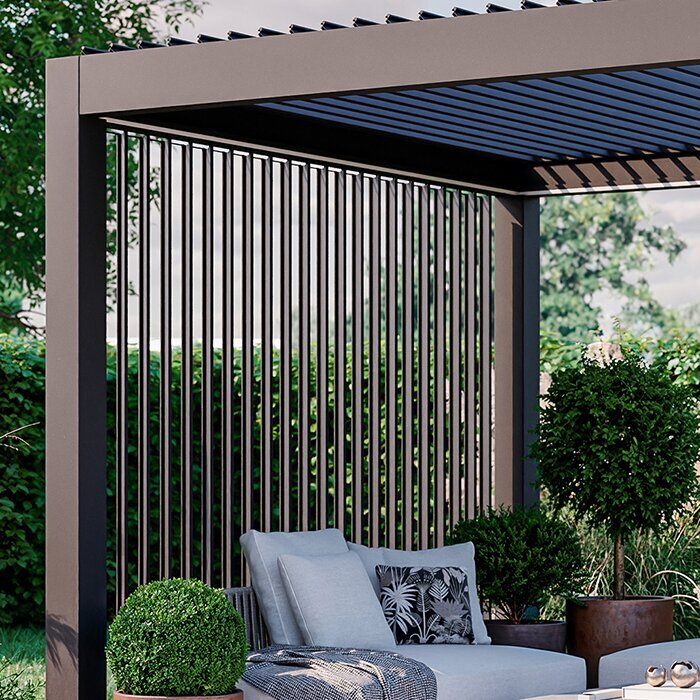
Wind changes which parts of a pergola are exposed. A closed roof may reduce rain falling from above, yet gusts can carry water beneath its perimeter, through open sides or towards the seating area. This is different from leakage through a blade joint, so ask whether the maker’s evidence tested wind as well as rainfall and, if so, under what stated conditions. A controlled vertical rain observation does not, by itself, show how the space behaves when rain arrives at an angle.
Consider the site’s exposure and the directions from which rain commonly reaches it, but do not treat those factors as a universal safe wind direction. For an enquiry about the wall-mounted pergola, photographs of the proposed position can help explain which sides face open ground and which sit beside the building. Note whether the intended seating is near an open corner or further beneath the roof. This helps separate your expectations for the central covered area from those for the perimeter. A nearby wall may shelter one side, but its presence does not establish the performance of the roof-to-building junction. Ask the supplier to distinguish evidence about roof ingress from any claim about shelter around the edges. If a demonstration shows only the centre of the space, it leaves unanswered what happened beside the frame, wall connection and open sides.
Why installation and alignment matter
The result of a test depends on the arrangement being assessed. If a roof is assembled out of alignment, blades may not meet as intended, while channels or outlets may not follow the documented route. The model’s assembly information should set out the required orientation and any relevant alignment details. Ask the installer to confirm that the model and drainage arrangement match the drawings, and that the louvres move into the intended rain position without an obvious obstruction. This is a check of the specified installation, not a reason to adjust parts by guesswork.
Changes to an approved layout can affect where water travels. If your site appears to require a different orientation, outlet position or component, ask the manufacturer and a qualified installer whether that arrangement is suitable before work proceeds. Avoid adding sealant, drilling new outlets or altering a channel as an experiment; a change could affect the drainage route or create another path for water. The regular pergola listing can help identify the model, but installation and drainage details must come from the instructions for the exact configuration.
Side screens and glazing need separate evidence
Screens, blinds, glazing or fixed panels may reduce some sideways rain, but they do not automatically turn an open pergola into a watertight room. Panel joints, door openings, wall connections and thresholds introduce their own possible routes for water. A screen’s ability to reduce wind exposure is not the same as evidence that it excludes water. Check that any accessory is listed for the exact model and ask how fitting it affects the roof’s drainage and the overall rain-performance claim.
Look for evidence that matches the combination you intend to use: roof, side components, doors and their connections. For the bioclimatic pergola configuration, request a drawing identifying the proposed accessories rather than assuming compatibility from the product name. Ask whether the observation was made with panels shut, doors closed and any screens in their specified position. A result for that arrangement should not be presented as evidence for use with an opening left clear. Where side panels meet the frame, the assessment should make clear whether those connections were included or excluded. If the rain observation covers only the roof, it cannot establish how an enclosed configuration behaves at its joints or openings. This distinction matters when the purchase is intended to protect belongings near the sides rather than simply provide overhead shelter.
Understand what a rain claim does not cover
A stated test describes the conditions and arrangement that were observed; it is not a promise that every downpour will produce the same result. Exposure, wind direction, installation and the condition of drainage components can differ from the test setup. Ask what routine inspection or maintenance the manufacturer specifies, particularly for channels and outlets where debris could obstruct the route. If water appears where it should not, the diagram and instructions can help distinguish a drainage issue from entry at a roof joint or edge.
Rain evidence should not be read as proof of performance in other weather. A roof observation does not establish wind limits, suitability for snow or resistance to every combination of weather and site exposure. Nor does a result for one setup automatically apply to a different size, accessory set or position. Keep the limits alongside the headline claim when comparing products. The useful question is not simply whether a pergola is described as weatherproof, but which parts of its performance have been documented and under what conditions.

How to assess a demonstration or site observation
A demonstration can make a drainage drawing easier to understand, but judge what it actually shows. When arranging to view the Lean-To Pergola model, ask whether the demonstration uses the same roof version and configuration as the proposed order. Note the louvre position, which sides are open and whether water is applied across the whole roof or only a small part. A short video of water running from one outlet does not show what happened beneath every blade joint or around the perimeter. Ask to see the covered area as well as the discharge points, and establish whether the recording shows the full observation or selected moments. If the rate of water application was not measured, the demonstration may explain the route water takes without establishing a heavy-rain performance limit.
An observation during natural rainfall has a different purpose: it can reveal where water appears at a particular site. Record the time, approximate duration, wind direction, roof position and any open sides, then note the locations of wet patches or drips. Photographs taken from a safe, sheltered position can help an installer distinguish water coming through a roof joint from rain entering beneath an edge. Without measured rainfall and wind data, however, the event is not a repeatable performance test. One dry observation does not prove that the space will stay dry in stronger or longer rain, while one wet edge does not necessarily show a roof defect. Do not climb onto the structure or improvise a storm test; use the observations to support a specific enquiry.
Match the shelter to what you need to keep dry
Decide what “dry” needs to mean in your situation. Occasional rain cover for a seating area is a different requirement from keeping stored belongings dry through prolonged rain or gusts. With open sides, wind-driven water can enter even when the roof is doing its intended job. Consider which edges are exposed and whether the roof-only evidence covers the conditions that matter to you. If the requirement is a reliably dry enclosed space, look for evidence for the complete enclosure rather than assuming a roof claim applies to the whole area.
Compare models on the same evidence: the roof’s rain position, controlled observations, drainage route, outlets, exposed edges and tested accessories. When considering the Bloomcabin Pergola model page, separate what the supplied documents establish from what remains unanswered. For example, roof-only evidence may address overhead cover without resolving whether furniture beside an open edge will stay dry. That is a gap between the documented scope and your intended use, not a reason to assume either success or failure. Decide which uncertainties matter before committing to a configuration. A louvred pergola can offer useful rain shelter when its design and installation suit the conditions, but “watertight in heavy rain” is meaningful only when the test and configuration behind the claim are clear.
Frequently asked questions
Can I leave the louvres closed during heavy rain?
Check the instructions for the exact model. Some roofs are designed to shed rain in a specified closed position, but you should not assume that every setting or operating condition is suitable. If the manual does not explain when to close the roof or how it should be positioned in rain, ask the supplier for clarification.
Will a closed louvred pergola keep my furniture dry?
It cannot be guaranteed from the roof alone. Rain may enter at the sides or perimeter, and the outcome depends on wind, drainage and the tested configuration. If furniture or other belongings must stay dry, check whether the evidence covers the full enclosure you intend to use and consider how you will protect items when conditions exceed those limits.
Do drainage channels prove that a pergola roof is watertight?
No. Channels describe part of the route rain may take after it reaches the roof; they do not, by themselves, show that blade joints or edges prevent water entering. Ask for both a drainage diagram and model-specific evidence of how the closed roof performed under stated test conditions.
Will side screens make the pergola waterproof?
Not necessarily. A screen may reduce some sideways rain, but it is not automatically a sealed wall. Check that the accessory is compatible with the exact model, how its joints and openings are treated, and whether the roof and sides have been assessed together for water ingress.
What documents should I ask for before buying?
Request the exact model’s rain-performance information, including the roof position, rainfall and wind conditions, test arrangement and stated limits. Ask for a drainage diagram that traces water to its outlet, plus details of any tested side panels or screens. Make sure the documents describe the configuration you plan to order.
Judge a louvred pergola by the evidence for its exact roof and configuration, not by the word “watertight” on its own. A useful assessment states how rain was applied, what position the louvres were in, how water was observed and where it drained. It also makes clear what was not tested, particularly wind-driven rain at open edges or any side panels you plan to add. Those details let you compare the documented performance with the shelter you actually need, without treating a controlled result as a guarantee for every downpour.
