
Manual or Motorised Pergola Louvres: Which Suits Your Routine?
Pergola roof guide
Manual and motorised pergola louvres can both change how the roof is set, but the right control depends on your routine: how often you adjust it, who can reach it and whether the selected system's power and support arrangements suit you. This guide compares the day-to-day trade-offs and explains what to verify for a specific model. It does not assume that Bloomcabin offers either control option on every pergola.
What louvre adjustment changes
An adjustable louvred roof is useful when its blade angle can be set for the conditions you actually want to manage. Changing the angle can alter direct sun and the amount of open sky; any effect on airflow or rain depends on the roof's design, its position and the surroundings. Decide whether your priority is a more open feel, a degree of shade, or repeated changes as the day moves on. A broad description such as 'adjustable louvres' does not confirm a particular range, intermediate positions, rain handling or whether the whole roof moves together. Nearby walls, planting and neighbouring structures can also affect the result, so judge the setting rather than relying on a generic image.
Separate the roof's behaviour from the way you operate it. Manual and motorised describe how the louvres move; neither label tells you the available angles, how many control zones there are, or whether other features are powered. Use the Bloomcabin Pergola model page to identify the product when asking which roof types and operating methods are available. Before comparing controls, establish which movements the manufacturer documents. If terms such as 'open' or 'closed' are used, ask what they mean for that roof. A control that is convenient to use will not compensate for a roof movement that fails to provide the setting you want.
What manual louvre operation involves
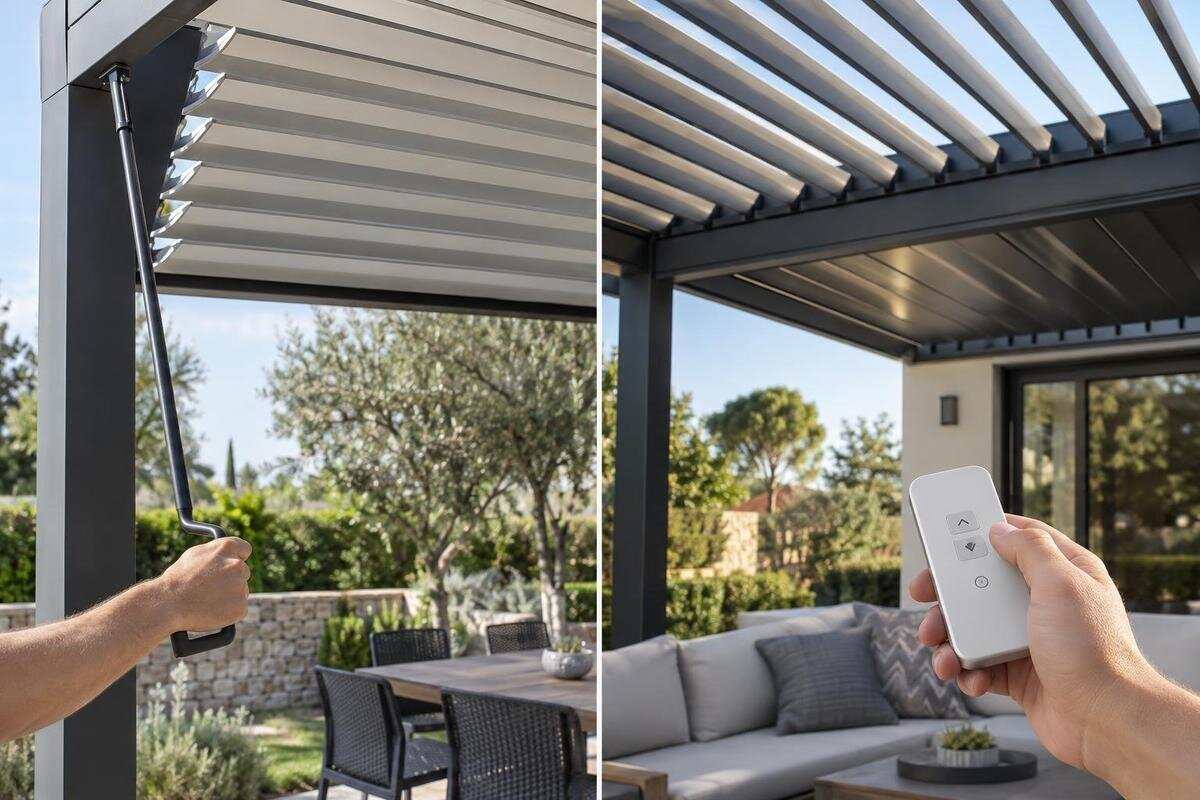
With a manual system, the user's hand supplies the effort that moves the blades, through a design-specific handle, crank or linkage. The movement might involve several turns or a different action, so do not infer how it works from a photograph or the word 'manual'. Ask to see the operating instructions or request a demonstration of the configuration being quoted; note where movement begins and ends, and whether intermediate positions can be held. Find out whether the handle stays attached or is removed after use, since a removable handle needs an accessible storage place. A manual roof may still have electrical accessories, so 'manual' does not establish the power requirements of the complete pergola.
Try the control from the place where you would normally stand, rather than judging it only from a drawing or a ground-level measurement. Consider whether the handle is within comfortable reach, whether there is room for its full movement, and whether operation remains practical with patio furniture in use. The force and travel depend on the mechanism, so do not assume a large roof is difficult or a small one easy to operate. Think about everyone expected to use it, including anyone who may find overhead reaching or repeated hand movement inconvenient. If the supplied mechanism feels awkward in a demonstration, treat that as a real drawback. Do not judge using a sample handle that is different from the one being offered.
How motorised louvres are controlled
Motorised louvres use a powered drive to move the roof after a person gives a command. Depending on the supplied system, that command might come from a wall control, handset or another interface; there is no universal control package. The practical gain is less repeated hand effort, especially if reaching a manual mechanism would be inconvenient. It does not guarantee faster movement, a particular noise level, finer positioning or operation from a particular distance. Ask which control is actually supplied, how it is powered, whether it operates one roof section or several, and how the user can tell the blades have reached the intended position. It is also worth asking whether the control has to be held while the roof moves.
Motorisation is not the same as automation. A powered drive can still require someone to press a control every time; an app, timer, wind or rain sensor, voice command or automatic response must be explicitly included and described. None should be assumed from the word 'motorised'. When enquiring about the Bloomcabin Bioclimatic Aluminum Pergola, establish which operating options are available before discussing additional controls. If an automatic feature is offered and matters to you, ask what triggers it, whether you can override it, and what happens if two commands conflict. Also find out whether it needs separate setup or user settings. Those details determine whether automation would genuinely reduce your involvement or simply introduce another control to manage.
How often you expect to adjust the roof
Think about an ordinary week rather than the handful of occasions when the weather is perfect. Does someone alter the blades once after lunch, or are changes likely as the sun shifts, guests arrive, or the terrace moves from dining to relaxing? Count the adjustments you would realistically make and note who makes them. A roof left in one position for most of a session may not justify powered operation for every household; several changes each day can make repeated effort more noticeable. Neither pattern decides the question alone, but writing it down stops the choice being driven by an imagined routine. Weekday use can differ from weekend entertaining, so include both if they are regular.
Consider the sequence as well as the number of adjustments. If someone has to get up, cross the terrace and use a control before sitting back down, the interruption may matter more than the effort. Conversely, if one setting lasts for a long period, a handset may add little convenience. When several people use the space, agree whether each person will adjust the roof or leave it to one person; a motor does not resolve competing preferences or choose an appropriate position. A demonstration, if available, can help each regular user judge the action and understand the control. Also ask how easily someone else can take over if the usual operator is away.
Reaching and using the controls
Control access should be assessed at the pergola, not from a product photograph. Find out where a manual handle or powered control will be located, whether it can be approached without moving furniture, and whether the operator can see the blades while making an adjustment. For a layout beside the house, include the doorway and its normal route to the seating area in your assessment. If you are considering the Bloomcabin Lean-To Pergola page, request a drawing showing the proposed operating point for your chosen configuration. Check that someone using it would not obstruct the doorway or need to stand in a narrow gap beside a chair. Mounting style alone does not establish the position of a handle or switch.
A handset can reduce the need to reach a fixed mechanism, but it needs a known place to be kept and must remain available to the people who use it. A fixed switch needs a convenient, clearly identified position; it should not end up hidden behind furniture or usable only by the person who arranged the installation. Ask whether controls are included, how many users can operate them, and whether anything shows the current roof position. Mark a proposed control location on the plan and check it with the installer before it is fixed. The same access check applies to manual operation: there should be room to stand safely and complete the full movement without leaning across a table or planter.
Power supply and power cuts
A motorised drive needs an identified source of power, but do not guess whether the proposed system uses mains electricity, a battery or another arrangement. Ask for the exact requirement in writing and establish what is included in the pergola package and what must be arranged separately. If a cable or connection needs to be planned around a house or garden, have the specification reviewed by a suitably qualified installer before work is agreed; this article cannot replace project-specific electrical advice. The supplier should clarify who is responsible for the connection and what information the installer needs. Include the intended control location in that discussion, rather than planning a route from a product photograph or generic description.
Ask what happens if power fails while the louvres are open or closed. Is there a documented backup supply, manual release, method of returning the roof to a particular position, or no user override? The answer must come from instructions for the exact motor and roof. When reviewing the bioclimatic pergola listing, request this information for any powered configuration being offered. Distinguish a loss of power to the drive from a flat handset battery: they are different problems and may have different remedies. Check what requires charging or replacement and how a fault is reported. Do not open covers, bypass controls or improvise electrical work; follow the supplied instructions and use a qualified professional where needed.
Care, repairs and after-sales support
Both types of system contain moving parts, so it is unhelpful to call one maintenance-free or to assume that powered operation inevitably means frequent repair. A manual mechanism can involve a linkage; a motorised system adds a drive and its controls. The inspection, cleaning and service requirements vary by product and must come from its care guide. Ask what routine checks are required, what signs mean the louvres should not be operated, and whether maintenance must be carried out by an authorised or qualified person. Do not lubricate or dismantle a mechanism unless its instructions permit it. Ask, too, whether routine cleaning can be done without interfering with the operating parts.
Before choosing, find out how faults are handled: whether the seller offers troubleshooting, which parts can be replaced, how to identify the right spare, and who can service a drive if it stops working. Request the written warranty terms without assuming they are the same for roof, motor, controls or installation; coverage depends on those terms. Keep the model reference and order configuration together, using the Bloomcabin Pergola page as a starting point for identifying the product in a service enquiry. Ask whether a fault should be reported to the seller or installer first and what information they will need. A clear support route is particularly valuable if a fault would leave the roof in an inconvenient position.
Check the full roof-and-control specification
Compare a complete roof-and-control package, not two labels in isolation. Verify whether the listed pergola actually has adjustable louvres, whether they are manually or electrically driven, what is included in the configuration, and whether a requested control is an option or a separate accessory. Confirm the movement pattern: which blades move, whether roof sections can be controlled separately, and what positions the maker documents. A model name can identify a product family without answering those questions. For the named bioclimatic model, check the current specification for the actual roof mechanism and control before treating it as a motorised option. Confirm whether the answer changes between sizes or layouts.
Compatibility matters when comparing a different size, layout or wall-mounted version, because a drive and its controls may be specific to a model or configuration. Do not assume a motor offered for one roof can be added to another, or that a manual design can be converted later. If a future upgrade matters, ask whether the manufacturer supports it and what would need to be changed. A supported conversion might still involve more than adding a motor, so establish the proposed scope rather than relying on a general assurance. Keep any upgrade information separate from the specification of what you are buying now; a possible future option is not an included feature.

Comparing quotations and checking handover
Compare quotations on the same basis so that a difference in the total does not conceal a difference in what is supplied. Separate the roof, operating mechanism, controls, accessories and installation work in each offer. One quotation might include work that another leaves for you to arrange; ask for unclear items to be itemised rather than assuming the packages are equivalent. If considering the lean-to model page, use its model name and selected configuration in the quotation request. Record whether each requested feature is included, optional or unavailable. This gives you a usable comparison of the available choices without treating the cheapest headline figure as the full cost of an operating roof.
Agree what handover will cover before installation work is commissioned. Establish who will test the operating system, demonstrate its use and provide the instructions. The demonstration should cover normal movement, stopping at a chosen position where supported, and recognising a condition in which the roof should not be operated. For powered equipment, it should also explain the documented response to a power or control failure. Arrange for regular users to see the demonstration or have access to the same instructions afterwards. If more than one contractor is involved, identify who confirms that the completed operating system is ready for use and who handles any outstanding issue. Keep that record with the order.
Choosing for your everyday routine
Manual operation is a sensible candidate when adjustments are occasional, the control is comfortably reachable, everyone expected to use it is happy with the effort, and avoiding a powered drive is a priority. Motorised operation deserves consideration when frequent changes or awkward access would make a hand mechanism a recurring nuisance, provided the power arrangement, controls and outage behaviour are acceptable. These are conditions to compare, not a ranking: a simple manual system may fit one household, while another may value the reduced hand effort. The evidence should be the exact mechanism and the way you expect to use the space, not a claim that one type is inherently superior. For many buyers, access and reliable support can be tie-breakers once the routine is clear.
If the choice still feels close, compare two realistic days: a quiet afternoon with one roof setting and a busy day when different people want adjustments. For each, identify the inconvenience you are trying to avoid. Is it the hand effort, getting up from a seat, finding a handset, or relying on a powered system? This helps separate a useful improvement from a feature you may rarely use. When shortlisting through the regular pergola listing, match those priorities to the operating configurations the seller confirms are available. A manual option that everyone willingly uses may be a better fit than an unfamiliar powered control; equally, reduced effort can be decisive when it removes a daily obstacle.
Frequently asked questions
Will motorised louvres work during a power cut?
That depends on the selected drive. A system may have a documented backup or manual release, but neither should be assumed. Check the operating instructions and ask how the roof can be moved—or whether it can—during a power failure before choosing motorised operation.
Does motorised operation mean the roof adjusts automatically?
No. A motor powers movement when commanded; automatic adjustment needs separate, explicitly specified controls or sensors. Confirm whether the quoted system needs someone to operate it each time and which functions, if any, are automated.
Is a manual system always difficult to use?
No universal answer applies: effort depends on the linkage, control position and movement, as well as the people using it. Ask to try the exact mechanism or see it demonstrated, and assess reach and repeated movement rather than relying on the word 'manual'.
Which option suits frequent adjustments?
Motorisation can remove repeated hand effort, which may matter if you expect frequent changes. It still depends on a usable control and a confirmed power arrangement. If the manual mechanism is convenient and the effort is acceptable, frequent adjustment alone does not make a motor essential.
Can I assume a named pergola model comes with a motor?
No. A model name identifies the product, not whether its selected configuration includes louvres, manual control or a motor. Check the exact specification and included options for the model you plan to order; do not infer availability from another model's page or image.
The best operating method is the one that makes useful roof adjustments easy for the people who use your terrace. Manual operation may suit a reachable control and occasional changes; motorisation may be worth considering when repeated effort or access is the main obstacle. Choose between the configurations actually available, with a clear understanding of their controls and support. Convenience matters most when it improves an ordinary day, not just a demonstration.
