
Keeping Insects at Bay in a Pergola: Screens and Limits
Pergola planning guide
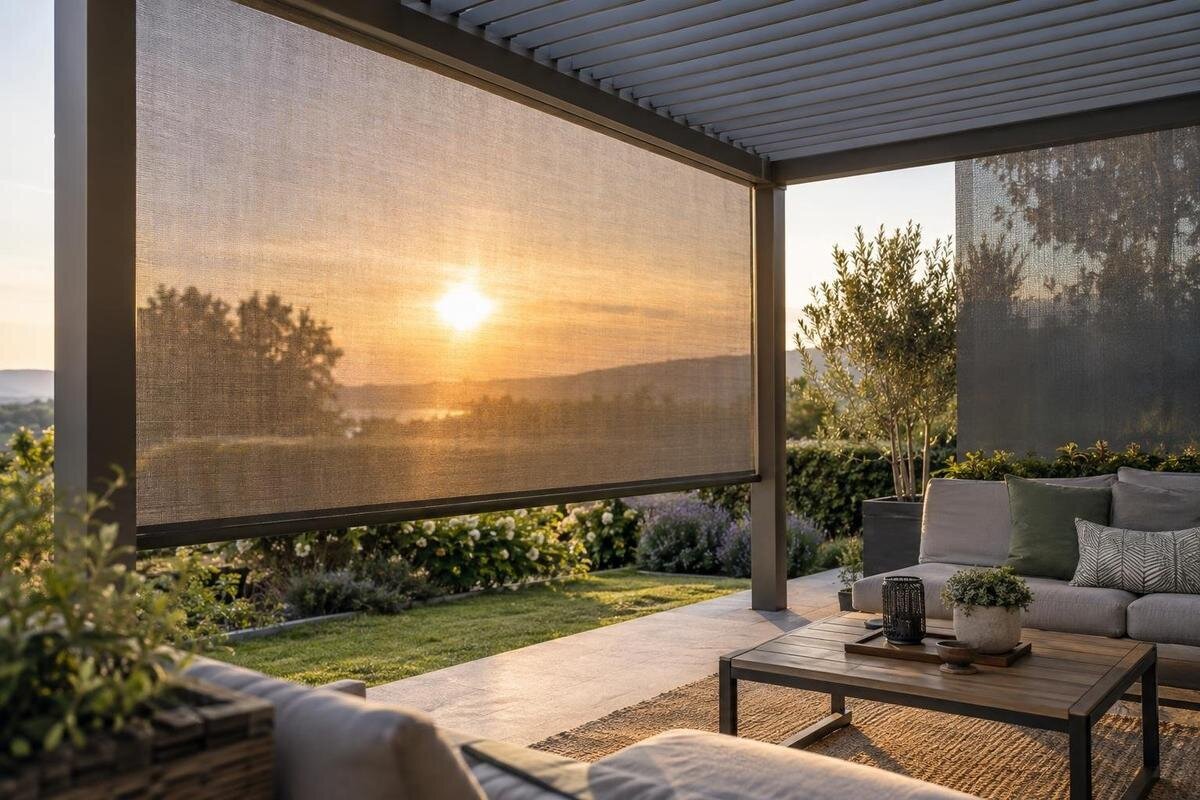
Side screens can make a pergola seating area less exposed to nuisance insects, but their effect depends on where the mesh ends, how the entrance closes and what remains open above or below it. Curtains may soften a breeze or add shade without forming an insect barrier. The useful question is not simply whether a side can be covered, but whether insects can get around that covering through other openings. This guide explains the practical limits, the airflow and access trade-offs, and the product details to confirm. The realistic aim is fewer interruptions, not a sealed, insect-proof room.

What insect screens can realistically do
A fitted insect-mesh screen can reduce the number of insects reaching a seating area through the side it covers. It works as a barrier across that opening only while the mesh is intact, its edges meet the frame or guide, and the panel is closed. It cannot protect an uncovered side, a gap at the top or bottom, or an entrance left open. Nor does a side screen remove insects that were already inside before it was closed. Think of it as reducing one or more routes into an outdoor space, not separating the pergola from the garden.
Set a proportionate goal before choosing a layout. If you want fewer interruptions at a meal, screening the most relevant side may still help even if the pergola remains open elsewhere. If the aim is a fully enclosed room, ordinary outdoor screens and curtains should not be treated as a way to achieve it: every junction and entry needs a suitable closure, and outdoor conditions remain. Judge success by whether your chosen seating area is more pleasant to use, not by a promise that no insect can get through. Species, season and local conditions also vary, so no single layout will solve every evening.
Mesh and curtains do different jobs
Insect mesh and curtain fabric are not interchangeable. Purpose-made mesh has openings that allow air and light through while excluding some insects; with finer mesh, airflow, visibility and cleaning deserve particular attention. Ask for the actual mesh specification and intended use rather than relying on a broad word such as “screen”. A panel sold for shade or privacy may not be designed to stop small insects, and cloth that looks dense from a few steps away can still have an open weave or unclosed edges. If very small flying insects are the concern, ask what the mesh is intended to exclude.
A curtain can still define a seating zone or interrupt a direct approach, but a loose panel may move in a breeze, and paired curtains can part at the overlap. Check the top, bottom and sides as well as the fabric. A curtain-style mesh arrangement only provides a useful barrier while its overlap falls back into place and its edges meet the support. Solid panels or glazing can close a side more firmly, but joints and access still need attention; they are different enclosure choices, not proof of an insect seal. Compare systems by how openings close in daily use, not by appearance alone.
Gaps to map around the perimeter
Make a simple plan of the full perimeter, not just the side facing the garden. Mark each post, corner, wall junction, roof edge, threshold and place where the paving changes height. Include the everyday entrance, any side normally left open, and where the table or chairs will stand. Inspect lower edges close to the ground and look up at the roofline; a panel that seems continuous from a seated position may still leave an opening above it. The aim is to see which routes the proposed screening would actually close, rather than focusing only on the largest side.
If you are assessing Bloomcabin Pergola, ask which sides, if any, can take an approved screen in the exact configuration you want. The model name does not confirm that mesh, tracks or closures are included. A useful answer should identify where each panel would start and finish and what happens at the floor, corners and roof connections. Note any gap that remains rather than assuming several covered sides make it irrelevant. A quick sketch can make those questions clearer than a general view of a pergola.
Roofline, corners and wall junctions
A screen needs to meet the edges around its opening. At the top, look for a closing detail rather than an unexamined strip between the fabric and roof. At each corner, check whether the mesh meets the adjoining side or stops at a post; an exposed return can leave a route even when the centre of each panel is covered. At ground level, paving changes, thresholds or uneven edges can prevent a panel from meeting the surface consistently. A barrier should not be judged from its broad face alone.
The roof and side screen are separate parts of the enclosure. If the roof has adjustable sections, confirm how the edges align in the positions you intend to use; do not assume a roof position used for shade also creates an insect-tight junction. A wall-mounted layout adds the building-side edge to the plan. For Bloomcabin Lean-To Pergola, ask how an approved screen would meet the wall, roof edge and end post in the arrangement you want, rather than planning a third-party panel around a general picture.

Access through a screened side
Access is easy to overlook because a panel that is open for only a short time can still leave a direct route into the seating area. Think about how people actually move through the pergola: carrying food, shifting chairs or going between the house and garden. If a screen needs careful fastening after every passage, it may not be closed consistently. Decide where the entrance should sit in relation to the table and the usual walking route, and consider how easily it can be opened and shut. A wide gap between curtains may be convenient, but it remains an opening.
If the system has a dedicated screen doorway, check how wide it opens, how the closure works and what sits along the bottom edge. Ask which access arrangement, if any, is available for Bloomcabin Bioclimatic Aluminum Pergola in the configuration you are considering; the model name alone does not describe how a screen entrance operates. Think about ordinary use, not just how the panels look when nobody is passing through. The aim is an entrance people can use without routinely leaving the screen parted or creating an awkward obstacle at the threshold.
Airflow and visibility as coverage increases
Every covered side changes the route air can take through the seating area. Open mesh lets some air pass, but a finer weave or several covered sides can feel less breezy than an open pergola. Solid fabric curtains generally block more of the direct airflow. The result also depends on wind direction and the surrounding layout, so no general screen choice guarantees a particular level of ventilation. If retaining a breeze matters, consider partial coverage or an open side, and assess the intended arrangement rather than assuming that mesh has no effect on airflow.
Check sightlines as well as airflow. Compare the view from a chair and the approach to the entrance, not just the appearance from outside. Mesh pattern, colour, light and viewing distance can affect how clearly you see through it, so a small sample may not show what a full side will look like. When assessing side-screen options for Bloomcabin Pergola, request a sample or a view of the proposed mesh across a full opening if available. Look through it towards both planting and the doorway: retaining a garden view and clearly seeing someone approaching are different practical considerations.
Choose coverage for the seating area
Base the plan on how you use the space rather than enclosing every side by default. Note when insects are most noticeable, where people sit, and which openings are used most often. If the problem seems concentrated near outdoor lighting or food, record that too; it is a clue about the setting, not a dependable insect-control method. A screen on one side may reduce a direct route to the table, but it cannot rule out insects entering from another direction. A few observations during normal use can help you decide which side deserves attention first.
Keep the furniture and everyday entrance in the sketch. Screening should not force chairs into an awkward position or make the route to the table impractical. When considering the Lean-To Pergola, allow room for chairs to be pulled out without pressing against the proposed mesh, and check where panels would sit when open. A gathered curtain or retracted screen may occupy space beside a post that you intended to use for seating. If only one side is covered, treat the others as open. For all-round coverage, weigh the intended reduction in insect entry against the space needed for furniture, airflow and comfortable passage.
Accessory compatibility depends on the exact model
Compatibility is specific to the model and configuration. A screen sold for a general pergola size may not line up with the posts, beams, wall fixings or moving parts of a particular structure. Confirm the exact model and chosen arrangement with the manufacturer or supplier, and ask whether the proposed screen is approved for it. Generic measurements do not establish fit. Check the attachment and the full opening it is meant to cover, including whether the screen would interfere with normal access or with parts that move.
Treat third-party screens as separate products unless compatibility has been confirmed. Ask who supplies or fits them, which sides and junctions they cover, and whether instructions are available for the exact attachment. For the bioclimatic model listing, ask about the precise version you are considering; the model label alone does not show that insect mesh is included or approved. Do not modify the pergola to fit an accessory without model-specific guidance. If the attachment needs technical judgement, seek advice from a suitably qualified installer.

Care and outdoor exposure
An insect screen needs ordinary care to keep its edges and closures working as intended. Check the mesh after installation and at the start of regular seasonal use for tears, loose seams, gaps and closures that no longer meet. Clean it only as the screen maker directs; unsuitable products or rough treatment may damage it. If the system uses a track, follow its care instructions so the panel can still travel fully. Deal with damage before relying on the screen for an evening, since a small tear or loose edge can leave an unintended route.
Outdoor conditions still reach the structure. Wind can pull loose curtains away from an edge, while rain, dirt and seasonal debris can affect how a screen closes. Side mesh is not a substitute for weather enclosure. Follow the accessory maker’s guidance on when to retract, secure or remove a panel; do not assume it is meant to stay deployed in every condition. For any screen proposed for the regular Bloomcabin Pergola model, find out whether seasonal removal is required and how it should be stored. Include those tasks in your comparison: an accessory that needs frequent attention may not suit occasional, spontaneous use.
A practical check before ordering
Before ordering, compare the quotation with your perimeter sketch. It should distinguish the pergola itself from any proposed mesh panels, guides, closures and fitting work, rather than leaving you to infer what a photographed arrangement includes. Check that each screened opening is identified and that any unscreened roofline, corner or ground-level gap is recorded. If two proposals cover different parts of the structure, they are not equivalent simply because both mention insect screens. Ask for drawings or written clarification where the scope is unclear, so you can judge the actual coverage rather than the number of panels.
Keep a record of the agreed model, side arrangement and accessory specification. For the wall-mounted Bloomcabin model, this should distinguish the building-side junction from the outward-facing sides and identify the intended entrance. Confirm who is responsible for supplying and fitting each component, and retain the relevant operating and care instructions. Any unresolved gap should remain visible in the plan, rather than disappearing from the description once an order is placed. If a roofline, doorway or ground edge must remain open, decide whether partial protection would still be useful for your seating area. That is a practical limit to accept, not a basis for expecting full exclusion.
Frequently asked questions
Can side screens make a pergola insect-proof?
Not reliably on their own. Roof edges, wall connections, corners, the ground line and access points all need to form a continuous barrier, and every entrance used during the evening creates another opportunity for insects to get in. Treat screens as a way to reduce routes into an outdoor space, not as a guarantee of complete exclusion.
Are ordinary curtains enough to keep insects out?
Usually not. Curtain fabric may provide shade or partial screening, but it can have an open weave, gaps at the top or bottom, or panels that part in a breeze. For insect protection, check that the material is purpose-made mesh and that the edges and access opening can be closed appropriately.
Will insect mesh leave the pergola breezy?
Some air can pass through mesh, but the feel depends on the weave, how many sides are covered and local conditions. More coverage can reduce the breeze. Leaving a side open may preserve more airflow, but it also leaves a route for insects to enter. Assess both effects in the layout you intend to use.
Should I screen every side?
Not automatically. Observe where you sit, which openings are used and when insects are most noticeable. Screening a priority side may be a useful compromise, while covering more sides can make access and airflow less convenient. An open side remains a possible route, so avoid expecting one screened area to protect the whole pergola.
Can I fit a standard third-party screen?
Only if it is confirmed as suitable for the exact pergola model and configuration. Check how it attaches, which openings and junctions it covers, and whether it interferes with normal access or moving parts. A screen’s general dimensions or a photograph do not establish compatibility; ask the manufacturer or supplier for model-specific guidance.
Pergola insect screens are most useful when treated as a local barrier around a chosen seating area. Mesh intended for insects offers a clearer basis than an ordinary curtain, but the edges, entrances and roof junctions determine whether the barrier connects. More coverage can mean less breeze, a less open view and a more involved daily routine. Match the screen to the places you sit, confirm compatibility with the exact model and accept any route that remains open. The aim is to reduce nuisance while keeping the pergola recognisably part of the garden, not to turn it into a sealed room.
