
Should Pergola Louvres Be Open or Closed in Strong Winds?
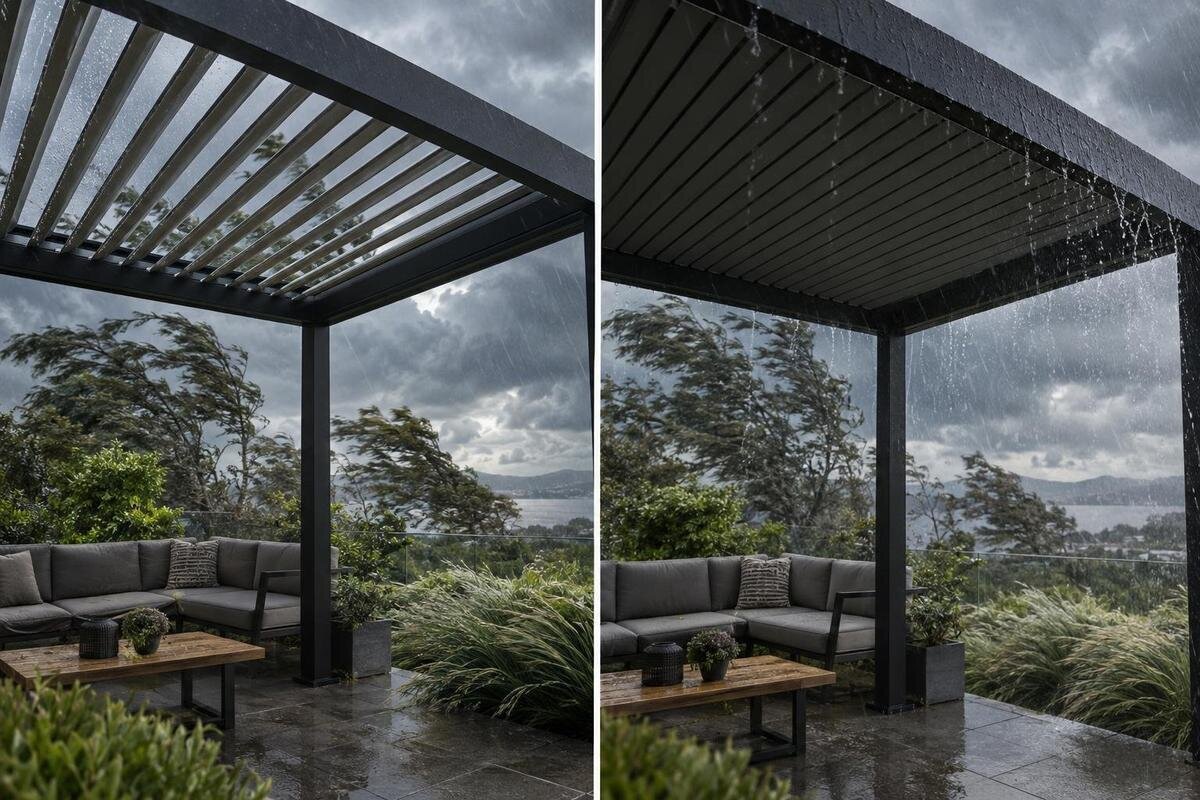
Pergola wind guidance
Whether pergola louvres should be open or closed in strong winds has no safe, universal answer. The position approved for one roof may not be right for another: louvre shape, supports, controls, mounting and any side enclosure all affect the model-specific guidance. Use the operating instructions for the exact pergola and installed configuration, including the wind conditions those instructions describe. If the manual does not give a clear setting, ask the manufacturer or installer rather than borrowing a rule from a similar-looking roof. Do not experiment with angles once strong gusts have reached the structure.

Model-specific document checklist 1
There is no universal open-or-closed setting
The right setting is the one the manufacturer specifies for the exact pergola and the wind conditions covered by its instructions. Strong wind is not precise enough on its own: a manual may distinguish gusts from sustained wind, name an operating limit, or describe an adverse-weather condition that needs interpretation. Do not turn a general forecast into an opening angle unless the manufacturer explains how to do so. A weather-service reading may also describe different conditions from those around the roof, especially where nearby buildings or trees affect airflow.
Pergolas differ in louvre profile, pivot arrangement, restraints, drive system and support design. Those details affect what the maker has assessed and which settings it permits. A position used for rain is not automatically the position for wind, and a visually similar roof is not proof that its instructions can be shared. Depending on the model, the answer may be a specified angle, a direction not to operate the roof, or another procedure. Check whether the instructions distinguish wind resistance while stationary from wind allowed during operation; those statements are not interchangeable.
Read the operating instructions for the exact model
Open the latest operating manual for the pergola you have, or the precise model you are considering. Look for sections on operation, wind, adverse weather or limits of use. The useful instruction is not just a preferred position: it should say whether the roof is to be opened, closed or set at a named angle, and when to make that change. Check whether it applies while the pergola is in use, before a forecast event, or only below a stated operating limit. Those are different instructions.
When comparing models, use the Bloomcabin Bioclimatic Aluminum Pergola product page to identify the product you are asking about, then request its operating instructions before ordering. Match the model designation, product code and configuration recorded on your quotation or order to the manual and installation handover. If identifiers conflict, ask which document applies before relying on it. Read the surrounding instructions too: a limit may restrict operation rather than tell you to adjust the roof at that moment. Pay particular attention to how the manual labels roof positions. Open might mean a defined end position, not any angle that leaves a gap; closed might also have a specific meaning in the control instructions. If a diagram, angle label and written instruction appear inconsistent, ask for clarification rather than interpreting the illustration yourself. This makes the eventual wind procedure usable by everyone who operates the roof.
Model-specific document checklist 2
Why open and closed positions behave differently
An open position may leave gaps through which some air can pass, but the louvres, pivots and supporting frame remain exposed. Gusts can change direction and act on surfaces at different angles, so an open roof is not free of wind force. Closing the louvres changes how the roof meets the wind; depending on the design, it may present a more continuous surface. That does not make a closed position automatically safer. The manufacturer’s assessment of the particular assembly is what matters.
A partly turned roof is not automatically a compromise between open and closed. It presents a different profile and may be permitted, prohibited or untested for the conditions in question. If the Bloomcabin Pergola is on your shortlist, ask whether the relevant instructions identify a particular roof position for wind and how that position is recognised using the supplied controls. Do not infer an approved angle from a product photograph: it may simply show the roof arranged for shade or ventilation. Treat claims such as leaving the louvres open so air can pass through, or closing them to secure the roof, as guesses unless the exact instructions support them. Even an observation that a roof seemed quieter at one angle does not establish its wind resistance. Noise, visible movement and apparent comfort beneath the roof are not substitutes for the manufacturer’s stated operating conditions.
Wind ratings and operating limits are not interchangeable
Weather information can refer to different things: a tested condition, a structural design value, a limit for leaving the pergola in place, or an instruction for operating the louvres. These are not automatically interchangeable. A statement about the frame under a stated load does not necessarily say which roof position to use, or whether it is safe to move the roof at that time. Ask what a figure or label describes and whether it sets an operating threshold, a condition for the structure while stationary, or something else.
Where a supplier provides a test report or controlled observations, look for the setup and limits: the exact model, louvre position, wind direction, definition of gust or average, mounting arrangement and any side enclosure. Without that context, a headline figure may not apply to your installation. When enquiring about the Bloomcabin Lean-To Pergola, request the explanation behind any weather-performance figure supplied with the quotation. Keep its units and wording together; do not copy just the largest number into a comparison sheet. Ask whether the evidence covers your proposed size and configuration, and whether it describes the whole assembly or only a particular component. Controlled observations should also identify what was observed and under which conditions. They do not automatically establish a limit for other conditions. If there is no accompanying operating instruction, the result still leaves the open-or-closed question unanswered.

Model-specific document checklist 3
The documents to assemble before deciding
Make a record of the exact product name and code, the roof configuration on your order, the control type and whether the installation is freestanding or attached. Note any side screens, glazing, blinds or other accessories, along with information from the installer’s handover. For a model found through the bioclimatic pergola listing, retain the quotation and order details so the supplier can identify the version actually supplied. A general brochure may cover several versions without explaining which instructions apply to yours. Keep a simple document index recording each document’s title, revision or date, applicable model and relevant page numbers. This lets you find the wind procedure quickly without searching through sales material. For an existing installation with incomplete records, use any accessible identification label and the original invoice; do not climb onto the structure to look for a code. Ask the supplier to help resolve missing identification.
Request the current operating manual, installation instructions, model-specific weather information and any diagram showing permitted louvre positions. If a sensor or control system is fitted, include its operating instructions; also request the drainage diagram for the roof configuration. Check document dates and model references, and confirm that any stated weather conditions match the installed options. If several versions of a guide exist, do not choose one simply because its product name looks similar. Ask the supplier or manufacturer to confirm the applicable revision.
Check the installed configuration as well as the roof
The roof is only one part of the wind setup. Side screens, curtains, fixed or sliding glazing and nearby structures can change where wind enters and how it moves around the pergola. A freestanding and an attached installation may also be considered under different conditions. Check whether your accessories and mounting arrangement are included in the manufacturer’s guidance. Instructions written for a roof without side enclosures should not be assumed to apply unchanged when screens or panels are added.
For a proposed Lean-To Pergola installation, include the wall attachment and any planned enclosure in your request for model-specific guidance. Give the manufacturer or installer an accurate description of the arrangement and ask which manual and wind instructions apply. A sketch or photographs taken safely from ground level can help distinguish an open side from one fitted with panels or screens. Ask whether movable accessories have their own required wind positions and whether those instructions need to be followed alongside the roof procedure. Do not assume that opening the louvres compensates for leaving a screen deployed. If the supporting wall, fixings or installed arrangement are uncertain, have their suitability assessed by a qualified professional rather than trying to resolve the issue through roof settings. Keep any later accessory changes in the installation record so future advice relates to the configuration you actually have.
Model-specific document checklist 4
Plan the adjustment before strong gusts arrive
Read the relevant instructions while conditions are calm, then work out how you will follow them. Identify the control, make sure the people responsible for using it know the stated procedure, and check whether the manual sets a limit on operating the roof in wind. If it specifies an adjustment before particular conditions, plan around that instruction rather than waiting until the pergola is already buffeted by gusts. A general forecast is a prompt to review the manual, not a substitute for its definitions.
If the manual allows a change only within stated conditions, do not try to operate the roof after those conditions have been exceeded. Avoid climbing, leaning over the structure or reaching into moving parts to get to a control. Before choosing the regular pergola model, ask how its documented wind procedure would fit your intended use, particularly if the property is often unattended. Establish whether the procedure requires someone to be present and whether any approved automatic response is available; do not assume either from the catalogue name. For a shared household or holiday property, keep the applicable instructions accessible and agree who is responsible for following them. This avoids one person changing a setting that another has already selected under the manual. If guidance is missing and the wind is rising, do not test different angles; keep people clear if there is an immediate concern and seek advice when conditions allow.
Treat wind sensors as one part of the system
If a wind sensor or automatic control is fitted, check its own instructions alongside the pergola manual. Confirm whether it is approved for that exact roof and installation, what conditions trigger a response, and which louvre position the system is meant to command. Do not assume that a sensor is included, compatible or configured simply because an automatic control is mentioned in a general description. The model-specific paperwork should explain what the equipment does and what still requires attention from the user.
Ask what happens if the power supply is interrupted, the sensor cannot communicate with the controller, or the louvres are already in a different position. Also check any inspection, testing or maintenance directions; do not change settings or disable a control without manufacturer guidance. When requesting a quotation for the Bloomcabin Bioclimatic Aluminum Pergola, ask for any proposed sensor and controller to be identified separately, together with their applicable instructions. A useful handover should explain how you recognise normal operation, any warning indication and the response required from you. Ask how wind commands interact with other fitted controls, such as a rain response, if relevant to the proposed system. Do not invent a priority between them or assume that the last command is correct. Treat automation as a feature whose behaviour must be understood, including its limitations, rather than a replacement for the manual’s wind procedure.

Model-specific document checklist 5
Keep wind advice separate from rain and drainage claims
A louvre position used for rain does not, by itself, answer what to do in wind. Nor should a statement about rain protection be read as a guarantee about performance in driving rain or strong gusts. The permitted positions and weather conditions need to come from information for the exact model. Keep those questions separate when you review documents: ask which setting is specified for wind, and what conditions or configuration apply to any statement about rain.
A drainage diagram explains the intended route for water through the relevant roof design; it is useful context, but it is not a wind-setting guide. For the pergola shown in the product listing, request a diagram that matches the quoted configuration rather than relying on gallery images. Read it alongside any instructions about water remaining on the louvres or being released when the roof moves. If the documents discuss this, note the conditions and precautions they specify; do not infer them from another design. Follow the manufacturer’s directions for keeping drainage paths clear, with maintenance planned for suitable conditions rather than during gusts. Where rain and wind occur together, ask how the operating instructions address both if this is unclear. The aim is to understand the documented procedure, not to choose whichever position seems driest underneath. Any apparent conflict needs clarification from the manufacturer.
What to do when the instructions are missing
Ask the manufacturer or installer a specific question and provide the details needed to identify your setup: product name and code, roof configuration, mounting arrangement, controls and any side enclosure. Ask which position is permitted in the wind conditions they define, when the louvres should be moved, and whether operation is allowed once gusts have begun. If a document gives a wind figure, ask what it measures and which configuration it covers. A clear written answer is more useful than a general assurance that the pergola is suitable for outdoor use.
Keep that answer with the manual and installation documents so anyone operating the roof can refer to the same guidance. If two documents disagree, ask which revision governs before relying on either one; do not resolve the difference by copying instructions from a similar model or online discussion. If the installed setup is not covered, request model-specific advice from the manufacturer or a qualified installer. Where the wind is already strong, do not approach the structure to experiment. Make the decision about operation when it is safe to do so.
Frequently asked questions
Is it safer to leave pergola louvres open in strong winds?
Not as a general rule. Open louvres may leave gaps for some airflow, but the blades and supporting structure are still exposed. The effect of opening them depends on the particular roof and its instructions. Use the position specified for your exact model.
Should I close the louvres when a wind warning appears?
Follow the manual’s stated trigger and procedure rather than treating every warning as an instruction to close the roof. Check whether it distinguishes gusts from sustained wind and says when adjustment is allowed. Do not wait for strong gusts to try an unverified setting.
Can I leave the louvres partly open?
Only if the instructions for your pergola permit that position in the relevant conditions. An intermediate angle is not automatically a safe compromise: it changes the roof’s profile and may not be an approved or assessed position.
Does a wind rating tell me whether to open or close the roof?
Not necessarily. A wind figure may describe a stated test condition or structural limit rather than an operating instruction. Ask what it refers to, which louvre position and installation it covers, and whether it specifies when the roof may be moved.
What if the manual does not mention a wind setting?
Ask the manufacturer or installer for written guidance for the exact model and installed configuration. Provide the product code and details of any screens, glazing or other options. Until the answer is clear, do not rely on advice for another pergola or experiment in strong gusts.
There is no dependable rule that open or closed louvres are always safer in strong wind. Use the position and timing specified for the exact pergola and its installed configuration, paying attention to how the instructions define wind conditions and operating limits. If those documents do not give a clear answer, get model-specific guidance before changing the roof. Appearance, a general forecast and another owner’s experience are not substitutes for the instructions that apply to your pergola.
