
Pergola Rain Sensors: What They Detect and What They Do Not
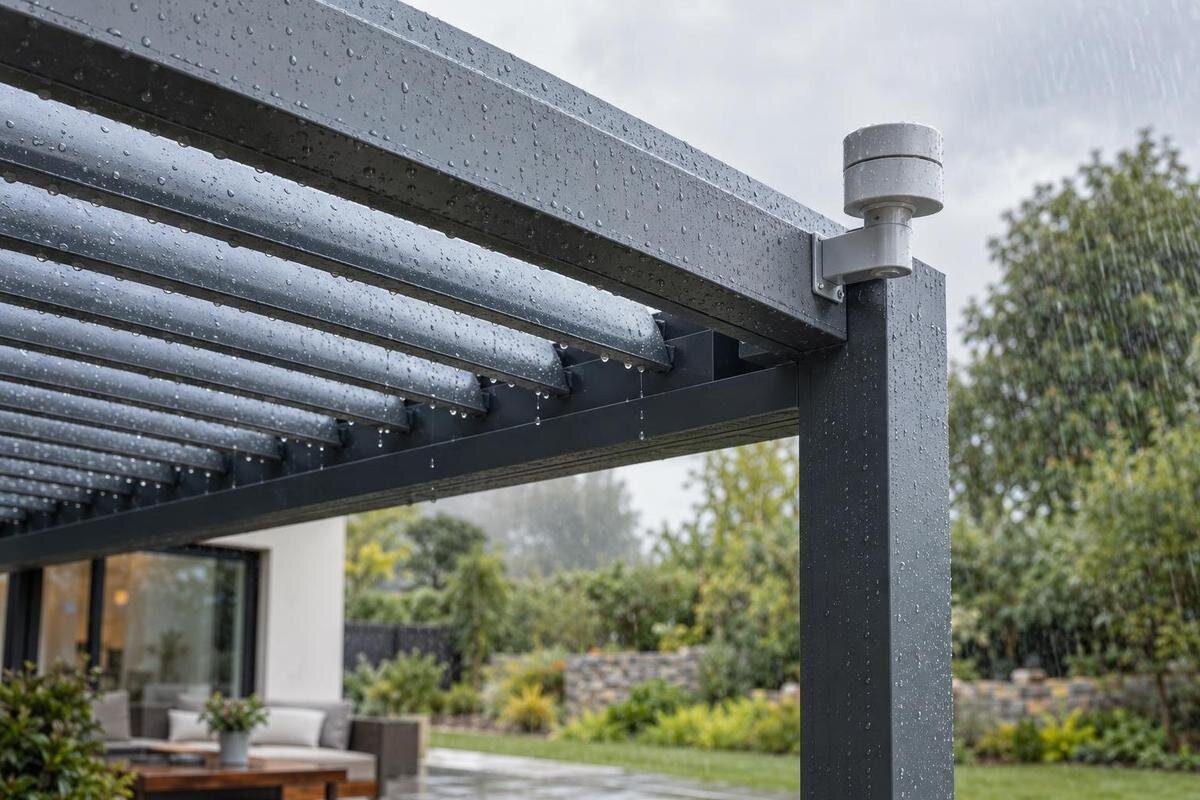
Pergola controls
A pergola rain sensor is a trigger input, not a miniature weather service. It reports what its sensing element can register; a controller may then apply its own settings and send a command to a compatible roof mechanism. The outcome depends on sensor type, position, threshold, delay, control logic and the mechanism itself. This guide separates what a sensor can detect from broader assumptions about forecasts, weather protection and automatic movement, and explains what the system documentation should confirm before you rely on a rain response.

What a pergola rain sensor actually reports
A rain sensor reports conditions at its sensing point, not across the whole pergola. In a common surface-wetness design, water on an exposed element changes the sensor’s reading and the controller receives a local wet/dry signal. That may be useful as a trigger, but it is not a forecast, weather radar or proof that rain is falling on every part of the terrace. A sheltered sensor can experience different conditions from an exposed seating area, and a wet element may remain damp after a shower has passed. Treat the reading as one input to an automation system, not as a complete account of the weather or a guarantee about the roof.
Sensor terminology alone may not explain the trigger. A product description can say rain sensor without stating whether the device detects surface moisture, measures rainfall or sends a simple wet/dry signal to a controller. Those are different functions. The manual for the exact sensor should identify its sensing method and output, then explain how the control unit interprets them. If the documentation gives no units or rainfall rate, do not assume it measures millimetres of rain. If it reports only wet or dry, ask what threshold or persistence rule changes that state, whether the setting can be adjusted and what signal reaches the controller. This separates the sensor’s reading from the roof’s eventual response.
Wetness detection is not the same as measuring rainfall
Many outdoor sensors respond to water reaching a sensing surface, rather than counting drops over the roof. In a conductive wetness design, for example, moisture changes an electrical reading across an exposed element; other sensor principles are possible. A wet/dry output can mean that the element has crossed a set threshold, but it does not automatically quantify rainfall depth or intensity. Depending on the design and filtering, a splash, condensation or lingering droplets may register as moisture, while rain blowing past a sheltered element may not register promptly. The specification should state whether the device reports wetness, a rainfall amount or another defined signal. Do not infer a measuring range from a sensitivity control: it may adjust a trigger, not measure rainfall.
When comparing pergolas, keep the roof description separate from the sensor specification. Use the Bloomcabin Pergola product page to identify the regular model, then check which sensor, if any, is offered with your chosen configuration. An accessory list should name the device so that you can distinguish a wetness detector from equipment that measures rainfall. Check its stated output as well: a wet/dry signal answers a different question from a rainfall measurement. If the description only says rain sensor, ask what that means for the particular accessory. Neither the product name nor the roof format establishes the sensing method or confirms that automatic movement is included.
How a wet reading becomes a roof command
Automatic movement involves several stages: the sensor registers a condition, a control unit interprets the signal, and a compatible motor or mechanism receives a command. A sensor can be present without that final movement being enabled; in some arrangements it may provide an alert, while other systems may have a programmed response. The manual should say which event triggers an action and what action follows. Check whether the command depends on the roof’s current position, another setting or a particular control mode. Without this chain being documented, rain-activated does not tell you whether the roof closes, changes angle, pauses or does nothing. A trigger and a movement are separate specifications.
Ask for the exact response, not only confirmation that a rain sensor is compatible. Does detection cause a defined movement, send a notification or require manual input? Is the command applied to every controlled section, and what happens if the roof is already at an end position? When considering the Bloomcabin Bioclimatic Aluminium Pergola listing, establish whether the quoted configuration includes the sensor, controller and mechanism needed for that response. The model name alone does not confirm those components. A useful explanation should trace the signal from detection to the resulting action, so that you know whether the proposed package delivers the behaviour you expect.
Thresholds and delays affect the trigger
Some controls allow a sensitivity or threshold setting; others use a fixed trigger. The terms and scales are not universal, so a high or low setting cannot be translated into a rainfall amount without stated units. Check what condition is being adjusted, the available range, the factory setting and whether the setting belongs to the sensor or its controller. A change may alter when a wet surface is recognised, but it cannot make a sensor report conditions its sensing element does not encounter. If there is no adjustable setting, the documentation should still identify the fixed trigger or explain the expected sensing behaviour. This matters if light showers, intermittent drops or local splashing would lead to different roof decisions.
Timing is another part of the logic. The system may require a signal to persist, delay movement or wait until the sensor has dried before changing back; it may instead use a different rule. A delay can help avoid a response to a brief wetting event, but it also means the roof may not move at the first drop. Nor should you assume it reopens as soon as rainfall stops: a wet element, a reset delay or a manual setting may keep the previous state. If you are considering the Bloomcabin Lean-To Pergola, ask separately about the detection delay and the reset rule. These describe different stages of the response and cannot be inferred from the lean-to model name.

Sensor position shapes the reading
Placement determines which patch of weather the sensor samples. A device tucked under an overhang may receive less direct rain than the covered area, while a more exposed location may get wet before a sheltered table does. Wind direction, a nearby wall, roof edges or drips from surrounding surfaces can also make local conditions differ. These are reasons to follow the manufacturer’s specified sensor position, not to choose a spot simply because it is convenient. Ask what exposure the instructions require and whether the reading is intended to represent the pergola roof, a nearby area or a particular opening. In real use, position can matter as much as the trigger threshold.
Check the location against the actual site rather than treating the sensor as if it were distributed across the whole roof. When reviewing Bloomcabin’s regular pergola listing, consider where the seating area sits in relation to walls, overhangs and nearby sources of dripping water. Ask the supplier or installer to identify the prescribed sensor location for the exact system and explain how surrounding shelter could affect its reading. A convenient mounting point is not necessarily representative of conditions over the terrace. This is especially relevant if one part of the seating area is exposed while another is sheltered: the sensor still provides a local reading, not a separate assessment of each area.
Rain detection does not cover every weather risk
A rain sensor cannot report every weather condition. Unless the documented system also includes the relevant sensing equipment, rain detection does not tell the controller wind speed or direction, gusts, frost, snow, hail or temperature. A wet surface is not a reliable proxy for all of those hazards: the sensor could be dry while a separate weather risk exists, or wet in otherwise calm conditions. Do not assume the words weather sensor mean that wind or other conditions are covered; look for named sensors and the rules associated with each input. If wind response matters for your site, confirm it separately in the roof system’s documentation, particularly where rain and wind may arrive together.
Nor can rain detection confirm how water behaves after it reaches the roof. It does not establish that runoff is unobstructed, that drainage parts are clear, that no water is collecting or that a joint or covering is watertight. A rain-triggered position is a control response, not proof of weather protection. Read the roof specification for its stated use and water-management details, and raise site-specific questions with a qualified installer where required. Keep these checks separate from the sensor’s detection claim: one concerns what the device registers; the other concerns how the roof and its drainage are designed to handle water. Neither can be inferred from the presence of automation alone.
The roof mechanism must support the response
The sensor can influence a roof only when the rest of the system supports the required command. A manually operated or fixed roof does not gain automatic movement just because a sensor is added; compatible controls and a mechanism must be provided, and the allowed movement must be specified. Different roof designs may have different available positions and control limits, so do not assume rain means a particular louvre angle or that a retractable covering must close. Ask which position the system is designed to request and whether any conditions can prevent the movement. This is a compatibility question across the sensor, controller and roof mechanism, not a decision made by the sensor alone. The documentation should identify the supported combination.
Treat the roof’s format and its automation options as separate points in your comparison. For the bioclimatic aluminium pergola model, establish which controls are included in the selected configuration and which, if any, are offered separately. The term bioclimatic does not itself confirm a sensor, motor or rain-response setting. If a control unit is proposed as an addition, ask who confirms that it works with both the sensing device and the roof mechanism. The important detail is the supported combination, not simply the availability of individual accessories. That distinction helps you compare a complete operating package with a roof whose automation options remain unconfirmed.
Power loss and faults need separate answers
Ask what happens when part of the control chain is interrupted. A power cut, failed sensor signal, lost connection or controller fault could lead to different outcomes on different systems: the roof might hold its last position, stop, reject commands or show a fault, but none of those responses should be assumed without a manual. Check whether the system identifies a sensor fault and whether rain automation resumes automatically after power or communication returns. Also ask what manual control remains available and whether it works independently of the sensor. These are normal operating questions, not a reason to assume an automatic system has a particular backup mode. The specification should describe recovery as well as the normal trigger.
For the wall-mounted pergola listing, separate the mounting arrangement from the control system’s behaviour during an interruption. Ask what fault indication a user would see, whether manual operation remains available and what happens when power or communication returns. These answers should apply to the precise sensor and controller pairing under consideration. In particular, distinguish recovery of the controls from resumption of rain automation: knowing that the system can operate again does not explain whether its previous mode is restored. Do not infer a fail-safe position from the pergola’s name or mounting style. These questions matter if you expect the roof to respond while nobody is there to check it.

What to verify in the system specification
Before choosing a rain-sensing package, ask for the sensor and controller model numbers, whether each component is included, what the sensor actually measures and what input changes its state. Then confirm whether the trigger is fixed or adjustable, any stated threshold or units, any detection or reset delay, the command sent to the roof and what happens if a sensor or communication fault occurs. The documentation should name compatible roof mechanisms and say whether the response covers one control zone or several. These points turn a broad feature label into an operational description. Ask for the relevant manual or diagram for the exact configuration, not a general brochure for a product family. Written confirmation can clarify references to optional accessories.
Do not confuse the pergola’s advertised area with a sensor zone. The regular pergola model page shows a 97–258 ft² range, but that figure does not state how many sensor inputs, movement groups or independently controlled areas a particular system supports. If your terrace needs different roof sections to respond separately, ask how a rain signal is distributed between them. Establish whether one detection event sends the same command to every section or whether the documented controls allow separate responses. If all sections move together, consider whether that suits the seating and sheltered areas you use. Confirm the arrangement for the selected configuration rather than inferring it from the area figure.
Choosing rain automation for your terrace
Think about what you expect the automation to achieve. A sensor can reduce the need to notice local rain and press a control, but it cannot predict a shower, assess every exposed item or guarantee that the terrace stays dry. Consider whether a delayed response, a sensor that remains wet after the rain or an unwanted wet reading would be acceptable for your use. If you expect the roof to react while nobody is home, ask how faults are reported and what the system does without a reliable sensor signal. An alert, a timed command and automatic movement are different outcomes; make sure the one documented is the one you actually want.
When comparing options, record the behaviour that matters to you alongside each shortlisted roof: what triggers a response, what movement follows and how the rain state clears. Use Bloomcabin’s bioclimatic model page to identify the product, without treating the listing as confirmation that rain sensing is included. Keep included features, optional components and unanswered questions separate in your comparison. Where a response remains unspecified, do not fill the gap with assumptions drawn from another pergola. This gives you a practical basis for judging the proposed automation: whether its documented behaviour suits your terrace use, rather than whether the product description simply mentions a sensor.
Frequently asked questions
Does a pergola rain sensor measure rainfall in millimetres?
Only if its documentation says it measures rainfall and gives units. A sensor that reports wet or dry may detect moisture at its sensing point without calculating rainfall depth or intensity. Check the sensor’s method and output rather than assuming it acts as a rain gauge.
Will a rain sensor close the pergola roof automatically?
Not necessarily. Automatic movement requires a compatible controller and roof mechanism, plus a programmed response. Some systems may provide an alert or require manual input instead. Confirm the exact action in the documentation for the sensor, controller and pergola combination.
Can one sensor detect rain across the whole terrace?
It reports conditions at its own sensing point. Rain may reach one part of the terrace while the sensor is sheltered, or the sensor may become wet before the seating area does. Its specified position and exposure affect how representative its reading is.
Does a rain sensor also detect wind, snow or frost?
Do not assume so. Rain detection alone does not report wind speed or direction, or identify snow and frost. Check whether the system specifies separate sensors for those conditions and what response, if any, each input triggers.
Why might the roof stay in the same position after the rain stops?
The sensing element may still be wet, or the controller may use a reset delay or require a manual command. Some systems may follow another rule. Check the exact manual for how the rain state clears and whether the roof is meant to move again automatically.
A rain sensor is most useful when you know what its sensing point detects, how the controller interprets that signal and what action the roof is designed to take. Treat the sensor, controls and roof mechanism as one documented chain. If any part of that chain is unspecified, the expected rain response remains uncertain.
