
Outdoor Sockets Under a Pergola: Everyday Planning
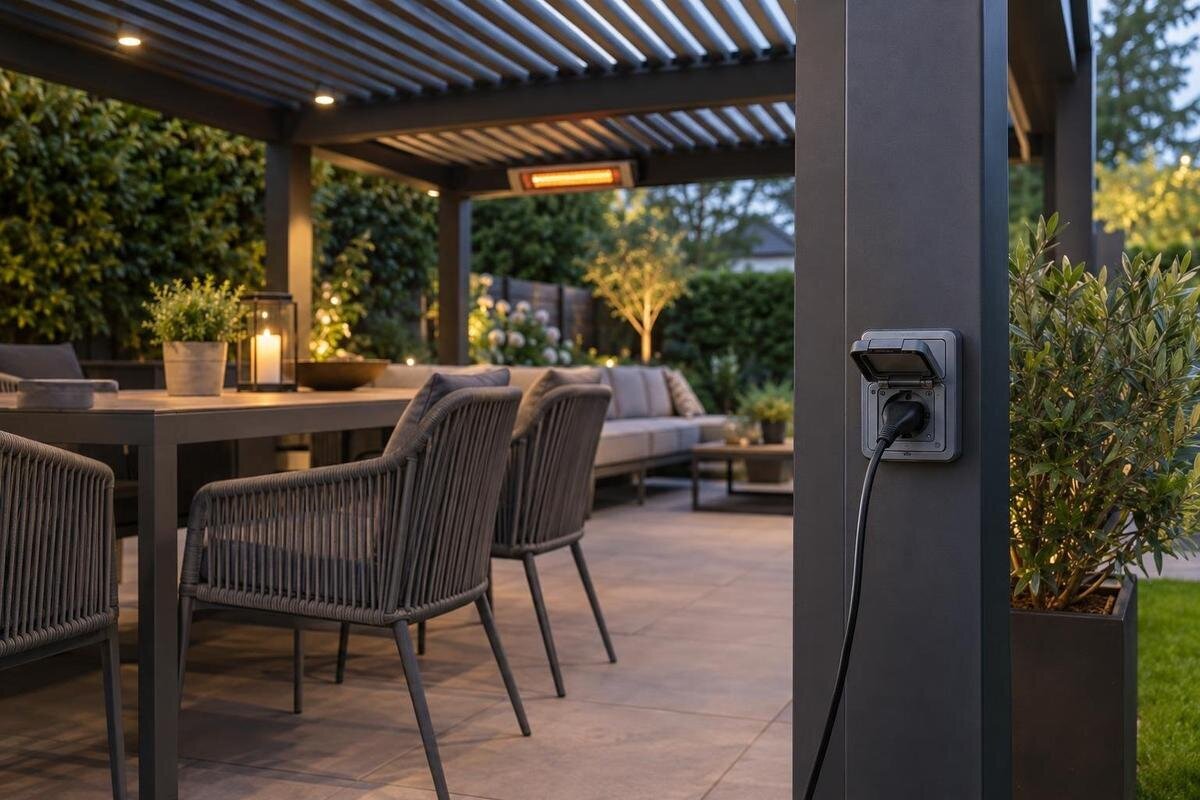
Pergola electrical planning
An outdoor socket beneath a pergola can make everyday tasks simpler, from charging a phone to powering a lamp or an appliance at a meal. Its position and specification still depend on what will be plugged in and how exposed the spot is. A roof does not automatically make the space dry, and a pergola product name is not proof that a socket or cable may be attached to its frame. Use this guide to prepare a practical brief for a qualified electrician; it explains what to decide and ask, not how to wire the installation.

What to prepare for your electrician 1
How many sockets will you need?
Write down each device you genuinely expect to use: task or decorative lighting, phone chargers, a laptop, a speaker, a drinks fridge, a television, cooking equipment or a heater. Divide the list into regular, occasional and seasonal use, then mark which items might operate together. Include guests’ devices or festive lights only if they are realistic parts of your routine. A charger has a different demand profile from a heater or cooking appliance; the number of plugs alone does not tell the electrician whether the existing supply can serve the plan. This prevents socket quantity being confused with electrical capacity.
For each likely appliance, record its maker, exact model if known, stated electrical input and instructions for outdoor use. Note whether it is portable or expected to stay in one place, and whether it has a motor, timer, electronic control or unusually bulky plug or transformer. If you have not chosen the appliance, describe the task rather than guessing its demand. Keep this inventory alongside your structure shortlist, including Bloomcabin Pergola if you are considering it, so each proposed layout can be discussed against the same needs. Mark confirmed choices separately from possible future additions.
Position sockets around people and furniture
Sketch the dining, seating, cooking and circulation areas as they will probably be furnished, not just as an empty floor plan. Mark the table, doors, steps, gates, movable furniture and routes into the garden; then note which appliance needs power at each point. Imagine a lead running from its socket to the device while chairs are pulled out and people pass through. A position that is technically available but hidden behind a bench or planter will be frustrating to use, and a lead across a route may create a trip hazard. Allow for seasonal rearrangements, not only the furniture layout you have today.
Agree practical locations with the electrician instead of applying a standard height or putting a socket in every corner. Consider ease of access from the house and seating, door and window swings, access for children or visitors, and places where drinks may spill or a hose is used. If you are considering Bloomcabin Lean-To Pergola, include the adjoining house wall and doors in your layout discussion. Check whether furniture would obstruct the chosen socket when its cover is open and a plug is connected. A convenient position should remain usable without moving a heavy planter or reaching behind an appliance.
What to prepare for your electrician 2
Treat the pergola as an exposed outdoor setting
Rain does not stop at the edge of a roof: wind can carry it under a cover, while drips from an edge or gutter, open sides, irrigation, washing down and wet plugs can expose nearby accessories. Describe these conditions instead of labelling the space dry because it has a roof. Note where water falls or pools, whether sprinklers reach the area, how the patio is cleaned, and whether a cover is left open or adjusted. The electrician needs the expected conditions at the exact socket position, not a general description of the pergola. Photos after rain may help show drip lines, but do not replace an assessment of the site.
Also mention full sun, frost, condensation, dust, salt-laden air and cleaning products where relevant; exposure can differ between a wall, a post and an open edge. Record conditions throughout the year, not just on the day of a site visit. A spot that appears sheltered in summer may receive rain when the wind changes, while seasonal furniture covers can conceal damp surroundings. If the regular pergola is on your shortlist, use its proposed position on the site sketch to explain these conditions. The electrician can then assess each intended socket location rather than relying on the general description of a covered patio.
Choose outdoor sockets for the actual conditions
Do not choose an outdoor socket solely by colour, style or a broad sales term such as weatherproof. Ask the electrician to identify the specific accessory proposed and explain how its ingress protection, often expressed as an IP rating, relates to the expected exposure. Its manufacturer’s instructions also matter: they should describe the intended setting, fitting conditions, cover operation and any limits on use while a plug is connected. If positions have different exposure—for example, one close to an open edge and another beside a wall—ask whether different accessories are needed. A rating on its own does not settle every aspect of suitability.
Check the fit of the items that will use the socket, not just its empty appearance. A bulky adaptor or transformer may block a second outlet, and a cover may not close around a chosen plug. Include any lead that remains attached and explain whether appliances will be unplugged and stored after use. When reviewing a layout for the lean-to pergola, show the electrician photographs or dimensions of these plugs and adaptors as well as the intended furniture. Ask how easily the cover can be operated and the plug removed in that position. An accessory that suits the weather still needs to be practical for the devices you own.

What to prepare for your electrician 3
Include fixed lights, motors and controls
Decide whether the brief covers only plug-in sockets or also fixed lighting, motorised parts, controls or a permanently connected heater. These are separate items to specify, not simply extra sockets: each has its own instructions, supply needs, switching and environmental limits. Give the electrician the exact make and model of any fixture already chosen, its manual and proposed position. If you have not selected equipment, describe the job it must do and ask what details are needed before a suitable model can be assessed. Do not assume a generic outdoor fitting can be attached to the pergola frame.
Plan how lighting and controls will be used: which areas need light, whether lights should operate together, and where a switch or control can be reached on arrival and from the seating area. Include remote, timer or motor controls in the inventory, even when their supply arrangements differ from those of socket outlets. When discussing the bioclimatic pergola configuration, ask which electrical options, if any, are documented for your chosen version and obtain their manuals before including them in the brief. Distinguish equipment included in the proposed order from separately sourced fittings, so neither the supplier nor the electrician has to assume what will be provided.
Give heaters and cooking appliances special attention
Heating and cooking equipment can change a socket plan more than chargers or small lamps. List a patio heater, electric barbecue, pizza oven, kettle or other appliance only if you genuinely expect to use it, and record the rated input from its label or manual. Note whether it stays in one place or is moved, how long it is likely to run, and which other items could be on at the same time. State whether you expect a plug-in appliance or a fixed connection; the electrician should work from the intended equipment rather than an assumed average load. Include likely winter use or gatherings if they change the pattern.
Ask the electrician to assess the existing supply and circuit capacity against that pattern, and to explain whether the proposed arrangement needs additional provision. Check the appliance maker’s outdoor-use, clearance and connection instructions separately: a suitable socket does not make an indoor-only appliance suitable outside. If you are considering Bloomcabin’s regular pergola model, discuss the intended cooking or heating area with the supplier before finalising its position; compatibility must be established from the relevant documentation. Do not build a permanent plan around extension reels or indoor multiway adaptors. If an appliance is still undecided, record what remains unknown and have the electrician review the chosen model before purchase.
What to prepare for your electrician 4
Agree protective devices with the electrician
Give protection its own line in the brief. Ask the qualified electrician to identify the proposed residual-current protection, overcurrent protection, earthing arrangements and means of safely isolating the pergola equipment, then explain what each measure is intended to cover. The answer should be based on the existing installation, the new outdoor equipment and the way it will be used, not a generic promise that the sockets are safe. Ask whether sockets and fixed appliances need separate protection or switching in this plan, and why. If you have records of the existing installation, make them available without opening electrical equipment.
A residual current device (RCD) or an RCBO, which combines residual-current and overcurrent protection, may form part of the solution. Neither makes a damaged lead, unsuitable enclosure, wet connection or overloaded circuit acceptable. Ask how the electrician will verify the completed installation and what documentation will be provided about its protection and user checks. Have them distinguish routine checks described in the product instructions from work requiring professional attention. Do not open a consumer unit, alter protective devices or diagnose wiring yourself. Ask whom to contact if a protective device trips repeatedly rather than assuming that resetting it resolves the cause.
Keep routes clear of movement and maintenance
Include access for maintenance in the layout, not just access for plugging in appliances. Show where storage boxes, planters and furniture will stand, and identify anything that stays in place throughout winter. Ask the electrician which sockets, controls and connection points must remain accessible for inspection or replacement. A location behind a fixed bench may look tidy but make later work awkward; a removable furnishing is a different proposition from a permanent enclosure. Note how the patio and pergola are cleaned, too, so the proposed arrangement can be assessed against both ordinary use and maintenance without relying on furniture always being moved out of the way.
If there is an adjustable roof, retractable cover, sliding screen or other moving mechanism, show its full range of movement and any space needed for servicing. Ask the electrician and pergola supplier to coordinate the proposed cable route with movement, drainage and maintenance requirements. For a proposal involving Bloomcabin’s wall-mounted pergola, include the adjoining wall, doors and any planned screens in that discussion. Obtain the relevant drawings rather than assuming that a route hidden from view will be suitable. The agreed plan should explain how equipment can be reached later and who is responsible for keeping that access clear when finishes or furnishings are added.

What to prepare for your electrician 5
Confirm the structure allows the proposed mounting
An electrician cannot confirm mounting approval from a product name alone. Before fixing socket positions, give the supplier and electrician the exact model, selected configuration, drawings and instructions for any proposed lights, heaters or motors. Ask which surfaces, if any, are documented for electrical accessories, how fixings would relate to structural and drainage details, and whether a proposed penetration could affect operation or maintenance. If written approval for a frame location is unavailable, do not treat a product photograph or sales image as permission. Ask for the relevant detail and leave the socket position open until it is resolved.
Discuss the route from the house or existing supply at the same time as the pergola layout. An attached or freestanding arrangement affects the locations worth considering, but the electrician must assess the actual site, including paths, entrances and any planned landscaping. If your shortlist includes Bloomcabin Bioclimatic Aluminum Pergola, request documentation for the selected configuration and confirmation of any proposed electrical options. Establish who will provide mounting details and who will approve the proposed fixings before accepting a quotation that depends on them. Resolving these responsibilities before the structure and patio finishes are installed can avoid having to reconsider an otherwise convenient socket position.
What to include in an electrician’s brief
Send a simple annotated site sketch showing the pergola outline, house wall, doors, entrances, furniture zones, intended socket points and devices expected to use them. Add photographs of the locations, available product manuals and structure drawings, plus notes on rain, irrigation, cleaning and sun exposure. Mark which appliances may run together, which choices are confirmed, and which are only future possibilities. The sketch is a communication aid, not a wiring diagram: leave circuit design, cable sizing and installation routes to the electrician. If possible, walk through the likely routine with them at the site.
Before agreeing the work, ask for a written description of the selected outdoor accessories, where they will be used, the circuit and protection approach, isolation, any structural approval needed, and how completion will be checked and documented. Clarify who supplies each fitting, whether fixed lights or controls are included, what is excluded, and what assumptions could alter the quotation. Keep manuals and handover information with the pergola paperwork so a future replacement or added appliance can be assessed against the original plan. Tell the electrician if an appliance or structure changes before installation.
Frequently asked questions
Does a pergola roof make a standard socket safe outdoors?
No. A roof does not rule out wind-driven rain, drips or moisture from cleaning and irrigation. Ask a qualified electrician to choose an outdoor accessory for the exact position and check its manufacturer’s instructions for use with a plug inserted. The word weatherproof on its own is not proof of suitability.
How many sockets should I plan for?
There is no useful universal number. List the devices you expect to use, where you will use them and which may run at the same time, including seasonal equipment. Place sockets for convenient access without leads crossing walkways. Ask the electrician to assess circuit capacity separately: the number of sockets does not tell you what the supply can support.
Should a pergola socket have RCD protection?
Ask the electrician to specify the appropriate residual-current protection and explain how it works alongside overcurrent protection and earthing for your existing installation and planned equipment. The choice depends on the full arrangement; a device label does not show that an accessory and installation are suitable. Do not alter the consumer unit yourself.
Can I fit an outdoor socket to a pergola post?
Only after the supplier or manufacturer confirms that the proposed location and fixing are approved for the exact structure, and the electrician has assessed the accessory and route. A product photograph does not establish mounting approval. Do not drill the frame or conceal a cable based on a general illustration.
Can I use an extension lead for a heater or barbecue?
Do not treat an extension lead as a permanent supply. For occasional use, both the lead and appliance must be suitable for the outdoor conditions and intended load, and used according to their manufacturers’ instructions. If you expect to use the appliance regularly, include it in the electrician’s plan for a permanent socket or connection.
A useful pergola socket plan is less about fitting an outlet in every corner than matching convenient positions to actual routines, realistic simultaneous loads and the weather they will face. An appliance list, marked layout and exact structure documentation give an electrician the information needed to assess accessories, routes and protection. When those details are settled before the pergola and equipment are finalised, charging, lighting and appliance use can be planned as one coherent brief.
