
Planter Box with Legs: A UK Buying and Setup Guide

Bloomcabin · Raised-bed guides
Planter Box with Legs: A UK Buying and Setup Guide
Choose a planter box with legs only once you know you can reach the growing surface comfortably, the usable depth suits your crops, and both the planter and the surface below can take the filled load. Then check where it drains and whether all its feet will sit firmly in the intended position.
Look beneath the box
A planter box with legs needs a supported floor above ground. Tall sides alone do not make a bed freestanding.
Measure for yourself
Check the height you’ll actually work at, then measure the usable depth and how far you can comfortably reach.
Verify both loads
Confirm the manufacturer’s load limit and the suitability of the surface under the feet before filling.
Plan the runoff
Decide where excess water can go and check that the outlet stays accessible once the box is in place.
If you’re setting up a small growing space on a patio or beside a garden path, start with three things: who will tend it, what they’ll grow and where the feet will stand. A planter box with legs can bring sowing and harvesting closer to hand, but extra height is no help if you can’t reach the back or the roots run out of room.
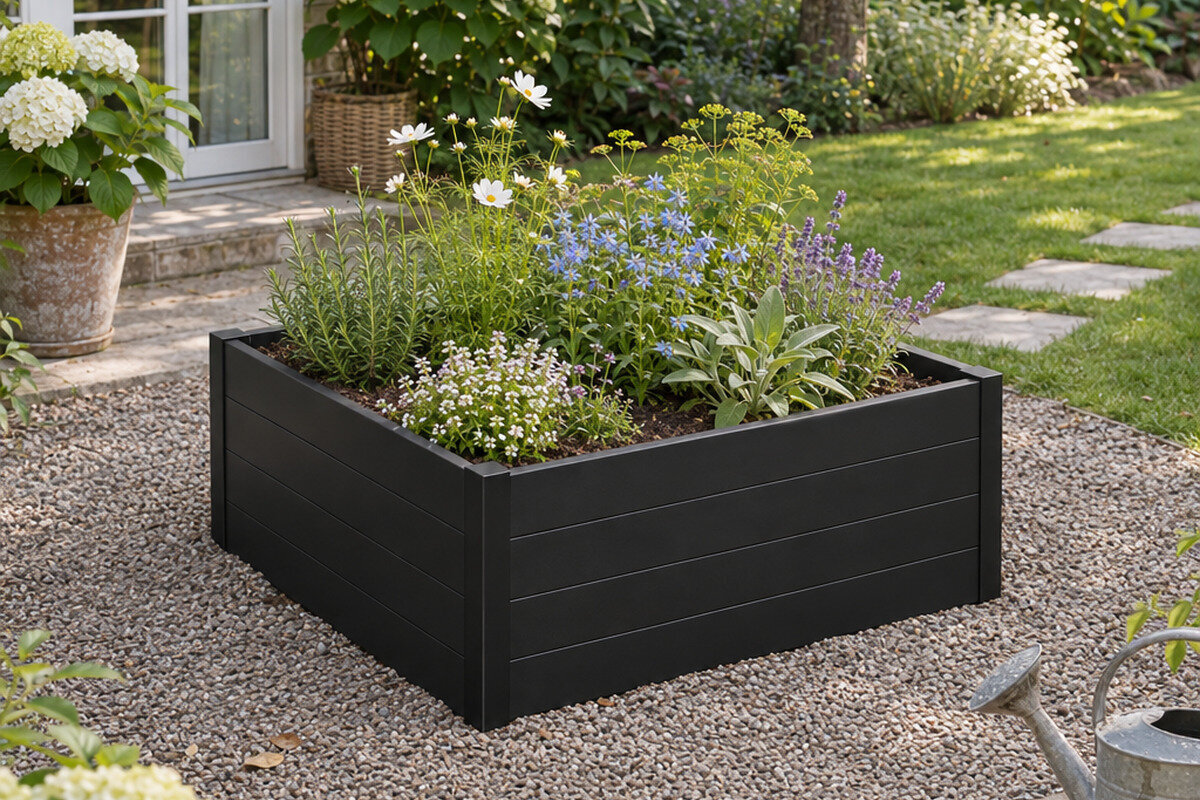
Use the checks below to compare ready-made models before you order. The Bloomcabin UK beds shown here are open to prepared ground, so treat them as alternatives for a soil site rather than examples of elevated boxes. For a true standing planter, get the dimensions, drainage details and load rating for the exact model you intend to buy.
01
Check how the growing area is supported
Look at the underside first. A planter box with legs holds its growing medium in a container with a floor supported above ground. A conventional raised bed may have equally tall walls but no floor: it holds soil in place at ground level. If the listing only gives a wall height and shows the product from above, ask for an assembly drawing that shows how the bottom is supported.
Judge materials as part of the whole assembly. A timber planter box with legs might use a liner, while a metal model might have a separate insert. Check what is actually supplied and what the maker says about outdoor care. Look at the material of the floor and supports as well as the sides; a description of the walls doesn’t tell you what carries the growing medium.
If you have prepared ground and don’t need the planting tray to stand above it, Bloomcabin’s UK raised-bed range offers a different construction. The Narrow Aluminium Raised Bed 100×50×30cm has a nominal footprint of 100 × 50 cm, a nominal planting area of 0.5 m² and 30 cm walls. It is open to prepared ground, not fitted with an elevated floor. Those are useful dimensions for comparing a narrow ground bed, not a specification for a planter box with legs.
- Ask for external dimensions, internal dimensions to the fill line and a drawing showing the base and leg positions.
- Check that the finish, planting-contact surfaces and any required liner are suitable for the intended outdoor use and crops.

02
Measure working height, reach and rooting depth
Try out the height of a planter box with legs before ordering. Mark the proposed rim and growing-surface heights beside a table or worktop, then mimic sowing, watering and harvesting. Try it from the chair you intend to use if you garden seated. Measure clearance under the lowest part of the frame, not just the gap under the middle of the box: bracing or splayed legs can stop you getting close enough.
If a planter box with legs will stand against a wall, mock up its width and reach the far edge from the front. Try the same reach holding an empty watering can or with the other hand resting where it normally would. If it feels like a stretch while empty, opt for a narrower box or leave access on another side rather than relying on reaching over mature plants.
A high rim on a planter box with legs can sit over a shallow planting tray. Measure usable rooting depth from the surface that supports the growing medium, above any raised insert or reservoir, to the intended fill line. The outside height includes the legs and tells you little about root space. Compare the usable depth and area with the requirements of your chosen varieties. If you can’t get the internal measurements, don’t order on the strength of the external size alone.
- Mark the outer footprint and the position of the feet. Leave room for your approach, any mobility aid and a fully open door or gate.
- Ask for the usable length, width and depth of the planting space. The nominal footprint also includes space occupied by the structure.

03
Verify the load limit and check what’s under each foot
Get two answers before buying a planter box with legs: what load can the assembled planter carry, and what load can the intended surface support where the feet will sit? These are separate checks. A patio, deck or balcony is not automatically suitable because the planter is marketed for outdoor use. Don’t divide the weight by the planting area and use that figure to judge the load at the feet.
Ask whether the manufacturer’s number is a payload limit or a maximum total filled weight. A payload excludes the empty unit; a total includes it. Check how the maker accounts for wet growing medium, retained water, plants and accessories. Use the permitted fill line and any conditions the maker gives for distributing the load. An estimate helps you compare options; it is not a substitute for a verified rating.
Stability is a separate question even when the weight figures work. A planter box with legs can rock on uneven paving or sit with a foot partly over an edge. Choose a firm, level position that meets the instructions and gives every foot full contact. Think about wind exposure and whether tall planting or accessories are permitted. If the product requires anchoring, confirm that its specified method is suitable for the site; don’t improvise.
- Get the rating in writing for the exact model and configuration you intend to use.
- If either the planter’s load rating or the site’s suitability is unknown, don’t fill it until you’ve resolved the uncertainty.

04
Follow the water from the tap to the outlet
On a planter box with legs, find out where water exits before deciding which way the box will face. Some designs direct water to a specific outlet; others let it drain beneath the growing area. Check the supplied instructions for the actual model. Look at where water would land and where it would flow from there: a clear drainage hole is no help if the discharge runs across a doorstep or drips onto a balcony below.
Fit any liner or insert as directed and make sure it leaves the intended drainage route open. Don’t drill extra holes or add a layer that takes up root space to compensate for an unclear design. If there is an outlet you need to inspect or clear, leave enough room to reach it without moving the filled box. Where the instructions allow, check the drainage route with a small amount of water before adding growing medium.
Look at how much light the spot receives and whether it suits the crops you have in mind. While you’re there, check how you’ll water the planter box with legs once it’s planted up. Growing media differ in how they hold water and supply nutrients, so use the label to choose for your planting rather than assuming all bags behave alike. Make access for watering part of the position decision, not something to solve after assembly.
- Check that you can get water to the box without carrying it through a cramped gap or dragging a hose across a busy route.
- Choose a peat-free growing medium labelled for the plants and intended container use, and check its watering and feeding instructions.

05
Work through a filled-weight decision before ordering
Hypothetical worked example: a gardener wants a planter box with legs for salad leaves and herbs beside a patio path. Assume the model has a rectangular interior measuring 80 × 35 cm with 20 cm of usable depth to the fill line, no reservoir and no insert displacing growing medium. These are made-up dimensions, not measurements of a Bloomcabin product. The gardener has already checked that the reach works and that their chosen varieties suit that depth.
The fill volume is 80 × 35 × 20 = 56,000 cubic centimetres, or 56 litres. To compare loads, suppose suitable data for the chosen medium put its planning weight at 8 kg per 10 litres when wet, including the water held in it. Then 56 litres weighs an estimated 44.8 kg. Allow another 2 kg for plants and accessories: that’s 46.8 kg of payload. With a 12 kg empty planter, the estimated total on the patio is 58.8 kg.
Suppose the hypothetical manufacturer specifies a maximum payload of 45 kg for this configuration. The gardener rejects this planter box with legs for the intended fill: 46.8 kg exceeds the rating even before allowing for uncertainty in the estimate. They can look for a model with a documented rating suitable for the intended load or reconsider the planting plan and choose a different container. Either way, they still need to check the surface for the final choice. The numbers illustrate the comparison; they aren’t a generic weight for compost or a safe limit for paving.

06
Assemble and inspect the box while it’s empty
Before assembling a planter box with legs, read the instructions for the exact model, lay out the supplied parts and check that the floor, supports and drainage components are present. Assemble and tighten fittings in the sequence given. If a part is missing or a joint won’t seat correctly, contact the supplier instead of substituting fixings or packing out a leg.
Put the empty unit in its intended position and check its level, access and runoff route. Check the frame for rocking without climbing on it, sitting on it or using it to support your weight. Leave space to inspect the supports, especially if the back of the box will be near a wall. Only then fit any liner or insert as directed and recheck that it hasn’t obstructed the drain.
Fill the planter box with legs in manageable amounts, spreading the growing medium as you go rather than piling full bags onto one end. Keep to the maker’s fill line and load limit. If the frame shifts or the base changes shape unexpectedly, stop adding material and follow the manufacturer’s guidance before using it. Don’t drag the filled unit to correct its position; check how the manufacturer says to move it and whether it must be emptied first.
- If the empty frame rocks or the base does not seat as shown, stop and resolve it before filling.
- Keep the instructions so you know which checks the maker recommends later and whether the planter can be moved at all when filled.

07
Plant for comfortable access and adjust as crops grow
Plan your first planting on paper using the internal dimensions of the planter box with legs. Put frequently picked leaves or herbs within the easiest reach. If you want compact root vegetables, pick varieties whose depth requirements match what you actually measured. Mark mature spacing before sowing so you can see whether all the crops fit. Use seed-packet instructions for sowing depth and spacing, and check local UK growing guidance for timing and outdoor conditions.
Check moisture below the surface before deciding whether to water, especially as weather and plant size change. Raised growing media can dry out sooner than you expect, but a damp surface after rain doesn’t tell you how wet the rest of the box is. Follow the crop and growing-medium guidance for watering and feeding. If water starts pooling or draining somewhere new, check the outlet and runoff route before simply adding more water.
As the season goes on, inspect the planter box with legs as directed by its maker and take new rocking, loose fittings or changes in the base seriously. Stop using it and seek the manufacturer’s guidance if it appears damaged or unstable. After harvest, note which crops you could tend comfortably and where foliage got in the way. Use that information to adjust next season’s spacing and layout before assuming you need a larger box.

Questions readers ask
Can I put a planter box with legs on a balcony?
Only if the planter is suitable for that location and the balcony’s capacity has been checked for the actual filled weight and the way it bears through the feet. A planter’s load rating tells you what the planter can take, not what the balcony can take. If the supporting structure is in doubt, get advice from a suitably qualified person before filling.
Does a taller box give vegetables more room to root?
Not necessarily. A planter box with legs can have a high rim and a shallow tray. Ask for the usable depth of growing medium above the installed base or insert and below the fill line. Compare it with guidance for the particular crop and variety, not just the figure on the product title.
Can I put a saucer under the outlet to protect paving?
Use a catch tray only if it is compatible with the manufacturer’s drainage arrangement. Make sure it does not obstruct the outlet or let backed-up water reach the growing medium, and plan to empty it. If capturing the runoff would be awkward or unreliable, choose a position where water can discharge without crossing a path.
Make the decision before buying the compost
The right planter box with legs is one you can reach, water and harvest from without working around an awkward height or poor location. If its usable depth, drainage or load limit is unclear, resolve that before buying. It is easier to change the choice on paper than to move a full planter.
Find a raised bed for your plan
Compare layouts and check the dimensions on the product page.
