
Plastic for flower beds: how to choose edging, walls or a liner

Bloomcabin · Raised-bed guides
Plastic for flower beds: how to choose edging, walls or a liner
Plastic for flower beds can be a good choice if the product is designed for the job you need it to do. Use purpose-made edging to mark a border, a documented raised-bed system to hold back soil, and a liner only where it serves a clear purpose without blocking drainage.
Name the job
Edging marks a boundary. A raised wall must hold back fill, while a liner has a different job again.
Read the specification
When choosing plastic for flower beds, look for a stated material grade, panel thickness and intended use.
Trace the drainage
Know whether water will leave through the ground or through a purpose-made outlet before you fill the bed.
Measure what matters
Measure the outside fit and the inside planting space separately. Check reach from the path as well.
The first thing to check when shopping for plastic for flower beds is whether the product is supposed to hold soil in place. A strip separating lawn from flowers is doing a different job from a panel retaining a raised layer of damp soil. A sheet sold to suppress weeds should not be assumed to work as a liner inside a planting container.
Start with the job, then check the supplier’s specification and fitting instructions against your site. What is the material? What keeps it in place? Where does excess water go? If the listing gives you a colour, a photo and a size but none of those answers, you have enough information to judge its appearance, not its suitability.
01
Decide what the plastic needs to do
If you want to keep lawn and flowers visually separate without raising the soil, look for edging designed for that boundary. Check how much of the strip stays above ground once fitted and whether the instructions cover straight runs, corners or curves. Flexible edging may follow the outline you want, but flexibility is not a reason to use it as a raised wall. When buying plastic for flower beds to hold back soil, look for a system explicitly intended to retain fill at your planned height.
If you already have a sound frame and are considering plastic for flower beds as a liner, decide whether it is meant to cover the sides, the base or both. A side liner and a sheet across the bottom do not do the same thing. Likewise, if weed control is the aim, check whether the product is permeable and how the instructions deal with planting openings and edges. Do not assume a dark sheet lets water through or that an impermeable sheet is a useful substitute.
Before shopping, finish the sentence: ‘I need plastic for flower beds to…’ Mark a lawn edge, hold back a raised layer of soil, line an existing frame or cover the soil between plants are different answers. If the listing does not identify the job you need it to do, ask for written confirmation or move on. You can rule out the wrong sort of product before comparing sizes or finishes.

02
Check the grade, finish and wall construction
A listing for plastic for flower beds should tell you what the working part is made of. Is it a named polymer, a composite or a plastic coating over another material? If there is a material grade, look for it in the technical sheet. Check what the supplier says about coatings or treatments, outdoor exposure and contact with planting soil. If sun exposure matters at your site, ask what the outdoor-use statement covers rather than reading a service life into a phrase like ‘UV resistant’.
For a raised wall, read the thickness alongside the panel shape, the distance between supports and the way the corners are joined. A thickness figure on its own will not tell you whether a long side can retain fill at the planned height. If the panel is hollow or ribbed, clarify whether the measurement describes the full profile or the material itself. Check that the fasteners and connectors in the instructions match the version you are buying, especially if the listing shows several heights.
When comparing plastic for flower beds, separate what is documented from what you still need to ask. ‘Recycled’, for example, does not identify the grade or the composition of the finished part. Unknown composition is not proof of a problem, but it is not evidence of suitability either. If you might later grow edible plants in the bed, verify that use separately rather than extending an ornamental-use statement to it.

03
Measure the planting space and trace the water
When sizing plastic for flower beds, mark the outside footprint on the ground first, including any projecting posts. Then ask for the clear internal dimensions: those are the ones that tell you how much room the flowers have. Wall height is not the same as fill depth or total rooting depth. With an open base, the soil below matters too. Keep the path measurement separate from the bed footprint, and try reaching across the marked space from where you can actually stand. Plan to tend the flowers from the path rather than stepping onto the growing soil.
Before choosing plastic for flower beds, trace where excess water will go. For an open-bottom frame on soil, check whether water already pools in that spot after rain and prepare the ground as instructed. A frame without a floor does not solve poor drainage underneath it. If you are considering a liner, check whether it is intended to run down the sides only and whether its placement would obstruct the planned drainage route.
On paving, check that the product is intended for that surface and find out where its outlets discharge. Avoid a layout that sends water across the path you use to tend the flowers. If the site is a balcony or terrace, check that the surface can support the filled installation before buying. A bed’s outside measurements tell you whether it fits, not whether the structure beneath can carry it.

04
Use the fitting instructions for the actual kit
Read the manual for your plastic for flower beds before ordering, not after delivery. Check which parts are supplied, which tools you need and what the maker expects you to prepare beneath or around the bed. For an edging strip, look for instructions on insertion depth, curves and joints between lengths. For a raised frame, look for the assembly sequence and any requirements for intermediate supports. If you want a longer run than the instructions show, ask whether the system is designed to be extended.
When fitting plastic for flower beds, use the joining method and fasteners specified for that model. On a raised frame, check that all connections are in place and the sides sit as shown in the manual before adding fill. Leave the specified drainage route clear. If a panel does not align, check its orientation and the parts list instead of forcing it into place. Do not substitute screws, drill extra holes, add an improvised brace or fix the wall to a fence to compensate for a joint that will not fit.
If a document covers several kits, match its parts diagram to your wall height and panel profile. A photograph can help you recognise a corner but cannot tell you how the joint is secured. Resolve missing parts or ambiguous instructions before filling, when you can still reach the connections easily.

05
Plan for cleaning, inspection and repair
Care instructions for plastic for flower beds should say how to clean the exposed surfaces and whether any cleaners or tools should be avoided. Think about how you will work around the material. Along a lawn, check where your mower or strimmer will run; do not assume a strip can withstand repeated contact. For a liner, pay particular attention to any exposed upper edge where you might catch it with a spade or hand fork.
Once the bed is in use, look for joints opening, panels changing shape, damage along the top edge or water collecting where you did not expect it. For a container with outlets, check for accessible blockages as the instructions allow. If a wall begins to move, do not add more fill or attempt to pull it back into place while loaded. Ask the supplier how to deal with it. A change in shape or a loose join is more useful to act on than a general assurance that the material is low maintenance.
If you are choosing plastic for flower beds for a spot you cannot easily work around, ask whether a damaged length, panel or connector can be replaced on its own. Also check whether replacement would mean removing plants or emptying the bed. Those answers can make one design more practical than another without making any assumptions about which will last longer.

06
Compare designs that solve the same problem
Compare plastic for flower beds with alternatives that do the same job. For ground-level edging, compare how closely each option follows the line you want, how the joints meet and how much of the edge is visible after fitting. For a raised bed, compare the documented wall height and support arrangement, the useful width inside, the base and the work involved in fitting it. A flexible roll sold to divide lawn from soil is not an alternative to a raised wall simply because both are sold for borders.
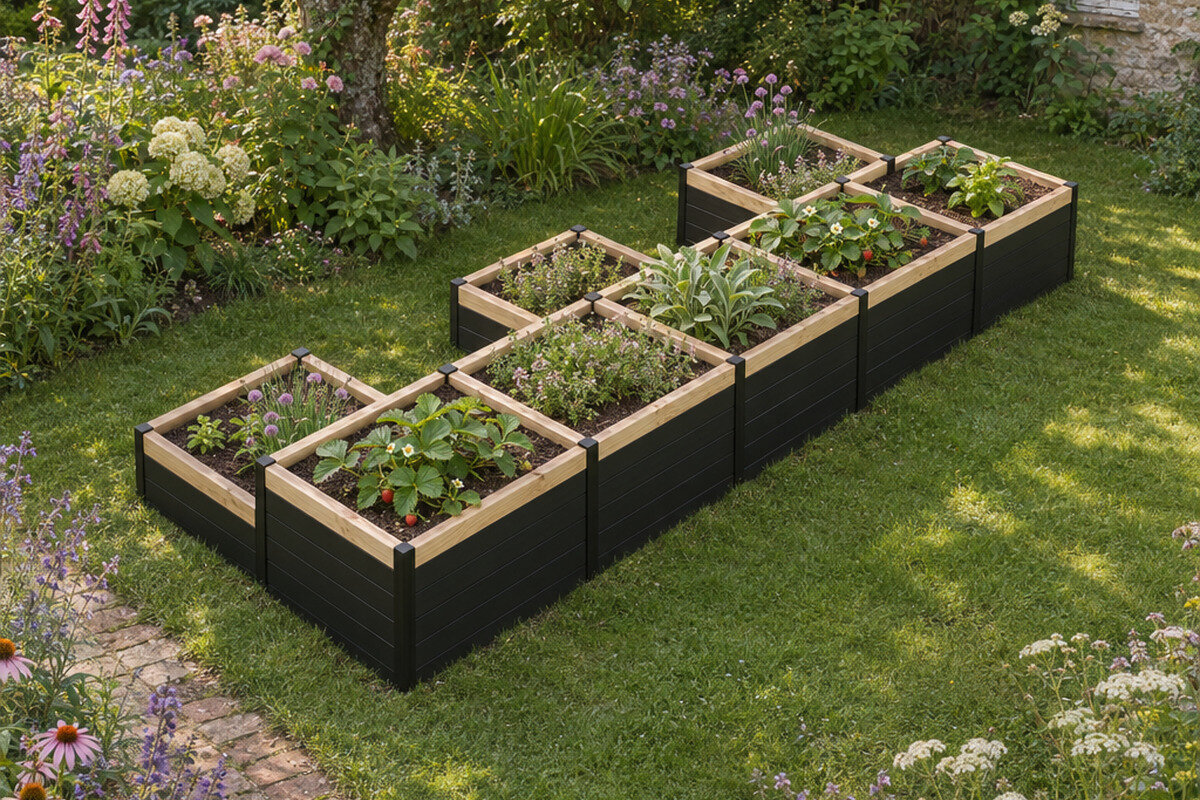
In Bloomcabin’s raised-bed range, the Narrow Aluminium Raised Bed 200×50×50cm is a useful comparison if you need a narrow raised frame rather than edging. It has a nominal footprint of 200 × 50 cm, a 50 cm wall height and an open base for prepared ground. Its long sides each use two 100 cm wall sections joined by an aluminium T connector, and it is supplied unassembled. The stated footprint is not a clear internal measurement. This is an aluminium example; the gallery does not establish a Bloomcabin plastic option.
If plastic for flower beds is still your preference, look for an equally clear specification covering the points that matter to you. Compare the work involved in preparing the site, the supplied and required parts, and how you would repair the frame. The material name alone does not establish which product is easier to fit, easier to maintain or better value.

07
Worked example: edging or a raised wall beside a path?
Hypothetical worked example: Priya has a soil strip beside a paved path, measuring 2.2 m long by 0.7 m deep. She wants a 25 cm rise in planting-soil level for an ornamental border and can tend it only from the path. She finds two listings for plastic for flower beds: a flexible strip specified for ground-level edging and a rigid frame advertised with a 2.0 m × 0.6 m outside footprint. The edging has a documented use, but it is the wrong use for this job: the listing does not say it will retain raised fill.
On paper, the frame leaves 20 cm spare along the length and 10 cm across the depth, in total. Priya marks those dimensions on the ground and tests her reach from the path. Before buying, she confirms whether the dimensions include the posts and whether the small gaps leave enough space to fit the parts. She asks for clear internal width and allowable fill depth rather than assuming that the outside width is all plantable or that the advertised wall height equals the level to which she can fill it.
Priya would choose plastic for flower beds here only if the frame is documented to retain fill to her planned depth, the supplier provides the material and joining details, and the base suits the soil strip without directing water onto the path. If the seller confirms only the footprint, the decision is to hold off. She can compare a better-documented frame or reconsider whether she needs to raise the border at all.

Questions readers ask
Can I reuse leftover plastic for flower beds?
Only if you can identify the material and establish that the product was intended for the job you have in mind. If you do not know what it is, what it previously held or how it was treated, do not rely on it as a soil-contact liner or a wall holding back raised fill. Having a piece that fits is not the same as knowing it is suitable.
Should plastic for flower beds have drainage holes?
That depends on what it does. An upright edging strip is not a container floor. An open-bottom raised frame leaves the ground beneath exposed, while a container with a floor needs a documented way for excess water to leave. Do not drill holes in a kit unless its instructions or supplier confirm where and how to do so.
Does recycled plastic for flower beds need different checks?
Apply the same checks as for any other product. Recycled content is useful information about where the material came from, but it does not tell you which polymer is present, how the wall is supported or whether the product is intended for contact with planting soil. Ask for the specification for the actual item.
Buy for the job, not the label
The right plastic for flower beds is the product you can verify for the job, whether it is a simple lawn edge or a wall retaining raised soil. If you cannot confirm the material, the fitting method or the drainage route, ask before you buy. A clear answer is more useful than a promise that the product is suitable for every garden.
Find a raised bed for your plan
Compare layouts and check the dimensions on the product page.
