
Raised garden bed with base: choosing, setting up and planting

Bloomcabin · Raised-bed guides
Raised garden bed with base: choosing, setting up and planting
Choose a raised garden bed with base if you need to hold growing medium above a patio, courtyard or other surface you cannot plant into. Look for a supported floor and a way for excess water to escape. The Bloomcabin beds shown here are different: they have no floor panel and sit over prepared ground.
Check for a real floor
A raised garden bed with base for paving needs a floor that holds the growing medium and a way for excess water to leave.
Check the site
Confirm the filled load, how the floor is supported and where runoff will go before ordering.
Measure the planting space
Use the inside dimensions and planned fill depth, not the outside footprint and wall height, to estimate litres.
Know the alternative
The illustrated Bloomcabin beds have no floor panel. Compare them if you are planting over prepared ground.
The word “base” can mean the bottom of an open frame or an actual floor. If you are buying a raised garden bed with base for hard standing, that difference matters more than the height of the rim. Check what holds the growing medium, where the water exits and what supports the bed when it is full.
Start with the surface and the plants you want to grow. Then compare the space you can reach, the depth available to roots and the volume you will actually fill. The courtyard example below shows how to make those checks before ordering.
01
What counts as a proper base?
When comparing a raised garden bed with base, start with a drawing or a view of the underside. Look for the panel or tray that retains the growing medium, how it is supported and whether it comes with the bed or is sold separately. A listing might use “base” to describe the bottom edge or the surface the frame stands on. A photo taken from above rarely settles the question.
The floor of a raised garden bed with base does not have to be sealed. It needs to hold the growing medium while providing for drainage. Some designs use a separate liner to retain the mix around openings. Check what the manufacturer calls for: a liner may keep material in place, but it is not itself a load-bearing floor. Mesh laid under an open frame is not a floor either.
Choose a raised garden bed with base when you need to contain the growing medium separately from the surface below, such as in a courtyard with no soil to plant into. The trade-off is that roots cannot extend into the ground underneath, so your plants have to fit the depth and volume inside the bed. If the site has suitable soil and you simply want to raise the growing surface or mark out a border, an open-bottom frame may meet the brief without a floor.

02
Check what the surface can support and where water will go
Before choosing a raised garden bed with base for paving, decking or a balcony, find out how the bed is meant to bear on that surface. Check whether the model needs continuous support or bears on particular points. Ask for the permitted fill and the expected loaded weight for your proposed setup, allowing for wet growing medium and any water the design retains. If the surface’s capacity is uncertain, get it checked before buying. Litres tell you how much mix to order, not how much weight the site can take.
Trace the water route for a raised garden bed with base from the outlet to where it will end up. Look for awkward spots: an outlet directly over a paving joint, water running towards a doorway, or a tray that can only be emptied by shifting the bed. If the design needs clearance underneath for drainage, check that its intended supports provide it. Do not improvise a stand just to make an outlet accessible.
Mark out the bed and the working route together. Can you turn with a watering can, reach the outlet to clear it, and still open the gate fully? Think about the height you will work at and whether the route to water is easy to use. If you garden seated, check the actual reach and clearance rather than assuming that a higher rim makes a straight-sided bed easier to use.

03
Measure the space you can actually plant
Measure a raised garden bed with base in two ways. The outside footprint tells you where it can stand; check the widest points, including any projections shown on the drawing. The internal length and width tell you what can fit in the planting area. If you can work from only one long side, mock up the width and check whether you can reach the far edge without resting your weight on the rim. Keep a separate path so you never need to step into the growing area.
For a raised garden bed with base, measure planting depth from the top of the floor or insert to the intended surface of the growing medium. The wall may continue below the floor, and the medium usually stops short of the rim. A tray or reservoir specified by the design may also occupy some of that space. Compare the resulting depth with the needs of the plants you want to grow, rather than buying on the strength of the advertised wall height.
For a simple rectangular interior, multiply internal length by internal width by planned fill depth, all in metres, then multiply by 1,000 to get litres. If the sides taper or an insert takes up part of the interior, use the manufacturer’s fill figure or a calculation based on the actual geometry. For separate compartments, assess each one on its own; neither a divider nor an access notch can be filled as if it were part of one uninterrupted rectangle.

04
Use the Bloomcabin examples to compare open-bottom layouts
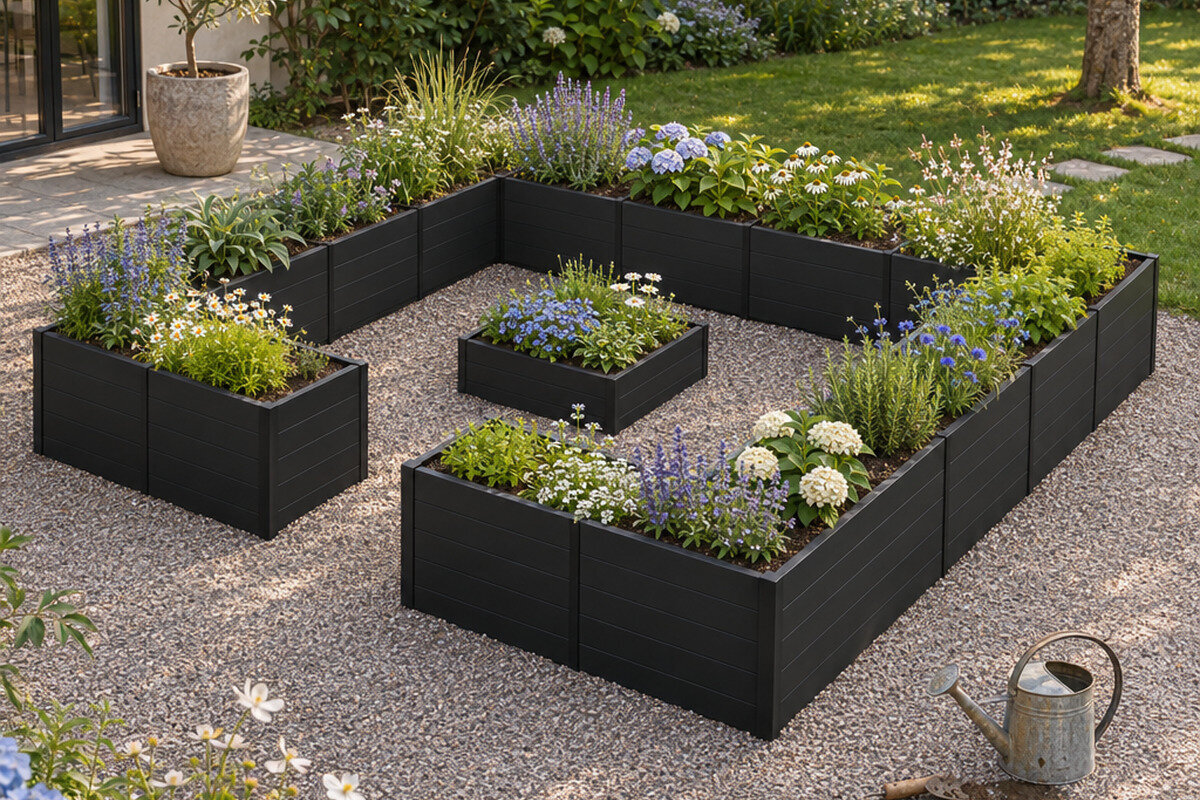
The Bloomcabin beds illustrated here are not options for a raised garden bed with base if you need a floor. All are supplied unassembled and open to prepared ground, with no floor panel. Their dimensions are useful for comparing different layouts on soil, not for deciding how much growing medium a floor could carry.
For a small soil border, the Narrow Aluminium Raised Bed 100×50×30cm has a nominal footprint of 100 × 50 cm, one planting compartment, a nominal planting area of 0.5 m² and 30 cm walls. For a larger layout, the U-Shaped Aluminium Raised Bed 300×200×30cm has a nominal footprint of 300 × 200 cm and five planting bays, each nominally 100 × 100 cm. Its planting area is 5 m², not the 6 m² of its enclosing rectangle. The nominal 100 × 100 cm notch is access space, not another bay or a guarantee of comfortable access.
If you are shopping for a raised garden bed with base elsewhere in the comparison, prioritise information about the floor and its supports over the appearance of the walls. The illustrated Ascending Triple Accoya Raised Bed, for instance, has Accoya at the top of each wall with aluminium panels below, but it is still open to the ground. A wall material or finish tells you nothing about whether there is a floor underneath. Ask for a parts list if the distinction is not clear.

05
Worked example: decide whether a courtyard bed fits
Hypothetical worked example: a gardener wants to put a raised garden bed with base in a paved courtyard and grow leaf lettuce and chives. They have 150 cm along a wall and a total depth of 120 cm from the wall to the opposite edge of the available space. They shortlist a generic model with an assumed outside footprint of 100 × 50 cm. These are planning assumptions, not Bloomcabin specifications.
Positioning the bed 10 cm away from the wall would leave 60 cm in front: 120 − 10 − 50 = 60 cm. The gardener marks that strip on the ground and tries carrying a watering can through it and reaching the back of the bed from the front. The 10 cm gap is an assumption, not a recommended clearance. If the drainage fitting needs more space or the working strip proves too tight, the gardener revises the layout before committing.
Suppose the raised garden bed with base has a rectangular interior of 90 × 40 cm and the instructions allow a planned fill depth of 25 cm. The estimate is 0.90 × 0.40 × 0.25 = 0.09 m³, or 90 litres, assuming no insert displaces any of that space. The gardener checks the depth and spacing against the guidance for the chosen varieties. The decision is conditional: go ahead only if the working space feels usable, the filled load is suitable for the site and the outlet can discharge without sending water towards the door.

06
Fit and check the floor before filling
Set up a raised garden bed with base in its final position before filling. Follow the exact model’s instructions for the walls, floor, supports and any liner or outlet fittings. Check that the floor is seated as shown, the bed is stable and the drain can be reached. If the instructions permit, try a small amount of water before filling to check where it exits. This is a check of the route, not a test of the bed’s strength or a guarantee that the outlet will stay clear.
Fill a raised garden bed with base with a growing medium suited to the intended plants and to container use. Look for a clearly labelled peat-free mix for the job, rather than relying on general environmental wording. Mixes differ in how they hold water, maintain structure and supply nutrients, so use the label and crop guidance rather than a universal recipe. Keep the designed outlet clear and do not add a gravel layer or liner as a substitute for making the drainage work.
Work to the manufacturer’s fill level and any specified weight limit. If there is room to choose the fill line, leave enough space below the rim to water without washing the mix over the edge, while preserving the depth the plants need. Add medium evenly and stop if the base shifts, the frame moves or a joint opens. Resolve the problem before adding more. If you choose an illustrated open-bottom frame instead, follow its instructions for preparing the soil beneath it; the steps for fitting a tray or floor do not apply.

07
Plant for the available depth and watch how the bed drains
Plan planting around the usable depth of the raised garden bed with base and the mature spread of the varieties you choose. If your preferred crop needs more root room than the bed provides, select a smaller variety, a different crop or a deeper bed before buying the mix. Use seed packets or plant labels for spacing and sowing depth, and local UK growing guidance for timing. Position plants you pick frequently where you can reach them easily without leaning across the whole bed.
After the first heavy rain and the first few waterings, look at both the medium and the outlet. A raised garden bed with base can have a dry-looking surface while still holding water lower down. Check moisture below the surface where practical and water according to the crop, the mix and the weather, not a fixed timetable. If water pools or the normal discharge stops, inspect the accessible outlet and follow the maker’s instructions for clearing it before adding more water.
Between crops, check the visible supports, fittings and drainage route as well as the condition of the mix. Replace lost medium or renew it according to the needs of the next planting and the mix instructions. If you plan to move the bed, check its instructions first and do not assume it can be lifted or dragged while full. Keeping the underside and outlet accessible from the start makes these checks easier once plants fill the bed.

Questions readers ask
Does a raised garden bed with base need drainage holes?
If rain or watering can collect inside it, the bed needs a way to discharge excess water. That could be holes or a designed outlet system, depending on the model. A floor that retains growing medium does not have to be watertight. Check how the supplied design drains rather than drilling holes that the instructions do not call for.
Can I turn an open-bottom frame into a raised garden bed with base?
Only treat it as a floored bed if the manufacturer confirms a compatible floor, the required support and how the assembly should drain. A loose liner or mesh can serve a specific purpose, but it does not turn a frame into a container rated to hold wet growing medium.
Can I put a raised garden bed with base on a balcony?
Only after confirming that the exact model is suitable and that the balcony can take the expected filled load where the bed will stand. Check any building restrictions and where runoff will go. A small footprint, a lightweight empty frame or a stated fill volume is not a substitute for those checks.
Make the floor your first buying check
Buy a raised garden bed with base only once you know what supports the floor, how much planting depth remains and where the water will go. If you have suitable soil underneath and do not need to contain the growing medium separately, compare the open-bottom options instead.
Find a raised bed for your plan
Compare layouts and check the dimensions on the product page.
