
Repairing Scratches on a Powder-Coated Pergola
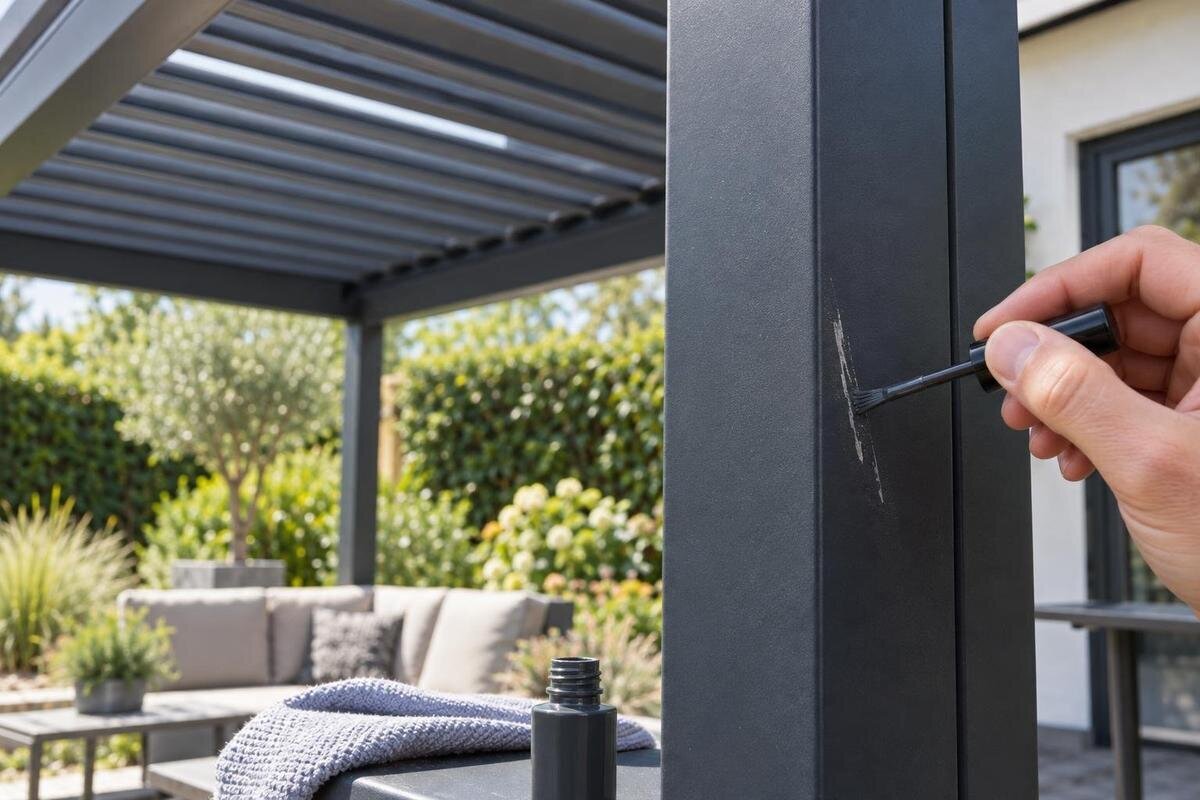
Pergola care and repair
A scratch on a powder-coated pergola may be a transfer mark sitting on the finish, a shallow scuff or a break through the coating. These need different responses: permitted cleaning may resolve the first, while coating damage calls for a repair system confirmed for the exact model and finish. Before rubbing, sanding or applying a touch-up product, establish what the mark looks like and record it clearly. This guide explains the visible clues, the information to gather and the questions to ask before any repair begins.

01
Distinguish a surface mark from a scratch
Not every dark streak or pale line is a scratch in the coating. It may be material transferred onto the surface, residue or a reflection caused by a change in gloss. Note how it looks, then clean only as the pergola’s care instructions allow. If the mark comes away and the colour and texture beneath look continuous once dry, it is more likely to be a surface mark. Treat that as a clue, not proof: residue can obscure a small defect. Inspect the cleaned area again in daylight, both straight on and at a shallow angle.
A scratch is more likely if the line interrupts the finish’s texture or sheen, has a groove or shows a different layer beneath it. Even then, appearance alone cannot tell you how deep it is or whether the underlying material is affected. A line’s colour by itself is unreliable; shadow, dirt or a slight change in gloss can make it look deeper than it is. Don’t drag a fingernail, coin or blade over it, pick at the edge or use an abrasive test. If gentle inspection leaves you uncertain, record it as a mark needing assessment rather than guessing.
Clean gently before you inspect
Use the care instructions for the exact pergola rather than advice written for garden furniture in general. If your paperwork identifies a Bloomcabin Lean-To Pergola, request the care document that applies to your unit and finish. A current product listing is useful as a model reference, but is not a cleaning guide. Check whether the instructions distinguish routine washing from removing stubborn deposits: permission to wash the frame does not necessarily authorise a stain remover. Remove loose grit only in the way the instructions specify, because rubbing particles across the coating can add marks. If the cleaning guidance is missing or unclear, send a photograph and ask which method is permitted before treating the mark. A product labelled mild or suitable for outdoor furniture is not automatically safe for this surface.
Avoid scourers, wire brushes, blades, abrasive polish, solvents, paint removers and strong degreasers unless the manufacturer expressly permits the specific product and use. They may alter the finish, remove evidence of what caused the mark or enlarge a damaged edge. Follow the stated rinsing and drying steps, and don’t keep repeating the clean if the line remains. If someone has already used a cleaner, note its name and don’t try to counter it with another chemical. Once the area is dry, compare it under steady light with a photo taken before cleaning.
02
Look for signs of a coating breach
Possible signs of a breached coating include a visible change in surface texture, chipped or missing finish, an edge that is lifting, flaking or blistering, or an area where the underlying material appears exposed. Pitting or unusual staining can also justify closer assessment, but a photograph cannot identify the cause by itself. A dark spot alone does not establish that corrosion is present. Don’t scrape or peel an edge to check what is underneath, and don’t cover a suspicious area with household paint or sealant. If material appears exposed or the coating is loose, stop cleaning and ask the manufacturer or service provider how to proceed.
Look beyond the colour of the mark. A deep gouge, dent, bent or distorted member, sharp burr, loosened fixing or damage at a joint can involve the pergola part as well as its finish. Touch-up coating cannot restore a shape or address a mechanical problem. If the mark is close to a joint, fixing or moving mechanism, don’t dismantle or adjust the area to reach it. Photograph what is visible from a safe position and arrange qualified service if a component or mechanism may be affected. A finish repair is not a substitute for assessing damage to the part itself.
Record the damage before seeking a repair
Make a simple location map rather than describing a scratch as just on the left. Name the post, beam or panel, then relate it to a fixed point such as the nearest end, corner or joint; say which side of the pergola you mean. Take one overall image that shows the part in context and one close view of the mark. Include the model name from your paperwork, such as Bloomcabin Bioclimatic Aluminum Pergola, so the photographs can be associated with the right enquiry. Add a second close-up from a different angle if glare hides the edge of the mark. Keep enough undamaged finish in the frame to show the contrast, rather than cropping so tightly that the location and surrounding surface disappear.
Add the mark’s approximate length and width, how many marks there are, when you noticed them and any known cause, such as contact during moving or cleaning. Label anything uncertain as a possibility, not a fact. For scale, place a ruler or plain reference beside the mark without touching it. Keep the original images unfiltered and unedited, since phone colour adjustments can misrepresent a finish. If there are several marks, number them on a separate sketch or copy of the photo, not on the pergola itself. Don’t climb, remove a cover or reach over a mechanism just to improve an image.

03
Confirm the exact pergola model
Check the order confirmation, invoice, assembly paperwork, identification plate or label if accessible, and any earlier service correspondence. Copy the exact model name, serial or identification number, configuration and purchase date rather than shortening everything to pergola. The Bloomcabin Pergola catalogue entry may help you recognise the public product name if your purchase documents are incomplete. Keep that tentative identification separate from a confirmed match to your unit. Where several structures were bought on one order, specify which one has the damage and attach its label photograph if available. Mention any component that has previously been replaced, as its details may differ from the original order. Don’t remove covers to find a number; ask support where to look if it is not readily accessible.
Model identification matters because names that sound similar do not, by themselves, establish that a repair product or replacement part fits. Include the original order number or seller details if available, and distinguish what you know from what you have inferred. If a label is missing or unreadable, send an overall photo and the information available from your purchase record. Ask the supplier to confirm the unit before ordering a repair product. Don’t choose one because another pergola looks similar or an online photograph seems close.
Match the finish, not just the colour name
Colour matching needs more than a broad description such as white, grey or black. Look for an original finish name or code in your paperwork, then ask whether a separate reference identifies the gloss, texture or coating system. A standard colour reference, including a RAL number if one is supplied, is not enough unless the manufacturer confirms that it matches this pergola’s finish and the proposed repair product. When enquiring about a Bioclimatic Aluminum Pergola finish, attach the actual order specification rather than selecting a colour from a current catalogue image. If different parts of the structure appear to have different finishes, identify the damaged part specifically. Report any previous repainting or touch-up, too: support needs to know whether it is assessing an original finish or an area already treated.
Even where a colour name matches, a small repair may look different from the surrounding surface because of sheen, texture, age, lighting and viewing angle. A photo on a screen or a swatch viewed indoors is an aid, not a guarantee. Ask the supplier how the proposed system is matched and what visual result to expect, including whether a repair edge may remain visible. Don’t apply a sample to a noticeable area unless the approved instructions say where and how to test it. If appearance is important, explain that before agreeing to a local touch-up.
04
Ask for the complete approved repair system
When you contact the manufacturer, retailer or authorised service provider, send the model and serial details, purchase information, any finish code, the location map, approximate dimensions and original photos. State whether permitted cleaning changed the mark, and describe visible signs without guessing what lies beneath them. For an enquiry concerning the Lean-To Pergola model, make clear whether the damage was present on delivery, occurred during assembly or was noticed later in use. If the cause is unknown, say so. Include the date of any earlier report and its reference number so separate messages can be connected. Mention any cleaner, polish or paint already applied, with its product name if known; this is relevant information for assessing the surface, not something to omit because the result was unsuccessful.
Ask for the complete approved repair system for that unit and finish, not simply a tin or pen described as a matching colour. Request confirmation of the permitted surface preparation, whether a primer or other layer is required, the suitable applicator and the type or size of damage the system is intended to address. Ask about application, drying and curing limits, expected appearance and whether a qualified technician should do the work. Also ask whether a replacement component is a more appropriate route. A written answer gives you a clear reference before you buy or apply anything.
Apply only the method supplied for your pergola
Proceed only when the manufacturer or supplier confirms that the product and method are approved for your pergola’s exact coating and that the damage falls within the repair system’s stated scope. If your enquiry concerns the Bloomcabin Lean-To model, keep that model reference alongside the written approval and the supplied product details. Before opening a kit, check that its name, colour reference and any specified primer match the recommendation. Query substitutions rather than assuming a similarly named product is equivalent. Generic enamel, automotive touch-up paint, permanent marker, nail varnish and a spray can marketed for metal are not substitutes unless specifically approved. Check any stated shelf life and storage requirements as well, particularly if you are reusing material left from an earlier repair.
Follow the supplied instructions, product label and safety information for preparation, application, ventilation, protective equipment and curing; don’t borrow steps from a different kit. Don’t invent sanding, priming, coating thickness, number of coats or waiting times. If the package and the written repair guidance appear to conflict, pause and ask which applies. Confirm whether the area must remain protected from rain, cleaning or contact while the repair cures, and plan the work around those stated conditions. Touch-dry and ready for normal use may be different stages; use the instructions rather than a finger test to decide when the area can be handled. Keep repair material away from seals, drainage openings, fasteners and moving parts unless the instructions explicitly say otherwise. If the work involves access at height, dismantling, a large area or a mechanism, leave it to suitably qualified service.

05
Check service and warranty requirements first
Before changing the finish, read the warranty and care documents supplied with your pergola and ask the seller or manufacturer whether the proposed repair is approved. Don’t assume that a scratch is covered or excluded, or that a home-applied touch-up has no effect on later service. Ask for relevant guidance in writing and keep it with the order record, photographs, product label and repair-system instructions. If you already have a service enquiry open, add the damage photos before doing anything. If a repair is arranged, record who specified the method and which product was used.
Use documents for your actual unit rather than drawing conclusions from a current product page. The Bloomcabin Pergola model reference does not establish the warranty terms or service eligibility of a particular purchase. Keep the seller’s assessment separate from any repair quotation: an offer to supply a product or carry out work does not itself explain whether the cost is covered. Ask who will assess the photographs, whether an inspection is needed and whether you should leave the area untreated until that assessment. If you are asked to obtain a quotation from a coating specialist, confirm what information or approval is needed before commissioning work. Any service involving a powered or mechanically operated assembly should follow the requirements for that equipment, rather than treating access to the scratch as ordinary cosmetic work.
Choose between touch-up and component replacement
A small, isolated surface defect may be suitable for an approved touch-up if the underlying part is sound and the supplier confirms the system is appropriate. A long scrape, several damaged areas, lifting coating, suspected corrosion, a dent or repeated coating failure may call for inspection or replacement of the affected component instead. The right route depends on the condition and repair guidance, not only on how visible the mark is. A colour-matched patch cannot straighten a bent member or secure coating that is loose beyond the visible scratch.
If component replacement is being considered, ask for its exact identification and compatibility with your model and production details; don’t infer a fit from appearance. Clarify whether the proposal is for the damaged part alone or includes associated items and fitting work. If the discussion turns to a new structure, the Bloomcabin Bioclimatic pergola product page provides a separate catalogue reference, not evidence of a like-for-like replacement or compatibility with the existing installation. Keep local repair, component replacement and a new purchase as distinct options when comparing scope and cost. For an approved touch-up, retain the original photographs and take a comparable image after the stated curing period. Judge the result in similar lighting rather than comparing a wet repair with a dry original surface. If the finish lifts again or the mark changes, send the new images with the repair record instead of repeatedly adding paint. This gives the service provider evidence of how the treated area has behaved.
Frequently asked questions
How can I tell whether the mark is only on the surface?
Clean it only by the method permitted in your pergola’s care instructions, then inspect the dry area in steady light. If the mark comes away and the finish beneath looks continuous, it may have been residue. Don’t rub harder or test it with a tool; ask for advice if you’re unsure.
Can I use a generic touch-up paint pen?
Not unless the manufacturer confirms that the specific product and method are suitable for your model and finish. A pen described as suitable for metal, or one that looks like the right colour, is not proof of compatibility.
Will a RAL number guarantee a colour match?
No. A RAL number or colour name can help describe a shade, but it may not identify the coating, gloss or texture used on your pergola. Ask the manufacturer to confirm the correct finish and repair system for your unit.
What should I send with a repair enquiry?
Include the exact model and serial details available, purchase information, any finish code, the scratch’s location and approximate size, and clear overall and close-up photos. Note what changed after permitted cleaning and separate observations from guesses.
When should a professional inspect the damage?
Ask for qualified service if the coating is lifting or missing, the underlying material appears exposed, or the mark is accompanied by a dent, distortion, loose fixing or affected mechanism. Don’t dismantle the pergola or apply a cosmetic repair to conceal the area first.
The useful distinction is between residue, a surface scuff and a break in the coating. Clean only within the pergola’s care guidance, then record what you can see without probing the mark. Exact model and finish details, together with clear original photos, make it easier to request an approved match and find out whether touch-up or a component repair is appropriate. A colour name or general-purpose paint is not enough to establish compatibility.
