
Sleeper raised bed kits: how to check the timber and choose a kit

Bloomcabin · Raised-bed guides
Sleeper raised bed kits: how to check the timber and choose a kit
Choose sleeper raised bed kits if you want thick timber walls and can verify that the timber, treatment and assembly are suitable for what you plan to grow and where the bed will stand. If the treatment is unknown or the seller cannot confirm the intended use, choose a better-documented kit rather than buying on appearance.
Verify the timber
For sleeper raised bed kits, ask for the timber species or grade, treatment details and written guidance for what you intend to grow.
Measure both ways
Measure the outside for fit and reach, but use clear internal measurements to work out planting space and fill.
Read the parts list
Check which fixings, supports and base components are included, and which the instructions require you to supply.
Distinguish the materials
An Accoya top course over aluminium panels is not a timber sleeper wall. Compare the actual construction, not the photograph.
A garden sleeper is a thick timber section. In a kit, those sections form walls that hold the growing soil, provided they are joined and supported as instructed. When comparing sleeper raised bed kits, ask for the parts list and assembly drawing before you order. Two frames with the same outside dimensions can leave different amounts of planting space and require different work on site.
Start with a practical question: will this kit let you grow what you want, in the space you have, without guessing about the timber or improvising the build? Check the material first, then compare the wall design, clear internal dimensions, base and aftercare. If timber is a preference rather than a requirement, compare it with a documented alternative once you know what the site needs.
01
Check what ‘sleeper’ means on the listing
The word ‘sleeper’ describes the form of the timber here, not its species, grade or treatment. When comparing sleeper raised bed kits, establish whether the thick timber sections form the soil-retaining walls or whether the listing simply describes a sleeper-style finish. A photograph can help you decide whether you like the look; a parts list tells you what you will actually assemble.
For sleeper raised bed kits intended for vegetables or herbs, ask for written guidance covering edible growing and the proposed contact between timber and growing soil. Suitability for outdoor landscaping does not answer that question. Where sleepers are reclaimed, ask what is known about their previous use and treatment. Colour, smell and surface appearance are not substitutes for that information.
Keep the specification and instructions for the product you order. That gives you a record if the delivered parts differ or you need to identify a replacement later. Rule out sleeper raised bed kits with unknown treatment for an edible project rather than assuming that a liner resolves the uncertainty. For ornamental planting, still check the stated uses and whether the product is intended for contact with soil.
- Ask for the timber species and any stated grade, plus whether the sleepers are new or reclaimed.
- Ask for the treatment or coating name, or confirmation that neither has been applied.
- Ask whether the instructions cover your planting use and site, and what restrictions apply to liners, cutting or repairs.

02
Compare the wall design and what comes in the pack
Compare sleeper raised bed kits as complete wall systems. Thickness affects how much room the walls take up; the length of each section and the number of courses tell you where joints will fall. A thick sleeper is not a substitute for a documented joint or support detail. Look for an assembly drawing showing how corners connect, how stacked courses are tied together and whether the chosen length or height requires intermediate support.
Put the component lists for two sleeper raised bed kits side by side. Are all lengths cut to size? Are fixings supplied, and does the supplier specify compatible replacements? Check whether any brackets or supports shown in the instructions come in the pack. A kit that arrives cut to size may still need drilling or other preparation, so check the tool list before assuming it is ready to fasten together.
Finally, check what you can handle on site. Ask for individual component weights if you need to carry parts through a narrow gate or assemble the frame without help. Some sleeper raised bed kits may be easier for you to bring in as separate lengths than to move after assembly. Plan to build at the final position if the instructions allow, and arrange help or suitable handling equipment where needed.

03
Measure the space you can plant and reach
Many comparisons of sleeper raised bed kits start with the advertised length and width. First confirm what the nominal footprint represents and whether projecting ends, posts or fixings add to the overall space needed. Mark the outside on the ground, then mark the inside edges separately. Thick walls take space out of the growing area and add to the distance your arm has to travel before you reach the soil.
Where sleeper raised bed kits will stand against a wall or fence, test reach from the side you will actually use. Stand or sit where the path will be and check whether you can tend the far edge without stepping into the soil. Allow room to work at the corners and keep a clear route for bringing in fill and water. If reach is limited, test the proposed height as well as the width before ordering.
For a simple rectangular bay, use clear internal length and width to work out planting area. Multiply that area by the planned fill depth to estimate the volume, not by the full wall height unless you actually intend to fill to the rim. Check any internal obstructions separately. Total rooting depth is a different question: with an open base, it also depends on whether plants can root into the ground below.

04
Read the build instructions before preparing the site
Download the instructions for any sleeper raised bed kits on your shortlist before preparing the site. Confirm the specified bearing surface, how level it must be and whether the frame has any site restrictions. If the ground slopes, do not assume the bed can also act as a retaining wall for the garden. Check what site preparation the instructions require or choose a position that meets them.
With sleeper raised bed kits that need drilling or trimming, check what the supplier permits and how it says to handle the work and any exposed cut ends. Do not swap in leftover screws, cut a wall section shorter or add another course without checking the instructions. Even when a modification fits the space, it may no longer match the documented assembly.
Use the order given for the product. Before filling sleeper raised bed kits, resolve any doubt about whether a piece is missing or an apparent gap is intentional. Soil makes the inside of the wall harder to inspect and can turn a straightforward correction into an emptying job.
- Lay out and identify all sections, supports and fixings before making permanent joints.
- Check corners, alignment and whether the frame sits level as directed. On a rectangular frame, comparing the diagonals can help you spot a frame that is out of square.
- Confirm every required support is in place before adding soil. If parts do not line up, resolve the mismatch rather than filling against an incomplete wall.

05
Find out where excess water will go
For open-bottom sleeper raised bed kits on soil, look at what happens where the base will sit after rain. If that spot regularly holds standing water, do not assume the timber frame will fix the problem. Choose a better-drained position or resolve the site drainage first. Check whether the instructions specify anything between the walls, the growing medium and the ground.
If you are comparing sleeper raised bed kits for paving, ask which model is intended for that surface, how it contains the fill and where discharged water will go. An open frame with no floor is not a container with a drained base. For decking or another elevated surface, confirm that the structure can carry the filled installation rather than judging by the weight of the empty kit.
If the supplier calls for a liner, check whether it lines the walls or also covers the bottom, and how the documented arrangement lets water escape. Do not use a liner or a layer of gravel as a substitute for a drainage route. Once the base is settled, choose a peat-free growing medium suited to the plants and the bed, and check moisture as you go rather than watering to a fixed timetable.

06
Work out whether you can inspect and repair the walls
Compare the care instructions for sleeper raised bed kits before you buy, especially if a wall will be close to a boundary. Ask which faces, cut ends and fixings need inspection or care and whether you can reach them with the bed in place. Check which finishes, if any, the supplier specifies for later use. A generic exterior finish is not necessarily appropriate for every kit or for the growing side of an edible bed.
When inspecting sleeper raised bed kits in use, look for changed joints as well as changes in appearance: a corner opening, a course shifting or a fixing working loose deserves attention. If a wall moves or a timber section deteriorates around a fixing, ask how to relieve the soil pressure and make the repair safely, rather than undoing the joint while it is holding back fill.
Ask whether individual lengths and compatible fixings can be replaced and how much of the bed has to be emptied to make a repair. Include any required tools, site preparation, growing medium and specified care materials in the overall comparison. That is more useful than ranking kits by a presumed lifespan based on thickness or treatment alone.

07
Compare two kits using the space they actually leave
Hypothetical example: A gardener is comparing two sleeper raised bed kits for salad leaves and herbs beside a fence. Both drawings show a rectangular outside footprint of 200 × 80 cm and a 30 cm wall height, with no projections or internal supports taking up planting space. There is a path along the front only. The gardener needs written guidance for edible growing and marks out both options to check that the far edge can be reached from the path.
Kit A has 10 cm thick walls on all four sides. Its clear bay is 180 × 60 cm, or 1.08 square metres. The gardener plans to fill to 5 cm below the rim, giving 25 cm of fill. That is 1.80 × 0.60 × 0.25 = 0.27 cubic metres, or 270 litres, before allowing for settling. Kit B has 5 cm thick walls: its clear bay is 190 × 70 cm, or 1.33 square metres. At the same depth, it takes about 333 litres. The extra planting space needs more fill and puts the far edge of the growing area 5 cm farther from the path.
Those calculations help compare sleeper raised bed kits, but do not tell the gardener which wall is better supported. If only Kit A has documented suitability for edible growing and a complete fixing schedule, Kit B's extra space is not enough to make it the better buy. If both qualify, the reach test, included parts and total set-up costs can decide.
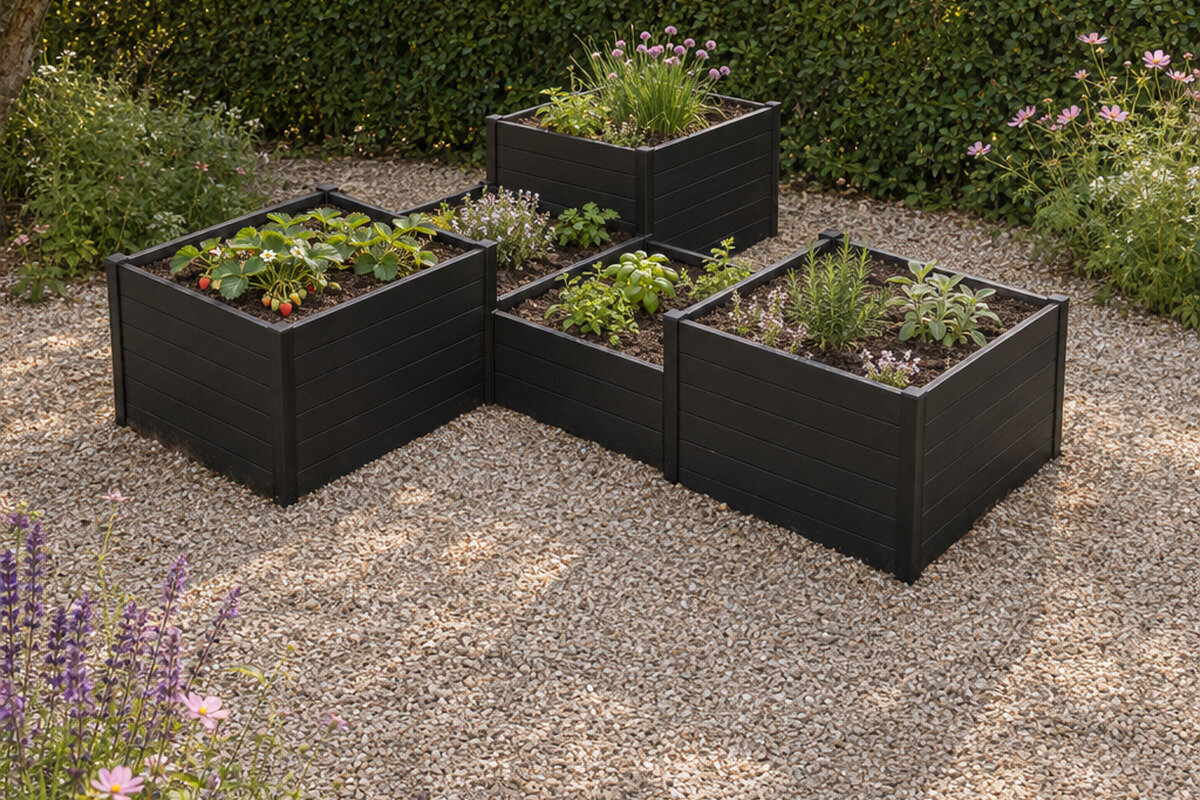
If timber is optional, use the Bloomcabin raised beds range to compare other layouts on their own terms. The Narrow Aluminium Raised Bed 200×50×50cm has a nominal footprint of 200 × 50 cm, a 50 cm wall height and an open base for prepared ground. The Ascending Triple Accoya Raised Bed has 20 mm thick Accoya boards forming the top 10 cm of each compartment wall, with aluminium wall panels below. Neither is a timber sleeper kit. When comparing them with sleeper raised bed kits, verify usable internal space and installation requirements rather than transferring the example's measurements or fill volumes.

Questions readers ask
Are reclaimed sleepers suitable for an edible bed?
Do not choose sleeper raised bed kits made from reclaimed timber for edible crops if the previous use or treatment is unknown. Ask for the material history and written guidance covering the intended use. If the supplier cannot provide it, choose another kit rather than relying on appearance or adding a liner to compensate.
Are the Bloomcabin beds shown here sleeper raised bed kits?
No. The illustrated Bloomcabin beds use aluminium walls or a combination of aluminium wall panels and Accoya top boards. They are alternatives if your priority is a particular layout or wall height, not options for a project that requires timber sleeper walls.
Is the listed wall height the depth I can plant into?
Not necessarily. Fill depth is measured from the base of the fill to the planned soil surface, which may sit below the rim. In an open-bottom bed, roots may also reach suitable soil underneath. Check the ground as well as the kit, and use seed packet instructions and local growing guidance to judge what your plants need.
Make the decision before you order
Shortlist sleeper raised bed kits only after you have checked the timber, intended use and assembly details. Then mark out the frame, test your reach and confirm where water will drain. A kit that passes those checks is a better fit than one that merely looks right in the listing.
Find a raised bed for your plan
Compare layouts and check the dimensions on the product page.
