
Spider Mites in a Greenhouse.
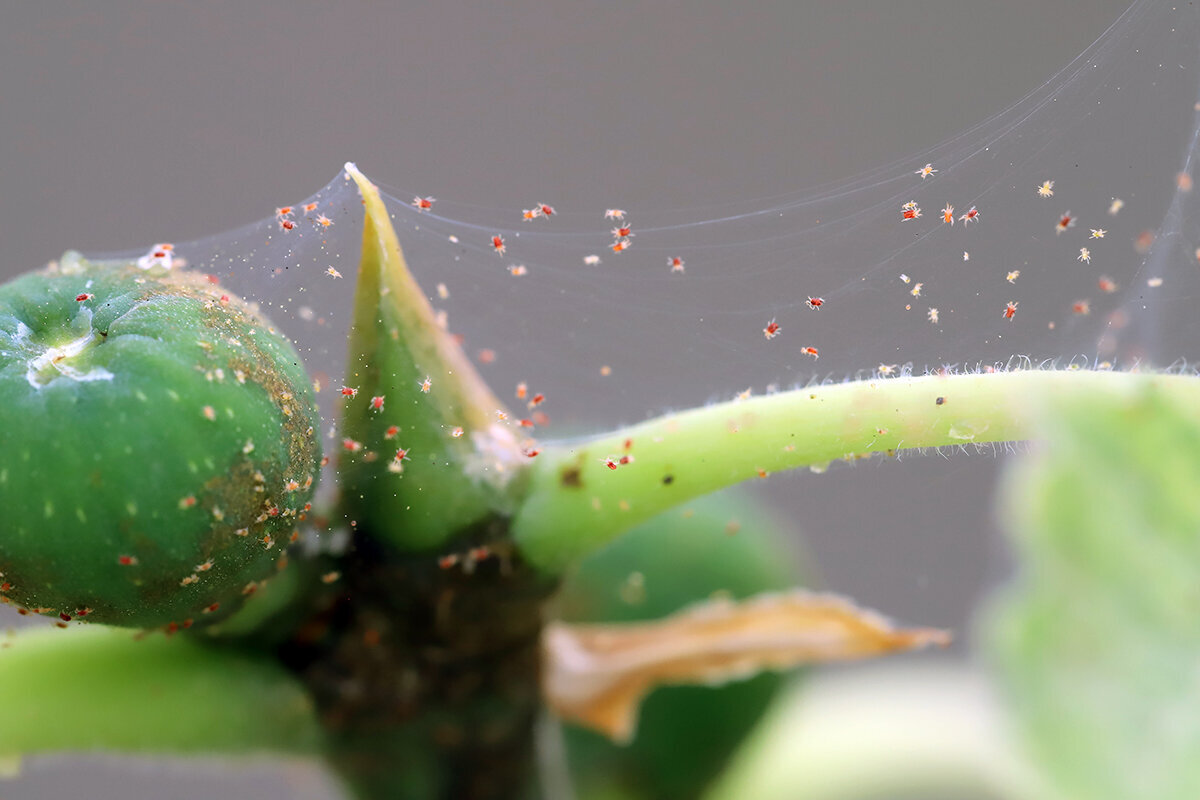
Bloomcabin field guide 41 · United Kingdom
Spider Mites in a Greenhouse.
Identification, prevention and control begin with a change of scale: from a tired-looking plant to the tiny population beneath its leaves. Early evidence is rarely a dramatic web. More often, it is pale stippling, stressed foliage and a protected colony beginning to multiply.
The first inspection
Do not diagnose the damage alone.
Spider mites do not chew holes or leave one obvious wound. They pierce individual leaf cells and feed from their contents, creating tiny pale or yellow pinpricks known as stippling. On a greenhouse bench, this can resemble dust, nutrient trouble, ageing foliage, water stress or thrips damage. The correct first move is not an indiscriminate spray, but a deliberate inspection at three scales: the crop pattern, the leaf surface and the minute evidence below.
Begin with the whole plant and its position. Mite trouble often starts in a small pocket: the warm end of a cucumber row, a drought-prone container, foliage close to glazing or an older lower canopy that has become difficult to reach. Note whether the damage is concentrated on one side, around particular veins, across touching plants or among several neighbouring pots. Then turn leaves over. Glasshouse red spider mites commonly gather on the underside, particularly near veins, where eggs, cast skins, feeding stages and fine silk are easier to find.
Use a hand lens where possible. As a simple supplementary check, hold white paper beneath a suspect leaf and tap it gently; tiny moving specks warrant closer examination, although they do not provide a final species identification. Inspect several leaves and compare young growth with older damage. A calm early diagnosis avoids treating an entire greenhouse when the living population may still be confined to one accessible hotspot.
Greenhouse architecture matters. A considered layout allows you to walk around crops, turn a leaf, clean beneath staging and reach the inner face of dense plants without brushing foliage together. When considering access, ventilation and practical growing space, the Classic Aluminium Greenhouse shows how a well-proportioned structure can support both cultivation and regular pest inspection.
01 · Plant posture
Read distribution.
02 · Leaf surface
Read pattern.
03 · Living evidence
Read activity.
Plant posture. Look for a tired grey-green cast, lower-leaf stippling and one stressed plant acting as a source. Mark its position rather than trusting memory.
Leaf surface. Fine pale pinpricks can merge into mottling, followed by a dull, bronze or greyed cast. Compare both surfaces and inspect several leaves, not one.
Living evidence. Look for moving mites, pale rounded eggs, white cast skins and fine silk around veins or leaf junctions. Living evidence shows whether damage remains active.
Identification atlas
From pale stipples to bronzing.
Visible severity helps you prioritise work, but it is not a perfect measure of the current population. A badly bronzed leaf may record an earlier outbreak after mite numbers have fallen; a relatively clean-looking plant may carry fresh eggs and an active young colony. Inspect for movement, eggs, new stippling and silk before declaring either failure or success.
Spider mites are arachnids rather than insects. Glasshouse red spider mites are extremely small and may appear only as moving points without magnification. During the growing season they are often yellowish green with two darker body patches; overwintering females may be orange-red. Colour alone is unreliable, because other red or orange mites can be predatory or incidental. Base control decisions on evidence from the plant, not the common name.
Sparse stippling
Mottled field
Bronzing
Silk appears
Leaf decline
Evidence, not anxiety
Spider mites versus the usual lookalikes.
Stippling deserves attention because it is visible, not because it belongs exclusively to spider mites. A sound diagnosis asks two questions: is the injury consistent with mite feeding, and can the mite or its direct signs be found? Examine leaf undersides, compare old and new growth, look for black faecal marks, assess the texture of damaged tissue and consider whether symptoms followed a watering, feeding or spraying event.
Thrips can produce pale or silvery scarring that resembles mite damage. Their clues often include tiny black faecal spots and slender insects moving in flowers, tender growth or folded foliage. Spray residue, dust or mineral deposits remain on the surface and may wipe or rinse away; spider-mite stippling lies within damaged leaf tissue. Oedema can follow an imbalance between water uptake and water loss, leaving corky, blistered or raised marks, often below the leaf. Natural ageing is usually more orderly: an older lower leaf fades relatively evenly rather than a fine stippled pattern expanding through a warm, sheltered microclimate.
Distorted growth also deserves caution. Not every curled or stunted leaf is evidence of glasshouse red spider mite, especially when classic stippling, eggs, silk and moving mites cannot be found. Check roots, watering rhythm, ventilation and recent crop treatments before assigning a pest. If tender new growth remains deformed and the cause is unclear, seek advice from a reputable biological-control supplier, horticultural adviser or plant-health professional rather than repeatedly applying an unsuitable treatment.
Why a small finding becomes a greenhouse problem
Heat, dryness and delay create pressure.
Mite development and damage are strongly influenced by temperature and crop condition. Warm weather can accelerate population growth, while dry, water-stressed plants are more vulnerable to injury. Crowding creates sheltered routes and makes inspection difficult. There is no responsible universal day count: crop, mite species, temperature and greenhouse microclimate all matter. A consistent inspection rhythm is therefore more useful than a promised calendar threshold.
Zone oneWarm leaf surfaces
Zone twoDry crop stress
Zone threeDense canopy
Zone fourLate detection
Warm leaf surfaces: foliage beside glazing, beneath roof vents or in sun-facing upper canopies may become much hotter than a thermometer near the open door suggests.
Dry crop stress: uneven root-zone moisture compounds the loss of functioning leaf area and makes plants less able to tolerate a modest level of feeding.
Dense canopy: touching plants create protected routes between pots, while crowded foliage prevents thorough underside inspection, washing or treatment coverage.
Late detection: eggs and active stages may overlap. An action that reaches only exposed mites can be followed by fresh activity unless the plants are reinspected.
Prevention is not about pursuing permanently high humidity. It means reducing avoidable plant stress, moderating severe heat, maintaining sensible ventilation, keeping benches and paths clean and finding a colony before the crop becomes a sheltered, webbed microclimate. On hot days, damping down a clear floor may reduce extreme dryness, but avoid persistent leaf wetness or disease-prone conditions.
Prevention through conditions and access
Build a greenhouse that is easy to inspect.
Keep incoming purchases or overwintered houseplants apart from the main collection where space permits. Cucumbers, tomatoes, peppers, aubergines, beans, fuchsias and many ornamentals can be vulnerable, and a low-level infestation may escape a casual glance. Examine leaf undersides on several occasions before integration. Keep a notebook or phone record listing the plant, position, date, symptoms, live signs and action taken. Over time, this reveals recurring hosts and warm zones more reliably than memory.
Water for stable growth rather than crisis recovery. Spider mites are not solved by flooding a dry root zone, and persistently wet foliage is no substitute for careful irrigation. Check compost moisture at root level, water evenly according to the crop and reassess drought-prone containers during bright weather. When planning an accessible, well-ventilated growing room, Bloomcabin’s Classic Aluminium Greenhouse provides a useful reference for balancing durable structure, usable growing space and day-to-day crop access.
Vent and shade with the canopy in mind. Roof vents, doors and appropriate shading can help moderate hot pockets, but equipment must support rather than replace observation. The difference between an attractive structure and a resilient growing room often lies in whether every plant can be reached. Consider circulation, bench depth and practical clearance when reviewing the Classic Aluminium Greenhouse and preserve clear paths rather than filling every available area with foliage or stored equipment.
Keep floors, bench undersides, pot rims, trays, canes, corners and glazing clean. Dropped foliage can conceal infested material, while crevices and structural parts may shelter overwintering females. Remove badly affected leaves when doing so improves sanitation or access without stripping an already stressed plant. Take heavily infested material out of the growing area promptly rather than leaving it beneath staging or composting it directly beside the greenhouse.
- New arrivals: separate them, inspect undersides and repeat checks before integration.
- Crop spacing: prevent foliage from creating an uninterrupted bridge between neighbouring pots.
- Watering: avoid repeated drought stress without overcorrecting into saturated root conditions.
- Heat: observe real leaf-zone pressure on bright afternoons, not only the morning weather forecast.
- Scouting: inspect weekly during active growth and more frequently in hot spells or while an outbreak remains active.
Treatment is a coverage problem
Reach the underside, then return to look.
For a small, early infestation, carefully rinsing suitable plants with water can physically dislodge mites and some webbing. Direct the water towards leaf undersides, avoid damaging tender growth and work where foliage can dry properly. Any authorised plant protection product must be suitable for the intended crop, location and pest. Contact methods only work where they land: a treatment that never reaches the protected colony cannot control it. Aim for deliberate, label-led coverage, never a stronger dose or an indiscriminate cloud of spray.
Incomplete path
Top surface only
Methodical path
Access before treatment
Excessive path
More is not better
Top surface only. Upper leaf surfaces become wet while colonies below remain protected. The plant looks treated, yet mites continue feeding around veins and sheltered junctions.
Access before treatment. Separate pots, support foliage and gently train stems so undersides can be reached. Remove only the worst leaves where that improves access, then follow the chosen method precisely and inspect again.
More is not better. Increasing a dose, improvising with household detergents or treating heat-stressed foliage can injure plants and disrupt beneficial organisms. Follow every label restriction, including crop suitability and application conditions.
For a small, isolated finding, separation, careful washing and close follow-up may be sufficient. A broader infestation calls for sanitation, improved access, stress reduction and a proportionate control route. Predatory mites can be effective within greenhouse integrated pest management: Phytoseiulus persimilis is widely used where red spider mite is present, while other predators may have preventative roles. Buy from a reputable supplier and follow its guidance on identification, release timing, temperature, humidity, handling and compatibility with previous or planned treatments.
United Kingdom legal note: Use only a plant protection product authorised for the intended crop, location and pest. The label governs dose, application method, treatment frequency, safety precautions and harvest interval. Check compatibility with predatory mites or other biological controls, as some products can disrupt them for a meaningful period. Never strengthen a mixture or use a professional product without the required competence and authorised use.
Recovery is a sequence, not a mood
Judge the next leaf, not the old scar.
Stippled or bronzed tissue does not become green again. Success is shown by fewer live mites, declining fresh stippling, no expanding silk and clean new foliage that remains clean over repeat inspections. Retain leaves that still contribute usefully unless removal has a clear purpose. Stripping every marked leaf can stress the plant and remove the visual record needed to distinguish historic damage from continuing feeding.
Day 0Confirm and contain.Mark affected plants, separate them where practical, inspect neighbours and record live mites, eggs, cast skins or silk.
First follow-upLook beneath the treatment story.Reinspect undersides, veins and dense canopy centres. Confirm that washing, predators or treatment reached the original colony zones.
Second follow-upSeparate old injury from fresh stippling.Compare marked leaves with young foliage nearby. New pinpricks, fresh eggs, moving mites or silk show that pressure remains active.
ThereafterReturn to routine scouting.Keep the record, correct recurring heat or irrigation stress and maintain access around every crop so that the next hotspot is found early.
A well-designed structure makes this routine easier. The Classic Aluminium Greenhouse can be arranged as a composed growing room rather than a crowded storage area. Retain a clear inspection aisle, keep susceptible plants within reach and use ventilation and shading choices in response to the conditions at your site. When considering how the structure might support changing crops over time, review the Classic Aluminium Greenhouse with access, circulation, staging and canopy clearance in mind.
Frequently asked questions
Clear answers for close inspections.
Can spider mites be present without webbing?
Yes. Fine silk is usually easier to see during a heavier attack, but an early colony may show only pale stippling above and mites, eggs or white cast skins below. Webbing supports a diagnosis; it is not required for one.
Should I discard an infested greenhouse plant?
Not automatically. A lightly infested or valuable plant may be isolated, carefully washed or treated appropriately, then monitored. A severely affected plant that cannot be reached or managed may remain a source for the wider greenhouse. In that situation, prompt removal can be the most practical choice.
Will higher humidity eliminate spider mites?
No. Reducing extreme dryness and maintaining even irrigation can make plants more resilient, while damping down a clear floor on hot days is a recognised cultural measure. Humidity is not a stand-alone cure. Preserve crop-appropriate ventilation and avoid persistent wetness that encourages fungal disease.
Can I use predatory mites after spraying?
Possibly, but compatibility depends on the exact product and its persistence. Check the current product label and ask the biological-control supplier for specific guidance before release. Predatory mites also need suitable handling, placement, temperature and humidity conditions.
How often should I inspect during an outbreak?
Inspect more frequently than the ordinary weekly routine. The exact interval depends on the crop, weather, population and control used. Mark affected leaves, then compare like with like three to five days later where appropriate, looking for fresh activity rather than old scars.
Are spider mites spiders?
They are arachnids and are related to spiders, but glasshouse red spider mites are minute plant-feeding mites. Their fine silk covers plant surfaces during established infestations and is not an ordinary spider’s large web.
Sources and further reading
A short, reliable reading shelf.
These UK resources support the diagnostic and integrated-management approach used here. Product authorisations and labels can change, so always check current conditions before making a crop-specific decision.
More from Bloomcabin: aluminium greenhouse FAQ · UK greenhouse gardening guide · Bloomcabin UK greenhouse collection
- RHS: Glasshouse red spider mite
- RHS: Biological control in the home garden
- AHDB: Spider mites
- AHDB: Integrated pest management of mites
- HSE: Using pesticides in your garden, home or allotment
- RHS: May greenhouse, conservatory and houseplant guidance
- RHS guidance on glasshouse red spider mite
- RHS home-garden biological control guidance
