
Steel raised beds: what to check before you buy

Bloomcabin · Raised-bed guides
Steel raised beds: what to check before you buy
Steel raised beds can be a good choice for vegetables, herbs or flowers if the supplier documents what the bed is made from, how it is supported and what it is designed to grow. Before ordering, check those details alongside the planting space, access and drainage at your site.
Read past the material label
For steel raised beds, verify the grade, finish, panel thickness, fasteners and intended growing use for the exact model.
Compare complete kits
Check how the walls are supported at the supplied height and length. Panel thickness is only one part of the design.
Measure before ordering
Use internal measurements for crop spacing and fill estimates. Check reach and the drainage route at the actual site.
Keep the materials distinct
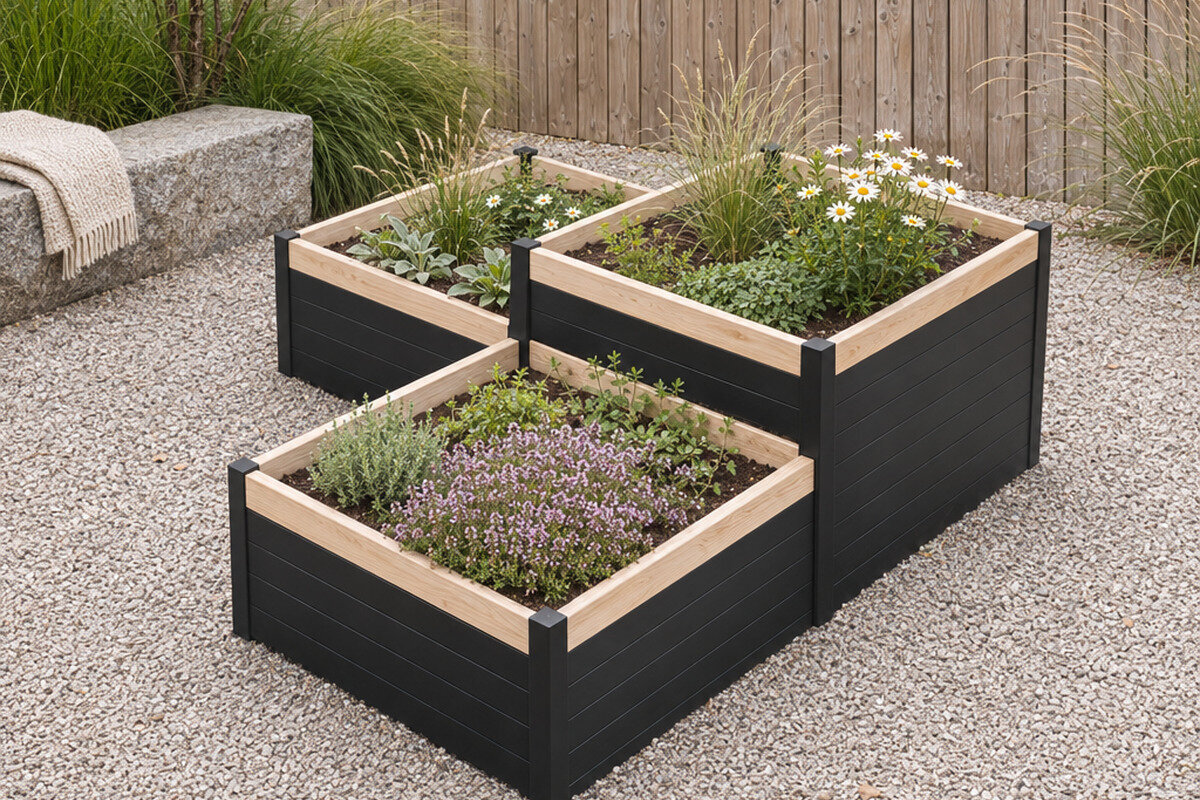
Bloomcabin’s aluminium beds are layout alternatives, not evidence of steel construction or performance.
If you’re comparing two listings for steel raised beds, start by asking for the specification and assembly instructions for each exact model. You want to know what will touch the soil, what holds the panels together and whether the supplier describes the finished bed as suitable for your intended use.
Then mark out the proposed bed where it will stand. A sound specification won’t help if you can’t reach the far side, the kit doesn’t suit the surface, or the advertised dimensions leave less planting space than you expected. Check the material and the layout together before you commit to a kit and its fill.
01
Separate the steel, the finish and the panel shape
Listings for steel raised beds often describe different parts of the specification with a single word. For ordinary steel, ask what corrosion protection is specified, if any. ‘Galvanised’ describes zinc protection; ‘powder-coated’ describes a finish but does not, on its own, identify the steel underneath or say what is applied to both faces. ‘Stainless’ and ‘weathering’ refer to types of steel, whereas ‘corrugated’ describes the panel shape. One bed can have several of these features, so don’t compare the terms as if they were alternatives.
With painted or coated steel raised beds, find out what is on the outside and on the face that contacts the growing medium. Ask how the edges and fixing holes are finished and what the supplier recommends if that finish is damaged. A colour swatch or a close-up of the outside wall won’t answer those questions. If a listing gives a thickness, check whether it refers to the steel sheet itself or the finished panel.
For steel raised beds intended for vegetables or herbs, ask for the supplier’s written guidance on edible growing for the exact model and finish. An outdoor-use description does not answer that question, and a statement about a sheet material does not necessarily cover the assembled product. If the grade or treatment of reclaimed panels is unknown, don’t assume that washing, painting or adding a liner resolves it.

02
Judge the walls as a complete assembly
The walls of steel raised beds retain growing medium, so assess the whole panel assembly, not just the thickness of the sheet. Folds or corrugations affect stiffness, and the distance between supports matters. Two kits with the same sheet thickness can use different panel profiles, joints and bracing. Check how the long sides join and where they are supported in the instructions for the actual length and height you want. Don’t assume a short kit can be extended with spare panels.
When comparing taller steel raised beds, ask whether the advertised height is delivered as one supported wall assembly and whether all the required braces or dividers are included. Check whether any of them cross the planting area or interrupt the positions you had planned for deep-rooted crops or supports. Ask how the top edge is finished, especially where you will reach across it regularly.
Get the fastener specification for steel raised beds as well as the panel specification. Check the material or finish of the bolts and any washers the instructions call for, and ask how to obtain replacements. A fixing that fits the hole is not necessarily the one intended for the joint. Likewise, a tidy top rim is not evidence that you can sit on it or use it for support.

03
Measure the planting space from your working side
Measure the site for steel raised beds in two passes. First, mark the nominal outside footprint and the approach you’ll use with a watering can or barrow. Allow access where you need it rather than fitting the bed tightly between boundaries. Then ask for the clear internal length and width, noting where joints, bracing or dividers take up room. Use the internal dimensions for planting rows and the outside measurements for siting.
For steel raised beds against a fence, try reaching to the far edge from the side you’ll actually work from. Use a temporary marker at the intended rim height rather than testing the reach at ground level. If you’ll garden seated, try from that position on the intended path. A narrower bed or access from a second side may make more difference than a taller wall. Plan your reach so you don’t have to stand on the growing medium.
Keep wall height, fill depth and total rooting depth separate. The fill may stop below the rim, and roots in an open-bottomed bed may have access to suitable soil beneath it. Don’t count paving or unprepared ground as extra rooting depth. Compare the space you can actually provide with the seed packet’s crop spacing and growing instructions, and use local guidance for planting times.

04
Worked example: two beds fit, but only one has the details
Hypothetical example: a gardener comparing two steel raised beds wants to grow salad leaves and herbs in a strip beside a path. Both listings give a nominal outside footprint of 200 × 50 cm and a wall height of 30 cm. Both fit the marked outline, and the gardener can reach the far side from the path. One supplier identifies the steel grade, finish on both faces, sheet thickness and fasteners, provides the assembly instructions, and confirms the model is intended for edible crops. The other listing says only ‘coated steel’ and the supplier cannot identify the finish.
Suppose the documented kit has a confirmed rectangular interior of 190 × 45 cm with no divider. Its internal planting area is 1.90 × 0.45 = 0.855 square metres. If the instructions allow a fill depth of 25 cm, the initial geometric fill estimate is 1.90 × 0.45 × 0.25 = 0.21375 cubic metres, or about 214 litres, before settling. Using the outside dimensions and full wall height instead would give 300 litres, an overestimate of about 86 litres.
The gardener can now check the row layout against the seed packets and verify that the intended open base is suitable for the border. Of the two steel raised beds, only the documented kit advances to that final site check. The second one fits the outline too, but those measurements do not resolve the unknown finish.

05
Settle the base and drainage before filling
Before assembling steel raised beds, read the exact model’s instructions and confirm the base and surface they call for. Check the panel, fastener and brace quantities against the parts list while everything is still easy to lay out. Follow the stated assembly sequence, including when to tighten joints or fit supports. If holes won’t line up or a part is missing, check the instructions and contact the supplier rather than drilling new holes or leaving a brace out.
On soil, steel raised beds with open bases need a site that can accept drainage. Look at the proposed spot after rain: if water routinely stands there, don’t assume raising the sides will fix the underlying problem. On paving, confirm that the model is intended for that installation and find out where excess water will leave the bed. If the site is a raised terrace or another suspended surface, check that it can support the proposed filled installation before buying.
Before filling, review the base and every joint against the instructions. If a liner is specified, check whether it goes on the walls, the base or both and keep the intended drainage route clear. Check also how you’ll get water to the bed. A location that technically fits can still be awkward if the only approach is blocked by the assembled frame.

06
Plan for watering and finish-specific care
Choose a peat-free growing medium suited to your crops and how you’ll use the bed. Compare the stated structure, moisture retention and intended use rather than choosing by bag size alone. Soil in raised beds can dry more quickly, so check moisture in the growing medium and adjust to the weather and plants instead of watering to a fixed timetable. Don’t judge the moisture throughout the bed by the appearance of the surface beside the wall.
The care routine for steel raised beds should match the finish. Keep the supplier’s cleaning and repair instructions, and use them when you spot a scratch or a change around a fixing. Ask before using a wire brush, touch-up coating or sealant, particularly on the soil-facing surface. A treatment intended for a different steel finish may not be suitable here.
When clearing crops from steel raised beds, take the opportunity to look at corners, joins and the inside of the rim. Check for changes such as lifting coating, loose fasteners, gaps at joints or a side moving out of line. If a wall has shifted or a joint is opening under fill, stop using the rim for support and ask the supplier how to make the bed safe before attempting an adjustment.

07
Compare alternatives without confusing the materials
Shortlist steel raised beds against the same requirements: stated growing use, steel grade and finish, sheet thickness, supports and fasteners, usable internal space, base arrangement and care instructions. Mark each requirement as confirmed, unknown or unsuitable. Treat an unknown that affects edible growing, assembly or drainage as a reason to pause. A missing decorative detail doesn’t have to hold up the decision in the same way.
If you started looking at steel raised beds because you wanted a narrow metal frame, not because steel is essential, compare the layout with Bloomcabin’s Narrow Aluminium Raised Bed 200×50×50cm. It has a nominal footprint of 200 × 50 cm and a wall height of 50 cm, with aluminium wall panels, corner posts and T connectors. Its base is open to prepared ground and it is supplied unassembled. Confirm clear internal measurements and site suitability separately.
If steel is a firm requirement, keep that aluminium model off the shortlist. If the material is flexible, compare equivalent details rather than assuming that aluminium, timber or steel raised beds will always be easier to maintain. For timber, ask for the species or material description and treatment; for any kit, check what the supplier says about the finish, fixings and intended use. Choose the one whose documented design solves your planting and siting problem.

Questions readers ask
Are steel raised beds suitable for growing vegetables?
They can be. Ask whether the complete model, including its soil-facing finish, is intended for growing edible crops. If the listing only says ‘outdoor use’, ask for a clearer statement. Then check that the usable soil depth, drainage and planting space suit the vegetables you want to grow.
Do steel raised beds need a liner?
Not as a general rule. Ask whether the supplier requires, allows or advises against a liner for that model, and what it should cover. A liner does not establish that an unidentified coating is suitable for edible growing, and it should not obstruct the intended drainage route.
Can I use leftover roofing sheets to make steel raised beds?
Do not assume that a roofing specification covers retaining soil or growing food. You would need to identify the sheets and their finish, including any previous treatment or contamination, and check how the cut edges, fixings and supports would be handled. If you cannot establish the material and its suitability, choose a documented kit for edible crops.
Make the decision before the bed is full
Choose steel raised beds when the supplier’s documentation answers your questions about the material, finish and assembly, and your site checks confirm planting space, reach and drainage. If a key answer is missing, ask before buying. It’s much easier to change your choice on paper than after you’ve filled the bed.
Find a raised bed for your plan
Compare layouts and check the dimensions on the product page.
