
Tall flower bed dimensions: check height, reach, fit and capacity

Bloomcabin · Raised-bed guides
Tall flower bed dimensions: check height, reach, fit and capacity
To size a tall flower bed, use the outside dimensions to check fit, the wall height to test reach, and the clear inside dimensions and planned fill depth to calculate litres. The height on the label is not automatically the depth of soil your flowers will get.
Keep two sets of measurements
Use actual outside dimensions for fit and clear inside dimensions for planting area and volume.
Check the depth
A tall flower bed’s wall height is not its fill depth or the total depth available to roots.
Calculate bay by bay
Multiply clear length, width and fill depth in metres, then multiply by 1,000 for litres.
Make room to work
Measure the clear path and test your reach at the proposed rim height before settling on a size.
If you are choosing a tall flower bed for a narrow strip beside a boundary, two decisions come first: can you reach the flowers from the path, and how much growing medium should you buy? A catalogue size can help you shortlist a frame, but it cannot answer both questions on its own.
Keep the listed measurements beside a simple site sketch. The guide below shows which figures to copy from a product listing, which to measure for yourself, and how to turn those measurements into square metres, litres and a bag count. The worked example is hypothetical and kept separate from the product specifications.
01
Translate the label into measurements you can use
Read the dimension labels before comparing the numbers. In a listing for a tall flower bed, ‘depth’ can refer to the front-to-back dimension on the ground, not the vertical depth of soil. Give each figure a name on your sketch: length along the border, front-to-back width, and wall height. If the listing shows more than one height, note the position of each rather than writing down only the tallest.
Bloomcabin’s Narrow Aluminium Raised Bed 200×50×60cm, for example, has a nominal footprint of 200 × 50 cm, a 60 cm wall height and a nominal planting area of 1 m². The area is consistent with the nominal dimensions: 2.00 m × 0.50 m = 1.00 m². Those figures describe the listed layout. They do not establish the exact clear span between the walls or the furthest outside points of the assembled frame.
Keep two sets of dimensions for a tall flower bed. For fit, measure the assembled outside span, including any projections relevant to the available space. For planting area and fill, measure between the inside faces. If the bed is not yet assembled, ask for a dimensioned drawing or confirmed clearances. A nominal drawing is fine for shortlisting, but a tight gap is a reason to confirm the actual outside size before ordering. Check the assembly instructions as well if you are working between fixed boundaries: the space needed to put the frame together may differ from the space it occupies afterwards.

02
Separate the outside outline from the area you can plant
Start with the overall length and width when checking whether a tall flower bed fits. Then draw the actual shape within that outline. For a rectangular planting bay, clear length in metres × clear width in metres gives the usable surface area in square metres. If there are several bays, add their clear areas. A central opening or a notch belongs on the site sketch, not in the planting-area calculation.
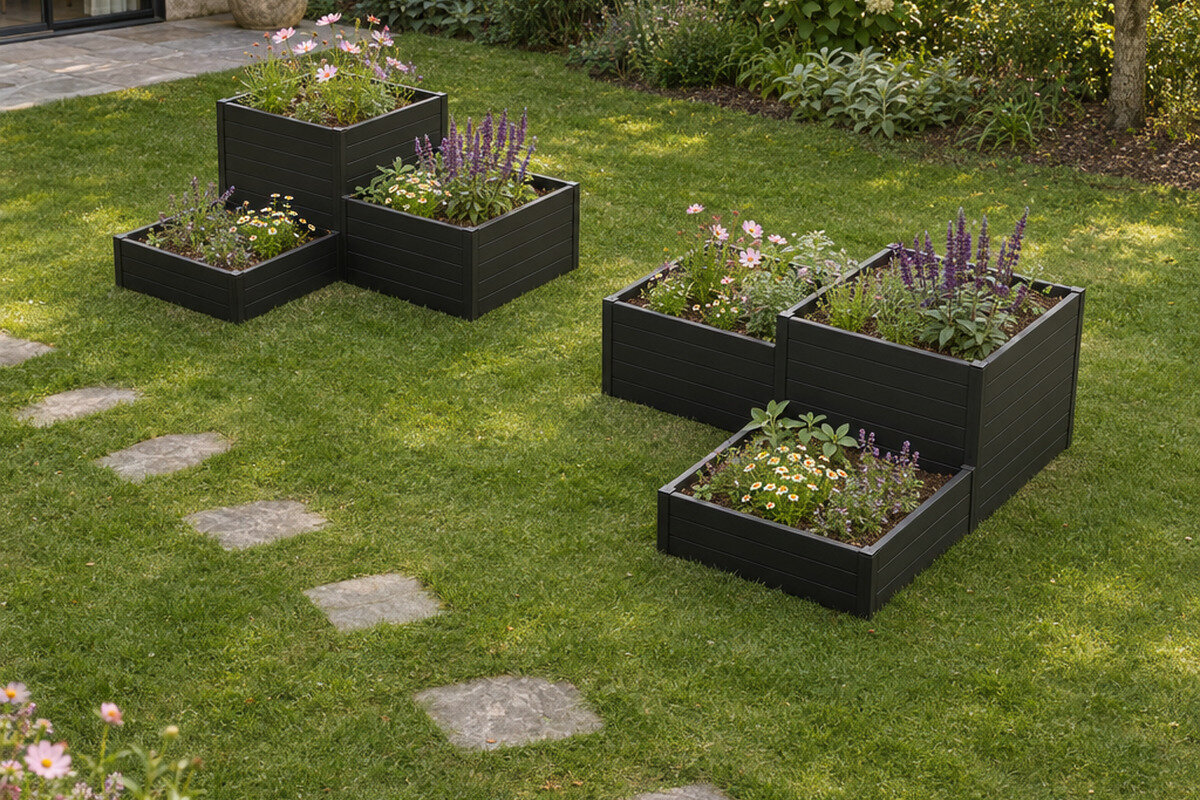
The Tall Triple Aluminium Raised Bed illustrates why equal areas do not necessarily mean one continuous planting space. Its nominal 300 × 100 cm footprint spans three nominal 100 × 100 cm bays. The three bays account for a nominal 3 m² of planting area, but a flower-spacing plan still has to work within each bay. A row drawn as if it could run uninterrupted for 300 cm ignores the dividers.
In contrast, the U-Shaped Aluminium Raised Bed 300×200×30cm spans a nominal outside rectangle of 3 m × 2 m, or 6 m². Its five nominal 1 m² bays total 5 m² of planting area; the nominal 1 m × 1 m notch accounts for the remaining square metre. Those are catalogue layout figures. If the notch is how you will approach a tall flower bed, check its actual clear opening and working space rather than assuming the nominal metre will suit you or your equipment.

03
Read wall height, fill depth and rooting depth separately
Take three vertical measurements for a tall flower bed: ground to rim, ground inside the frame to the planned soil surface, and path to the point you reach over. The first describes the wall on level ground, the second gives the depth of new fill above the starting surface, and the third tells you the height you will work at. If the path is lower than the ground on which the frame stands, that last distance can be greater than the listed wall height.
Read stepped heights in order. The Tall Triple Aluminium Raised Bed lists 80 / 50 / 80 cm walls from left to right. That is two taller end bays and a lower centre, not three 80 cm walls. It is open to prepared ground, with no floor panel. Mark a fill line for each bay relative to its own rim and check the assembly details at the dividers before assuming the bays can hold different fill levels.
For flowers in a tall flower bed, compare the plants’ needs with the depth roots can actually use. An open base may let roots extend below the frame into suitable soil. Do not count ground below the bed if you have not checked it, and do not assume an open-bottom model specified for prepared ground is suitable for paving or decking. Follow the actual installation instructions and use the plant label, seed packet or local growing guidance to check the needs of the flowers you intend to grow.
Mark the starting soil level as well as the finish line. If the ground is uneven inside the frame, a reading at one corner may not represent the whole bay.

04
Check fit and reach before you commit the space
Hypothetical worked example, not a Bloomcabin specification: you want a tall flower bed for flowers along a boundary. Assume a rectangular frame with an actual outside length of 184 cm and width of 44 cm, and clear inside dimensions of 180 × 40 cm. The site measures 220 cm along the boundary and 140 cm from the boundary to the edge of the usable strip. You plan to work from the front and want 10 cm behind the frame.
Along the boundary, 220 − 184 = 36 cm left over, or 18 cm at each end if the frame is centred. Across the site, 140 − 10 − 44 = 86 cm of clear front path, assuming no other obstruction. If your own trial shows you need 80 cm for that path, you have 6 cm to spare. The 80 cm is an assumption for this gardener, not a general access standard. If a gate or downpipe takes up 8 cm at the narrowest point, the path there is only 78 cm and fails that check.
Now test reach. Assume the 40 cm clear opening is centred within the 44 cm outside width. From the front outside face, the far edge of soil is 2 + 40 = 42 cm away, before adding any distance you stand back. If the same tall flower bed could be tended from both long sides, the centre would be 2 + 20 = 22 cm from either outside face. That shorter reach would only be useful if you also had space for a working path on the other side.
Mock up the edge of the tall flower bed at the planned rim height and try reaching the far edge of the soil. Allow for your normal stance and tools. Keep the approach clear and firm, and plan to work from the path rather than stepping into the growing area. Height alone does not establish wheelchair access.

05
Calculate litres from the space you will actually fill
Continue with the same hypothetical tall flower bed. Assume a 60 cm rim above a common level datum, a level existing soil surface 5 cm above that datum, and a planned finished soil surface 5 cm below the rim. The finish line is therefore 55 cm above the datum. Subtract the starting level: 55 − 5 = 50 cm of new growing medium. This is the fill depth, not a statement about how much farther roots can grow.
For a bay with straight vertical sides and a level starting surface, volume = clear internal length × clear internal width × fill depth. Divide each centimetre measurement by 100 to work in metres. The clear planting area is 1.80 m × 0.40 m = 0.72 m². Multiplying by the 0.50 m fill depth gives 0.36 m³. Since 1 m³ = 1,000 litres, the estimated addition is 360 litres.
Check it independently in centimetres: 180 × 40 × 50 = 360,000 cm³. With 1,000 cm³ in a litre, that is again 360 litres. By comparison, using the outside dimensions and the full 60 cm wall height would give 1.84 × 0.44 × 0.60 = 0.48576 m³, or about 486 litres. That is roughly 126 litres more because it includes space outside the clear bay and assumes fill from the datum right up to the rim.
If a tall flower bed has several bays, use each bay’s own clear area and intended fill depth, then add the results. If the inside shape changes substantially with height or the starting surface slopes, measure at several points and treat a single rectangular calculation as approximate.

06
Turn the fill estimate into a purchasing quantity
Convert the volume for your tall flower bed into a bag count only after choosing an appropriate medium. Check for a peat-free option intended for the flowers and the way you plan to grow them. Then use the volume printed on the bag. A weight in kilograms is not a volume in litres, so it cannot replace that figure in the calculation.
In the hypothetical example, 360 litres ÷ 40 litres per bag = nine bags, if the chosen medium comes in 40-litre bags. To see how sensitive that order is to measurement, take the clear area of 0.72 m² and multiply it by 0.01 m: each extra centimetre of fill takes about 7.2 litres. If the actual starting soil surface is 5 cm lower than assumed, the same finish line requires 36 litres more, or 396 litres in total. That would mean ten 40-litre bags rather than nine.
That difference is a reason to remeasure, not a rule to buy a fixed percentage extra for every tall flower bed. If you can, confirm the volume after assembly and ground preparation. If you must order earlier, note which figures are confirmed and which are estimates. For bagged medium, divide by the labelled bag volume and round up at the end. For a bulk order quoted in cubic metres, keep the original cubic-metre figure and check the quantity being supplied.

07
Choose the size that solves your actual constraint
If the main constraint is a narrow border, start with width and one-sided reach, then compare wall heights. The Narrow Aluminium Raised Bed 200×50×50cm shares the 200 × 50 cm nominal footprint of the 60 cm version, but its listed wall is 10 cm lower. The two models can go on the same shortlist for nominal site fit. The difference to test on site is how comfortably you can work over each rim at your planned soil level.
If the aim is a stepped flower display, shortlist by where the high and low bays sit, not just by the maximum height. Check from which side you will tend each bay. A tall flower bed can fit the ground plan while leaving the middle of a compartment beyond your reach. Where access is tight, a narrower bay or access from a second side addresses that problem more directly than a change in wall height alone.
Before ordering a tall flower bed, match each undecided question to the measurement that resolves it. An uncertain fit calls for the actual outer spans and clear gaps. An uncertain fill order calls for the internal spans and measured fill depth. Uncertain working access calls for a trial at the intended height. Use the Bloomcabin UK raised beds range to compare the listed layouts, then check the relevant product drawing and assembly instructions for details the headline dimensions do not give.

Questions readers ask
Does an 80 cm tall flower bed give flowers 80 cm of rooting depth?
Not necessarily. If 80 cm is the wall height, first find the depth from the intended soil surface to the ground within the frame. Roots may extend farther into suitable ground beneath an open base, but do not count that extra depth without checking what is there.
Can I use the listed planting area to order soil for a tall flower bed?
Only if it is the actual clear area and the fill depth is uniform. A nominal planting area is useful for comparing layouts, but it is not a measured internal area. Where depths differ, calculate the usable area and fill depth of each bay separately and add the volumes.
Why does a U-shaped bed need a bigger site than its planting area suggests?
Its overall length and width span the open notch as well as the planted bays. Check the full outline against the site, then measure the clear entrance and the space needed outside it. Do not count the notch as planting area or fill volume.
Measure fit first, then order the fill
For a tall flower bed, confirm the outside fit and try the reach before choosing a frame. Confirm the inside measurements and mark the intended soil level before buying growing medium.
Find a raised bed for your plan
Compare layouts and check the dimensions on the product page.
