
Rain or Condensation Under a Pergola: How to Tell the Difference
Pergola weather guide
Water beneath a pergola can come from rain reaching the underside, condensation forming on a cool surface, or a combination of both. A wet patch alone cannot identify which. The most useful clues are when it first appears, how it relates to the weather, where it forms and whether a repeat observation gives the same result. Record those clues before treating the issue as a leak or changing the roof configuration.

01
Start with when the water appears
Rain and condensation can leave similar droplets, so appearance alone rarely settles the question. Rain-related water tends to follow a shower: it starts while rain is falling or soon afterwards, increases with heavier or wind-driven rain, and may recur at the same joint, edge or channel. Condensation is more plausible after a cool, damp period, including a rain-free night, when moist air meets a sufficiently cold surface. These are patterns, not rules. A sheltered pergola, a changing wind or a roof that is still draining can alter what you see.
Treat the first wet patch as an observation rather than a diagnosis. Note when you first noticed it, whether the rain had stopped, and exactly which surfaces are damp. Rain can blow beneath a cover from the side or travel along a frame before falling; condensation can begin on only one cold strip. Both causes can also occur in sequence: rain wets the structure, then later cooling may produce condensation. If the timing is unclear, mark the event as uncertain instead of deciding that every drop proves a leak.
Compare the timing with local weather
Write down the weather at the pergola, not just the forecast for a nearby town. Record when rain starts and stops, whether it is light or heavy, and the wind direction if you can observe it. Wind-driven rain may reach an area that stays dry in calm conditions, so a seemingly sheltered position is not decisive. Note whether water appears during the shower, immediately afterwards or hours later. A delay can fit water continuing along a roof or drainage route as well as condensation; time by itself cannot identify the source.
Compare a rainy evening with a similar rain-free night. A roof surface can cool overnight; if it becomes colder than the dew point of the surrounding air, water vapour can condense on it. The dew point is the temperature at which air becomes saturated, not a particular outdoor temperature or season. Clear skies and low wind may make overnight surface cooling more likely, though local conditions vary. An air thermometer gives context but not the roof-surface temperature. If you are considering the Bloomcabin Lean-To Pergola, include the proposed wall-side position in your enquiry: observations from an exposed roof area may not explain moisture beside the house.
02
Map where the water first appears
Before wiping anything, photograph the whole roof from a safe position, then take closer images of each wet area. Mark the first point you noticed on a simple sketch; the spot where a drop lands may not be where water entered. Record whether dampness is beneath a broad roof area, along a panel or louvre joint, at an outside edge, beside a wall, or near a visible channel, outlet or support. Add any wet patches on adjoining surfaces and the time they appeared. Repeated locations matter more than one isolated photograph.
Use your map to separate an area-wide film from a repeatable line or point. A frame, slope or trim can carry rain sideways before it drips, while a designed route may pass near a joint without being a fault. If you can see water tracking along a member, mark its direction and where it disappears; do not guess what happens behind a cover. Look for model-specific drainage information before interpreting the route. When considering the Bloomcabin Pergola, ask for a drawing showing the intended outlets, then compare their positions with your planned seating area. This helps distinguish expected discharge locations from moisture appearing elsewhere.
Treat droplet shape as a clue, not a diagnosis
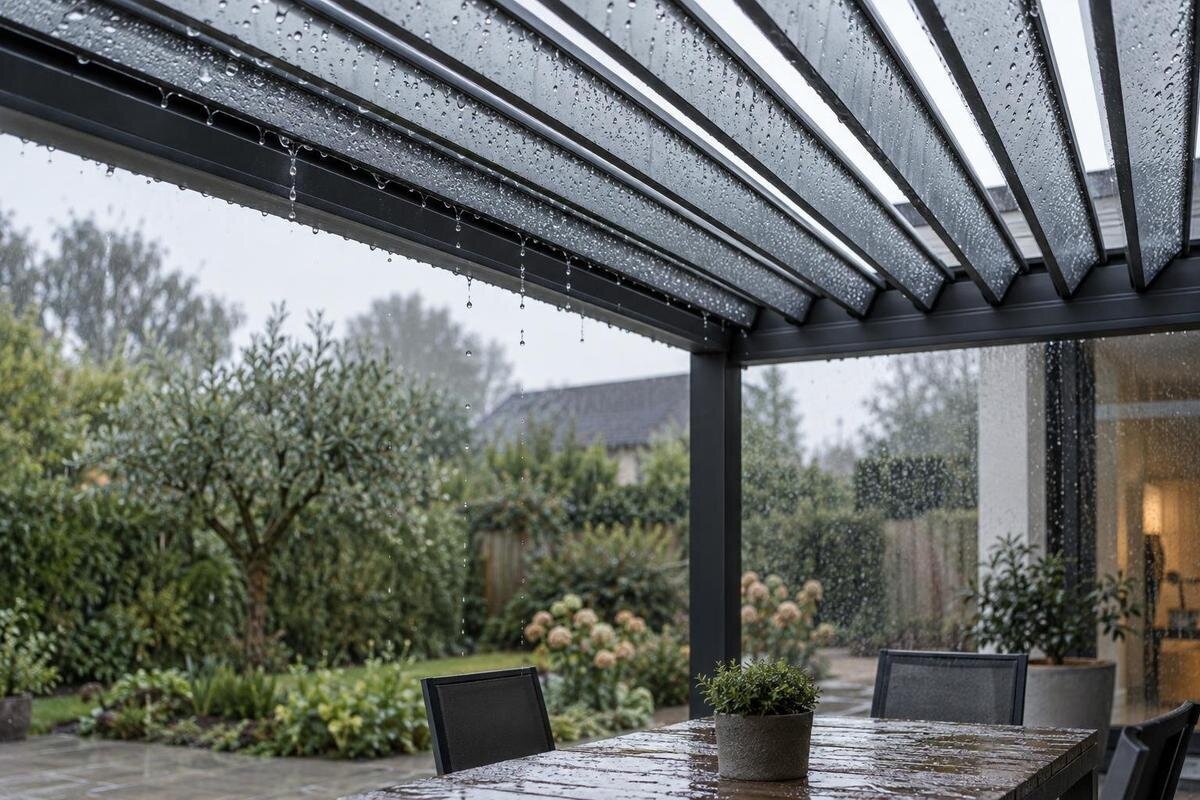
Small beads spread along a cool underside may fit condensation; narrow streaks, a drip from one repeatable seam or dampness following the same line after rain may fit water tracking. Neither pattern is decisive. Rain running across a surface can form a fine film, and condensation can collect into large drops. Dirt, surface finish and the length of time moisture has been present alter its appearance. Concentrate on where it begins and whether the pattern repeats, not on droplet size or clarity alone. A stain or dusty outline can show repeated dampness, but not its source.
Check which surfaces are wet and which remain dry. Condensation is more plausible where a surface has cooled below the dew point; neighbouring surfaces with different exposure may behave differently. Rain is more plausible when a recurring damp line follows a joint or route, although water can run under trim or along a frame first. If the roof has movable parts, record their position without changing it during the observation. For exact roof instructions, use the correct model name, such as Bloomcabin Bioclimatic Aluminum Pergola, rather than assuming a broad product category or photograph reveals its drainage path.

03
Keep a consistent moisture log
Use one page per weather event and write down the date, time, last rainfall, wind if known, first appearance, wet locations and when they dried. If there are side panels or other enclosure elements, note whether they were open or closed. Record any recent activity that could add moisture, such as cooking or hanging wet items nearby. Take a wide photo and close-ups from the same positions each time. If you use a humidity or temperature meter, keep it in the same place and treat its reading as context; one reading does not measure the roof surface or prove condensation. Exact humidity readings are optional: consistent timing and location are often more useful than measurements taken with different devices.
Repeat observations in more than one type of weather, for example during a shower and on a cool, rain-free morning. Where possible, keep the roof and enclosure in the same position so weather is the main changing factor; otherwise record what changed. Let surfaces dry before starting a new comparison, and photograph the first sign before wiping it away. Revisit a few fixed points each time; checking a different area can make a pattern seem to spread. For an enquiry about the wall-mounted pergola, include the installation date and any later changes to the surrounding area alongside your log. Do not create a hose test or alter seals unless the manufacturer or a competent installer confirms an appropriate method.
Trace the rainwater route from the ground
During or after rain, watch the roof from a safe position on the ground. Note whether water leaves by a visible edge or outlet, overflows, appears at a connection, or runs from a nearby building surface; describe what you can actually see rather than guessing at concealed parts. Check the same points during a later shower. If drops continue after rain stops, record how long and whether the pattern follows a channel or edge. A short delay may be water still draining; persistent water in dry conditions may point elsewhere. Note whether the change is limited to one point or occurs in several places, but do not treat visible flow alone as proof of a fault.
Where the design has a rainwater route, its diagram or installation instructions can help distinguish an intended outlet from an unintended drip point. Find information for the exact model and configuration, not a generic drawing. A reference such as the regular pergola model helps identify which product record you are comparing; it does not replace a drainage diagram for the pergola as installed. Not every apparent channel necessarily serves every roof section, so verify its purpose in the drawing. Do not climb on the roof, open covers or remove components to follow a hidden path. If you cannot see the route safely, a qualified installer can compare it with the model-specific documents.
04
Consider air movement and moisture sources
Condensation depends on both surface temperature and moisture in the air. A pergola does not need to be fully enclosed for condensation to form: outdoor air can be humid, and a sheltered roof surface can cool overnight. Screens or other enclosure elements may change airflow, while people, cooking, plants, wet cushions or nearby drying laundry can add moisture. Wet surroundings may also affect the air close to the roof. These factors make condensation more plausible in some circumstances, but none proves it. Rainwater can also be redirected by an enclosure, so consider drainage as well as ventilation.
Compare similar conditions rather than opening or closing everything at once. If droplets appear only when an enclosure is closed, note the association and repeat when the weather is comparable; it suggests a change in airflow or moisture, but does not rule out rain entry. Keeping sides open may expose the roof to wind-driven rain, so ventilation is not a standalone fix. When checking product options, the bioclimatic model listing is a model identifier, not evidence about which enclosure or operating arrangement is compatible. Confirm that in documents for the exact model before changing the configuration.
Check the house-side junction separately
For a pergola beside a house, map the wall-side area separately. Moisture may arrive from the pergola roof, an adjoining gutter or roof, a wall junction, a window or another building detail; a drop at the boundary does not identify which. Look from ground level to see whether the first damp point is under the pergola roof or higher on the wall, and compare it with the rain direction. If you are considering the Lean-To Pergola, ask how the proposed connection to your house will be assessed. For an existing installation, include photographs of that junction when requesting advice about the moisture.
Also note whether the same part of the house stays damp when the pergola roof is dry. A mark on the wall, water appearing above the roof line, or a pattern that does not follow pergola rainfall deserves separate assessment by an appropriate building professional; it should not automatically be treated as a pergola leak. Photograph accessible areas without removing trim or coverings, and note whether moisture appears on the outside, inside or both. Water can travel along a façade before it becomes visible, so the point where you see it may not reveal its origin. This separate wall check is particularly relevant to a wall-mounted structure.

05
Use documentation for the exact model
When comparing pergola designs or asking for help, collect documents for the exact model and installed roof arrangement. Look for weather-performance limits, a drainage diagram, instructions for roof operating positions and information about compatible enclosure configurations. Ask what conditions and configuration each statement covers; broad terms such as weather-resistant do not tell you how a particular joint should drain in your installation. Use the Bloomcabin Pergola product page to identify the model in your enquiry, and request any relevant documents that are not available there. Keep the documents with your quotation so you can compare the proposed arrangement with the information supplied.
Check that the documents describe the product version, roof, side enclosure and installation you are actually considering. A drawing for one arrangement may not apply after panels or screens are added. Ask whether any weather limit covers the roof position you intend to use and the planned side configuration; do not assume all wind directions or rain conditions are covered. Do not assume a universal storm, watertightness or snow guarantee: check the stated limits for the exact model. A general category label is not proof that a proposed enclosure is suitable.
Decide what the evidence supports
A likely condensation pattern is moisture appearing on one or more cool surfaces during a rain-free, damp period, often after a night, without a consistent water route. A likely rain-related pattern is a repeated onset with rainfall and a recurring path from an edge, joint, drainage point or wind-exposed side. A delayed drip after a shower can still belong to the rainwater route. These are reasoned conclusions, not certainties; if the evidence points both ways, write mixed or unresolved. One damp patch after a change in weather is not enough to justify a repair; compare more than one event and describe the result as more consistent with one cause rather than confirmed.
Arrange an assessment when water repeatedly appears at one point, the route is concealed, adjoining building fabric stays damp, or staining or deterioration is developing. Share dated photographs, weather notes, roof and enclosure positions, model details and relevant installation or drainage documents with the installer or an appropriate building professional. Avoid climbing onto the pergola, dismantling roof parts or applying sealant before the cause is understood. If water is close to lighting or wiring, keep clear and ask a qualified professional to assess it rather than handling wet electrical equipment.
Frequently asked questions
Does condensation mean the pergola roof is leaking?
No. Condensation is moisture from air forming on a surface that has cooled below the air’s dew point; it can leave beads underneath without rain entering. Check whether it appears in dry weather and on cool surfaces. Repeated timing and location are more useful than one wet patch, although rain can still be involved if water follows a joint.
Can droplets form after rain has stopped?
Yes. Rainwater can continue along a roof or drainage route after a shower, while a wet, humid period can also be followed by condensation as surfaces cool. Note the delay, roof position and first wet point; the delay alone does not distinguish the two. Compare what you see with the documents for your model.
Can condensation happen under an open pergola?
Yes. An open structure can still have moist outdoor air and a roof or frame surface cool enough for condensation. Side screens and other enclosures can alter airflow, but they are not necessary for it to form. Conversely, being open does not rule out wind-driven rain, so compare the wet pattern with rainfall and wind.
Is it safe to test the roof with a hose?
Do not improvise a hose test on the roof. It may create conditions unlike normal rain and make the pattern harder to interpret. Start with observation and the model-specific drainage instructions. Only carry out a controlled water test if the manufacturer or a competent installer confirms that it is appropriate.
What should I check before buying a pergola?
Ask for weather-performance information, drainage diagrams and instructions for the exact roof configuration. Check whether any proposed enclosure is confirmed as compatible, and establish which conditions and roof positions the stated limits cover. A model name, product image or general claim does not establish a universal storm or watertightness guarantee.
The useful distinction is not simply wet versus dry, but whether moisture repeatedly follows rainfall and a particular route or appears on cool surfaces in damp conditions without a consistent path. Timing, location, roof position, enclosure and local weather together give a more reliable picture than one droplet or one morning. If the evidence overlaps, describe it as mixed or unresolved and compare it with the exact model information before deciding what needs attention.
