
Unique Raised Garden Beds: How to Choose, Set Up and Plant Them
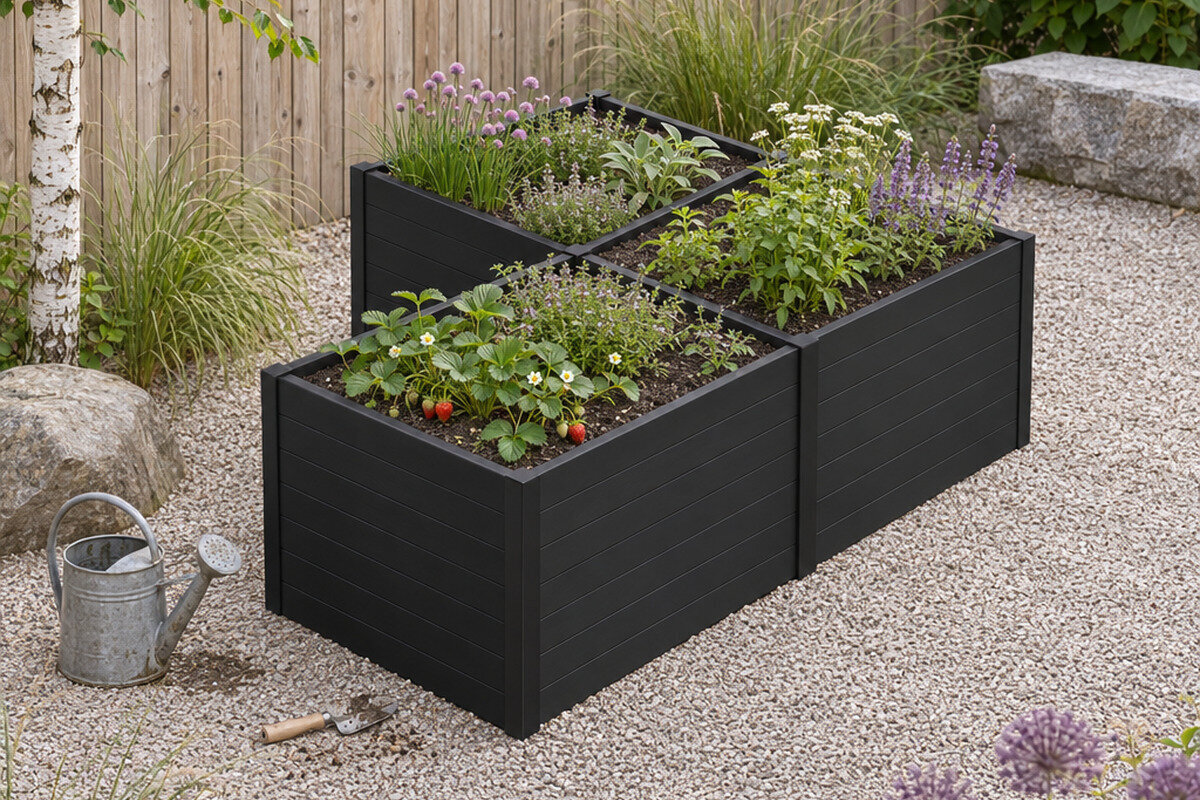

Bloomcabin · Raised-bed guides
Unique Raised Garden Beds: How to Choose, Set Up and Plant Them
Choose unique raised garden beds by the problem their layout solves: a narrow strip keeps planting close to an edge, a stepped row separates crops at different working heights, and a U-shaped bed gives you an inner approach. Measure the bed and its paths together before deciding which shape fits.
Choose for the site
The best shape solves a real problem: a tight edge, separate planting bays or an awkward reach.
Measure separately
With unique raised garden beds, the footprint, planted area and access gaps are separate measurements.
Test the reach
Mark out the bed and paths, then try reaching each bay at its intended wall height.
Calculate bay by bay
Use confirmed internal dimensions and the intended fill depth of each bay to estimate growing medium.
‘Unique’ is not a technical specification. What matters is whether a distinctive shape lets you grow and tend plants more easily in the space you have. A U can give you another place to stand, for instance, but it also needs room to approach the opening.
This guide compares open-bottomed Bloomcabin beds in the UK range. Use it to shortlist unique raised garden beds, mark out the space you would actually work in and check what you need before assembly and planting.
01
Choose the feature that earns its space
What sets unique raised garden beds apart is the arrangement of their growing space. A narrow bed trades front-to-back planting room for a slimmer footprint. A stepped row gives you distinct bays with rims at different heights. A U-shaped bed leaves an opening you can work from, but that opening does not put every part of the bed within reach.
Think about the job you repeat most often. If you pick leaves regularly from a border beside a path, a narrow strip may be more useful than a set of five bays. If you want three clearly separated planting areas without paths between them, look at a divided row. A U is worth considering if you can approach it from both the notch and the outside. Among unique raised garden beds, the most useful feature is the one that makes a recurring task easier.
Shape and material are separate choices. The Classic aluminium models here have aluminium wall panels. The Accoya fusion example uses Accoya at the top of the walls and aluminium panels below; it is not an all-timber bed. These unique raised garden beds are purpose-made kits, not collars designed to fit around a pallet.
- Narrow strip: choose it to keep a route open alongside a garden edge, not to squeeze the same planting plan into less space.
- Stepped row: choose it when separate bays and different working heights serve a purpose. Check the reach over each rim.
- U-shaped layout: choose it when the inner approach helps you reach the planting. Check the rear bays from the notch and the outside.

02
Read the dimensions as a planting plan
When comparing unique raised garden beds for a tight border, start with the shorter aluminium options. The Narrow Aluminium Raised Bed 100×50×20cm and Narrow Aluminium Raised Bed 100×50×30cm each have one bay, a nominal 100 × 50 cm footprint and a nominal planting area of 0.5 m². The extra 10 cm of wall on the taller version does not add planting area. The Narrow Aluminium Raised Bed 200×50×50cm and Narrow Aluminium Raised Bed 200×50×60cm each offer one longer bay and a nominal 1 m² of planting area within a 200 × 50 cm footprint.
The Ascending Triple Accoya Raised Bed and the Tall Triple Aluminium Raised Bed occupy the same nominal 300 × 100 cm footprint. Each has three nominal 100 × 100 cm bays and 3 m² of nominal planting area. The Accoya fusion model rises from 30 to 50 to 80 cm, left to right. The all-aluminium model has 80 cm walls at the ends and a 50 cm centre. If the centre is where you expect to work most often, compare those two layouts rather than just their tallest walls.
For U-shaped options, both the U-Shaped Aluminium Raised Bed 300×200×30cm and the Framed U-Shaped Aluminium Raised Bed have a nominal footprint of 300 × 200 cm, five nominal 100 × 100 cm bays and 5 m² of nominal planting area. The sixth square metre in that outline is the nominal 100 × 100 cm notch, not another bay. The first kit has 30 cm walls throughout; the framed version raises the two rear corners to 60 cm. This is why unique raised garden beds with the same footprint and planting area can feel quite different to work in.
- Use the nominal footprint to shortlist a model, then confirm the actual outside dimensions and any fitting clearance if the site is tight.
- Use confirmed internal bay measurements for planting and fill calculations. Wall height is a separate measurement, not a promise of usable rooting depth.

03
Mark out the paths before ordering
Mark the outline with string or canes. For unique raised garden beds with an inner opening, mark the notch as well as the outer edges. Walk the normal route through the garden, then try approaching with a watering can or whatever you usually carry. The nominal opening is not a confirmed clear passage. Check the actual gap at its narrowest point and keep the route into it free of pots or other obstructions.
Next, mark the centre of each bay and try reaching it from the places where you can actually stand. For those comparing unique raised garden beds with stepped walls, use a cane to mark the intended rim height as you try the reach. A straight 100 cm bay against a boundary may have only one working side. In a U-shaped bed, being able to reach an arm from the notch does not tell you whether you can tend the far side of a rear bay. If the only way to reach a spot is by stepping on the soil, change the position or the layout.
Check the route to water as well as the route around the bed. If you garden seated or use a mobility aid, test the approach, path surface, turning space and reach at the proposed working height. A tall, straight-sided frame is not equivalent to an elevated planter with room underneath, and the notch measurement alone does not establish accessibility.

04
Prepare the ground and assemble the chosen layout
These unique raised garden beds have open bases and are intended for prepared ground. Read the instructions for the exact model before preparing the site: check how the base should meet the ground, how level the site needs to be and what working space assembly requires. If the proposed spot repeatedly holds standing water, investigate the site or choose another position rather than assuming the frame will solve the problem.
The kits are supplied unassembled. Lay out the parts according to the product instructions and identify which wall sections belong in each position before joining them. For example, each long side of the 200 cm narrow models uses two 100 cm sections joined by an aluminium T connector. The U-shaped kits also specify cross connectors. The parts list tells you what is used, not the installation sequence, so follow the guide for the model rather than borrowing a method from another layout.
With stepped or divided unique raised garden beds, check the orientation before filling. Stand at your intended working side and check that the tall and low bays are where you planned them. On a U-shaped kit, make sure the notch faces its approach path. Check the connections and ground contact as directed by the instructions, and resolve anything that does not fit before adding growing medium. Do not improvise supports, anchors or a floor.

05
Work out what each bay needs
The buying mistake with unique raised garden beds is to estimate soil from the outside rectangle. That counts the notch of a U-shaped bed as if it were planted and treats a stepped bed as if all its bays were equally deep. Instead, ask for the internal dimensions or fill guidance for each compartment. If the figures are not listed, confirm them with Bloomcabin or measure the assembled bays before ordering the full quantity.
For a rectangular bay, multiply its internal length by its internal width and by the intended fill depth, all in metres. Multiply the result by 1,000 to convert cubic metres to litres. With stepped unique raised garden beds, repeat the calculation for each bay using its own intended fill depth, then add the results. If the interior is not a simple rectangle, use the maker’s fill guidance if available rather than assuming the same calculation gives an exact amount.
Choose a peat-free growing medium suited to the intended plants and check its label for the intended use. Media differ in how they hold water and in the structure and nutrients they provide. Also look at the soil under the frame. An open base lets roots reach the ground below where conditions allow, but a wall measurement does not tell you whether that ground is suitable. Use the crop’s needs and the site conditions to decide on the usable growing depth before committing to a fill quantity.

06
Plant for the way you will tend the bed
Give each bay a job before sowing. On a narrow strip reached from one side, keep the crops you expect to pick most often within easy reach. Salad leaves or herbs are possible starting points if the site and seed instructions suit them. In unique raised garden beds with three bays, decide whether each bay serves a different crop group or a different sowing batch. A divider helps you keep track; it does not make adjacent plants compatible or guarantee an effective rotation.
Consider mature plants, not just seedlings. Check whether foliage will narrow the approach to the inner arms of a U-shaped bed or make it awkward to reach past the first row of a narrow bed. Wall height is not a planting plan either: a taller bay can bring plants closer to hand, but it can also put the far side beyond a comfortable reach. Follow seed-packet guidance and local growing advice for spacing, sowing depth and timing rather than assuming one calendar fits the whole UK.
In unique raised garden beds with bays of different heights or exposure, check the growing medium in each bay before watering. Raised soil can dry more quickly, and a check in the easiest bay to reach is not a check of the whole bed. Keep a simple note of what went where and which spots were awkward to water or harvest. Use that record when you plan the next sowing.

07
Worked example: fit three bays without losing the path
Hypothetical worked example: A gardener comparing unique raised garden beds has a level 3.4 × 2.0 m patch beside a boundary and wants three separate planting bays. They decide to reserve 0.8 m of the 2.0 m depth for their front working path. That is a preference for this example, not an access standard. It leaves 1.2 m of depth for the bed. A nominal 3.0 × 1.0 m triple row fits on paper, leaving 0.4 m spare along the length and 0.2 m in the depth budget. A nominal 3.0 × 2.0 m U occupies the full depth and would not leave the planned front path.
The gardener marks out both triple-row wall profiles. In this example, their reach check shows they can tend the middle of the end bays over the 80 cm rims, but want the central rim lower for frequent picking. They shortlist the Tall Triple Aluminium Raised Bed, with its 80 / 50 / 80 cm walls. If the end bays were awkward to reach, the dimensions on paper would not justify choosing it. They would try a different position or rethink the three-bay plan.
Before ordering, they use the current UK product details and assembly instructions to confirm the required clearance and check that the planned access remains workable. They confirm the internal dimensions before buying fill and consult the seed packets and local guidance before choosing what to sow. This is a useful order for comparing unique raised garden beds: rule out what cannot fit, then test whether the option that fits can actually be tended.

Questions readers ask
Are Bloomcabin’s unique raised garden beds pallet collars?
No. Pallet collars are frames designed to fit around pallets. The Bloomcabin models shown here are purpose-made raised-bed kits supplied unassembled. They have an open base, not a pallet or a floor panel.
Do taller unique raised garden beds always give crops more rooting depth?
Not necessarily. Compare the depth of growing medium you intend to add and the condition of the ground below. Wall height tells you where the rim sits, not the depth of soil that roots can actually use.
Can I put unique raised garden beds on paving?
Do not assume the models in this guide are suitable. They are open-bottomed and specified for prepared ground. Before considering paving or decking, check whether the manufacturer allows that installation and how drainage, soil containment and the weight of the filled bed would be handled.
Make the layout prove its worth
Shortlist unique raised garden beds by shape, then let your measurements and a reach check make the decision. Confirm the chosen kit’s assembly and fill details before ordering soil, and plant the bays you can comfortably tend.
Find a raised bed for your plan
Compare layouts and check the dimensions on the product page.
