
Warm or Cool Pergola Lighting: Choosing Colour Temperature
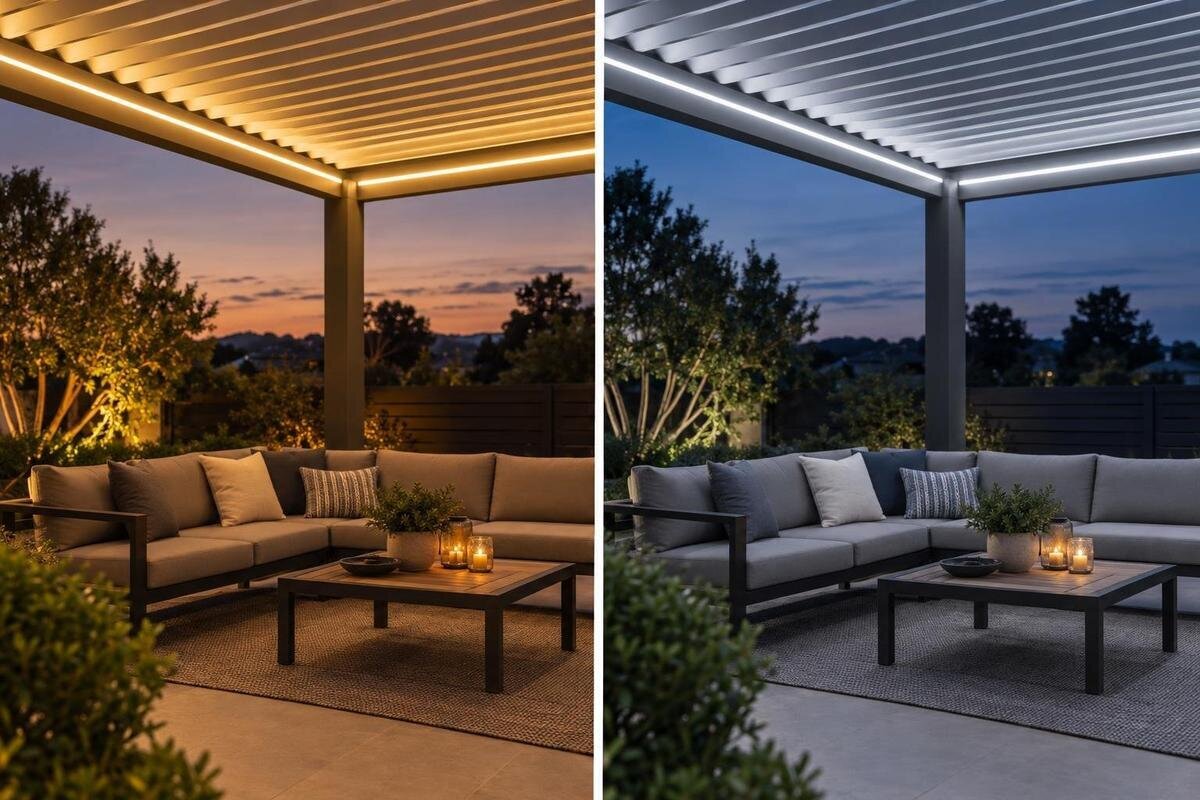
Pergola lighting
Warm and cool pergola lighting create noticeably different impressions after sunset, but neither colour temperature is automatically the better choice. The right setting depends on what you do outside, the finishes around the light, other lamps in view and the atmosphere you enjoy. This guide explains what Kelvin figures mean, how to compare options fairly and which product-specific details to confirm before ordering.

01
What colour temperature means
Colour temperature, often specified as correlated colour temperature (CCT), describes the apparent colour of white light and is expressed in kelvins (K). A lower figure usually looks warmer, with a yellow or amber cast; a higher figure tends towards a cooler, whiter or bluer appearance. Here, “warm” describes how the light looks, not how much heat it gives off, so choosing warm white will not make an outdoor seating area physically warmer. Nor does it describe the fitting’s casing or tell you how bright it will be. Keeping those meanings separate makes product descriptions easier to compare, especially when words such as “warm”, “bright” and “powerful” appear together.
For orientation, warm-white lamps are often labelled around 2,700–3,000 K; higher values are commonly described as neutral white and then cool or daylight white. The boundaries are not universal, so compare the stated Kelvin figure as well as the category name. CCT summarises the appearance of white light; it does not describe every part of the light spectrum. Two lamps with the same rating can therefore make a brick wall or cushion look different. Use Kelvin to shortlist a tone you may enjoy, not as a universal measure of quality or a guarantee that a fitting is suitable for pergola use. Some catalogues offer broad ranges rather than a single setting, and the same number can feel different in a darker outdoor scene than in a bright showroom.
Warm white for dining and conversation
Warm white is often chosen when a pergola is mainly a place to eat, talk or sit outside after sunset. Its yellow-to-amber quality can give an evening scene a softer, more intimate feel, and it may sit comfortably with brick, timber-look details, terracotta pots and other warm-coloured finishes. Those are common impressions, not rules: a low Kelvin value is not automatically cosy, and people respond differently to the same light. The scale of the space, the fitting’s output and nearby lamps all affect the result. Think about the mood you want most evenings, rather than choosing a colour simply because a product calls it warm white.
Assess the whole scene, not the lamp in isolation. The same fitting might feel inviting over a table but too golden against a cool grey wall; skin, food, foliage and fabric may also look different under lamps with matching Kelvin ratings. Greenery can be revealing, because the warm or cool label alone does not predict how a particular lamp will render leaves. If colour appearance matters, check the manufacturer’s colour-rendering information where available and test a sample against your own surfaces at the brightness you expect to use. When discussing the Bloomcabin Bioclimatic Aluminum Pergola, describe the table position and the surfaces you want to illuminate. This gives the supplier a concrete basis for discussing any verified lighting options, rather than relying on a general request for a cosy atmosphere.
02
When cooler white may suit the space
Cooler white may appeal if you want a crisp, alert impression for reading, serving food or carrying out a practical task. It can feel consistent beside cooler-coloured finishes or existing white exterior lamps, while neutral white may provide a middle ground if warm light seems too amber and cool light too stark. The labels are not perfectly consistent between makers, so judge the appearance rather than treating neutral as an exact Kelvin band. Higher CCT alone does not guarantee clearer vision: light output, contrast, the task and the lamp’s colour rendering all matter. Once the surrounding garden goes dark, a blue-white cast may feel more pronounced.
Decide where a cooler tone would be useful and whether you want it throughout the pergola. A crisp setting may suit a bench used for reading but feel less relaxing at a dinner table; it may also look noticeably different from warmer light spilling through a nearby window. If the structure is next to the house, compare both together after dusk. When considering the Bloomcabin Lean-To Pergola, include the adjoining room’s lighting in your comparison, especially if the doors are often open during meals. You need not make every outdoor lamp identical, but differences can look more deliberate when they serve separate areas. Consider whether the indoor and outdoor lights need to look harmonious together or whether you prefer a distinct atmosphere outside.
Match the light to evening activities
Choose the main use before choosing a Kelvin figure. For a space used mostly for unhurried meals and conversation, you may prefer a softer warm-white appearance; if someone regularly reads, sorts plants or serves food there, a more neutral setting might feel more practical. These are starting points for comparison, not rules about which colour belongs to which activity. Write down the two or three things you do most often and rank them. That prevents an occasional task, such as finding a dropped item, from dictating the colour of every evening’s general lighting.
If the pergola has several uses, decide whether one setting can reasonably serve them all or whether control by zone would be worthwhile. A separate task light may let general lighting stay softer, but only if its fitting and installation are supported for the structure. Adjustable white may also help if the exact lights and controls support it. For a configuration enquiry about the Bloomcabin Pergola, explain which activities share the same seating area and which take place elsewhere. Consider who will use the controls and how often: a complicated setting that rarely gets changed may add little practical value. A configuration discussion is more useful when you can name the activities, positions and preferred atmosphere you want, rather than simply asking for more lighting.

03
Consider nearby lighting and finishes
Colour temperature is experienced against its surroundings. Light from a kitchen or sitting-room window, existing wall lights, other garden lamps and the dark sky can make the same pergola fitting appear warmer or cooler by contrast. Visit the space after dusk, switch on the lamps you normally use and look from both the seating area and the house. A colour that seems balanced from one chair may look too blue or too golden through the doors. If there are several exterior lights, note which will usually be on together rather than judging each one in isolation.
Finishes change the impression as well: warm light can bring out yellow or red notes in brick and timber, while a cooler setting may make pale grey or white surfaces look crisper. These are tendencies rather than predictions; paint, paving, upholstery and foliage respond differently to different light spectra. If a finish is still being selected, compare samples in the actual evening light rather than relying on their daytime appearance. When reviewing the Bloomcabin bioclimatic pergola page, ask which finishes are available for the configuration you are considering and whether samples can be supplied. A gallery photograph is not a reliable guide to how a finish will look under your chosen lamp. The nearest large surface can occupy much of your view, so assess the scene from where you normally sit or stand.
Compare brightness and colour rendering separately
Colour temperature and brightness describe different things. Kelvin indicates the appearance of white light; rated light output is usually given in lumens. A warm-white fitting can be brighter than a cool-white one, and vice versa. If one option seems more vivid, compare the stated output and, where possible, adjust the samples to similar brightness before attributing the difference to colour. The same dimmer percentage does not necessarily give the same output on different fittings. Beam spread, diffuser and position also affect how much of the table or floor is lit, so a higher Kelvin number cannot compensate for insufficient coverage. Use like-for-like figures where the manufacturer supplies them.
Colour rendering is a further specification. A measure such as the colour rendering index (CRI), if provided, can help indicate how faithfully a source renders colours, but it is separate from CCT and does not describe every aspect of appearance. Two fittings with the same Kelvin value can render food, timber or fabric differently. Check whether dimming changes the tone: some products are specified to become warmer as they dim, while others keep a more consistent white. When discussing lighting for the Bloomcabin lean-to model, request the exact fitting references and any available output and colour-rendering data. Check whether quoted figures refer to the complete fitting or its light source, and whether they apply to the colour setting you want. If the information does not allow a fair comparison, ask for clarification.
04
Fixed or adjustable white light?
A fixed-white fitting offers one chosen colour temperature; an adjustable-white or tunable-white fitting lets you select from a stated range. Check the actual minimum and maximum Kelvin values, whether settings are stepped or continuous, and how they are changed. Adjustable can mean only a few presets rather than every point in the range, while smart controls do not necessarily provide an accurate Kelvin selection. If several people will use the pergola, consider whether the control is simple and whether each light can be adjusted as you expect. The product manual should explain the available settings.
A coordinated fixed setting can look more consistent than several unrelated whites; adjustable lights can provide flexibility, but only if their ranges and controls work together. Check whether a setting is remembered after switching off, whether separate zones can be set independently and whether dimming shifts the tone. RGB colour-changing is not automatically the same as a proper range of white light, so check the white-light specification. One fixed colour may be preferable if you want the same appearance every evening and do not expect to adjust it. Save the chosen Kelvin figure and model details if you later need a matching replacement. The Bloomcabin pergola model identifies the structure; only the exact options list and manuals can confirm supported lighting and controls.
Confirm outdoor suitability and mounting
Confirm that the proposed fitting and mounting arrangement are permitted before choosing its colour temperature. Check the exact pergola and light manuals for supported positions, the fitting’s outdoor rating for its intended exposure and documented approval for combining the two products. A general outdoor label or a photograph of a light beneath a roof does not prove suitability in a particular location. Nor should a convenient-looking surface be treated as approved for an extra fixture. Where the structure includes moving parts, the maker’s instructions need to cover clearances and operation with the proposed installation.
Ask the supplier or manufacturer for written confirmation where the instructions do not answer a mounting question, and seek qualified electrical input for the proposed electrical work. Keep the plan tied to the exact structure, fixture and control equipment; a colour-temperature description alone says nothing about weather exposure or compatibility. If the bioclimatic pergola model is on your shortlist, verify the mounting approval and exact lighting options for the configuration you are considering. Record the relevant product references so the installer can assess the components you have selected; a similar-looking replacement fitting may have different requirements. No rating, fitting position or installation method should be assumed from the product name.

05
Compare samples after dark
The most useful comparison is made after dark in the garden, not from a daytime product photograph or a phone display. If a retailer or installer can arrange it, view samples in the intended position and at the brightness you expect to use. Change one factor at a time: compare colour temperatures with output and placement as similar as possible, then assess brightness separately. Give your eyes a little time to adjust between settings. If you view two lamps side by side, check that their spacing and direction do not give one option an unfair advantage.
Look from normal viewpoints: seated at the table, standing to serve and indoors through the doors. Notice faces, food, foliage and the finishes that occupy most of the view, then ask the people who use the space most often. A camera may alter colour through automatic exposure and white balance, so photos are not a dependable record. Write down each sample’s Kelvin and output figures while you compare, together with the setting you preferred. If you cannot view the exact fitting, ask whether a sample is available rather than relying only on another lamp labelled warm white; settings and colour rendering vary. If you are considering Bloomcabin’s lean-to pergola, bring these observations to the configuration discussion so the supplier can establish whether a supported lighting option matches your preferences.
Details to confirm before ordering
Make sure the quotation records your chosen colour temperature clearly. A description such as warm white may cover more than one Kelvin value, and an adjustable fitting needs its available range stated as well. If you viewed a sample, record its model reference and chosen setting so the supplied option can be compared with it. Where several fittings are intended to look alike, ask whether they will be the same model and specification. If you have deliberately chosen different tones for separate areas, identify which fitting belongs in each area. This helps avoid an unintended mixture of whites and gives you a useful record if a fitting needs replacing later.
Before ordering, confirm the exact CCT or adjustable range, light output, colour-rendering information where available, dimming behaviour, control requirements, outdoor rating and approved mounting details for the selected fitting. Check what is included, what is optional and whether the manufacturer confirms compatibility with your chosen pergola. Keep the model number, Kelvin value and fitting details together when requesting product information, so a general note such as warm white is not mistaken for a confirmed specification. A pleasing colour is one part of a lighting plan, not proof that a fitting can be used there. Compare the light in your own evening setting, then choose the atmosphere and product combination that suit the space.
Frequently asked questions
What does 2,700 K look like compared with 4,000 K?
A 2,700 K light usually looks warmer and more amber; 4,000 K tends to appear cooler or more neutral. Labels and exact appearances vary between products, so compare the stated values and, if possible, view the actual fitting after dark.
Is warm white dimmer than cool white?
No. Colour temperature describes the appearance of white light, not its output. Compare the light-output figures in lumens and, where possible, view both options at similar brightness. Matching dimmer percentages alone does not guarantee matching output. The fitting’s optics and position also affect how bright the area seems.
Can I use warm and cool light in the same pergola?
Yes, but the difference may look accidental if the fittings illuminate the same area. If you choose both, consider whether they serve separate activities or zones, and whether you can control them independently. View the whole scene with the lights on together before settling on the combination.
Will dimming change the colour temperature?
Not necessarily. Some fittings are designed to become warmer as they dim; others mainly reduce their output while keeping a similar white tone. Check the exact fitting and control instructions for dimming behaviour, compatible controls and any available colour-temperature settings.
Does warm white make a pergola warmer?
No. Warm white describes the light’s yellow or amber appearance, not its heat output. Lighting and heating are separate choices; check the instructions and suitability of any proposed heater independently.
Choose the light that makes the pergola feel right at the time you use it. Warm white often supports a softer evening mood; neutral or cooler white may suit a crisper look or particular tasks, but neither is an engineering rule. Compare samples in your own surroundings at a similar output, and keep colour temperature separate from brightness, colour rendering and the fitting’s outdoor approval. A clear specification for the actual light and pergola turns a preferred colour into a lighting plan that can be checked properly.
