
Why Does Water Drip When Pergola Louvres Open After Rain?
Pergola rainwater guide
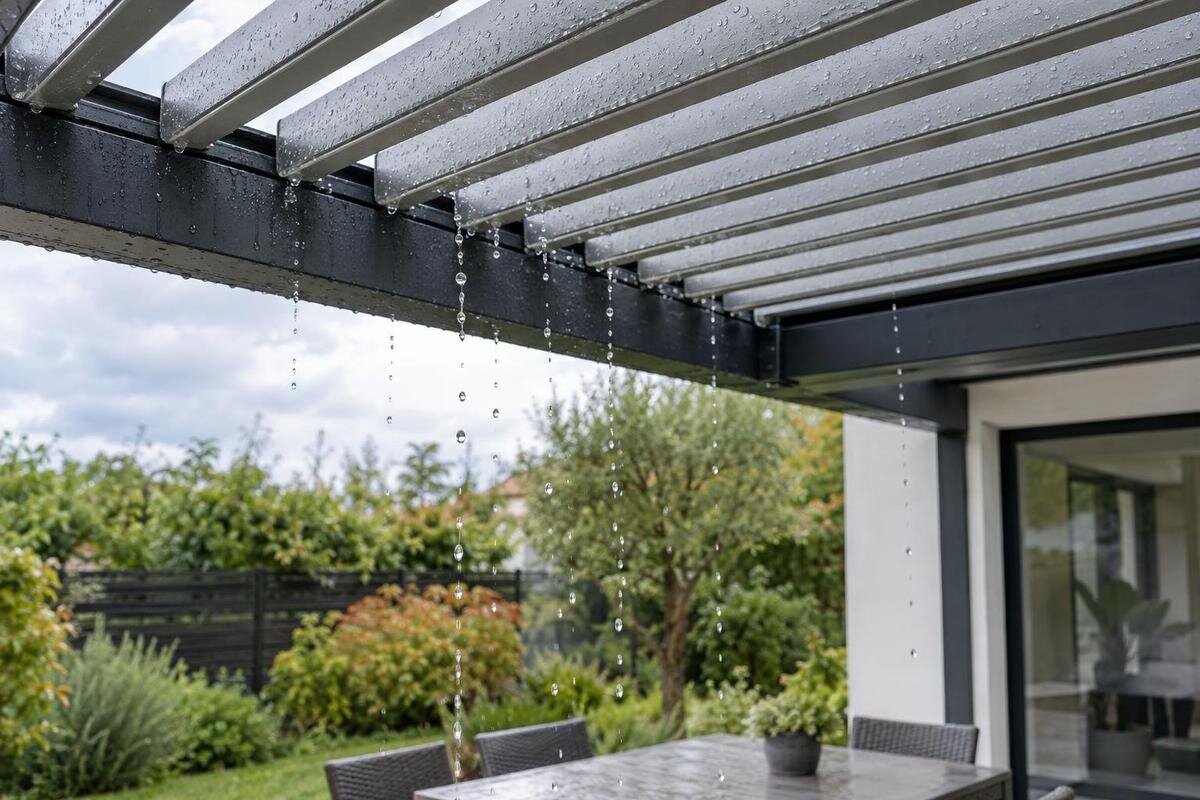
Water can remain on a louvred roof after a shower, even when most of it has drained away. When the louvres rotate, their surfaces and edges change position; leftover drops may run to a new edge and fall into the space below. The drainage layout and approved operating sequence for the exact pergola model determine whether that brief release is expected or needs investigation.

Questions to ask before buying 1
Why louvres can release water as they open
Opening a louvred roof changes the route that rainwater takes. In a closed or rain-shedding position, the louvres may direct water towards a channel or another part of the drainage system. As they rotate, their upper faces tilt and edges that were sheltered become exposed. Drops or a thin film left on a surface can then run to a different edge and fall. The movement may release water that was already on the roof, rather than allow fresh rain through a gap. This distinction matters after a shower has ended: a roof can have stopped receiving rain without every surface being dry. Opening changes the orientation of those wet surfaces, so the drainage behaviour while the roof moves may differ from its behaviour while closed.
A drip need not fall directly from the point where the water first collected. Depending on the design, it can move along a louvre edge, pass over an overlap or travel towards an end or frame as the angle changes. It may enter a channel or shed from the louvre itself; the route is model-specific. Water can also run along a connected part before it falls, so the nearest visible joint may not be the source. The roof’s drainage drawing is the best way to understand the intended route.
Where rainwater may remain on the roof
After most rain has drained away, small amounts can remain on wet louvre faces or around overlaps, ends and other changes in shape. Some designs may also have channels or frame details that carry water away; others may use a different arrangement. A thin film can be difficult to see from below, and there may be no obvious pool. When the roof moves, that remaining water can collect at a newly lowered edge and release as a few drops or a brief trickle. Small droplets can cling to a surface through surface tension before joining together and running off. However, visible standing water and a light film are different observations. Describe which you can actually see rather than assuming that any drip means a hidden channel is full.
When considering Bloomcabin’s bioclimatic pergola listing, ask for a drainage drawing that distinguishes the louvre surfaces from any channels and outlets. The catalogue name alone does not establish whether water travels within a louvre, along a frame or through a separate channel. Trace the intended route from the point where rain reaches the roof to the point where it leaves the structure. Check which roof position the drawing represents: a diagram of the closed roof may not explain what happens during rotation. If it shows arrows without explaining the moving roof, ask how residual water is handled as the louvres turn. This gives you a specific question about the design rather than an assumption based on how another pergola drains.
Questions to ask before buying 2
Why the amount of dripping varies
The amount left behind can vary from one shower to another. How long it rained, whether rain was still falling as the roof moved, and the wind direction may all affect which surfaces became wet. The starting angle also matters: water that was able to drain in one position may remain on a surface in another. The time between the rain and opening can change what you observe, but it does not provide a reliable test on its own; there is no single waiting period that guarantees a dry opening.
A comparison is most useful when it concerns the same roof under reasonably similar conditions. Two different pergolas may have different louvre profiles, drainage arrangements or operating sequences, so a neighbour’s experience cannot establish what yours should do. When assessing Bloomcabin’s lean-to pergola listing, ask what post-rain behaviour the supplier describes for that exact product and configuration. For your own roof, compare observations from ordinary use rather than creating repeated test cycles. Note whether one shower left the roof wet on a different side, or whether you opened it from a different starting position. A change in those circumstances may help explain a changed pattern. A repeatable difference with no obvious change in use is more useful information for an installer than a comparison with an unrelated roof.
How to read the timing and location of a drip
A few drops that appear during the first movement after rain, then stop when the roof is still, are consistent with water being displaced from a wet surface. That observation is useful, but it is not a diagnosis. Separate three periods in your account: before the movement, while the louvres turn and after they stop. Water already falling before opening should not be described as a release caused only by rotation. A longer flow, repeated dripping after the movement has stopped, or a marked change from the roof’s usual behaviour may merit closer attention. Also note whether rain had ended or was still reaching the roof. These details help an installer distinguish a momentary release from continuing water entry or drainage without assuming that the timing proves any particular cause.
The place where a drop lands may not identify where it came from, because water can travel along edges and connected parts. Record both the landing point and any visible point of release, if you can see it safely. Use the exact product identity, for example Bloomcabin Pergola, when asking the supplier or installer about expected behaviour. Do not label the roof as leaking solely because a drop appears as it opens; the drainage layout and the sequence of events matter.

Questions to ask before buying 3
What to record after a wet spell
A short record is more useful than relying on a general impression such as “it drips after rain”. Note when the rain stopped, whether more rain was falling, the roof’s starting position and which movement was made. Describe where the drops landed, whether they appeared during movement or afterwards, and roughly how long they continued. Use fixed landmarks such as the house side, a corner post or the centre of the roof so that another person can understand the location. A simple sketch can distinguish several drip points that would otherwise all be described as “near the edge”. If the same area is affected more than once, record that too. These observations help an installer compare what you see with the model’s drainage route and operating instructions.
Photos or a short video can show the timing and location more clearly, provided you can take them from a safe position. Keep clear of moving louvres and do not reach into the mechanism or stand on a ladder beneath a wet roof to get a closer view. Avoid deliberately repeating a movement if the instructions do not permit it or the conditions are unsuitable. If the pattern is persistent or the mechanism does not move as instructed, stop testing and ask a qualified installer or the supplier to assess it.
Follow the operating instructions for your model
Use the instructions for the pergola you own, not general advice for louvred roofs. They should explain which controls and movements are approved and may address operation in wet or changing weather. Do not assume that opening immediately after a shower, waiting for a set number of minutes or using a particular intermediate position is right for every model. If the manual is missing or does not explain what to do after rain, request guidance that clearly matches the product and its roof configuration.
For the Bloomcabin bioclimatic pergola, request guidance that explains what the controls do as well as which movements are permitted. Where a roof has named settings or automatic controls, the documentation should distinguish those functions from an approved procedure after rain; a setting’s name alone is not enough. Ask whether any post-rain guidance applies to the first opening only or to subsequent movements while surfaces remain wet. Follow the stated sequence, keep hands clear and do not force the mechanism if it meets resistance or moves irregularly. Instructions about opening speed, pauses or intermediate positions must come from the manufacturer, not from an improvised attempt to shake water off the roof.
Questions to ask before buying 4
When to look at the drainage route
If the drip continues after the louvres stop moving, or repeatedly appears in an unexpected area, compare what you see with the drainage diagram. Where the design includes channels or outlets, the drawing should show how water is intended to travel and where it leaves the roof. Look only at parts that are safely visible from ground level. A route that is hard to see, or an outlet that does not appear to behave as the diagram describes, is a reason to seek advice rather than guess at the cause.
For the Bloomcabin lean-to pergola, ask for the drainage information that matches the installed configuration, including any approved options that affect the route. Compare the labelled outlet locations with what is visible on your structure; an outlet somewhere else may indicate that you have the wrong drawing, rather than a drainage fault. Tell the installer if water emerges at a point the document does not identify, or if a normally visible discharge is absent during the event you recorded. Neither observation establishes a blockage on its own. Avoid dismantling covers or clearing components at height to test an idea. Ask which checks belong to routine owner maintenance and which require professional access, so that investigating a drip does not become an unapproved adjustment.
Why roof position changes where water falls
A louvre’s angle affects the slope of its wet surfaces, which edge is lowest and whether water can reach a channel. That means the first movement after rain may produce a different drip pattern from a later movement: some retained water may already have fallen during the first rotation. A roof that is open, partly open or closed may also direct water differently, depending on its design. The direction in which the louvres turn can help explain where a release appears, but it does not establish a safe operating procedure. In particular, do not assume that a partly open position is intended to drain leftover water, or that the same position has the same effect on every model.
If the instructions permit more than one operating position, record the starting and finishing positions during normal use. Use the control’s displayed setting or the manual’s terminology where available, rather than estimating an angle from below. For the Bloomcabin Pergola product page, request the corresponding position diagrams if the documentation is unclear. A description such as “opened from closed to the ventilation setting” can be more useful than “opened a little”, provided those terms actually appear in your instructions. Note whether drops began early in the movement or only near the finishing position. That detail can help the supplier relate the release to the changing roof geometry without requiring you to move the roof repeatedly or measure its angle.

Questions to ask before buying 5
Documents to request when choosing a louvred pergola
Before buying, ask for the model-specific operating instructions and a drainage diagram, then check that they cover the roof configuration being offered. Useful information explains the intended water route, which positions are approved, and what to expect when wet louvres move. Ask directly whether the documents describe residual water after rain and where it may be released. Weather-performance documents should also explain the conditions and limits for that model rather than rely on a general claim about pergolas.
If you are considering this Bloomcabin bioclimatic pergola option, ask the supplier to explain the difference between rain performance with the roof stationary and water released during opening. A statement about the closed roof does not necessarily answer the second question. If a demonstration or video is offered, ask whether it shows the same model and configuration, whether rain had stopped, and which opening sequence was used. A roof shown opening dry provides little information about retained rainwater. Equally, one wet demonstration is not a guarantee for every shower. Use it to clarify the explanation in the documents, particularly whether any temporary release could fall over the seating or dining area you plan to place beneath the roof.
How an enclosure affects the assessment
A side enclosure can change where released water lands or how easy it is to see a drip, but it does not by itself explain why water remained on the roof. Do not assume that adding panels, screens or glazing will stop water falling as the louvres move, or that an enclosure makes the roof a sealed space. The roof’s own drainage route and operating instructions still matter. Consider the complete configuration, including where outlets sit and whether they remain visible and accessible as intended.
When considering an enclosure alongside Bloomcabin’s Lean-To Pergola, request confirmation that the proposed panels or glazing are approved for the exact configuration. Ask for a drawing showing their relationship to the roof edges and drainage outlets, rather than assuming that an enclosed appearance means water cannot enter. If drops released during opening could reach an enclosure track or an internal floor edge, ask how that detail is intended to handle water. Also consider the position of furniture beneath the louvres: enclosing the sides does not move the overhead release point away from a table or cushions. This assessment is about the complete layout and the documented water route, not a claim that side panels will cure post-rain dripping.
Frequently asked questions
Does dripping as soon as the louvres move always mean there is a fault?
No. A few drops released during the first movement may be rainwater left on a surface or in a drainage detail. The timing alone cannot confirm that this is normal for your roof; compare the pattern with the instructions and drainage diagram for the exact model.
How long should I wait after rain before opening the louvres?
There is no universal waiting time that applies to every design. Follow the operating instructions for your pergola, including any guidance about opening it after rain. If they do not cover this, ask the supplier or installer rather than guessing.
Can a drip prove that the roof is leaking?
Not by itself. Water released only as the louvres move could have been retained on a wet surface. Note whether dripping continues once movement stops, and where it appears; use those details alongside the model-specific drainage information.
Should I open the roof part-way to drain it?
Only if the instructions for your model describe that as an approved position or step. A partially open roof is not automatically a drainage setting. Do not force the mechanism or experiment in conditions the instructions say to avoid.
What information should I give an installer or supplier?
Share the exact model, when the rain stopped, when the louvres moved, the roof position and where the drops fell. A photo or short video taken from a safe position can help show the pattern without requiring anyone to stand beneath the moving roof.
After rain, a few drops appearing as a louvred roof moves can result from water being displaced from wet surfaces, but the pattern alone cannot show whether the behaviour is normal for that design. Matching the drip’s timing and location with the exact drainage drawing and operating instructions puts the observation in context. It also makes a persistent or unusual pattern easier to describe to an installer or supplier.
