
Wicking garden beds: how they work and where to use them

Bloomcabin · Raised-bed guides
Wicking garden beds: how they work and where to use them
Wicking garden beds store water beneath the growing medium so moisture can move upwards to the roots. They suit crops that benefit from a steadier moisture supply and sites where you can reach the refill point, check the water level and let excess water drain away safely.
Follow the water path
Water moves upwards from a reservoir into the growing medium through a wick or a section of medium in contact with the water.
Match the crop and medium
Wicking garden beds suit crops that benefit from steadier moisture, provided the medium and rooting depth suit them too.
Plan for excess water
Before filling, confirm where excess water exits and make sure you can reach the inlet and inspect the outlet.
Check before refilling
Read the reservoir level and check moisture at root depth. A dry surface alone does not tell you to refill.
If you are comparing wicking garden beds with a raised bed you water from above, start with a practical question: can you trace the path from the refill point to the roots and then out through the overflow? A reservoir does not make the system hands-off. You still need to check that moisture reaches the plants and that excess water can leave.
Before you buy or fill a bed, check the design against the spot where it will stand, the growing medium it calls for and the crops you want to grow. Then use the same checks after planting: look at the reservoir, inspect the overflow and feel the medium at root depth in more than one place.
01
How water gets from the reservoir to the roots
In wicking garden beds, water is stored below the main growing layer. A wick or a section of growing medium connects that supply to the rest of the medium. Water moves through small spaces in the material by capillary action, rather than having to be poured over the whole surface each time. The connection matters: a tank beneath a tray of compost will not water the plants from below if there is no path for moisture to travel between them.
The refill point lets you add water directly to the reservoir. The overflow sets the upper water level by giving excess water a route out. It matters when rain drains through the bed as well as when you refill it. The aim is to hold water below the main growing layer, not to keep the entire root zone submerged. A clear diagram should show both where the growing medium begins and where excess water exits.
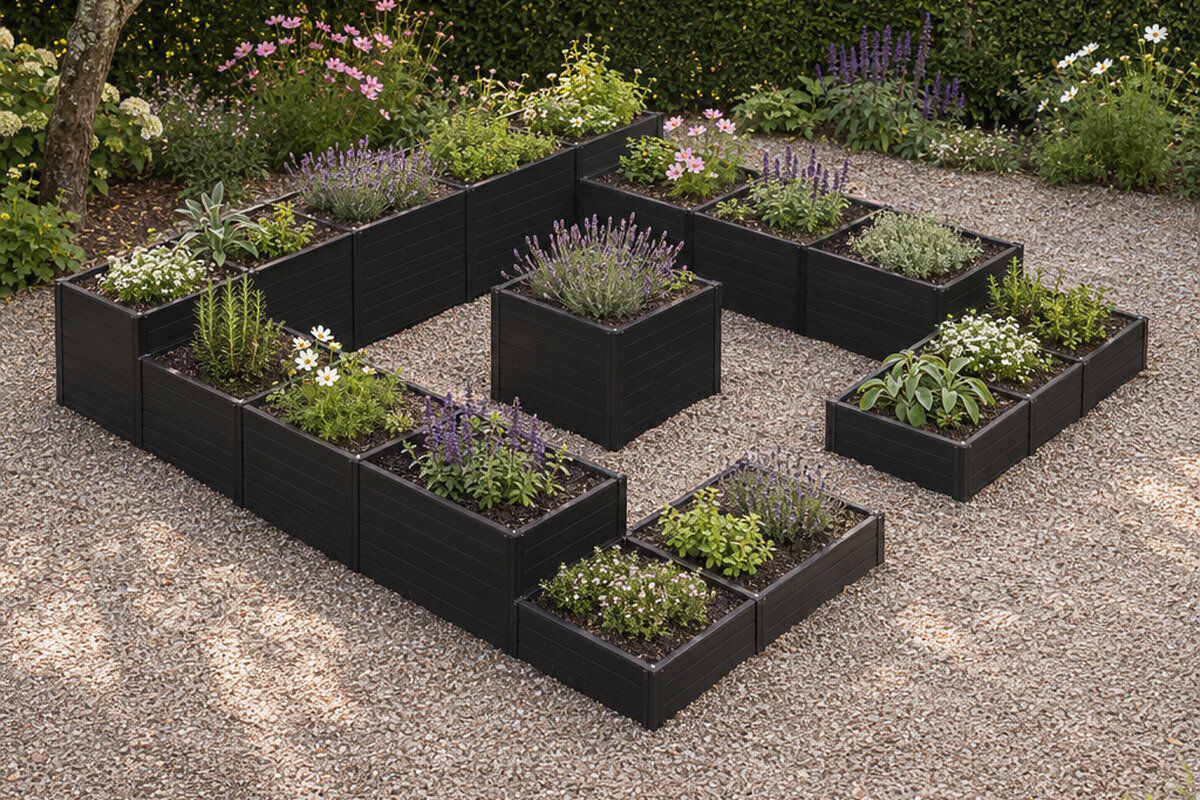
What distinguishes wicking garden beds from conventional raised beds is that water path, not the shape or material of the walls. The listed Bloomcabin frames are open to prepared ground and have no floor panel. Their specifications do not describe an integrated reservoir, inlet or overflow. The frames are therefore not ready-made wicking systems.

02
Find a site you can fill, inspect and work from
Wicking garden beds are worth considering where you can place a reservoir-fed system on a stable, level site and easily bring water to it. Check that the position meets the crop’s light needs before choosing it for convenience. A spot beside the tap is not much use if it does not suit the plants. If you are considering a balcony or other elevated surface, confirm that it can support the complete filled system, including wet growing medium and stored water. Do not infer that from the frame size.
Plan the overflow route before committing to the site. Look at where water will go once it leaves the outlet, not just whether there is room to install it. If the only route runs across your working path or towards a doorway, choose another position or find a route permitted by the system instructions. An outlet hidden against a wall also makes it harder to tell whether it is flowing freely.
Arrange wicking garden beds so you can refill, inspect and reach into them from firm paths. Stand where you expect to work and check whether you can reach the middle without stepping into the growing area. Leave space to bring a watering can or hose to the inlet. If the inlet is reachable but the outlet is not, change the layout before assembly rather than finding out after the bed is full.

03
Choose crops and growing medium as a pair
Choose the plants and the growing medium together. Wicking garden beds are a reasonable option for leafy crops such as salad leaves where the crop guidance calls for even moisture and the design allows enough usable rooting depth. They are a poorer choice for plants you intend to keep on the dry side if the system keeps their root zone persistently damp. Read the seed packet and check local growing guidance for the crop and variety rather than treating all herbs or vegetables alike.
A medium for wicking garden beds needs to carry moisture from the wick or contact zone while leaving air space around the roots. Peat-free mixes differ in structure, water retention and nutrients. Choose one that suits the crop and meets the system’s instructions. Do not replace the specified mix with garden soil just because it is on hand, or assume a bag described as multipurpose will behave like the medium the design calls for.
The top layer and the root zone in wicking garden beds need separate checks. A seed sown near the surface depends on moisture there, whereas an established plant may be drawing from deeper down. If the surface is dry at sowing depth, follow the crop guidance for watering the seedbed from above. Adding more water to a reservoir that is already at its operating level does not solve that problem.

04
Read the specification before committing
When comparing wicking garden beds, ask for a cross-section or assembly drawing. Use it to trace the water from the inlet into storage, upwards into the medium and out through the overflow at the maximum level. If the drawing does not show how one of those steps works, clarify it before buying or altering anything. In a divided layout, also check whether the planting bays share a reservoir or have separate supplies that need individual checks.
Read the dimensions on that drawing carefully. A nominal footprint tells you how much room to allow for the outside of the bed, not the internal planting area. Wall height includes the space taken by the watering components and is not necessarily the usable rooting depth. To compare wicking garden beds for a crop, check the specified depth available to roots and measure usable width and length inside the planting area. Use the stated reservoir capacity rather than multiplying the bed’s overall footprint by its wall height.
- Reservoir: find the water-holding compartment and the stated way to read the level.
- Wicking connection: identify the material or chamber that carries moisture into the growing layer.
- Refill: locate the inlet and confirm how the instructions tell you to recognise a full reservoir.
- Overflow: check its position and where discharge goes once it leaves the system.

05
Fit and test the parts before planting
Set up wicking garden beds in the order given in the assembly instructions. Start by checking the base is level and correctly supported, then fit the reservoir and any liner, separator, wick, inlet and outlet that belong to that design. Inspect the parts that will be hidden once the medium goes in. A misplaced wick or an outlet that will be covered by the finished layout is easier to correct at this stage.
Use the system’s prescribed test procedure before planting. If the instructions permit a water test before filling with medium, add water through the inlet and check where it goes. Look for leaks at joints that are meant to hold water and confirm that discharge follows the specified overflow route when the level reaches the outlet. If water escapes elsewhere or does not exit as described, stop and correct the fault before proceeding.
After adding the compatible medium, follow any instructions for moistening it at setup and leave the inlet and outlet accessible. On wicking garden beds with a level indicator, make sure you can still read it from your working position. For a separate reservoir proposed inside a conventional frame, do not cut an outlet through the frame or add a liner on the assumption that the assembly instructions cover the change. Verify compatibility first.

06
Use two readings to decide whether to refill
To decide whether to refill wicking garden beds, take two readings: the reservoir level and the condition of the medium where the crop is rooting. Check the medium in several positions at a comparable depth. The surface can look dry while the root zone is moist, and a damp patch beside the inlet does not tell you what is happening at the far end. Check more closely when conditions change, such as after heavy rain or as the plants put on growth, rather than working to a fixed interval.
If the level is low and the root zone is drying, refill as the instructions direct. If the level is low but the medium is still suitably moist, follow the system’s guidance on when to top up rather than watering because the surface looks pale. If the reservoir has water and the medium is dry at root depth, check whether the wicking connection is in place and the medium is the specified type. More water is unlikely to correct a break in that connection.
If wicking garden beds stay wet at root depth after rain, hold off refilling and inspect the overflow for obstruction or pooling at its exit. Water coming out of the overflow tells you that water has reached that exit, not that every part of the growing medium is equally moist. A note of the reservoir level, recent rain and which spots felt dry or wet gives you something to compare with at your next check.

07
Worked example: a dry patch with water still in the tank
Hypothetical worked example: a gardener wants to grow salad leaves in a purpose-built bed beside a garden path. The system instructions show a refill inlet at one end, a shared reservoir beneath the planting area, wicking chambers and an overflow. Before planting, the gardener confirms that the permitted peat-free medium and the usable rooting depth suit the chosen variety. They also check the seed packet for sowing guidance and test that the overflow discharges away from the path.
To check whether wicking garden beds are supplying moisture across the planting area, compare like with like. In this example, the gardener chooses three spots in the same crop: near the inlet, in the middle and at the far end. Once the seedlings are established, they take a small sample of medium at the crop’s current rooting depth at each spot, taking care not to disturb the plants. The first two samples feel evenly moist, but the far-end sample is dry and crumbly, even though the reservoir still holds water.
The gardener does not refill. They repeat the check nearby at the far end to rule out one unusually dry spot, then consult the assembly drawing to see how that end should receive water. They check that the bed is level and look for an interruption in the wicking connection or a difference in the way the medium was filled. If the affected plants need water while the issue is being investigated, they water that patch from above as the crop guidance allows. The useful lesson for wicking garden beds is that a level reading can rule out an empty reservoir without ruling out uneven watering.

Questions readers ask
Can I make wicking garden beds from open-bottom Bloomcabin frames?
The listed frames are open to prepared ground and have no floor panel. They are not specified as water-holding systems. For any conversion, you would need a separately documented reservoir design and confirmation that it is compatible with the frame and site. A match in nominal footprint does not establish compatibility.
Do wicking garden beds still need watering from above?
Sometimes. If the surface layer is too dry for seeds, or a new transplant’s root ball is dry while the surrounding medium is moist, apply water where it is needed, following the crop and system guidance. Top-watering to establish plants is different from continually topping up the reservoir.
Should I refill wicking garden beds after rain?
Check rather than assume. Look at the reservoir level and test the medium at root depth. If the root zone is already wet, more water is not the answer; check that the overflow route is clear. If both the level and the root-zone moisture are low, follow the system’s refill instructions.
Make the decision at root depth
Choose wicking garden beds when you can verify the water path, match the medium and rooting depth to the crop, and reach both the refill point and overflow. Once the bed is planted, let the reservoir level and root-zone moisture guide your next move, not the calendar.
Find a raised bed for your plan
Compare layouts and check the dimensions on the product page.
