
Greenhouse Temperature & Humidity Guide | Ideal Climate by Crop
USA Greenhouse Climate Guide • Bloomcabin Journal
Greenhouse Temperature & Humidity Guide
Ideal conditions by crop, season and time of day — plus VPD, dew point, condensation, ventilation, shading and sensor placement for U.S. growers.
The climate inside the glass
A greenhouse is not simply “warmer than outside.” It is a small climate system that changes every hour.
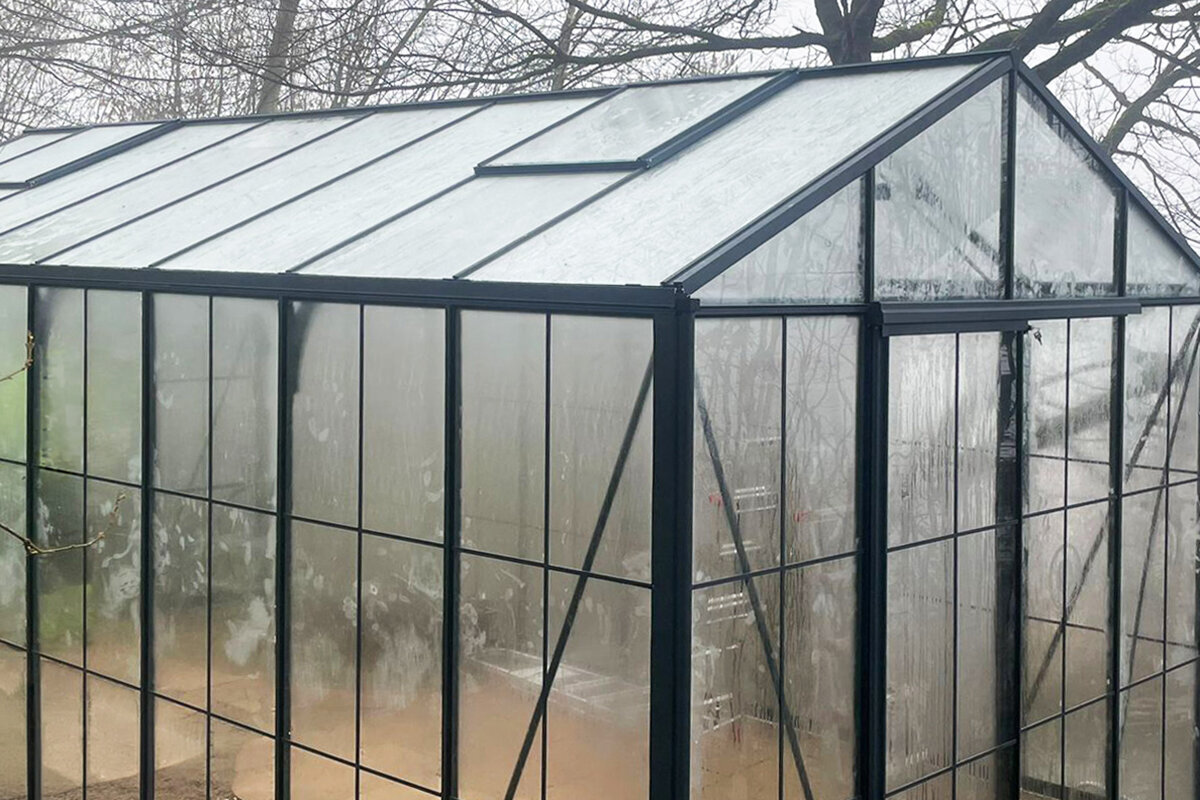
Sunlight can push greenhouse air far above the outdoor temperature within minutes. Plants then release moisture through transpiration. As afternoon turns into evening, the glass, aluminum and leaves cool; relative humidity rises; and surfaces can reach the dew point. By sunrise the greenhouse may contain cool air, wet glazing, damp leaves and completely different growing conditions from the previous afternoon.
That is why good greenhouse management is about relationships, not one thermostat setting. Temperature influences photosynthesis, respiration, flowering and fruit set. Humidity influences transpiration, nutrient movement, pollination, disease pressure and condensation. Air movement changes the boundary layer around leaves. Watering changes humidity. Shading changes leaf temperature. Ventilation changes temperature, moisture and carbon dioxide at the same time.
For a home grower, the practical objective is simple: create a stable, responsive environment that suits the crop you are actually growing. A large warm-season crop such as tomato or pepper needs a different climate from lettuce or seedlings. A greenhouse in Minnesota needs different summer and winter strategy from one in Arizona or Florida.
If you are choosing the greenhouse itself, climate control begins with the structure. Browse the full Bloomcabin U.S. greenhouse collection with ventilation, glazing and size in mind—not only exterior appearance.
01 • Temperature
What is the ideal greenhouse temperature?
There is no universal ideal. For a mixed home greenhouse, a useful mental model is to separate crops into cool-season and warm-season groups. Lettuce and many leafy greens perform best at much cooler temperatures than tomatoes, cucumbers, eggplants, basil, peppers and chilies. University of Minnesota, for example, places head lettuce around 60–65°F as an ideal temperature range, while warm-season vegetables generally require substantially more heat.
For many warm-season greenhouse vegetables, comfortable daytime conditions commonly fall somewhere in the upper 60s through low 80s°F, with cooler nights. But fruiting crops are sensitive at both extremes: tomatoes may struggle to set fruit in persistent high heat, and peppers can drop flowers when days or nights move outside useful reproductive temperatures.
The practical rule is to define the greenhouse by its crop mix. A house dedicated to leafy greens can be run cooler. A greenhouse filled with tomatoes, peppers and basil should run warmer. A mixed house needs zoning, good ventilation and acceptance that not every bench can be optimized to exactly the same number.
Better question
“What temperature range gives my specific crop good growth without heat, cold or moisture stress?”
02 • Day vs night
Why daytime and nighttime temperatures should be treated separately
During the day, light drives photosynthesis and leaves can become warmer than the surrounding air. At night, photosynthesis stops while respiration continues. A moderate day–night differential is normal and often desirable; what matters is avoiding a night so cold that metabolism stalls, or so warm that the crop experiences continuous respiratory demand.
Clear nights can also cool leaves and greenhouse surfaces below air temperature through radiation. That matters because condensation depends on surface temperature, not merely the number on an air thermometer. A leaf may reach the dew point even while the measured air remains a few degrees warmer.
In northern states, night temperature is often the reason a greenhouse is so valuable: the structure buffers wind and slows cooling. In southern states, summer nights can remain too warm, which means the greenhouse must release heat rather than preserve it. This is one reason a greenhouse with generous interior air volume—such as the Classic Plus 385—can be easier to manage than a very small enclosure.
Use a min–max thermometer or data logger. A single noon reading can hide the two numbers that often explain crop behavior best: yesterday’s maximum and last night’s minimum.
03 • Humidity
What is the ideal greenhouse humidity?
Humidity is where oversimplified greenhouse advice becomes dangerous. Relative humidity is temperature-dependent. Warm air can hold more water vapor than cool air. If the amount of water in the air stays the same but temperature falls, relative humidity rises. That is why a greenhouse can move from a comfortable afternoon to nearly saturated air after sunset without anyone adding water.
UMass Extension explains that the highest relative humidity in a greenhouse is often found inside the crop canopy, where transpiration releases moisture and leaves reduce air movement. This means the hygrometer by the door can show a reasonable number while the dense tomato canopy remains much wetter.
For a mixed home greenhouse, think in terms of a moderate working humidity rather than a magical percentage. Very dry air can drive rapid transpiration and wilting. Very humid air suppresses drying, worsens pollination in some crops, encourages condensation and extends leaf wetness. The best target changes with crop, growth stage and temperature.
If you want one practical rule: do not allow the greenhouse to stay near saturation for long periods, especially overnight. Dry leaves and moving air are more useful disease-prevention goals than trying to hit one exact RH number every hour.
04 • VPD
VPD: the better way to understand what the plant feels
Michigan State University describes vapor-pressure deficit, or VPD, as the more appropriate measure of the driving force for plant water loss. Put simply, VPD combines the effects of temperature and moisture into a number that says more about how strongly the air is pulling water from the leaf.
At low VPD, the air is very moist relative to its capacity. Transpiration slows and leaf surfaces are more likely to remain wet. At high VPD, the air is dry relative to its capacity and water leaves the plant more aggressively. Neither extreme is automatically desirable. The useful zone depends on the crop and stage.
Home growers do not need to become greenhouse engineers. A temperature/RH sensor that calculates dew point or VPD is enough to turn an abstract concept into something practical. The important lesson is that 70% RH at 55°F does not mean the same plant condition as 70% RH at 85°F.
Think of it this way
RH describes the air.
VPD better describes the drying demand on the plant.
That is why serious greenhouse climate control uses more than one number.
05 • Dew point
Dew point & condensation: why a dry afternoon becomes a wet greenhouse at night
The dew point is the temperature at which the air can no longer keep all of its water vapor in vapor form. If glazing, metal, pipes or leaves cool below that temperature, water condenses on them. UMass notes that the coldest greenhouse surfaces reach this point first. Eventually, if conditions continue cooling, the plants themselves can become wet.
That wetness is not merely cosmetic. Condensation dripping from glazing can splash soil and debris. Damp canopies create favorable conditions for Botrytis and other pathogens. A greenhouse that is sealed tightly every night to “keep all the heat in” can therefore create exactly the humidity conditions that increase disease pressure.
The solution is not to leave the greenhouse wide open all night. It is to combine sensible heating, short moisture-purging ventilation cycles, air movement, early watering, clean floors and adequate spacing so surfaces do not remain wet from dusk to dawn.
A useful misconception to break
“Outside air is rainy, so venting cannot dry the greenhouse.”
It can. UMass shows that cool saturated outside air can contain substantially less moisture than warm humid greenhouse air. When that cooler air enters and is warmed, its relative humidity drops and it can absorb more moisture.
06 • Climate by crop
Practical greenhouse climate starting points by crop
These are practical home-greenhouse starting points, not universal commercial setpoints. Cultivar, growth stage, light, root temperature and local climate all change the optimum. Humidity is shown as a management tendency rather than a false exact target because RH must be interpreted together with temperature and dew point.
| Crop | Useful daytime zone | Night strategy | Humidity strategy |
|---|---|---|---|
| Tomatoes | About 65–80°F for strong vegetative/fruiting growth; sustained >90°F can hurt pollination and fruit set. | Cooler than day; avoid persistent cold or very warm flowering nights. | Moderate; avoid saturated overnight air and prolonged leaf wetness. |
| Cucumbers | Warm; roughly 70–85°F is a useful home-greenhouse band. | Keep nights warm enough to avoid checking growth. | Can tolerate a moister climate than many crops, but still needs airflow. |
| Peppers & chilies | About 70–80°F is an excellent practical zone; flower set declines in extremes. | Warm nights, but not persistently hot nights during flowering. | Moderate; avoid very high RH during flowering and overnight condensation. |
| Basil | Warm; roughly 70–85°F works well for active growth. | Protect from cold nights; basil is highly chill-sensitive. | Moderate with strong airflow; wet foliage favors disease. |
| Lettuce | Cool; University of Minnesota places ideal growth around 60–65°F. | Cool nights are generally welcome if above damaging cold. | Avoid wet leaves and stagnant humidity; moisture-related disease can be limiting. |
| Day-neutral strawberries | Broad tolerance; UMN reports best growth roughly 45–85°F. | Cooler nights fit the crop well. | Keep flowers and fruit dry; airflow and disease prevention matter greatly. |
| Seedlings | Crop-dependent; usually moderate rather than hot after germination. | Avoid both cold root zones and warm, low-light nights. | Higher humidity can help germination, but reduce it after emergence to prevent weak growth and damping-off. |
For crop-specific detail, see our guides to growing tomatoes in a greenhouse, peppers and chilies, basil and other greenhouse crops.
07 • Seasonal control
Greenhouse temperature & humidity through the U.S. seasons
Spring
The danger is believing a warm afternoon means the greenhouse is ready for tender crops. Track night minima and root-zone temperature. Vent on bright days because the house can overheat even when outdoor air is cool. Water early so the crop and floor have time to dry before the coldest part of the night.
Summer
Overheating becomes the dominant risk in much of the U.S. Vent early, maximize air exchange, consider shade during persistent heat and protect root zones from hot floors or undersized black pots. In humid regions, airflow remains important even when outside humidity is high. In arid regions, excessive drying and very high VPD become more important.
Fall
Humidity management becomes critical because warm sunny days can load the greenhouse with moisture, followed by rapid evening cooling. Reduce watering as light falls, continue ventilation on mild days and use short heat-and-vent cycles if the greenhouse is heated and condensation becomes persistent.
Winter
Temperature is only half the winter problem. Low light slows transpiration and growth, while tightly sealed glazing traps moisture. Heating without moisture removal can create high RH; ventilation without enough heat can chill crops. Northern growers should decide whether the goal is frost protection, cool-season production or true warm-season growing—three very different energy strategies.
08 • Air exchange
Ventilation is the greenhouse climate system you use every day
Ventilation removes heat and moisture, refreshes carbon dioxide and reduces temperature differences. Passive ventilation uses buoyancy and wind: hot air exits through high vents while cooler air enters through lower openings and doors. Mechanical ventilation uses fans to exchange or circulate air.
For a home greenhouse, the strongest setup is usually not one tiny roof window. It is a combination of high-level roof vents, doors or lower inlets, and interior air circulation. Automatic vent openers are especially valuable when a sunny morning begins while nobody is home.
If easy climate management is a priority, compare structures with usable openings and generous interior volume such as the Bloomcabin Prestige Greenhouse or the more compact Lean-To Greenhouse.
Roof vents, side openings or doors?
Roof vents: excellent for releasing rising hot air.
Doors / lower openings: supply replacement air and create stronger cross-flow.
Circulation fans: do not replace outside-air exchange, but reduce hot/cold pockets and stagnant humid canopy zones.
High tunnels: often depend heavily on passive ventilation, making large openings essential. See the Bloomcabin High Tunnel Greenhouse for a different protected-growing format.
09 • Heat control
How to cool an overheating greenhouse
Ventilation comes first. Shading does not remove accumulated heat; it reduces incoming solar radiation. Used together, they are powerful. In hot U.S. climates, shade cloth or sun-reducing glazing can be useful during the most intense months, especially for seedlings, lettuce and fruits vulnerable to sunscald.
Also manage the root zone. Black containers on dark pavers can become dramatically hotter than the air. Larger containers, mulch, reflective surfaces and floor irrigation management can reduce root stress. Avoid aggressive defoliation immediately before a heat wave because suddenly exposed fruit can burn.
In a small structure, temperature changes quickly. A Mini Wall Greenhouse is excellent for compact growing, but its limited air volume makes attentive venting particularly important on sunny days.
Cooling order of operations
1. Open high vents and doors early.
2. Increase internal air movement.
3. Add shading if solar load remains excessive.
4. Stabilize root-zone moisture and temperature.
5. Re-evaluate crop placement if one zone repeatedly overheats.
10 • Moisture control
How to reduce excess greenhouse humidity without damaging the crop
Water early. Morning watering gives foliage, benches and floors time to dry while the greenhouse is warming.
Avoid excess runoff and standing water. Every puddle becomes a source of humidity.
Space crops. Dense canopies trap moisture exactly where disease begins.
Move the air. UMass notes that continuous air circulation reduces temperature differences and makes condensation on leaves less likely.
Vent moisture in cool weather. Brief exchanges of humid greenhouse air for cooler outside air can reduce moisture once the incoming air is warmed.
Keep surfaces warmer than dew point where practical. Bottom heat, improved insulation and air mixing reduce cold surfaces.
Reduce late-day watering. The crop should not enter the coolest part of the night with wet leaves and saturated air.
Remove unnecessary plant mass. Old leaves, weeds and overgrown canopies add transpiration and block airflow.
11 • Measurement
Where should you place temperature & humidity sensors?
Place the primary sensor close to crop-canopy height, where leaves actually experience the climate. Avoid direct sunlight on the sensor unless it has a proper radiation shield. Do not place it immediately beside a door, heater, fan outlet or roof vent unless you specifically want to measure that local condition.
One sensor is enough for a very small greenhouse, but larger houses often contain distinct zones. Michigan State has documented significant temperature variation within greenhouses depending on size, structure, fans, humidity and other factors. If you consistently see one crop struggling in a corner, place a second logger there for a week rather than guessing.
For a spacious greenhouse such as the Bloomcabin Orangerie, multiple measurement points can help identify differences between the sunny end, shaded end, center aisle and crop canopy.
A useful sensor set records current temperature, current RH, daily minimum/maximum and ideally dew point or VPD. Continuous data logging is even better because it shows how fast the climate changes after sunrise, after watering and after vents open.
12 • Common mistakes
Seven climate mistakes that cause more problems than growers realize
1. Measuring only at noonThe worst humidity may happen before sunrise; the coldest temperature happens at night; the hottest leaf temperature may happen before the air sensor catches up.
2. Closing every vent at sunsetThis can trap the day’s moisture. In a heated house, short controlled venting may be better than sealing saturated air inside.
3. Treating RH as a fixed targetRH changes with temperature. A VPD or dew-point view gives better context.
4. Watering because the plant wiltedA plant can wilt from extreme heat even in wet soil. Check the root zone before adding water.
5. Packing the greenhouse too denselyCrowding creates a humid canopy microclimate even when the aisle feels comfortable.
6. Installing the sensor in direct sunSolar radiation can make the sensor read more like a hot object than the actual air.
7. Designing for average weatherA good greenhouse is managed for the cold night, sudden sunny morning and heat-wave afternoon—not only the monthly average.
13 • FAQ
Greenhouse temperature & humidity FAQ
How hot is too hot for a greenhouse?
It depends on the crop, but once a mixed vegetable greenhouse moves into the upper 80s and 90s°F, many fruiting and cool-season crops begin experiencing heat stress. Flowering is especially sensitive. Use crop-specific thresholds rather than one universal alarm.
Should I ventilate when it is raining?
Often yes, particularly in a heated greenhouse with trapped moisture. Cool saturated outside air can contain less total water than warm greenhouse air; once brought inside and warmed, its RH falls and it can absorb moisture.
What humidity is too high?
Do not judge by percentage alone. High RH becomes especially risky when temperature is falling toward the dew point and leaves remain wet. Long periods near saturation are a stronger warning sign than a brief daytime spike.
Do I need a fan?
Not every small greenhouse needs mechanical circulation, but moving air becomes increasingly valuable as the crop canopy becomes dense. Fans reduce stagnant pockets; they do not replace roof vents or outside-air exchange.
Is a larger greenhouse easier to control?
Larger air volume generally changes temperature more slowly than a tiny enclosure, but design, glazing, vent area, orientation, wind and crop density still matter. A large greenhouse with poor ventilation can still overheat.
What greenhouse design should I consider for serious climate control?
Prioritize usable ventilation, good working height, enough air volume and a layout that allows crop spacing. Compare the Classic Aluminum Greenhouse, Prestige Premium Greenhouse and larger Orangerie formats according to your crop plan and local climate.
A practical weekly routine
Five minutes of climate observation can prevent weeks of problems
1. Record last night’s minimum and yesterday’s maximum.
2. Compare aisle RH with canopy RH if you have two sensors.
3. Look for morning condensation on glazing and leaves.
4. Check whether automatic vents actually opened and closed at useful times.
5. Feel the root zone before changing irrigation.
6. Look at crop responses: flower drop, soft growth, leaf curl, wilting, disease spots or unusually slow ripening.
If you are still learning your greenhouse, the Bloomcabin Greenhouse Gardening for Beginners guide and our greenhouse setup, layout and care guide are useful companion reads.
Final perspective
The best greenhouse climate is not a number — it is a controlled rhythm
A greenhouse lets you shape temperature, light exposure, air movement and moisture in a way that open-ground gardening cannot. But the structure does not control climate by itself. The grower does, using vents, doors, shading, irrigation, spacing, circulation and data.
Once you begin watching maximum temperature, minimum temperature, humidity trend, dew point and crop response together, greenhouse management becomes much more predictable. You stop reacting to wilted leaves or dripping glass after the fact and start preventing the condition that caused them.
Explore Bloomcabin GreenhousesSources & Further Reading
- UMass Amherst Extension — Reducing Humidity in the Greenhouse.
- UMass Amherst Extension — Horizontal Air Flow Is Best for Greenhouse Air Circulation.
- Michigan State University Extension — Water Vapor-Pressure Deficit.
- Michigan State University Extension — VPD vs. Relative Humidity.
- Michigan State University Extension — Temperature Variation Within a Greenhouse.
- Penn State Extension — Greenhouse Production.
- Penn State Extension — Psychrometric Chart Use.
- Oklahoma State University Extension — The Hobby Greenhouse.
- University of Minnesota Extension — Head Lettuce Growing Temperature.
- University of Minnesota Extension — Day-Neutral Strawberries.
- University of Arizona Cooperative Extension — Growing Tomatoes.
- University of Maryland Extension — High Tunnel Best Management Practices.
This guide is written for home greenhouse growers in the United States. Crop temperatures are practical starting points rather than universal production setpoints. Always adjust for cultivar, growth stage, local weather, greenhouse design, root-zone conditions and the actual response of your plants.
