
Buying a Domestic Sauna for a Glamping Site: Key Questions
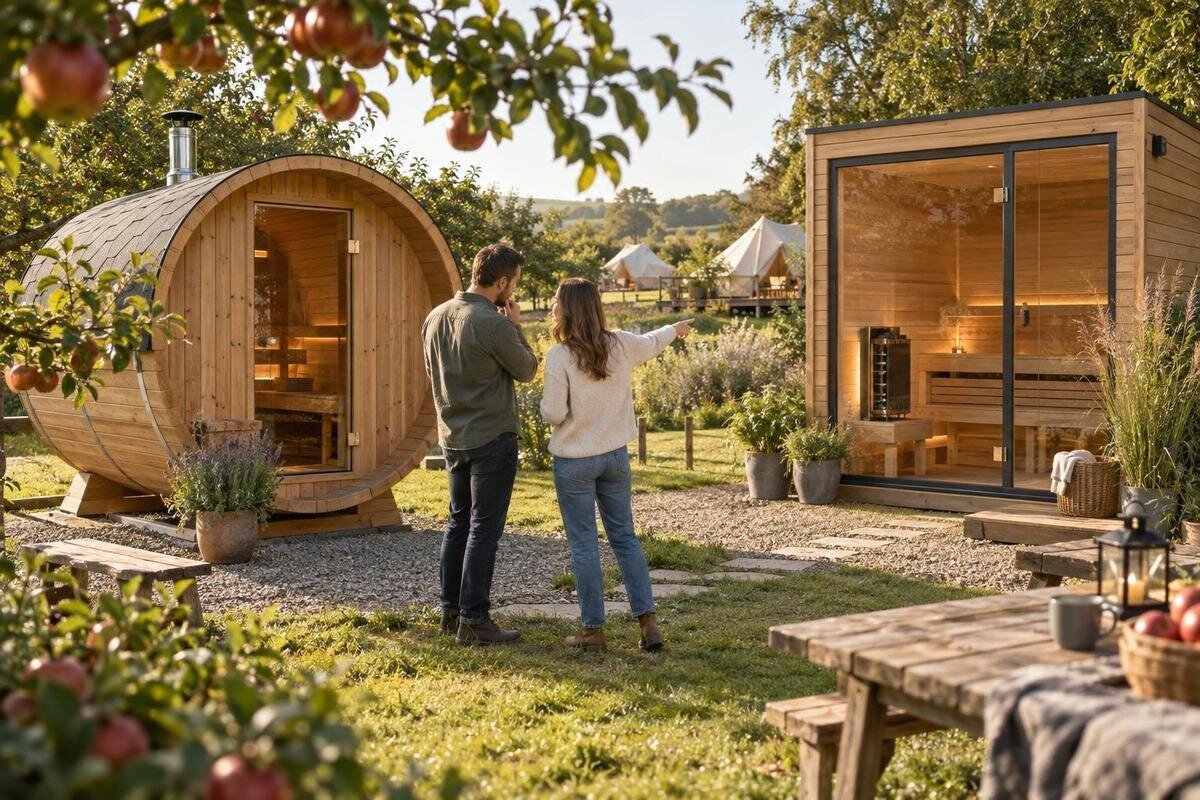
Glamping sauna buying guide
A sauna can be an appealing feature at a glamping site, but a domestic model’s label does not tell you whether it fits paid guest use. Before comparing options, consider who will use it, how often it will run, where it can be installed and what support the supplier provides. The right questions also cover capacity, delivery, energy requirements and the work needed to keep the sauna ready for guests. Use the points below to assess the site and the model together, rather than choosing by a name or photograph.
01
Confirm that a domestic model suits your operation
The word domestic on a product page does not establish whether a particular sauna is suitable for paid glamping use. It may describe the intended customer or product category, but it does not tell you the expected number of heating cycles, whether consecutive guest bookings are acceptable, or whether accommodation use is covered by the supplier’s terms. Ask about the exact model and describe your operation: private or shared sessions, likely users at once, operating days through the season and expected turnover. Request a model-specific answer in writing rather than relying on a general assurance that a sauna is suitable for home use.
Map the service before comparing listings. Note whether the sauna serves one accommodation unit or several, whether access is included in a stay or booked separately, and how many sessions a typical booking may generate. The busiest day matters as well as average occupancy: one reserved session per party creates a different pattern from a shared amenity that guests can book repeatedly. These details give a supplier something practical to assess and help you decide whether a domestic model fits the service you intend to offer. If the projected schedule falls outside the maker’s guidance, do not assume quieter periods make the mismatch acceptable. Also consider how cancellations, late arrivals and overlapping stays affect access. A timetable that works on paper should still leave enough time for cleaning, checks and preparation between guest sessions.
Match capacity to the number of sauna users
Plan for the number of people likely to use the sauna at the same time, not simply the total number sleeping in the accommodation. A larger booking may take turns, while a smaller party might expect to use it together. Decide how access will work, then compare ordinary and peak use with the manufacturer’s stated capacity. Ask how that figure is defined and whether it refers to seating positions or a suggested maximum. The usable bench layout matters too: a nominal capacity does not explain how much room each person has or whether the arrangement suits the experience you want to provide.
Request the verified internal dimensions, bench measurements and any stated occupancy guidance for each option. For example, the Thermowood barrel sauna S 140 product name does not establish its interior dimensions or seating capacity. Do not read measurements into a model code, and do not use a photograph as a substitute for a plan. If capacity is not clearly documented, ask the supplier to clarify it before comparing the model with your guest numbers. This avoids choosing on an assumed fit and gives you a fair basis for assessing how the sauna would serve a typical booking. Consider guests carrying towels or changing clothes nearby as well. The number of seated users is only one part of whether the space will feel workable for the booking type you sell.
02
Measure the location and the delivery route
Check more than the space where the sauna will stand. Allow for the full external footprint, the door opening, access for installation and any room needed for future maintenance, using the model’s actual drawings. Trace the route from the delivery point to the proposed location, including gates, turns, slopes and narrow passages. On a glamping site, the approach from guest accommodation also matters: consider privacy, a clear path and whether people can reach the sauna without crossing an area reserved for another booking.
A model name such as Thermowood barrel sauna HC150 cannot replace a dimensioned plan or confirm clearance needs. Ask whether the supplier’s measurements describe the complete exterior and what additional space the installer requires. Mark the proposed footprint and route on a site plan, then check them against the written dimensions rather than relying on a visual estimate. If the delivery route is tight or the site changes level, share those details with the supplier and installer early. A sauna that fits the final position may still be impractical to get there. Include temporary obstacles in this review, such as parked vehicles, landscaping, fences and seasonal site structures. Identifying a workable route early may influence both the chosen location and the delivery arrangement.
Check outdoor exposure and base requirements
If the chosen location is outdoors, establish whether the exact model is designed for the site’s exposure. Ask the supplier about its guidance for rain, wind, sun and moisture, as well as any protection or ongoing care it requires. Do not infer an outdoor rating from a product photograph or from a material name. The ground and base also need attention: ask what surface and support the manufacturer requires, how water should drain from the location, and whether site conditions need to be assessed by an installer or other qualified professional.
A listing such as the Thermowood barrel sauna HC 225 identifies a product page; the name alone does not establish an exposure rating or base specification. Get the applicable siting and preparation requirements for the model in writing, then have the proposed location assessed against them. A sloping or uneven site may call for professional advice, but there is no single base arrangement to assume for every property. Resolving this before ordering helps prevent a mismatch between the product’s requirements and the work planned for the site. Think about the ground after heavy rain, not only during a dry site visit. Access for maintenance and the route guests use should remain practical when the surrounding surface is wet or muddy.
03
Confirm the heater and energy requirements
Find out exactly what heating equipment is included, what is optional and what the selected model is designed to use. Ask for the maker’s requirements for the heater, energy supply and any associated installation work. If the site has limited electrical capacity or is off-grid, check whether the proposed setup can be supported before placing an order. If a fuel-burning option is being considered, have the supplier and a suitably qualified installer explain the necessary system and siting requirements. Do not choose a heater or plan a connection from appearance or assumptions about the model.
The Thermowood barrel sauna N 210 product name does not say whether a heater is included or identify its connections. Request an itemised quotation and the written technical information for the exact configuration you are considering. Share those details with a qualified electrician or relevant installer so they can assess the site requirements before purchase. Ask whether any approvals need to be checked with a suitable professional or relevant local authority. This is especially useful when the sauna will be installed away from the main accommodation or where the available services differ between pitches. Record which works are included in each quote and which must be arranged separately. This prevents a comparison from overlooking cables, protective equipment, fuel storage or other site work identified by the qualified professional.
Clarify delivery, assembly and site access
Before comparing delivery costs, establish what the supplier means by delivery. Ask whether the sauna is supplied assembled or in parts, where the delivery vehicle will leave it, and who is responsible for unloading and moving it to the final position. Check the route for the actual package dimensions and any handling requirements supplied by the seller. A remote or uneven approach may affect what equipment or people are needed, so describe the access accurately rather than assuming the vehicle can reach the installation area.
The Thermowood barrel sauna N 250 name alone does not show how it arrives or what assembly is included. Ask for the delivery scope, package details, assembly responsibilities and exclusions in writing. Confirm whether the quoted work includes positioning, assembly or final service connections, and arrange separately for any tasks that are not included. Coordinate delivery with site preparation and the installer so the sauna does not arrive before the base, access or services are ready. This gives you a more useful total cost than comparing product prices in isolation. Establish who will inspect the delivery on arrival and how any visible issues will be recorded. A named site contact can also direct the driver and prevent uncertainty about the agreed unloading point.
04
Plan for guest access and day-to-day operation
Consider how guests will reach and use the sauna as part of their stay. Decide whether access will be self-service, arranged through the host or supervised by staff, and whether the sauna serves private bookings or a shared area. The control layout and operating sequence should make sense for the people who will be responsible for it. Ask the supplier for the user manual before choosing, and check that you can turn its instructions into clear guidance for guests without relying on assumptions about how a domestic unit works.
A listing such as the Thermowood barrel sauna LC 260 does not show how its controls work or what guests need to know. Review the manual and ask the supplier to explain the normal operating steps, any routine checks and what staff should do if there is a problem. Consider whether the arrangement fits your opening hours and the people available on site, particularly if guests may use the sauna without a host nearby. Those practical details can rule out an otherwise attractive option before you invest in it. Plan where guest guidance will be kept and how it will be updated if the configuration changes. Staff should have a consistent handover process so that instructions do not depend on one person’s memory.
Estimate the full cost of ownership
Set a budget that includes more than the purchase itself. Allow for site preparation, delivery, assembly and professional installation, as applicable, along with the costs of the required energy supply and routine care. Then estimate likely use from your booking pattern: typical sessions, busy periods and seasonal operation all affect the questions you need answered. Ask which maintenance tasks or consumables the supplier expects and whether specialist servicing is needed. These are inputs to a comparison, not costs that can be safely guessed from the product name or a generic sauna estimate.
The Thermowood barrel sauna HCF 300 name, for example, provides no verified operating-cost figure. Ask for the heater details and any energy-use information the maker can provide, including the conditions behind an estimate. Use your actual local energy rates and a realistic operating schedule when comparing options. Request maintenance guidance and expected service requirements as well, then include them in the same budget. This gives you a clearer view of the cost of offering sauna access to guests, rather than focusing only on the initial quotation. Set aside a contingency for site work that cannot be confirmed until the location has been inspected. Keeping one comparison sheet for all candidates makes omissions and different assumptions easier to spot.
05
Ask about service and coverage for guest use
Ask what support applies when a sauna is used at accommodation that welcomes paying guests. Confirm the written terms for the exact model, including any stated limits or exclusions related to frequency of use, installation or the site conditions. Find out who handles service enquiries, whether replacement parts are available through the supplier and what support can be provided to your location. Do not assume that terms for a domestic purchase automatically cover the way your glamping site plans to operate.
When assessing a page such as the Thermowood barrel sauna LCF 300, ask the same support questions you would ask about any shortlisted model. Keep the supplier’s answers, quotation and installation scope together so you can see whether they describe the same configuration and use. If the answer about guest use is vague, request clarification before ordering rather than relying on a verbal impression. A clear support arrangement is part of the buying decision, particularly when the sauna is a promised feature of a guest stay. Ask how you should report a fault and what information the supplier will need to identify the installed configuration. This can make later support conversations clearer, especially where several people manage the site.
Compare the options against a written site plan
Bring the main questions into one comparison: intended frequency of use, number of people at once, verified dimensions, route and base requirements, heater and energy needs, delivery scope and after-sales support. Record what is confirmed for each model and what still needs an answer. Separate information supplied in writing from estimates you have made yourself. If a critical point such as capacity, exposure, installation or guest-use terms remains unclear, pause the comparison until the supplier or a qualified professional can resolve it.
A domestic model may be a reasonable option for a modest, carefully scheduled service if the manufacturer confirms the intended pattern and the site can meet its requirements. A frequently shared sauna with repeated bookings may call for a different product class or a different operating plan; do not stretch a model beyond the guidance you receive. Choose according to the guest experience you intend to provide and the practical work your team can support. When those details align, you can compare actual options on fit instead of appearance alone. Revisit the plan if you expect the number of units, bookings or staff responsibilities to change. The best choice should remain manageable as your glamping operation develops, rather than only meeting its first season’s assumptions.
Frequently asked questions
Can a domestic sauna be used at a glamping site?
Possibly, but the label alone does not confirm suitability for paid guest use. Describe your expected booking pattern and frequency to the supplier, then get written confirmation for the exact model and its terms before you order.
How many people should the sauna accommodate?
Plan for the number of people likely to use it at the same time, not simply the total number staying on site. Compare that with the maker’s stated capacity and ask how the figure is defined, including the usable seating arrangement.
Can I judge the size from a model name or product photo?
No. A name, code or image does not confirm dimensions, usable interior space or installation clearances. Request a dimensioned plan and check it against both the intended location and the route for delivery.
What installation details should I confirm before ordering?
Clarify the prepared base, delivery and assembly scope, heater and energy requirements, and any site-specific approvals that may apply. Share the model’s written requirements with a suitably qualified installer before committing.
What if the sauna will be used frequently by guests?
Give the supplier a realistic picture of peak and typical use, including consecutive bookings. Ask whether the exact domestic model is intended for that pattern and whether its support terms apply to accommodation use. If the answer is unclear, compare alternatives rather than relying on assumptions.
The most suitable sauna is not necessarily the largest or the one that looks best in a product photo. It is the model that the supplier confirms for your planned guest-use pattern, fits the site and delivery route, and can be installed and supported as required. Once those points are clear in writing, you can compare the real costs and practical fit of domestic models—and decide whether one is right for your glamping operation.
