
Buying a Preassembled Sauna: Delivery and Crane Access
SAUNA BUYING GUIDE
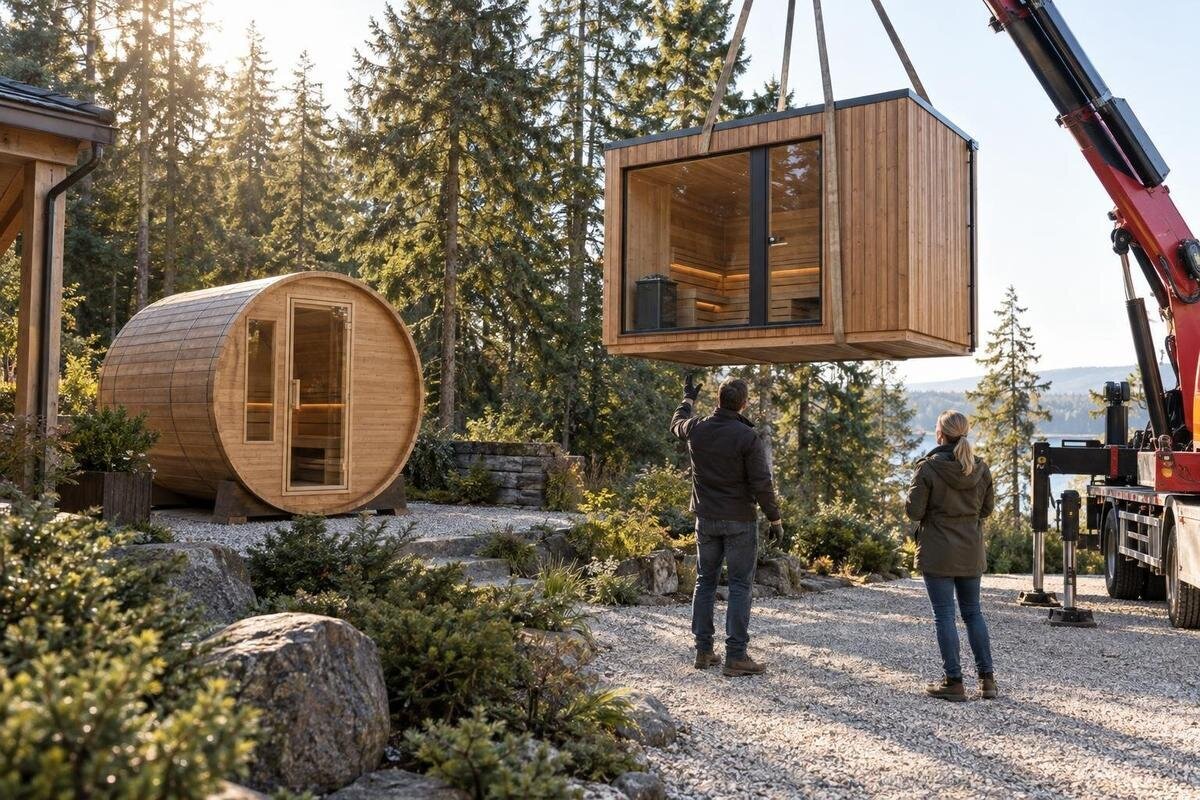
Buying a preassembled sauna shifts more of the decision to delivery day: you need a practical way to move the cabin from the vehicle to its final position. The term ‘preassembled’ can describe different delivery formats, and a clear driveway alone does not show that a crane can place a load where you want it. Before choosing a model, confirm what arrives, how it will be handled, where the vehicle can stop and what the final set-down requires. Match the supplier’s transport details to your measured site, and involve the delivery provider or a qualified lifting contractor when feasibility depends on equipment or ground conditions. The point is to identify constraints while you can still compare options, not to devise a technical lift plan yourself.
Define the delivery format before you compare models
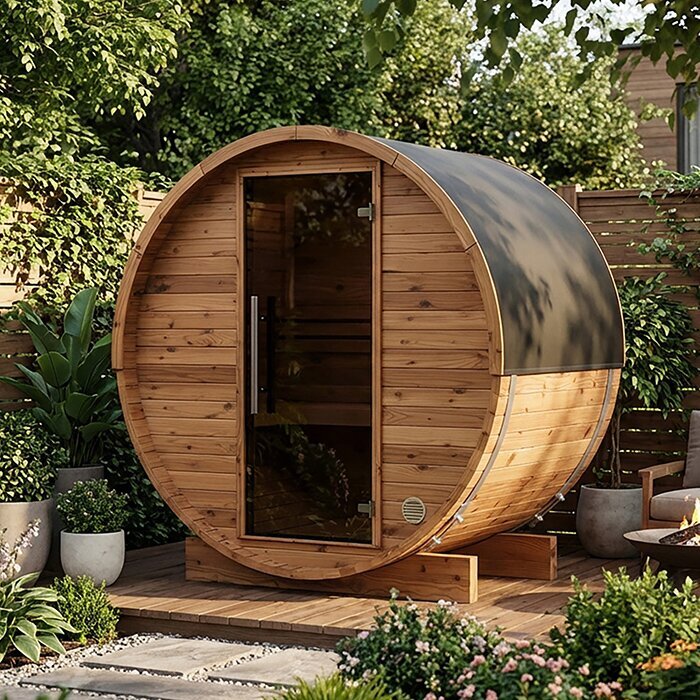
Ask the supplier to define ‘preassembled’ for the exact order. It may mean a cabin is assembled before dispatch, that large sections arrive ready to join, or only that some components have already been fitted; the word by itself does not settle the matter. Confirm what work remains at your property, who will do it and whether the delivery crew’s job ends at unloading or includes positioning the sauna on its prepared base. Ask whether separate packages or components arrive on another vehicle, whether someone needs to be present to receive each delivery, and how much working space the agreed work requires. The answer affects the route you must measure, the labour to arrange and how long you need to keep access clear.
Request transport measurements and weight for the exact delivery configuration, plus a drawing or packing schedule that identifies the largest item that must pass through each restriction. The finished cabin’s dimensions may differ from those of a load delivered in sections; a separately packed component can also change the route plan. Do not assume the cabin can be dismantled, tilted or handled in a particular orientation unless the supplier confirms it. When reviewing the Thermowood barrel sauna S 140, use the listing to identify the product you are asking about, not as evidence of shipping dimensions. Confirm whether final positioning, assembly and packaging removal are included or excluded.
Measure the route from unloading point to final position
Walk the full route from the vehicle’s proposed unloading point to the installation area, rather than measuring only the driveway or gate. Record the narrowest clear width and lowest overhead point, then note each turn, step, change in level, slope, tight corner, door or gate. Measure openings with gates in the position they will be in on delivery, and distinguish the clear opening from the size of the structure. Include fixed obstacles such as walls and posts, as well as temporary ones such as parked vehicles or stored items. Check vertical as well as horizontal clearance: a path that looks wide enough from above can still be blocked overhead.
Make a simple sketch showing the route, measurements, vehicle stopping point and intended sauna position, and take photographs facing both ways at each pinch point. Send actual measurements rather than asking the delivery team to estimate from photos. Note which barriers could be removed and who has agreed to remove them; do not build a plan around an unconfirmed change. A listing such as the Thermowood barrel sauna HC150 is a useful reference for identifying the item, but the supplier must confirm the dimensions of the load being delivered. Ask the carrier to flag any point it cannot accept and clarify whether the proposed route is still suitable if a delivery format changes.
Confirm the delivery vehicle’s access and stopping place
Treat the delivery vehicle’s approach and stopping place as separate from the sauna’s route across the property. Ask the supplier or carrier what vehicle they expect to use and what access it needs to turn, reverse and unload; do not guess from a car’s ability to reach the site. Check the approach from the road, entrance height, bends, gates, surface and any shared access that could be blocked. If the vehicle cannot pass a particular point, find out before ordering whether it can stop elsewhere and what additional handling that would involve. A useful answer identifies a specific stopping place, not simply that delivery is made to the area.
Agree the unloading point and the handover there in writing. If the vehicle must stop outside the property, at a gate or some distance from the final position, establish who provides the equipment or labour for the remaining move and whether the carrier accepts that arrangement for the load. Confirm how the delivery appointment is arranged, who the access contact is and what happens if the agreed stopping place is unavailable on the day. The Thermowood barrel sauna HC 225 listing can identify the product in a request, but it cannot tell you which vehicle will serve your address. Send photographs of the approach and proposed stop to the carrier, and ask about any limits on turning, waiting or unloading.
Ask for a site-specific crane assessment
A crane can address a difficult ground route, but the fact that it can reach over a wall does not prove that a lift can be carried out. A competent lifting contractor needs to assess the load, the crane’s proposed position, the path the load would travel and the landing area together. Buildings, trees, overhead services, boundary features and neighbouring property may affect clearances or access. The vehicle also needs an acceptable place to set up; a clear driveway is not automatically that place. Ask the supplier who arranges a site-specific assessment and what information is required. Do not choose crane size, estimate reach or devise the lift from a photograph or rough measurement.
Send the assessor the exact product reference, confirmed transport dimensions and weight, a marked site sketch and current photographs of the approach, proposed crane position and landing point. List known overhead obstructions, restricted entrances and any point where the vehicle could not stand. Ask whether a site visit is required and what assumptions the assessment relies on, including access to the proposed set-up location. If the necessary load information is not available, ask the retailer to obtain it before you book the crane. When comparing listings such as the Thermowood barrel sauna N 210, remember that the model label does not establish that a lift is feasible; the contractor’s assessment must relate to the actual order and site.
Plan the landing point, not just the crane’s reach
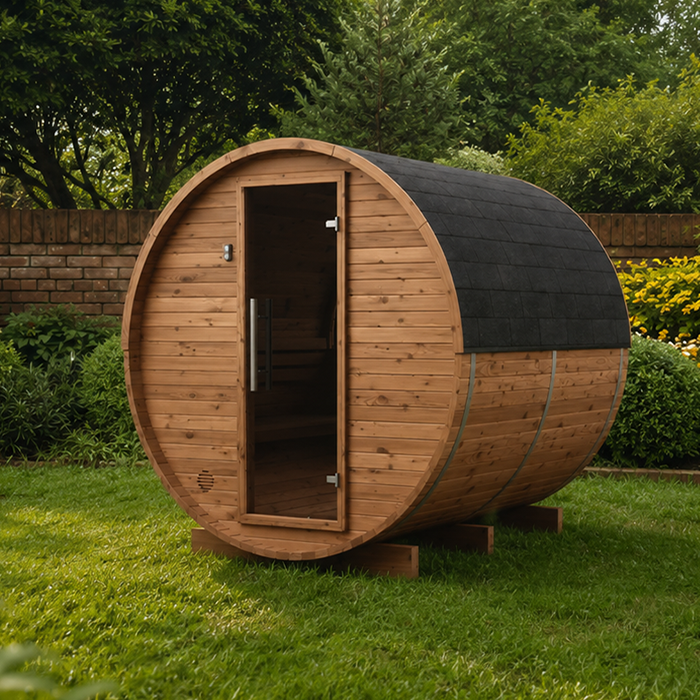
Treat the landing zone as its own part of the plan. Confirm the precise point where the cabin is expected to touch down, the direction it will face and whether any further move is needed to reach the prepared base. A lift that clears a boundary may still not have a clear approach to the final position. Mark eaves, branches, fences, service lines and other obstacles near the intended landing area, and identify what needs to be cleared before the crew arrives. Include space for the agreed positioning work, rather than marking only the cabin’s final outline. Give the retailer and lifting contractor the same plan so each is assessing the same destination.
Ask the lifting contractor to assess the surface and space needed for its vehicle and equipment, and ask the sauna supplier or an appropriate site professional to specify the requirements for the final base. These are separate checks: a suitable place for a crane is not proof that the sauna base is suitable, and a prepared base does not prove that a crane can set up nearby. Avoid relying on a visual judgement of soil or paving, or on a base intended for another structure. For the Thermowood barrel sauna N 250, request the delivery and installation information that applies to the exact order, then have the responsible people confirm the landing point before booking. If nobody will confirm a key condition, it remains unresolved.
Prepare the base and services from the right documents
Use the supplier’s installation drawing and stated base requirements to prepare the site; do not work from a photograph, model code or footprint guessed from a category page. Ask which measurements apply to the cabin and what clear space is needed for positioning and later access. Think through how people will reach the entrance, whether the door can open without obstruction and whether routine access will remain possible after nearby fences or garden features are in place. If ground levels, drainage or other site conditions are uncertain, ask an appropriate site professional for advice rather than choosing a foundation by guesswork. Base preparation should follow the documents for the version you intend to order.
Confirm services separately. If the selected sauna includes or requires an electric heater, obtain the exact electrical requirements for that configuration and ask a qualified electrician to assess the connection; do not infer supply needs from a photograph or another sauna. Show the proposed service route on the site plan so it is considered alongside unloading and final positioning. For a product reference such as the Thermowood barrel sauna LC 260, ask the seller which installation documents and service information apply to the order. The model name helps identify what you mean; it is not a substitute for technical documents or professional advice.
Get the delivery scope and extra charges in writing
Request an itemised written delivery scope before comparing prices. It should state the delivery address and unloading point, what transport covers, whether a crane or other lifting arrangement is included, and whether final positioning, assembly or packaging removal is part of the service. Ask what happens if the vehicle cannot reach the agreed point or a further move is needed. Have any site survey, specialist assessment, waiting time or extra handling identified as included, excluded or separately chargeable, and ask how an additional charge is approved. This gives you a fair basis for comparing quotes: a transport figure may cover a different service from one that includes unloading at the prepared base.
Read the practical conditions as carefully as the cost. Confirm how the date and arrival window are arranged, how much notice you receive, who must be present and whom to contact if access changes. Ask how the supplier wants you to inspect the delivery and report visible damage, and whether delays, failed access or a postponed lift change the charge. Check whether quoted amounts include all applicable fees and whether assumptions about your site are recorded in the order. For the Thermowood barrel sauna HCF 300, request a quote tied to your address and chosen delivery method; a product name alone cannot establish the cost of site-specific handling.
Compare alternatives if a crane lift will not work
If the proposed lift is not workable, ask whether the supplier can offer the same order in a different delivery format, or whether another model or delivery method could suit the site. Delivery in sections or assembly at the destination may be possible in some cases, but availability varies and needs explicit confirmation. Do not assume a preassembled cabin can be dismantled after manufacture, or that the supplier offers a kit version. Compare the complete arrangement: the largest package, route, unloading and handling, work at the property, base requirements and quoted charges. A method that avoids a crane can still require space, labour or access you do not have.
Get each alternative described in writing, including transport measurements, vehicle access, the unloading point, what assembly is included and who performs it. Check whether a different format changes the intended position, site preparation or service route, and whether the supplier confirms it is available for the exact product. When considering the Thermowood barrel sauna LCF 300, ask about delivery choices for that listing rather than assuming another model’s arrangements transfer. If no workable method is confirmed, reconsidering the purchase before transport is booked is more sensible than relying on an untested promise that the cabin will fit.
Give every delivery party the same site information
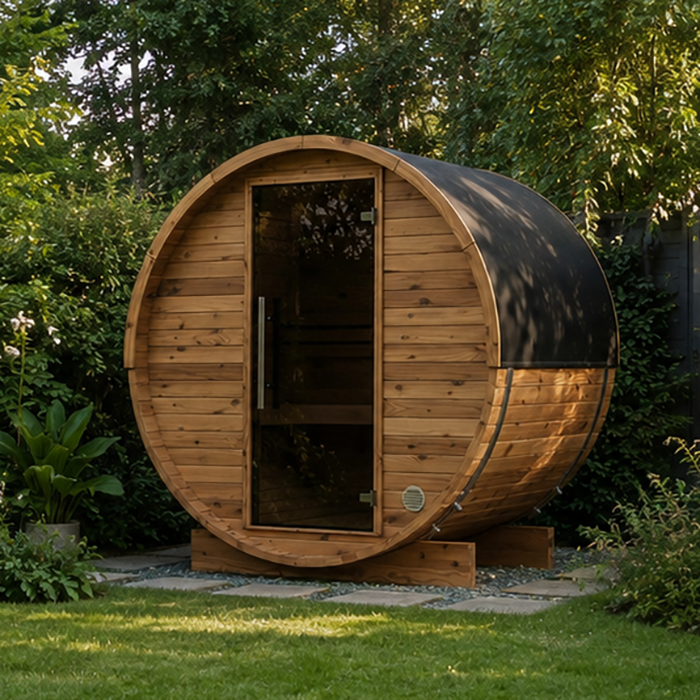
Create one site pack for everyone involved: the product reference, confirmed dimensions and weight of the delivered load, measured route, vehicle stopping point, proposed landing location, photographs and known restrictions. Send the same dated version to the retailer, carrier and lifting contractor, and ask each party to flag missing information or assumptions. This helps prevent one party planning for a different load or unloading point from another. Note when photographs were taken, especially where fences, branches, stored materials, building work or parked vehicles might change before delivery. Label revised plans clearly so an old layout is not mistaken for the current one.
Ask whether a site survey is available, who performs it and what it covers. A review of photographs may identify questions, but do not treat it as a lifting assessment unless the contractor responsible for the lift confirms that it is sufficient. Get written confirmation of assumptions about access, vehicle position, obstacles and the landing point. Name a contact who can coordinate the retailer, transporter and crane provider, and clarify who gives the final go-ahead for delivery. This matters particularly when separate companies handle transport and lifting: an explicit handover is clearer than expecting you to reconcile different plans on the day.
Resolve open questions before placing the order
Before committing, match the product order, delivery quote and site plan line by line. The selected model and delivery format should agree; the transport dimensions and weight should be confirmed; and the carrier should accept the vehicle route and stopping point. Where a crane is required, the responsible lifting contractor must have assessed the proposed arrangement, not just the general property. The final landing area, base requirements, remaining work and service connections should each have a named person responsible for confirming them. A verbal ‘it should fit’ leaves unclear who assessed the difficult point and what assumptions support the answer.
Hold the order if a critical load detail, route measurement, lift assessment or delivery responsibility remains unresolved. Ask the supplier or relevant professional to close the gap, then make sure the quote and site pack reflect the same confirmed plan. Revisit the assessment if the route, landscaping, entrance, unloading point or installation position changes before delivery; earlier advice may depend on details that are no longer true. Pausing here lets you compare a preassembled delivery with a confirmed alternative, or reconsider the purchase, before transport and specialist handling are arranged.
Frequently asked questions
Does preassembled mean the sauna is ready to use on arrival?
Not necessarily. The term describes how much may be assembled before dispatch, not what the delivery includes or what remains at the property. Ask who positions the sauna, what assembly is still required, and what needs to be arranged separately, including any service connections.
Can a crane reach the sauna if it can reach the garden?
Not necessarily. The contractor needs to assess the crane’s proposed position, the load, the route through the air and the landing area together. Clear reach from one spot is not enough to confirm that a lift can be carried out at your property.
What information should I send for a crane assessment?
Ask the supplier for the transport dimensions and weight, then share those details with a marked site plan and current photographs. Show the vehicle’s proposed position, access route, overhead obstructions and intended landing point. The lifting contractor can tell you whether it needs more information or a site visit.
Will the delivery team move the sauna from the gate to the base?
Only if that is part of the agreed delivery scope. Confirm the unloading point, who handles any move beyond it, what equipment is included and whether the method has been accepted for the delivered load. Get the arrangement in writing before placing the order.
Should I prepare the base before ordering?
First get the base requirements and layout for the exact configuration you are considering. Ask whether the supplier or delivery team needs to inspect the site, and have an appropriate professional advise on any uncertain ground conditions. Avoid preparing the site from a product photo or assumed dimensions.
A preassembled sauna is a delivery choice as much as a product choice. It suits a property only when the actual transport format, vehicle access, handling method and receiving area work together. If a crane is needed, let the responsible contractor assess feasibility using confirmed load details and site information. Once the base, remaining work and delivery scope are also clear, you can compare your options against the conditions at your property rather than relying on a favourable assumption.
