
Choosing an Outdoor Sauna for Long, Cold Winters
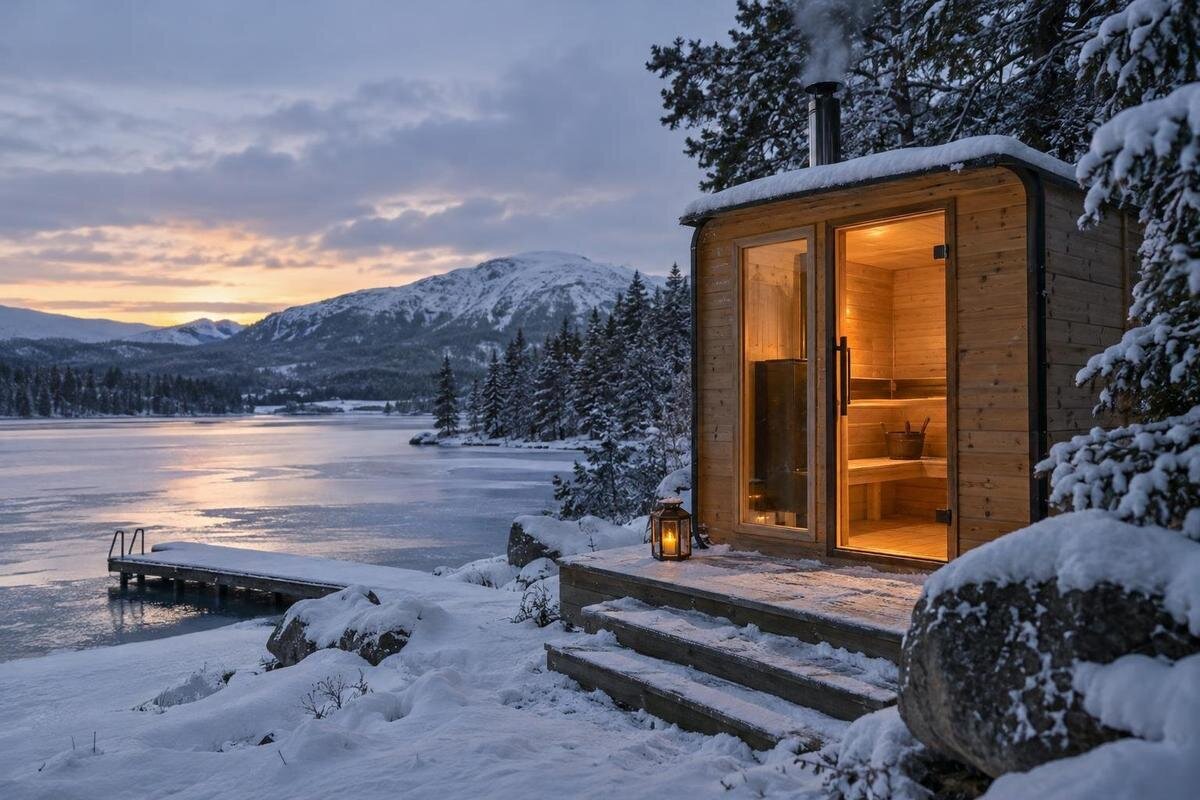
Outdoor sauna planning
An outdoor sauna chosen for a long, cold winter has to work as part of a site-specific installation. A product name or photograph cannot confirm an operating limit, roof rating or suitable heater. Compare the documented cabin-and-heater configuration, then assess the ground, weather exposure, drainage and route you will use in icy conditions. Where a figure is missing, treat it as a question for the manufacturer or a qualified local installer, not as an assumption.
01
Verify the winter operating limits
Begin with the manufacturer’s written operating limits for the complete sauna-and-heater configuration, not a broad label such as ‘outdoor’ or ‘all-season’. Ask for the lowest outdoor ambient temperature, if the maker specifies one, and whether it applies to storage, installation, heating or regular operation. Confirm which cabin, heater, controls and options the guidance covers; a limit for one configuration cannot automatically be transferred to another. Ask what site conditions the figure assumes, including any specified shelter, base or ventilation. If a seller quotes only an interior temperature, request the outdoor conditions and test context behind it. Check whether the cabin, heater and controls have separate requirements that must all be met.
When considering Thermowood Barrel Sauna HC-225, request the manual and a written answer about the conditions that apply to your intended setup. Ask whether prolonged cold, wind exposure or long periods between uses affect the instructions. Save the response against the exact model and options, rather than relying on an answer about a product family that may include different configurations. Keep any unanswered questions together so you can distinguish confirmed limits from assumptions when comparing models. If a point is unclear, ask the retailer to refer it to the manufacturer before you order.
Ask for a complete construction specification
Cold-weather performance depends on the specified assembly, not the words ‘barrel’ or ‘Thermowood’ alone. Request a drawing or section showing the shell, roof junctions, floor, door, any glazing, and any insulation or lining. Ask for the material schedule and details of how the parts meet, including seals and the specified finish. If the maker specifies tapes, coatings, ventilation openings or other components, confirm whether they are supplied and how they should be maintained. Do not assume that a photograph shows the kit contents, or that an extra insulating layer can be added without changing the intended assembly. Ask how any site-specific modifications affect the documented build.
For Thermowood Barrel Sauna N-210, request the model-specific drawing and confirm what the kit includes, which parts must be sourced separately and whether assembly has orientation or shelter requirements. Check details around the door and roof as well as the larger wall surfaces; a specification that describes the shell alone may leave out joints exposed to weather. Ask whether optional finishes, linings or glazing change the documented construction. Give these details to your installer so the proposed assembly and any separately supplied components can be included in the installation plan and quotation.
02
Compare heating claims under stated test conditions
Compare heating-time and energy claims only when their test conditions are clear. Ask which exact sauna and heater were tested, the starting outdoor temperature, the target cabin temperature, and whether doors, ventilation and glazing were configured as in your proposed version. Find out whether the result is a typical guide or a controlled measurement, and how colder or windier weather might affect it. A time quoted without those details cannot reliably predict performance at your property. If no comparable evidence is available, use the manufacturer’s documented operating limits and configuration requirements instead of assuming an advertised figure applies to your winter. If energy use matters, request an estimate for your expected use and the assumptions behind it; a general figure is not a guaranteed bill.
Should you consider Thermowood Barrel Sauna N-250, ask for the heater recommendation for that exact cabin and its options; do not infer it from an area figure. The maker’s instructions should identify the compatible combination and any conditions that affect it. Confirm whether glazing, a different door, lining or another selected feature changes the recommendation. Put each model’s test conditions and heater pairing alongside its quoted warm-up time. A small difference between catalogue figures is not enough to establish which cabin will heat faster or use less energy when the figures describe different configurations or test conditions.
Assess roof and weather exposure
Assess the position and the enclosure together. Ask what roof covering and junction details are specified, how runoff is directed, and how the door and any windows are protected from wind-driven rain. Request written guidance for snow and wind exposure, freeze-thaw conditions and any siting limits for the exact model. A product photograph cannot establish a roof-load or storm rating, and a familiar-looking roof does not prove that it suits your site. Consider where roof water and melting snow will land: if they collect beside the base or cross the entrance, they can complicate maintenance and create an icy route. Check whether shelter changes the manufacturer’s instructions or the stated inspection routine.
If Thermowood Barrel Sauna LC-260 is on your shortlist, request its own roof and weather-protection details rather than borrowing an answer from a similar-looking sauna. Ask whether exposure limits depend on orientation, shelter or clearance from nearby structures, and what routine checks are specified for edges, fixings and seals. On a site exposed to strong wind or drifting snow, share the exact location and manufacturer’s drawing with a qualified local builder or installer. They can assess whether the proposed position and support suit the site. If no answer covers the exposure you expect, keep suitability unresolved rather than relying on the appearance of a product page.
03
Match the base to the ground
Ground conditions can change across one property. Slope, drainage, fill, paving, nearby retaining structures and possible frost movement all affect what support may be appropriate. Ask for the manufacturer’s support layout, external dimensions, required level and installation clearances. Have a suitably qualified local professional assess the actual ground and choose the support solution; do not copy a base shown for another site or infer one from a photograph. The aim is to keep the cabin supported as specified and direct runoff away from it. Discuss how snowmelt will drain and whether maintenance access is needed around the base. Include room for construction access as well as the final cabin position. No single generic foundation detail suits every plot.
For Thermowood Barrel Sauna HCF-300, use the model-specific dimensioned drawing to plan the support area, approach and assembly space; do not treat a catalogue area figure as the bearing footprint. Confirm where support is required and whether the drawing includes overhangs or other projections. Include any stated access for inspection or service, not only the cabin outline. If soft ground, a slope or freeze-thaw movement is a concern, ask the professional to resolve it for that site rather than relying on an online rule of thumb. Keep the final base arrangement consistent with the manufacturer’s installation instructions, and retain the agreed drawing with your site plan for future maintenance.
Specify the heater and services together
Treat the heater and services as part of the sauna specification, not a later add-on. Ask which heater and controls are approved for the exact cabin, what supply or fuel they require, and whether cold conditions affect the manufacturer’s operating instructions. A unit that physically fits is not automatically a suitable match. Have a qualified professional assess the proposed installation and applicable local requirements. For an electric heater, that means a qualified electrician checks the supply and installation; for a fuel-fired system, obtain appropriate professional guidance on the flue, air supply, clearances and fire protection. Do not adapt wiring, combustion arrangements or safety distances from generic advice. Confirm who supports the final system and how its controls are serviced.
If Thermowood Barrel Sauna LCF-300 is a candidate, obtain the cabin-specific heater pairing and manuals for any controls or options before requesting an installation quote. Verify which components are included and which are separate purchases; a cabin page and a heater page do not necessarily describe one approved package. Give the installer the exact model details, site conditions and manufacturer’s drawings, then ask them to confirm what else the installation needs. Make sure the quotation names the agreed model and options. Check who is responsible for commissioning, maintenance advice and servicing if a control or heater fault occurs.
04
Plan a usable route in winter
Plan the route from the house to the sauna for the conditions in which it will actually be used. Walk it on a cold or wet day if possible and note slopes, steps, surface changes, drainage, gates and places where snow can drift or meltwater freeze. Choose a path you can keep clear and maintain, and plan enough lighting for winter evenings; have fixed lighting or access features assessed by the relevant professional. Check the entrance dimensions and door-opening direction on a drawing, leaving room to use the door without standing on an icy patch. Decide where wet footwear, towels and dry clothing will wait so they do not obstruct the entrance or walkway. Consider the route when carrying supplies, not only when walking empty-handed.
Before placing Thermowood Barrel Sauna S-140 on a garden plan, request the external and entrance dimensions, door swing and clearance requirements for that exact version. A listed cabin area does not tell you how wide the approach must be or how much room is needed with the door open. Mark the delivery and assembly route as well as the everyday path; a location can fit the cabin but still be difficult to reach or maintain in winter. If you plan to clear snow, make sure there is somewhere for it to go without blocking the entrance or directing meltwater over the route. Keep service access in the plan too. If clearing the path is not practical through winter, reconsider the location before ordering.
Manage water, ventilation and drying
Snow and rain brought inside, condensation and thawing ice all need a planned route out. Follow the model’s instructions for ventilation and post-use drying, and do not block designed openings or drainage paths. Avoid adding an insulation layer, seal or vent based on a general guide; a change may affect the intended airflow or weather protection. At the site, ask how roof runoff and meltwater will move away from the base and entrance. If the ground tends to hold water, have a qualified local professional assess drainage rather than relying on a generic slope suggestion. Consider where wet items can be set down without tracking water across the main winter access route. If snow could cover a designed vent, ask how to keep it clear as part of the site plan.
For Thermowood Barrel Sauna HC-150, ask for the model-specific ventilation and drying instructions and any stated exterior drainage details. Use these to plan both post-use care inside the cabin and water management around its base. Check whether runoff could collect beneath the structure or cross the path, and discuss any unresolved drainage points with the installer. Keep decisions about vents or added layers tied to the maker’s manual rather than borrowing a layout from another sauna. If water services are planned separately, have the relevant professional address their protection and drainage in freezing conditions; do not assume they form part of the sauna kit.
05
Confirm maintenance and warranty terms
Choose a maintenance routine you can realistically follow through a long winter. Ask for written schedules and approved methods for the exterior finish, seals, roof, fasteners, floor and heater, as relevant to the supplied design. Find out which parts should be inspected before winter and after severe weather, and which jobs require a service person. Do not infer treatment needs from a product name or apply a coating simply because it is commonly used on a different timber building. Keep the instructions with the installation record and confirm they match the materials and options you actually buy. Ask whether specified maintenance products are included or must be sourced separately, and where to obtain them.
Request the applicable warranty terms before purchase and ask specifically how they address prolonged cold, snow or wind exposure, water entry, freeze-thaw damage, installation conditions and maintenance. These are questions, not assumptions about what is or is not covered; get the response in writing for the intended site and setup. Clarify who handles faults and servicing locally, whether repairs or adjustments require a qualified professional, and which installation and maintenance records you should retain. A general assurance may not explain how the terms apply to your chosen configuration. Keep warranty documents alongside the operating and maintenance instructions.
Compare complete installations, not just cabins
Bring the evidence together in a comparison sheet for each exact model: operating limits, cabin and heater pairing, construction drawings, weather-exposure guidance, base requirements, drainage, winter access, maintenance and written warranty terms. Mark each point as documented, confirmed in writing or unresolved. Keep listed area, usable interior space, external dimensions, assembly clearance and support footprint as separate fields until the drawings define them. Check that the product page, manual, quotation and installation plan all name the same version and options. Record who confirmed each point and which document supports it, so unresolved details do not get lost between sale and installation. If a critical winter condition has no answer, pause rather than filling the gap with a guess.
Then assess the whole arrangement against your routine: the path you can keep clear, space to open the door, maintenance access and room for the installer to reach required services. Ask the retailer to confirm the current local configuration and availability, and identify anything excluded from the kit or installation. Confirm delivery access and assembly needs for the actual garden, without assuming those services are bundled. Compare complete configurations on documented suitability rather than an area figure, photograph or assumed seat capacity. A sauna may fit the garden yet be a poor winter choice if you cannot reach or maintain it reliably. A smaller model is not automatically more appropriate; it still needs to suit the site and your intended use.
Frequently asked questions
What cold-weather operating limit should I ask about?
Ask for the lowest stated outdoor condition, if one is specified, for the complete sauna and its named heater and controls. Check whether the guidance applies to storage, installation or use, and what assumptions it makes about the base, shelter and ventilation. These are not automatically the same limits.
Does a Thermowood barrel sauna automatically suit a cold climate?
No. The name identifies a product, not its operating range, construction details or suitability for a particular site. Confirm the documentation for the exact model and configuration, including its heater pairing and weather-exposure guidance. A product name or photograph is not evidence of winter performance.
Can a listed area determine which heater I need?
No. An area figure does not, by itself, establish the cabin’s internal volume, construction or operating conditions. Ask the manufacturer to specify a compatible heater for the exact configuration, then have a qualified professional assess the proposed installation and services.
What should I check about winter access?
Consider the whole route: surface, slope, drainage, lighting, door clearance, snow clearing and where wet footwear or towels will go. A cabin can fit the garden yet be awkward to reach when it is icy or dark. Plan for the conditions in which you will actually use it.
Can a product photograph confirm the roof or base is winter-ready?
No. A photograph cannot show the support footprint, ground requirements or documented weather limits. Request model-specific drawings and exposure guidance, then ask a qualified local professional to assess the site. A base that suits one plot may not suit another.
For long, cold winters, the strongest choice is the sauna whose operating limits and complete configuration are documented for your site. The base, weather exposure, drainage and winter route all matter alongside the cabin itself. Compare exact models rather than relying on a name or image, and keep unresolved details visible until you have reliable answers. That way, the decision reflects the whole installation you can support, protect and reach through the season.
