
Outdoor Sauna Roofing: Assessing Weather Protection and Maintenance
Outdoor sauna buying guide
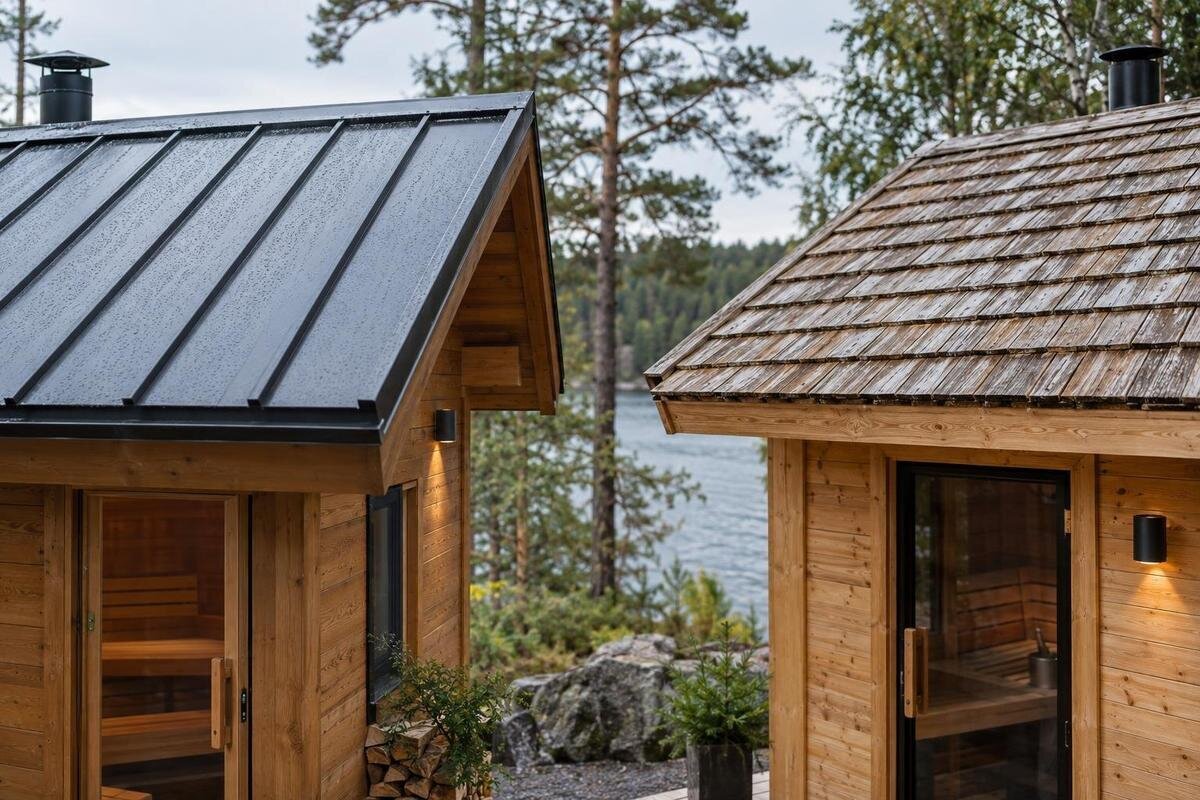
An outdoor sauna roof needs to be assessed as a complete weather-management system. The visible covering is only one part: joints, roof edges, openings and the route rainwater takes can matter just as much as the material name. Sun, wind and debris also affect how often it needs attention. Product photographs cannot establish the roof build-up or its suitability for a particular site, so a useful comparison depends on model-specific drawings, a written list of inclusions and the maker’s care guidance.
Roof coverings, supporting layers and inclusions
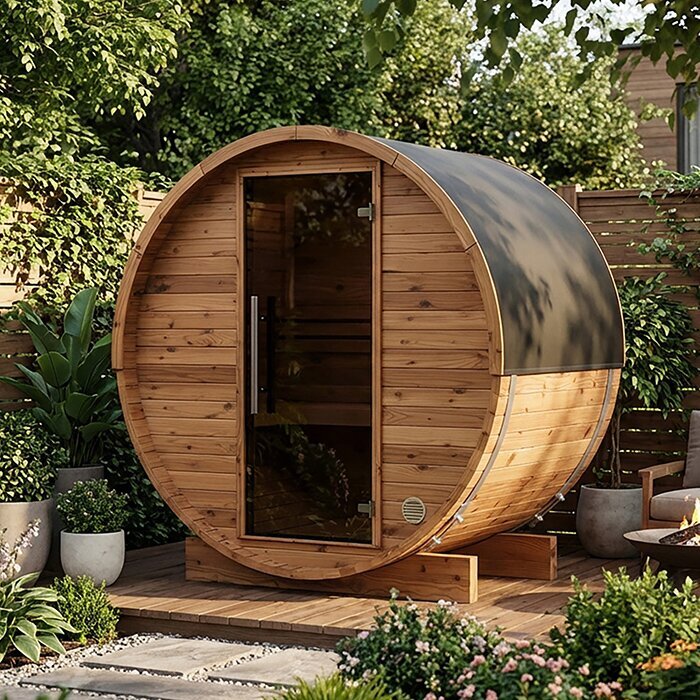
An outdoor sauna roof is an assembly: its supporting shape, covering, any underlay or protective layer, fixings and edge details all have a role. The arrangement varies by design; a curved barrel form and a cabin with a conventional pitched profile do not necessarily use the same build-up. Do not infer the layers beneath a visible finish from a photograph or product name. Ask the supplier to identify what is included in the selected configuration, what is optional and what must be supplied or completed separately. Get that explanation for the exact model and version being quoted, so similar-looking products are not compared on different assumptions.
Use precise language when discussing water protection. A covering may shed rain, but that does not establish how the complete roof performs at seams, openings or the wall junction. Ask what any claim of water resistance or waterproofing applies to, whether it depends on a specified installation, and what the instructions require at each transition. Clarify what to do if a roof component is damaged and whether compatible repair materials can be obtained. For Sauna LCF-300, request the current roof specification for the exact configuration rather than treating the model name as a technical description.
What the roof drawings and specifications should show
Drawings answer questions that a sales summary may leave open. Ask for a roof plan or elevation and a cross-section for the exact model, with the covering shown or identified. Useful details include the overall form, slope or curved profile, ridge and eaves, overhangs, roof-to-wall junctions and any openings. If the roof is supplied in separate parts, ask for a drawing that shows how their edges meet. Check that the drawing’s revision and model code match the current quote; an illustration for another size or version may not describe what you are buying. The outer silhouette alone cannot show concealed layers or fixing details. Where several roof options appear in the same brochure, have the supplier identify the one included in your quote. Keep optional trims and accessories separate from standard components in your comparison, so a more complete package is not mistaken for a different roof design.
Read the drawing alongside an itemised specification and installation manual. The specification should identify the cover type, underlay if there is one, trims, fasteners and accessories sold separately; the manual should set out the intended care and repair approach. If a detail is missing, record it as unanswered rather than filling the gap with an assumption. A photograph can help you recognise a shape but may not show laps or concealed edge treatment. When reviewing Sauna S-140, confirm that the documents relate to the current version and ask whether any roof option changes the drawing or care requirements.
How to compare roofing materials and their upkeep
A material name is not enough to compare roofs. Check the specified product and finish, what it is fixed to, which compatible parts are used at the joints and edges, and whether the care instructions call for cleaning, recoating or replacement. Ask for the maker’s guidance rather than assuming that a material described as suitable for outdoor use is automatically appropriate for a particular sauna design. Repairability matters too: clear instructions and identifiable replacement components can make future upkeep more manageable. Ask how a replacement part would be identified: by its material, finish, component code or position in the assembly. Also clarify whether the recommended repair is a task for the owner or requires a specialist. These answers make the maintenance requirements easier to compare without guessing at future costs or repair frequency. Compare documented information about the offered assembly, not a broad claim that one material always lasts longer or needs no attention.
Different types of covering have different details to check. With sheet-style products, ask about overlaps, fixings and the finish at exposed edges. For tiles, find out how the design deals with damaged or displaced pieces and how replacements are identified. A flexible membrane or shingle product has its own requirements at boundaries and around openings. These are prompts, not a ranking: products within each category vary, and no category name guarantees a particular lifespan or level of water protection. For Sauna HC-150, check which covering and care instructions apply to the version currently offered.
Details at edges, seams and penetrations
Pay close attention to places where roof components meet: the ridge, eaves, corners, seams and the junction between the roof and the sauna walls. These transitions need to be covered by the design, not left to guesswork during assembly. Ask what trims or flashing are included, how the drawing identifies each junction and whether the maker specifies particular compatible components. Also check whether exposed fixings need inspection or particular care. A neat-looking roof edge in a product photograph does not show how it has been formed, so use the drawing and written instructions to confirm the detail.
Openings for a flue, ventilation or other services need model-specific detailing. Ask whether the opening is part of the supplied design, which compatible components are required and who is responsible for the work. Do not adapt a roof or make a new opening based on a generic diagram; changes can affect both weather protection and the product configuration. Use the maker’s instructions and an appropriately qualified installer for work that requires specialist knowledge. For Sauna HC-225, include any planned opening or roof modification in the questions about the exact configuration.
Rainwater runoff and discharge
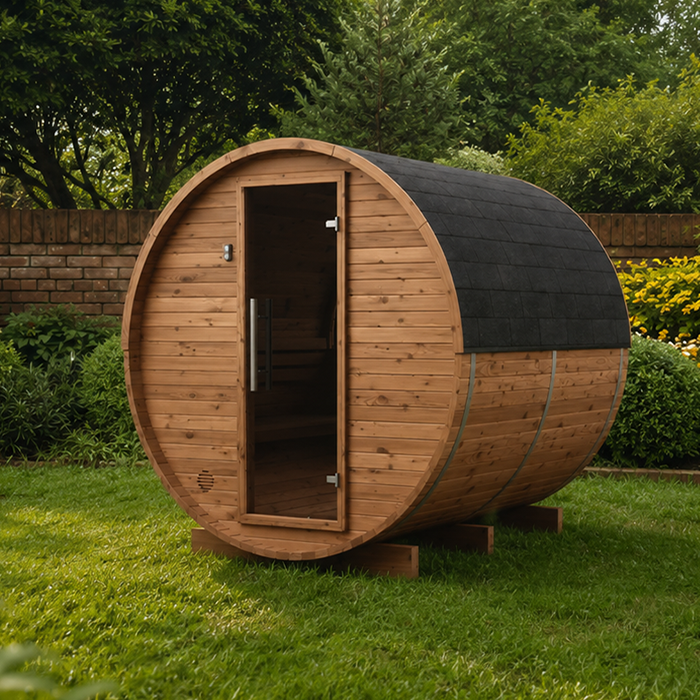
The route rainwater takes is part of roof planning. Use the drawing to establish the intended direction of runoff, then consider what lies below that edge: a path, doorway, seating area or ground that tends to hold water. Ask whether the design directs water away from the sauna’s base and whether a gutter or other accessory is intended. Do not assume that every roof needs a gutter, or that a gutter is included. If the flow direction is not clear in the documentation, ask the supplier to explain it before settling on a site.
Consider the whole route after the water leaves the covering. Even correctly directed runoff can create a problem if it lands where water collects or splashes against nearby surfaces. Check how any downpipe or outlet is meant to discharge, and whether it can be reached for cleaning. On a simple site sketch, mark the proposed sauna position, entrance, nearby paths and intended discharge point. This gives you a clear basis for discussing whether the runoff route conflicts with access or other uses of the space. If the position changes, revisit that route rather than assuming the original arrangement still works. Keep roof runoff separate in your planning from any water supply or drainage arrangement inside the sauna; they are different questions. After Sauna N-210 is installed, observe the runoff during rainfall and address unexpected pooling or a blocked outlet using the relevant guidance.
Sun exposure and temperature changes
Sun exposure can affect exterior finishes over time, although the effect depends on the material, coating and conditions. Repeated warming and cooling can also matter to the way some roof materials, joints and sealants behave. Ask the manufacturer what resistance is claimed for the exact finish, whether any recoating or other care is recommended, and which products are approved for maintenance. Avoid assuming that a covering described as durable outdoors is maintenance-free. If a roof is partly shaded, that does not by itself prove that its seams or finish will need less attention.
Look at the exposure across the year, not only on the day you view the site. Trees, adjacent buildings and overhead shelter may change how much direct sun reaches the roof, and they can also affect access or debris. Ask whether the chosen finish has care requirements that vary with exposure, and how to identify an approved replacement if a component later needs attention. When considering Sauna N-250, treat its model identity separately from any claim about sun resistance; confirm the relevant finish and maintenance guidance for the configuration being offered.
Wind and debris exposure at the site
An exposed position, nearby trees or the arrangement of surrounding buildings can influence what reaches a roof and how accessible it is for inspection. Wind may carry leaves, branches or other debris, while branches close to the roof may need to be considered as part of the site choice. A fence or wall should not be assumed to provide reliable shelter. Ask the manufacturer whether the offered roof arrangement is suitable for the conditions at the intended site, and whether any site-specific review is needed. Do not infer wind performance from the roof’s appearance or from another installation.
Check how the edges and covering are secured in the design, but do not select extra fixings or alter the roof based on a guess about wind exposure. Ask for the manufacturer’s written recommendations for the exact configuration and use an appropriately qualified professional if the site or proposed work needs assessment. Consider how leaves or other debris could reach the roof and whether they could block a gutter or outlet. For Sauna LC-260, request the applicable roof and care documents rather than assuming that a model name establishes suitability for a particular exposed position.
Roof inspections and cleaning
Use the maintenance instructions for the selected roof rather than adopting an interval from a different product. A visual check can look for changes such as lifted edges, displaced pieces, damaged finish, rust, blocked outlets or a change around a seam. It is also useful to check after severe weather, but avoid climbing onto a roof without a safe, suitable access arrangement. If the condition cannot be assessed safely from the ground, have an appropriate professional inspect it. When noting a change, describe its location precisely, such as the entrance-side edge or the seam nearest an outlet. Record what you can actually see rather than diagnosing a cause. This makes an enquiry about care or repair more useful than a general report that the roof looks different. A visible mark does not always mean there is a leak, but a change worth investigating should not be ignored.
Cleaning methods should match the covering. Ask whether the instructions allow particular brushes, cleaning agents or pressure washing; do not assume that a method suitable for a garden surface is suitable for the roof. Remove leaves or other debris in the way the maker recommends, taking care not to damage the finish or joints. Keep a simple record of inspections, cleaning and repairs so you can notice changes and refer to earlier work. For Sauna HCF-300, confirm which maintenance guidance applies to the current configuration before setting up a routine.
Separate canopies and access to the sauna roof
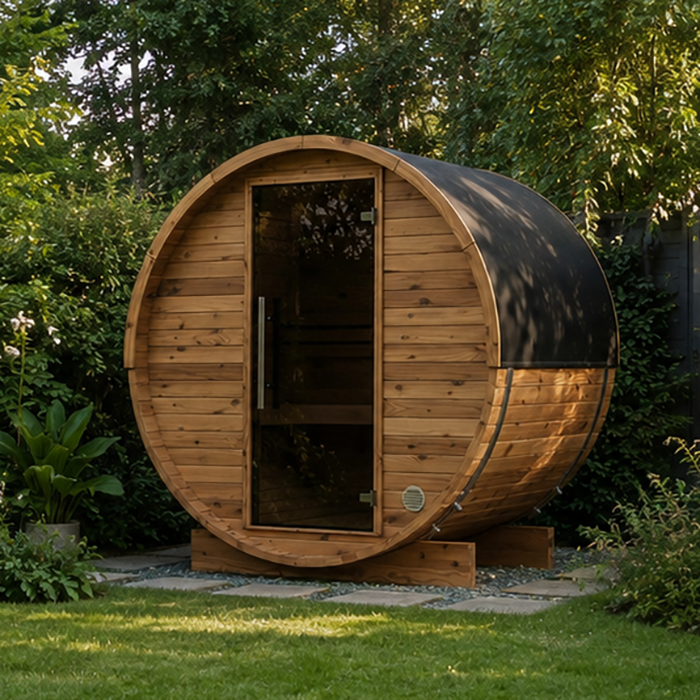
A separate canopy may change how much direct rain or sun reaches a sauna, but it does not automatically correct a roof detail or make the sauna waterproof. It may also redirect runoff, collect debris or make parts of the roof harder to inspect. Treat the canopy and sauna roof as distinct parts of the site, with their own materials, joints and care requirements. Before planning one, ask whether the sauna manufacturer approves the combination and whether the proposed arrangement affects access, ventilation or the roof’s intended weather protection.
Do not assume that a pergola, garden shelter or other structure is rated to carry a roof, support a sauna or accept attachments. Equally, do not assume the sauna roof is designed to support a separate covering. Ask who is responsible for the design and installation, how rainwater will leave both structures, and whether the arrangement needs a qualified professional’s assessment. Where a shelter is already present, confirm compatibility for the exact model rather than relying on its general appearance or purpose.
Comparing roof specifications and maintenance
A like-for-like comparison can be recorded in a few categories: the exact roof covering and included layers; the drawing for edges and openings; the route for rainwater; the maker’s guidance for the site conditions; and the care and repair requirements. Mark each point as confirmed or still unanswered. Keep the same categories for every option, even where a supplier uses different terms. Record the actual component or requirement rather than copying a promotional description. If an optional covering is being considered, give it a separate entry so its inclusions and upkeep are not confused with those of the standard version. This is more useful than comparing product photographs or relying on a broad description such as weatherproof. If one design has unclear inclusions or no available maintenance guidance, treat that as missing information rather than assuming it matches another design.
Then consider whether the documented routine fits the site and the time you can reasonably give to upkeep. Check whether routine cleaning is straightforward, whether specialist attention is recommended for certain work, and how replacement components are identified. Separate tasks you expect to manage yourself from those you would arrange through a service provider. Consider access as well as frequency: a routine may sound manageable on paper but be awkward in the proposed position. Resolve that practical mismatch while comparing designs, rather than leaving it until the first cleaning or repair is due. Read any roof-related warranty wording alongside the care instructions, so you understand what maintenance is expected without assuming that all roof problems are covered. The most useful comparison matches a clearly described assembly to the exposure and runoff at the intended site.
Frequently asked questions
Can I assume an outdoor sauna roof is waterproof?
No. The model name or visible covering does not establish how the complete roof is detailed or what conditions its protection applies to. Check the current specification and installation instructions for the exact configuration, including how the edges and openings are treated.
Which roofing material needs the least maintenance?
There is no reliable answer based on a material name alone. Finishes, joints, installation details and the maker’s care requirements all matter. Compare the maintenance guidance and repair options for the specific roof assembly being offered.
Does an outdoor sauna need gutters?
Not necessarily. The roof shape, intended runoff route and conditions around the sauna affect whether gutters are appropriate. Ask where water is meant to discharge and whether gutters are compatible with the selected design. Plan for cleaning if they are included.
How often should I inspect the sauna roof?
Follow the maintenance schedule for the exact roof design. It is also sensible to look for visible changes after severe weather, without climbing onto an unsafe roof. If something appears loose, damaged or blocked, use the maker’s guidance or ask a suitable roofing professional to assess it.
Can I add a pergola or canopy over a sauna?
Only if the sauna maker confirms that the proposed arrangement is compatible. A separate structure is not automatically suitable to support, cover or attach to a sauna, and it may change runoff and access for maintenance. Have the combination assessed by an appropriately qualified professional.
A sound roof assessment brings the covering, its junctions and the runoff route together with the conditions around the sauna. Drawings and written specifications show what is actually included; maintenance guidance shows what the finish and joints will need over time. When those details are clear for the exact configuration, it is easier to compare weather protection fairly and to plan care that suits the site.
