
Replacing an Old Garden Sauna: Can the Base and Connections Be Reused?
Garden sauna replacement guide
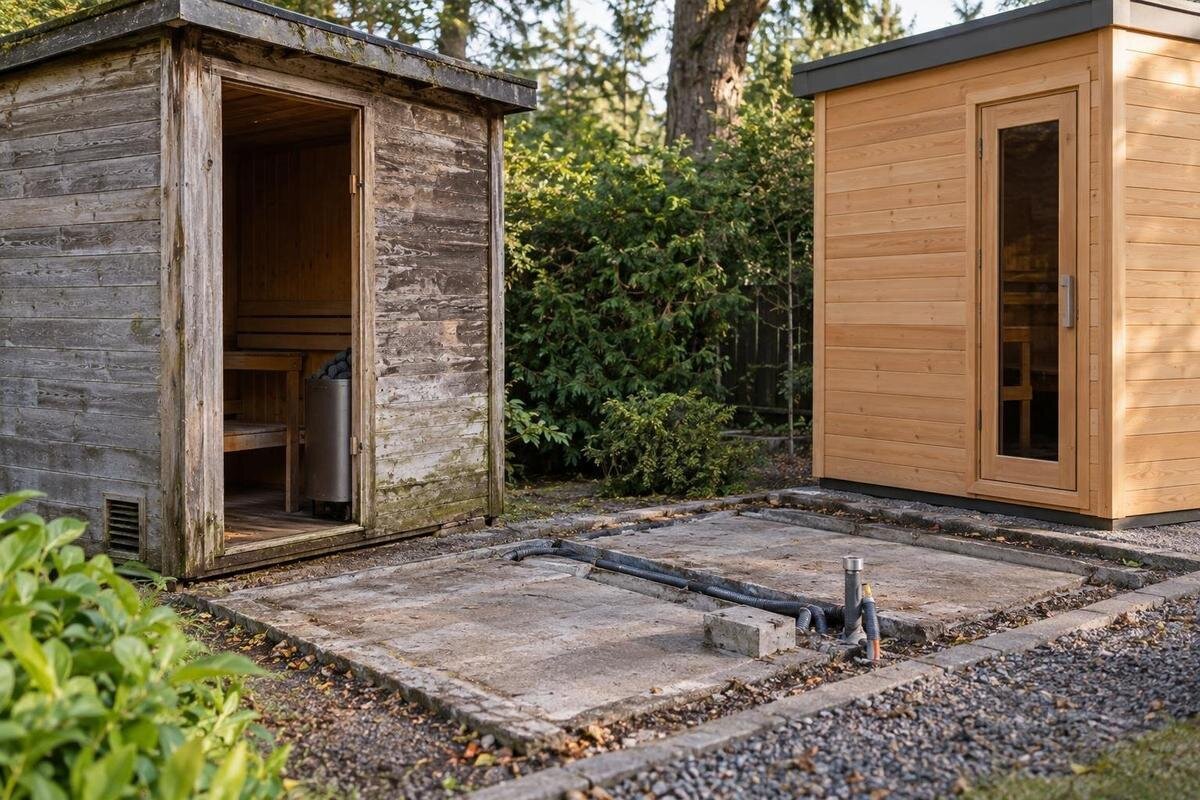
An existing garden sauna may leave behind a useful base and service routes, but neither is automatically suitable for its replacement. A new cabin can have different dimensions, support details or heater requirements, while the old platform, wiring or pipes may have deteriorated unseen. The reliable test is to compare the exact replacement and its chosen equipment with the actual site, then have the relevant parts assessed by qualified professionals. This guide covers the base, electrical supply, other connections and access so you can decide what to retain before removal begins.
A replacement needs a fresh site assessment
Installing a new sauna in the same garden position does not make the job a like-for-like swap. The replacement may differ in external dimensions, entry orientation, support arrangement or heater, and the old base may have shifted, weathered or been altered since installation. The old power connection was selected for equipment that may not be in the new configuration. Even if the previous cabin seemed to work normally, that describes the old setup; it does not establish that the base or services meet the new manufacturer's requirements. Small differences can affect where the sauna bears on the base, what clearances are needed and how services reach it. Treat reuse as a question to verify, not a default.
Before dismantling anything, identify the old cabin and heater if possible, note repairs or recurring issues, and find manuals, drawings or service records. Record changes to paving, ground levels or landscaping since installation, and list any services added later, such as lighting or plumbing for an optional feature. Photograph visible base edges and service routes only where safe; photographs explain what is present but cannot show hidden construction or prove suitability. Then settle the exact replacement configuration and obtain its current installation information. If a document is missing, ask the supplier or manufacturer which version applies, and mark unknown details for the relevant professional to assess rather than treating the old arrangement as precedent.
Identify the replacement before assessing the base
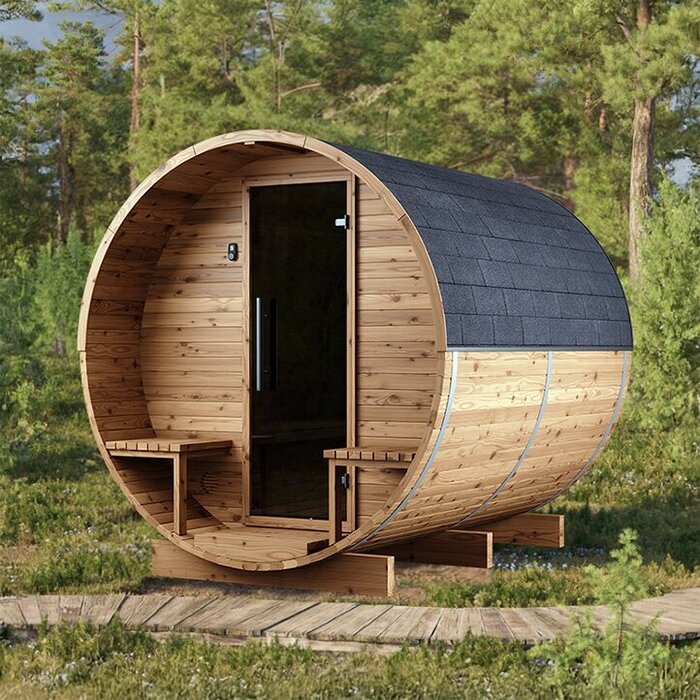
Choose the exact replacement model and intended configuration before testing whether the old base fits. Record the selected heater, whether it is included or chosen separately, the entrance orientation and any options that may change the layout or services. Compare a dimensioned drawing and installation information, not just a photograph or approximate floor area. A catalogue figure is not a plan: the listing identifies the Thermowood Barrel Sauna HC-225 as 4.4 m², but that number does not give you its outer length and width, support interface, edge clearance or opening position. Ask for the current drawing wherever those details are unclear, and note the model and document version so everyone checks the same unit.
If you are comparing candidates, repeat the check for each one; similar names, shapes or floor-area figures do not prove that their bases are interchangeable. Heater choices and accessories can also affect requirements, so compare the precise configuration shown in the manufacturer's documents. Avoid altering the platform to suit a provisional choice and then switching models. Before deciding whether to retain the base, confirm the dimensions against the actual site and allow for the access and clearances stated in the installation information. Base the decision on an exact model, not a broad product family or the footprint of the sauna being removed.
Compare the base dimensions and support arrangement
Measure the existing slab, deck or platform itself, not only the area covered by the old cabin. Record its usable length and width, shape, steps, raised edges, irregularities and nearby obstructions. Note whether the visible surface is a slab, paving or a deck with a supporting frame; appearance alone may not show how it is supported. Compare those observations with the replacement's dimensioned footprint and its stated base interface. Mark where the entrance faces and whether there is room to approach it. A platform may appear large enough yet leave part of the intended support outside its usable area, or put the door facing a fence.
Have the installer or builder compare the documented support arrangement and any specified fixing details with what is actually present. For a candidate such as the Thermowood Barrel Sauna N-210, use the current model information rather than assuming its interface matches the old cabin. Confirm whether the existing type of base is permitted and whether the specified support or fixing points can be accommodated. Do not assume a wider platform is automatically suitable, or that old fixings can simply be retained. If a deck, slab or paving needs alteration, have a suitable professional assess the work before cutting, drilling or adding support.
Inspect the base and its supporting ground
Look over the base and surrounding ground for signs that need investigation: cracking or movement, loose paving, crumbling concrete, soft or decayed timber, corrosion on exposed metal, standing water and repairs with an unclear history. These observations are not, on their own, a diagnosis. A smooth surface can conceal movement or deterioration below it, while a small surface mark may be superficial. Note any gaps, distortion or rocking seen while the old sauna is in place, and record when and where these occur. A base that appeared stable under the previous cabin still needs assessment if its condition has changed or the replacement has different requirements.
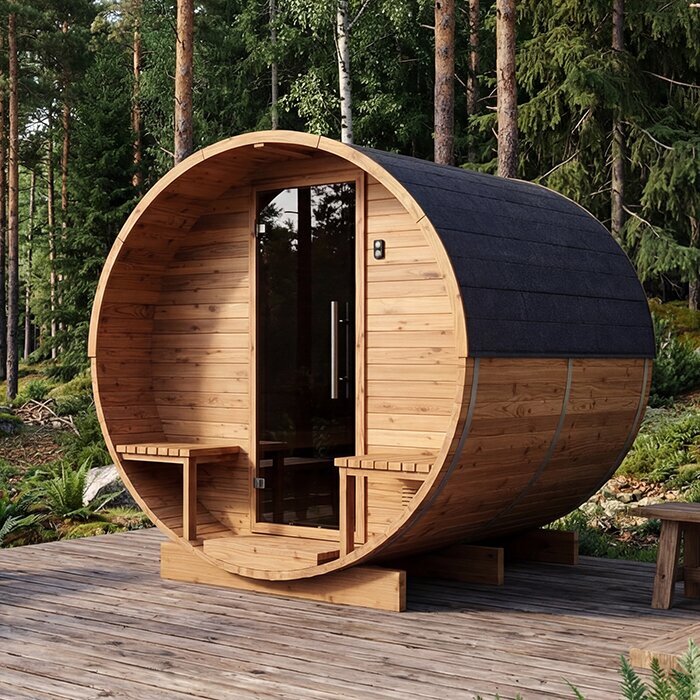
The construction and supporting ground must be considered against the new sauna's documented requirements; they cannot be judged by appearance alone. Ask a builder or structural professional to assess the base if its construction, condition or capacity is uncertain. If you are considering the Thermowood Barrel Sauna N-250, compare its stated support requirements with the existing platform rather than inferring them from the model name or the old sauna's performance. Do not try to correct suspected movement with improvised packing or extra paving. If the assessor recommends work, get the proposed solution confirmed before the replacement is installed.
Check drainage, edges and clearances
Check how rainwater moves around the existing position. Note puddling, soil washout or soft ground, runoff from nearby roofs and paths, and whether a drain or inspection cover is close to the base. Look for signs that water collects against an edge or cannot reach an existing drainage point. The arrangement that worked around the old cabin may be affected if the replacement has a different outline or sits in a different position. Include these observations in the base assessment so that the surrounding ground and drainage are considered alongside the exact installation information.
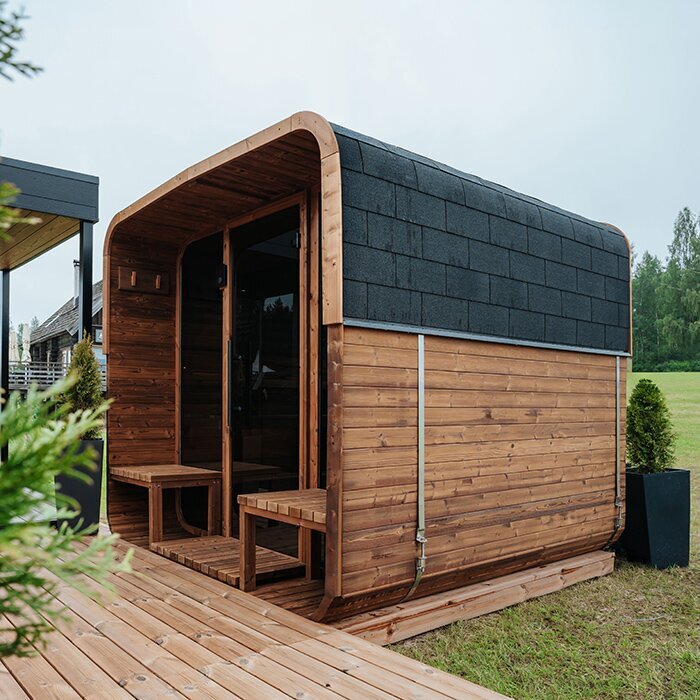
Compare the proposed outline with nearby paving, fences, walls, vegetation and service points, and check any clearances or access requirements stated by the manufacturer. Use the current external drawing for the LC-260 model, rather than its floor-area figure, to assess the space around the cabin and its edges. If the new position would trap water, block access to a drain or leave no practical room to inspect the base, ask a builder to assess the layout. Have any changes to levels or drainage planned with the base so that runoff is not redirected onto another structure or retained service.
Have the power supply checked against the new heater
An existing power connection cannot be deemed suitable for reuse simply because it ran the old sauna. If the replacement configuration uses an electric heater, compare that heater's stated requirements with the actual supply and its condition; the old heater may have different requirements. A qualified electrician should assess the circuit, cable condition and route, protective devices, earthing and connection point. The review should also account for any lights or controls included in the new setup. A breaker label, old invoice or similar-looking cable may help identify the installation, but none of these confirms compatibility or condition on its own.
Before ordering or removing the old unit, give the electrician the exact heater model and its current manufacturer's information, along with reliable details about the previous heater and existing installation. Ask whether any part can be retained, what needs repair or replacement, and whether a change to the supply or route is required. For a cabin such as the HCF-300 sauna, the cabin model name alone does not establish the heater configuration; check that separately. Arrange for a qualified person to disconnect the old equipment before removal. Do not cut, move or reconnect wiring yourself, and allow time for any necessary electrical work to be planned before fitting begins.
Review plumbing and other services separately
List each service attached to the old sauna and why it was installed. It might be a water feed, drain, lighting, control wiring or a connection for an optional shower or rinse area. Separate services that belong to the sauna's current configuration from later additions. A pipe or drain beside the old cabin is not evidence that the replacement needs it, and a service that was useful before may be poorly located or in unsuitable condition now. Check the new design and actual inclusions; do not plan to carry every connection forward by habit. Some configurations may not require plumbing, while optional features need their own review.
If the selected replacement does call for a connection, have the relevant trade check its condition, route and intended location against the current model information. A plumber can assess plumbing, while an electrician should check electrical circuits for lights or controls. When considering the Thermowood Barrel Sauna LCF-300, verify its exact configuration and included features instead of inferring them from the model name or a neighbouring model. If an old line has no role in the new setup, ask the appropriate professional whether it should be removed or retained for another documented purpose.
Plan removal and delivery access
Assess both the route for removing the old sauna and the route for bringing in the replacement. Check gates, narrow points, turns, steps, slopes, overhead obstructions, soft ground and the distance between the unloading point and the base. An old delivery route may no longer be usable if fencing, paving or landscaping has changed. Ask the supplier or installer what dimensions and handling information apply to the exact replacement, and whether the delivery and removal methods require a particular approach to the site. Do not assume that an easy route for the previous cabin will suit another unit.
The listing for the S-140 model identifies the product, but its model name and floor-area figure are not delivery measurements. Confirm the relevant handling dimensions and requirements for the selected unit. Identify buried or concealed services before any ground disturbance, using appropriate professional help, and protect the base, paving and services that are to remain. Arrange electrical disconnection before removal and agree who is responsible for each part of the work. Coordinating the removal and delivery plans can prevent damage to a base that has been assessed for reuse.
Prepare a handover for the installer and trades
Put the available information in one place so each person can assess the same site. Include the old sauna and heater details, known repairs or changes, service records, manuals and any recurring problems. Add dated photographs of the visible base and service routes, plus measurements of the platform and nearby obstructions. Describe what you can see without guessing about hidden construction or electrical components. Mark missing information clearly. If a cable route or base material is unknown, say so rather than recording an assumption as fact; this tells the assessor what still needs investigation.
Give the installer the exact replacement model and configuration, its current drawings and the heater information, then pass relevant service details to the appropriate trades. If you are considering the Thermowood Barrel Sauna HC-150, include that exact model identifier and any separately selected heater in requests for assessment. Ask each professional to state which existing parts they have assessed, what can be retained and what needs work. A written scope helps prevent one trade's assumption from being mistaken for another trade's assessment, especially where the base, electrical supply and plumbing are handled separately.
Decide what can be retained, altered or replaced
There are three useful outcomes: retain, alter or replace. Retain a base or connection only when its present condition has been checked and its suitability is established against the exact replacement requirements. Alter it when a relevant professional identifies specific work that can make it suitable and confirms the proposed approach. Replace it when it is damaged, does not match the documented requirements, or cannot be assessed reliably. The base and electrical supply need separate decisions: a suitable platform does not confirm electrical compatibility, and a suitable power supply does not confirm the platform.
A clear sequence is to choose the model and heater, obtain the current documents, inspect the base and services, resolve unknowns with the relevant professionals, and then agree the work before removal. Make the scope clear about which existing elements are being retained and who has assessed them. If a key question remains unanswered, treat it as a hold point rather than an assumed yes. Planning the decision before the new sauna arrives leaves room to arrange repairs or replacements without relying on last-minute guesses.
Frequently asked questions
If the replacement sauna is the same size, can I keep the base?
Not automatically. A similar floor area or outside size does not confirm that the support arrangement, base interface, clearances and condition are suitable. Compare the exact replacement's current installation information with the platform, and have its construction and condition assessed where necessary.
Can the existing power connection be used for a new sauna heater?
Possibly, but a qualified electrician needs to compare the exact heater's requirements with the existing supply and assess its condition. Previous use with the old heater, or a label on an existing circuit, does not establish compatibility with a different configuration.
Will the replacement need the old water and drain connections?
Only if the chosen design or features require them. A connection may serve an optional shower, rinse area or another addition rather than the sauna itself. Check the new configuration and have a plumber assess any pipe or drain you intend to retain.
Should I remove the old sauna before checking the base?
Gather the documents and plan the removal first. Some parts of the base may only be visible once the old cabin is gone, so coordinate an inspection at that stage with the installer or builder. Arrange for a qualified person to disconnect electrical services before removal.
What should I give the installer before the replacement is fitted?
Provide the exact new model and configuration, its current drawings and heater information, plus records of the old sauna, repairs and known service issues. Add photos and measurements of the visible base and mark any unknown details. This helps each trade assess the part of the installation within their scope.
An old base or connection can be reused only when the new model's documented requirements match it and its current condition has been checked. If the evidence is incomplete, keep the answer open and plan an assessment rather than assuming the previous installation carries over. Where checks confirm reuse, identify the retained elements clearly; where they do not, plan repairs or replacement before the new sauna arrives. The decision should fit the actual sauna and the actual site.
