
Getting a Sauna into a Garden with Narrow Access
SAUNA DELIVERY GUIDE
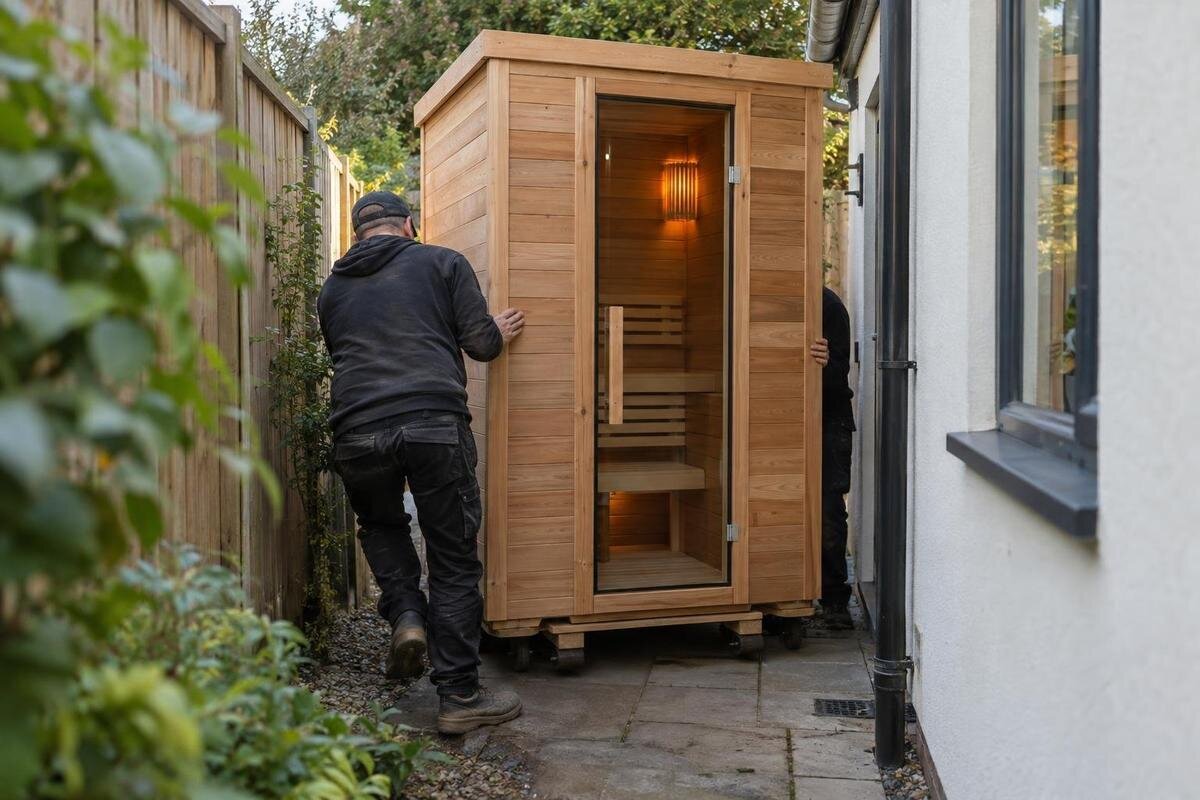
Getting a sauna into a garden with narrow access is a delivery-route problem, not simply a question of whether the finished unit fits its base. A package may be longer, taller or less manoeuvrable than the structure after assembly, and the route may include a gate, a corner, overhead obstructions or ground that is unsuitable for the agreed handling method. Plan from the delivery vehicle’s stopping point all the way to the site. First confirm the exact shipment, then measure every pinch point and agree who unloads and moves it. If a critical detail is unknown, settle it before booking transport.
Before choosing a sauna 1
Confirm the shipment before measuring
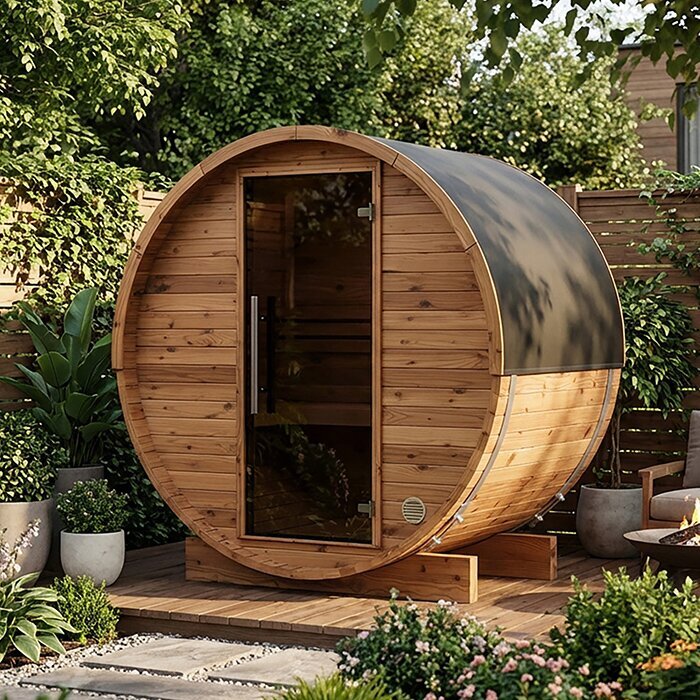
Before measuring a gate, establish how the exact sauna and chosen configuration will be delivered. A product page may show the installed unit or floor area, but neither tells you the dimensions of the largest item in transit. Depending on the model and dispatch arrangement, delivery may involve an assembled unit, partly assembled sections or several packages; do not assume which applies. Ask the seller or manufacturer for the current shipment details and package count. For Thermowood Barrel Sauna N-250, use the page to identify the candidate, then request the dispatch specification, including the outside length, width and height of each package and its weight.
Ask whether those measurements include a pallet, protective frame, wrapping and anything projecting beyond the box, and confirm how many items arrive together. Find out how the longest or bulkiest item is meant to be oriented and whether it can be handled separately from other parts. Ask if the manufacturer permits assembly at the garden site and which components, if any, can pass through independently. Do not assume packaging can be stripped, parts detached or a package tilted to fit: the instructions and competent handlers determine what is acceptable. Keep the response with the exact model and option details so everyone plans for the same shipment.
Map the full route from vehicle to site
Sketch the whole journey from the point where the delivery vehicle can stop to the prepared site, rather than starting and ending at the garden gate. Mark the unloading point, driveway or kerb, boundary entrance, side passage, every door or gate, bends, steps, changes in level and final approach. Note which side of the house the load must pass and whether the route crosses an awkward or shared area. Label each drawing with the chosen model and configuration. If you are considering Sauna LC-260, for example, keep its shipment details alongside the route plan so the measurements can be compared. A labelled sketch with measurements and arrows is more useful than a list of widths without locations.
At each stage, record the smallest usable width and height, plus the space available just before and after it. Measure where the load and its handlers will travel, including around open gates, latches and wall returns, not just along the centre of a path. Mark what must move on delivery day: pots, bins, parked cars, washing lines or garden furniture. The route is only as open as it is when the team arrives, so note temporary obstacles as well as fixed ones. Photos taken from both directions can help the delivery company understand the sequence and spot a constraint a flat plan may hide.
Before choosing a sauna 2
Measure the gate’s usable opening
Treat a gate’s nominal width as a starting point, not the usable opening. Open it to the position the delivery team can actually maintain, then measure between the nearest obstructions: posts, hinges, latch, handle, wall, fence or a projecting pillar. Check the height beneath any header, arch or fixed fitting, and include a raised threshold or uneven paving that changes the passage. Measure at more than one height if posts or walls are not parallel. Record the gate’s opening direction and whether its leaf occupies turning room on the approach. This gives you the real clear aperture rather than a figure taken from a plan.
Compare that aperture with the largest package or component in its permitted orientation, and ask the supplier and carrier what working clearance their handling method needs. A near-equal match is not a confirmed fit: a trolley, protective wrapping, hands or an uneven approach can use space not included in a box measurement. When checking a candidate such as Sauna HCF-300, request its exact packed dimensions before relying on a product-page figure. If the opening looks marginal, have the delivery team assess the measured route; do not plan to force the package through, remove parts or tilt it without approval.
Check whether long packages can turn
Check the space needed to move around every corner, not just the width of the passage. A long or rigid package may pass through a straight passage and still be unable to turn between a house wall and a boundary wall. Note the approach length before the bend, the available space on the inside and outside, and the clearance beyond the corner. Include window sills, downpipes, meter boxes, steps and planting that narrow the path. Also check whether there is room to reposition the load after each gate; a tight turn immediately beyond a gate can be harder to negotiate than the gate itself. A sketch should show the direction of travel and obstructions on both sides.
Ask the seller or installer to review the route using the shipment’s actual length, width and height, including approved handling orientation. Do not rely on diagonal measurements or assume a package can simply be stood on end or rotated; the package and its handling guidance determine what is acceptable. If Sauna LCF-300 is on your shortlist, attach its exact configuration and package schedule to the question rather than asking whether a sauna with a similar footprint will fit. Where the turn remains uncertain, arrange a competent site review before booking delivery.
Before choosing a sauna 3
Measure overhead clearance
Look up as well as across the path. Check carport beams, eaves, gutters, pergolas, branches, washing lines and overhead services where a load would pass. Measure the lowest clear point along the route, including where the package must rise over a threshold or change direction. The person carrying or moving it may need room too, and agreed handling equipment can change the required clearance. A route that clears a stationary box may not clear it while being handled. Mark the overhead pinch points on your sketch and ask the delivery team to confirm the clearance its method needs.
Keep the height measurements with the shipping details for the model you are considering. If you are looking at Sauna S-140, request the height of its delivered package rather than relying on the finished sauna’s dimensions. Record any overhead restriction alongside the space available below it, including thresholds or changes in level that affect the passage. If a branch, fitting or service would have to be changed, agree who is qualified and authorised to assess that work. Treat overhead services as a reason to stop and seek advice, not something to move or work around during a lift. Check any alternative route for overhead clearance too.
Check the surface and changes in level
Inspect what is underfoot from the stopping point to the site. Paving, concrete, gravel, soil, lawn and steps can present different conditions for people and handling equipment, particularly when they are uneven or wet. Look for loose pavers, soft patches, drains, narrow edging, steep changes in level and places where a trolley might need to stop or turn. This is not a request to calculate a surface’s carrying capacity: ask the carrier or installer what ground conditions and equipment the proposed method requires, and have a suitable professional assess any doubtful section. Do not assume a garden path that is fine for walking will suit a package being moved.
Record slopes and level changes as delivery constraints, not as a reason to improvise ramps or temporary supports. If a package must be carried by a team, check that the team can move along the full path and pause safely at bends; if equipment is proposed, confirm it can reach and operate on the actual surface. When discussing delivery of Sauna HC-150, give the carrier its confirmed package dimensions and weights together with your notes on the path. The product’s listed area is not a delivery specification. Revisit the route shortly before delivery if rain, site work or stored materials may have changed its condition.
Before choosing a sauna 4
Agree on unloading and movement
An accessible garden is not enough if the delivery vehicle cannot get close enough to unload. Confirm where the vehicle will stop, whether it can enter or turn in the driveway, and what road, gate, carport or overhead restrictions affect it. Ask the seller and transport company exactly what their service includes: a kerbside drop-off, placement at a specified point, movement through the garden, or something else. Do not treat delivery as a promise of installation. Give the company the address, annotated route and photos, and ask it to confirm the stopping point and unloading arrangement for the particular shipment.
Agree who supplies staff and equipment for the move from vehicle to site, and who is responsible if the vehicle cannot reach the planned point. Do not rely on family members, extra helpers or a particular trolley unless the delivery provider has approved that method. If a crane, forklift or other lifting service is being considered, leave the assessment and operation to suitably qualified providers; they need to judge access, setup area, overhead constraints and the path to the landing point. Give the transport company the exact model, such as Sauna HC-225, but remember that a product page does not specify the unloading service.
Ask whether the delivery configuration can change
If the full package cannot pass, ask whether the manufacturer permits another delivery configuration or assembly on site for the exact model. Some buyers may be able to plan for separately delivered components, but do not assume a finished sauna can be dismantled, a packaged kit can be split or every part will fit through the tightest opening. Request the relevant manual, component dimensions and written confirmation of any approved delivery or assembly sequence. For Sauna N-210, the product page identifies a candidate; only the manufacturer’s instructions and the actual shipment can establish whether another access plan is available.
On-site assembly changes the space needed, not just the shape of the delivery. Confirm there is room to bring each item in, keep parts protected, lay them out and let the installer work in the stated sequence. Include any temporary staging area, access for workers and a route for removing packaging. Ask whether the installation team will work at the proposed location and what preparation it expects; do not infer this from the finished footprint. If assembly access is not confirmed, compare another verified delivery plan before ordering rather than assuming an obstruction can be overcome on the day.
Before choosing a sauna 5
Prepare the property and a fallback plan
Review the route in the condition it will be on delivery day. Moveable obstructions such as pots, bins, hoses, outdoor furniture and parked vehicles need an agreed place to go, and that new position must not block the turning area or unloading zone. If a gate leaf, fence panel or planting may need temporary alteration, obtain the owner’s agreement and arrange competent help where needed; do not make removal part of an informal delivery-day improvisation. Note fragile surfaces, low walls and corners that could be struck, and ask the delivery provider how it plans to protect them without obstructing safe handling.
Set a clear contingency before transport is booked. If a measurement changes, a gate cannot open fully or the agreed equipment is unavailable, the team needs a defined pause point and someone to call. Agree whether the carrier will stop at the entrance, hold the load or return it, and who decides whether another approved route can be used. Ask about the arrangements and any consequences rather than assuming a failed attempt can be corrected at no cost. Never force a package, strip it or attempt an unplanned lift simply to avoid a delay; resolve a mismatch with the supplier and delivery provider.
Confirm the plan before dispatch
Before confirming the order or delivery date, bring the information into one record: exact model and configuration; package count, dimensions and weights; a marked route with minimum clear widths and heights; turn and overhead checks; path condition; vehicle stopping point; and the agreed unloading and movement service. Ask the supplier and carrier to confirm the same shipment and method in writing. Share the tightest measurements rather than simply saying access is narrow, and point out steps, soft ground, restricted turns or overhead services. This helps prevent a plan being approved from the finished unit’s dimensions when the delivery team will handle something different.
Recheck the actual route shortly before arrival: gates must open as planned, stored items and vehicles must be clear, and the surface must still suit the agreed method. Make sure the site is ready to receive the load; do not use an access passage as an unplanned storage area. If the package, crew or unloading arrangement differs from what was confirmed, pause and contact the responsible provider before moving it. A straightforward stop is safer and easier to resolve than discovering a mismatch at the tightest corner.
Frequently asked questions
How wide does a garden gate need to be?
There is no single width that suits every delivery. Start with the outside dimensions of the largest package or component in its approved orientation, then allow for the handling method and clearance the delivery team requires. Measure the true opening at its narrowest point, and ask the carrier to confirm any tight fit.
Can the sauna be unpacked to get it through a narrow entrance?
Only if the manufacturer confirms that approach for the exact model and delivery configuration. Unpacking does not guarantee that the largest component will fit, and it can change how the items need to be handled. Ask for the component dimensions and instructions; do not dismantle or tilt the unit on the assumption that it will help.
Are the assembled dimensions enough to plan the route?
No. Assembled dimensions describe the finished sauna, not necessarily its largest package or component. Request the current shipping dimensions and package count for the exact configuration, then assess the entire route using those details.
Who should confirm the unloading arrangements?
Confirm them with the seller and transport provider before booking. Ask where the vehicle will stop, what unloading and movement are included, who supplies staff or equipment, and whether the route and site have been assessed for the agreed method.
What if none of the measured routes looks suitable?
Pause and ask about approved alternatives, such as another entrance, a different delivery configuration or manufacturer-approved assembly on site. A lift over a wall needs a qualified, site-specific plan. Do not improvise a lift or force the load through.
Narrow access does not automatically rule out a garden sauna, but a suitable route must work for the actual shipment and agreed handling method, not just the finished footprint. Confirm the package dimensions, turns, overhead clearance, ground conditions and unloading arrangements before delivery is booked. If a measurement is missing or a passage looks marginal, resolve it while there is still time to plan an approved alternative.
