
Planning Your Home Electricity Supply for a Sauna
SAUNA ELECTRICAL PLANNING
Choosing an electric sauna involves more than matching a cabin to the space available. The exact heater has electrical requirements, and your home’s supply and existing demand need to be assessed against them. A model name, listed floor area or nearby outlet cannot establish that match. Before you finalise a purchase, give a qualified electrician the proposed sauna and heater documentation, information about your home’s electricity supply and the intended location. The electrician can then assess whether the proposal is compatible, whether any changes need to be considered, or whether a different model or heater arrangement should be investigated.
Check electrical suitability while shortlisting
Make electrical suitability part of the shortlist stage, rather than a detail to resolve after delivery. The cabin and heater are related choices, but a cabin’s product name does not confirm the electrical specification of a heater that may be supplied with it or selected separately. Identify the exact cabin and heater configuration you are considering, then obtain the current manufacturer documents that apply. If the offer or heater is unclear, ask the seller or manufacturer to identify it in writing. An electrician cannot reliably assess an unspecified appliance, and a general answer for a product family may not cover the unit in your proposed configuration.
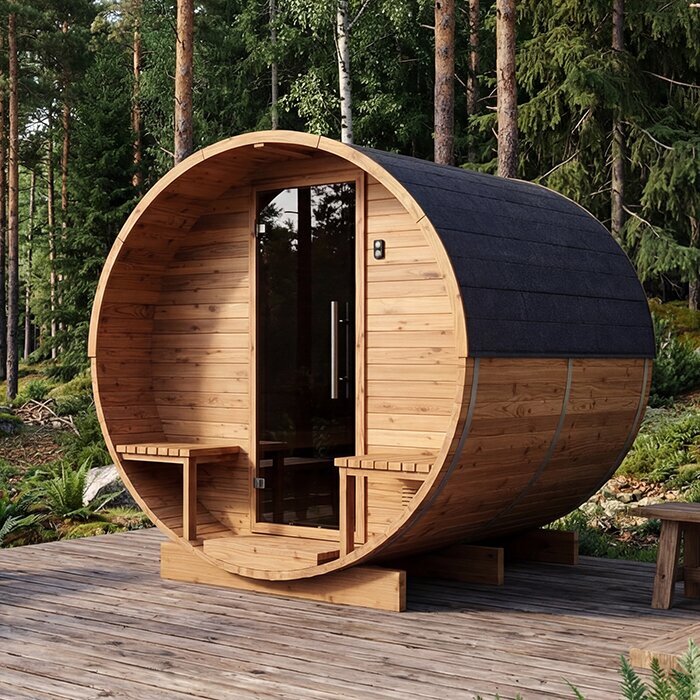
You could begin a shortlist with the HC-150 Thermowood Barrel Sauna, listed at 2.97 m². Record the cabin model alongside the heater being proposed, rather than treating the two as a single, fully specified item. If the seller has not yet identified a heater, mark that part of the shortlist as unconfirmed. This makes it clear which options are ready for electrical assessment and which still need information from the supplier. When comparing several offers, keep the details for each combination together so that a heater document from one offer is not accidentally attached to another. The cabin’s listed area helps identify the product; it is not a heater rating or evidence that your home can support the appliance.
Electrical requirements for the proposed heater
Ask for the make and model of the heater proposed for the cabin, along with the manufacturer’s manual or technical information for that exact unit. The electrician needs its declared electrical input and supply requirements, including any stated voltage or phase requirements and conditions relating to the circuit, controls or protective equipment. These are details for a professional to interpret, not instructions for you to size or install anything. If the paperwork describes several variants, ask the supplier to confirm which one is being offered; a document for a similar model may not be applicable.
For the HC-225 Thermowood Barrel Sauna, listed at 4.4 m², keep the cabin listing and the proposed heater’s technical information as separate items in your enquiry. Ask the supplier to identify the applicable model or variant in the documentation, especially where one manual covers several versions. Send the electrician the complete relevant document rather than a single figure copied into a message. If a quotation and a manual appear to describe different equipment, flag the difference and ask the supplier to clarify it before the assessment proceeds. You do not need to decide which electrical figure is correct yourself. The aim is to give the electrician an unambiguous description of the equipment being offered, with any unanswered questions clearly identified.
Match the heater information to the cabin configuration
Confirm that the heater documents apply to the precise cabin configuration on your shortlist. The manufacturer may need more information than a listed floor area when specifying a heater; its own selection guidance may ask for internal dimensions, room volume or details of design features. Do not try to turn a floor-area figure into a heater size. Ask the supplier or manufacturer to identify the heater specified for the exact cabin, and provide any measurements or configuration details that its documentation requests.
If you are considering the N-210 Thermowood Barrel Sauna, listed at 4.43 m², ask the supplier to identify the cabin configuration to which its heater recommendation applies. Keep any selected options with that recommendation, particularly if the supplier has asked for configuration details before specifying the heater. This separates two questions that need clear answers: which heater is specified for the cabin, and whether your home can support that heater. The supplier or manufacturer should clarify the first; the electrician assesses the electrical requirements against your home’s installation. If either answer is still provisional, record what remains undecided. That is more useful than passing on a heater suggestion without explaining which cabin details it was based on.
Your home’s supply and available capacity
The electrician needs to establish what supply is available at your property and how the proposed heater’s requirements relate to it. This can include checking the supply arrangement, available capacity and any relevant phase information, as well as considering demand from existing equipment. Do not infer suitability from the fact that other appliances work, or from the presence of a nearby outlet. The assessment needs to relate the actual home supply to the declared requirements of the specific heater, not to a general idea of what a household connection can support.
Share any useful supply records or earlier assessments you already have, but do not treat an electricity account or tariff statement as a technical assessment. Let the electrician verify the relevant details at the property. For an enquiry about the N-250 Thermowood Barrel Sauna, listed at 5.27 m², put the proposed heater information alongside those records so the purpose of the assessment is clear. If you do not know the supply arrangement or available capacity, say so rather than guessing from labels or previous conversations. Ask which details can be established during the visit and whether anything remains unresolved afterwards. Keeping confirmed information separate from assumptions helps you understand the answer without needing to interpret the home’s electrical installation yourself.
Household loads and patterns of use
Give the electrician a realistic picture of other substantial electrical loads in the home. Depending on your property, these might include water heating, cooking appliances, air conditioning, pumps, workshop equipment or electric-vehicle charging. Note which are present and when they are commonly used, especially if their use could coincide with sauna use. You do not need to add up their ratings or work out a maximum demand yourself; the useful contribution is an accurate list and an honest description of normal use.
For a proposal involving the LC-260 Thermowood Barrel Sauna, listed at 5.12 m², describe when you would normally want to use the sauna alongside the other household activities already listed. A typical weekday evening and a weekend may involve different combinations of appliances; explain your actual routine rather than suggesting that everything will always be switched off. Mention planned additions too, distinguishing firm plans from possibilities. This gives the electrician a clearer brief without asking you to calculate demand. If the assessment depends on a particular pattern of use, ask for that assumption to be stated clearly. You can then judge whether it reflects how your household operates, rather than accepting a proposal based on a schedule you are unlikely to follow.
Distribution board and circuit assessment
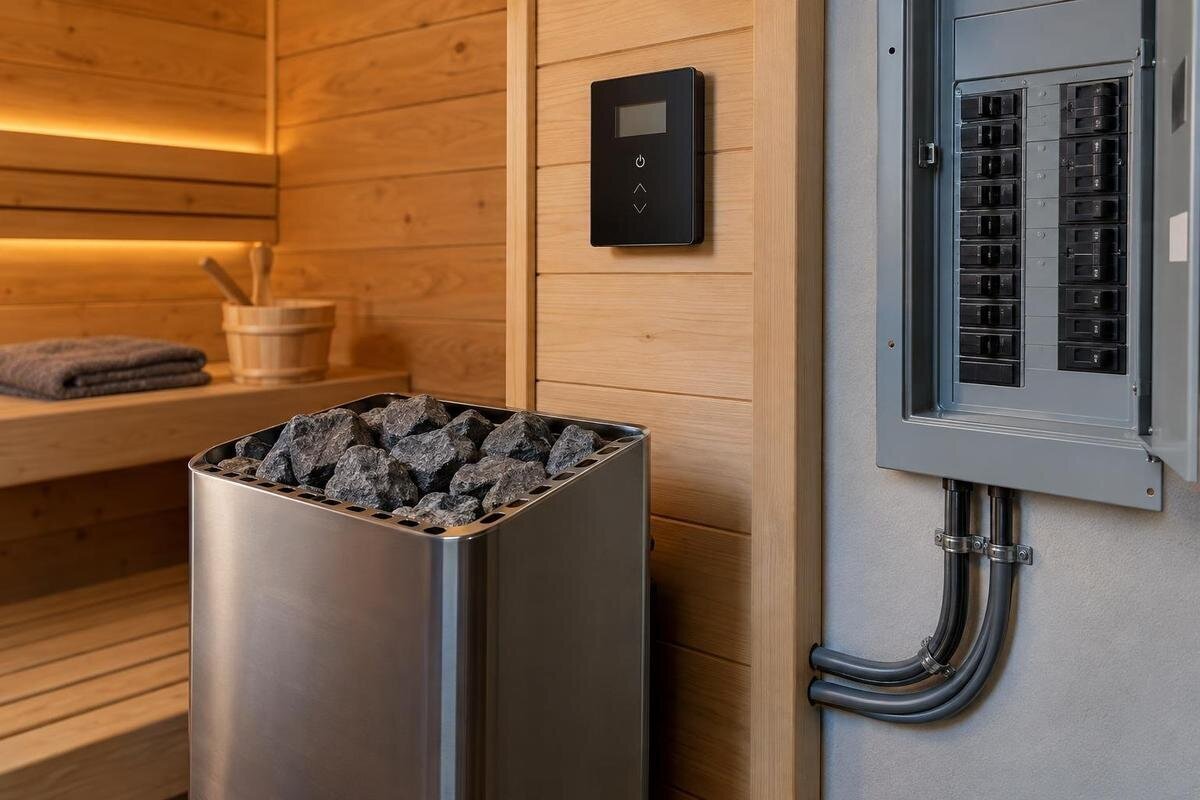
A qualified electrician should assess the existing distribution board and electrical installation against the requirements of the proposed heater. Depending on the equipment documentation and the property, the review may include existing circuit arrangements, available capacity and the protective or isolation provisions needed for the installation. Whether an existing arrangement can be used or changes are needed is a professional assessment, not something to decide from a photograph or a breaker label. Do not remove covers or test circuits yourself; leave inspection of the equipment to the electrician.
Give the electrician the intended sauna location as well as the heater details, because the proposed route from the home installation to the sauna forms part of the site assessment. If you are considering the HCF-300 Thermowood Barrel Sauna, listed at 6.89 m², use its exact model name in the brief and explain where you intend to place it. Before a visit, ask what access the electrician needs to inspect the existing installation and view the proposed route. You can point out access restrictions or building work without choosing a cable route or installation method yourself. Ask the electrician to distinguish findings about the existing installation from any work proposed specifically for the sauna, so you understand what each part of the assessment addresses.
Solar, batteries and backup power
If your home has solar panels, an inverter, a battery or a generator, include the system in the assessment. These arrangements differ, and their presence alone does not show whether they can supply a particular sauna heater or whether the heater is intended to operate from them. Provide the equipment details and any available system documentation to the electrician and, where relevant, the installer who understands the backup arrangement. Explain whether you want the sauna to run only when normal supply is available or also during an outage.
If load shedding is part of your planning, explain whether sauna use during an outage is a firm requirement or simply something you would like assessed. For the LCF-300 Thermowood Barrel Sauna, listed at 6.89 m², provide the proposed heater details with that request; the cabin name alone cannot establish backup compatibility. Ask the relevant professionals to distinguish their conclusions about normal supply from their conclusions about backup operation. A general answer that the sauna can be supplied should not leave you guessing which arrangement was assessed. If you are content to use the sauna only when normal supply is available, make that clear too. Keep the agreed operating assumptions with the assessment rather than assuming that the heater will be backed up because other household circuits are.
The proposed sauna location
Describe the intended position clearly. A simple site plan or annotated photograph can show where the sauna would sit in relation to the house and the distribution board, and what route may be available. Tell the electrician whether the proposed position is indoors or outdoors and note relevant surroundings, access constraints or planned building work. If the site is outside, ask which manufacturer instructions and equipment requirements apply to that environment; do not assume that a product listing alone confirms electrical suitability for a particular location.
Mark the proposed position of the S-140 Thermowood Barrel Sauna, listed at 1.93 m² on your plan, rather than sending only its product photograph. The electrician needs to understand the actual site, including where access is restricted and which parts of the plan are still undecided. If you are considering two positions, identify both and ask whether the assessment covers each one; do not present one location while intending to choose the other later. Photographs and a sketch can help explain your proposal, but leave the choice of route and installation method to the electrician. Once a position has been assessed, record it with the product details. A later move should be raised explicitly, even when you are keeping the same cabin and heater.
What the electrical assessment should establish
The outcome should be about the proposed heater, the home’s supply and the stated pattern of use. The electrician may find that the arrangement can support the proposal as documented, that some change needs to be considered, or that you should investigate a different heater or model. None of those outcomes can be assumed in advance from the product name, the size of the home or the fact that another appliance operates without an obvious problem. The finding depends on the information supplied and the electrician’s assessment of the property.
Ask what the conclusion is based on and whether it assumes a particular heater, cabin configuration, location or household load pattern. If changes are proposed, ask what they involve at a high level, who needs to assess them and whether the manufacturer has any related requirements. If you are comparing alternatives, ask whether each one needs a separate assessment. A clear written record of the assumptions helps prevent an informal “it should be fine” from being mistaken for confirmation of a different model or setup.
Information to gather before ordering
Send the electrician a concise set of information before the assessment where possible. Include the exact cabin model, the proposed heater make and model, the relevant manufacturer documents, the intended position and any available details about your supply. Add a list of major household loads and identify any solar, inverter, battery or generator equipment. Attach existing technical records if you have them, but do not open electrical equipment or attempt to take measurements to fill a gap. The electrician can tell you what further information is needed.
Ask for a response that is specific enough to guide your choice: does the assessment apply to this heater and cabin, what assumptions about household use or location does it make, and what remains to be verified? If changes are needed, ask who should confirm their scope and whether the supplier or manufacturer must clarify anything. Keep the answer with the product documents. If you later choose a different heater or alter the proposed location, update the brief rather than treating the earlier conclusion as a blanket approval.
Frequently asked questions
Should I ask an electrician before choosing a sauna?
Yes, it is sensible to ask during shortlisting, before you commit to a particular heater or cabin. You can compare models while the assessment is under way, but the electrician needs the requirements for each exact heater you are considering. A general answer about one option may not apply if the model or configuration changes.
What information should I give the electrician?
Provide the exact cabin and proposed heater details, the relevant manufacturer documentation, the intended location and any available information about your home’s electricity supply. Also list major appliances and any solar, inverter, battery or generator equipment. You do not need to calculate your home’s demand; the electrician can assess the information.
Can the sauna’s listed floor area tell me which heater to choose?
No. A floor-area figure identifies one aspect of a cabin, but it is not a heater specification or an assessment of your home’s supply. Ask the supplier or manufacturer which heater is specified for the exact cabin configuration, then have the electrician check that heater’s documented electrical requirements.
Can a solar or inverter system run an electric sauna?
Do not assume that it can. Systems differ, and having solar panels, an inverter or a battery does not by itself confirm compatibility with a particular heater. Give the electrician and system installer the heater documentation and the details for your existing equipment, and explain whether you want the sauna to operate during an outage.
Does an electrician’s assessment mean I will need a supply upgrade?
Not necessarily. The assessment may find that the proposed equipment can be supported as specified, that changes need to be considered, or that another heater or model should be investigated. Ask what information the conclusion depends on and whether it applies to the exact cabin and heater you intend to buy.
Treat electrical suitability as part of choosing the sauna, not as a question to settle from a product name or floor-area figure. The electrician needs the requirements for the exact heater and a picture of your home’s supply, other loads and proposed location. If the model or heater changes, have the assessment checked against the new details. That gives you a sound basis for deciding whether the proposal fits your home as it stands or whether another arrangement should be explored.
