
Sauna Showroom Checklist: What to Try, Measure and Ask
SAUNA BUYING GUIDE
An in-person sauna display can answer questions that a product photograph cannot: whether the entrance feels workable, how the benches suit the people who will use them, and which details need a drawing rather than a guess. Not every retailer has a model available to enter, so confirm what you will see before travelling. Use the visit to test the experience and record observations; use current model-specific documents to settle dimensions, equipment and installation requirements.
01
Confirm the display model before travelling
First establish whether the visit will involve a sauna you can enter or only a set of samples and photographs. Ask the dealer which make and model is on the floor, whether it is the current version, and which options, bench arrangement, heater and door layout are fitted. A display may differ in size or specification from the unit you are considering, so a broad category name is not enough to identify it. Confirm the opening hours and whether you need an appointment before making the trip. If there is no matching model to inspect, request the current dimensioned drawing and an interior view of the exact configuration.
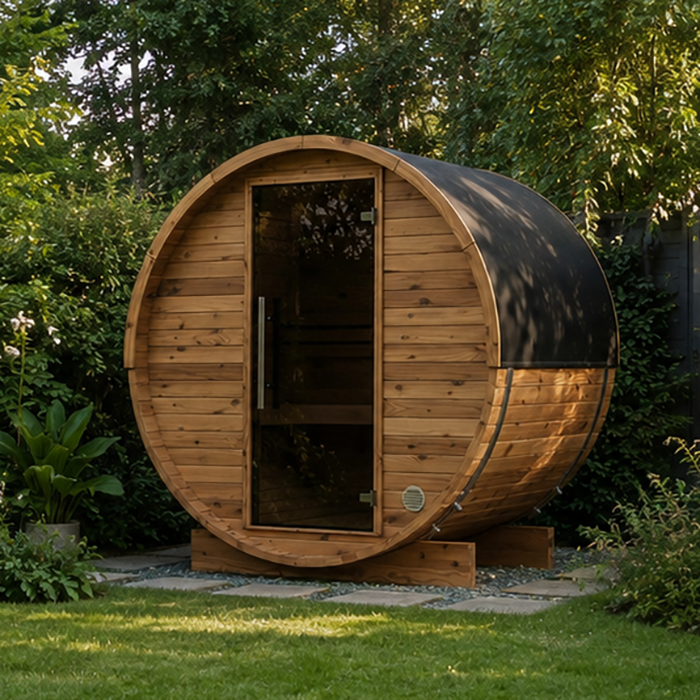
Write down the model code and any differences between the display and the version you are considering. Keep the display label, product page and quotation together rather than assuming that everything you see will be supplied. For example, save the Thermowood Barrel Sauna HCF-300 listing as a reference while asking the dealer to identify the display and explain its configuration. Record which features belong to the quoted model, which are optional and which are for display purposes only. This gives you a clear basis for the rest of the visit: you can assess the features that match and note those you cannot try in person. If the representative cannot identify the display, record that as an unanswered question instead of relying on a general description.
Try the doorway and entry route
With permission, approach and enter the display as you would at home. Notice whether you can reach the handle comfortably, open the door without having to move awkwardly, step across the threshold and turn once inside. Check how much clear floor space the open door occupies and whether another person can wait nearby without blocking the route. If the display door is locked or staff do not allow visitors to use it, do not force it; ask for the clear opening dimensions and a drawing that shows the door position.
Consider the needs of everyone who is likely to use the sauna rather than treating your own experience as a guide for the whole household. If someone finds narrow openings, steps or turning space difficult, include them in the assessment where possible. Ask for the clear opening width and height, threshold detail and space required to open the door in the selected configuration. If you are considering the Thermowood Barrel Sauna S-140, keep those measurements beside its model details in your notes. Distinguish the clear passage through the doorway from the overall door dimensions, and note any part of the approach you could not assess at the display. Explain the particular access difficulty to the representative rather than asking only whether entry is easy. Leave any changes to the proposed access arrangement to the manufacturer or installer.
02
Assess the benches while seated
If staff allow you to sit in the display, try the positions your household would actually use. Check whether you can sit upright without feeling cramped, where your knees and feet rest, and whether getting into or out of each position feels manageable. If there is more than one bench level, assess each one rather than judging the whole interior from the doorway. Think about the usual number of people using it together and whether they can sit without crowding one another. Do not assume that a stated capacity or a photograph guarantees the same sense of space for every group.
Look at how the bench layout affects movement as well as sitting: can a person turn or shift position without awkwardly negotiating around someone else? Ask for the bench dimensions and internal measurements for the model you intend to order; showroom furniture can differ from the quoted arrangement. If the Thermowood Barrel Sauna LCF-300 is on your shortlist, compare its proposed bench layout with the positions you have tried. Note which seat you assessed, whether your back felt supported and where your feet rested, rather than writing only that the seating was comfortable. If you could not try a position, leave it unassessed in your notes. This keeps a brief test of one seat from becoming an assumption about the whole interior.
Measure the sauna and your site
Ask for a drawing that gives the overall external width, depth and height, along with internal usable dimensions, doorway opening and bench measurements. Compare those figures with what you can observe, but do not assume that measurements taken from a display fully describe the model being quoted. Note the position of the door and any features that affect how the sauna can be placed. A stated area figure on the Thermowood Barrel Sauna HC-150 listing is one useful catalogue detail, not a substitute for a dimensioned plan. Label your own measurements separately from the supplier’s figures, including the points you measured between. If the two sets of figures appear different, ask the representative to explain what each measurement includes before using either on your site sketch.
Measure the intended site and the route to it, including gates, corridors, turns and height restrictions that may affect access. Sketch the position of nearby walls, fences or other fixed features, and note where you expect the door to open. Ask the supplier how the unit will be delivered and what access the chosen delivery method needs; do not guess based on the showroom route. For the base, clearances and any ongoing access for inspection or maintenance, use the model-specific instructions and ask the relevant installer to assess the site. A display floor cannot confirm that your location is suitable.
03
Check the heater and utility details
Treat equipment on the display as something to identify, not as proof of what is included. If a heater, controller, light, guard or other component is visible, ask for its make and model and whether it forms part of the configuration being quoted. Do not touch equipment or operate controls unless showroom staff explicitly say that it is safe. A display may have a different arrangement from the one you are considering, so note where the equipment sits and ask whether that position is fixed or depends on the selected model or options.
Request the manufacturer’s current documentation for the exact heater and control arrangement, including the stated supply requirements and clearances. Ask which components are included and which, if any, are separate choices; have the written quotation reflect the answer. When discussing the Thermowood Barrel Sauna HC-225, keep the proposed equipment details alongside the sauna model code so that you can distinguish the cabin choice from the equipment selection. If the display uses different equipment, ask which aspects of the arrangement you can meaningfully compare and which remain unassessed. You can also ask staff to explain the controls without operating them yourself. Leave electrical and installation decisions to an appropriately qualified professional working from the correct documentation, not from a quick look at a showroom display.
Inspect visible finishes and ask about care
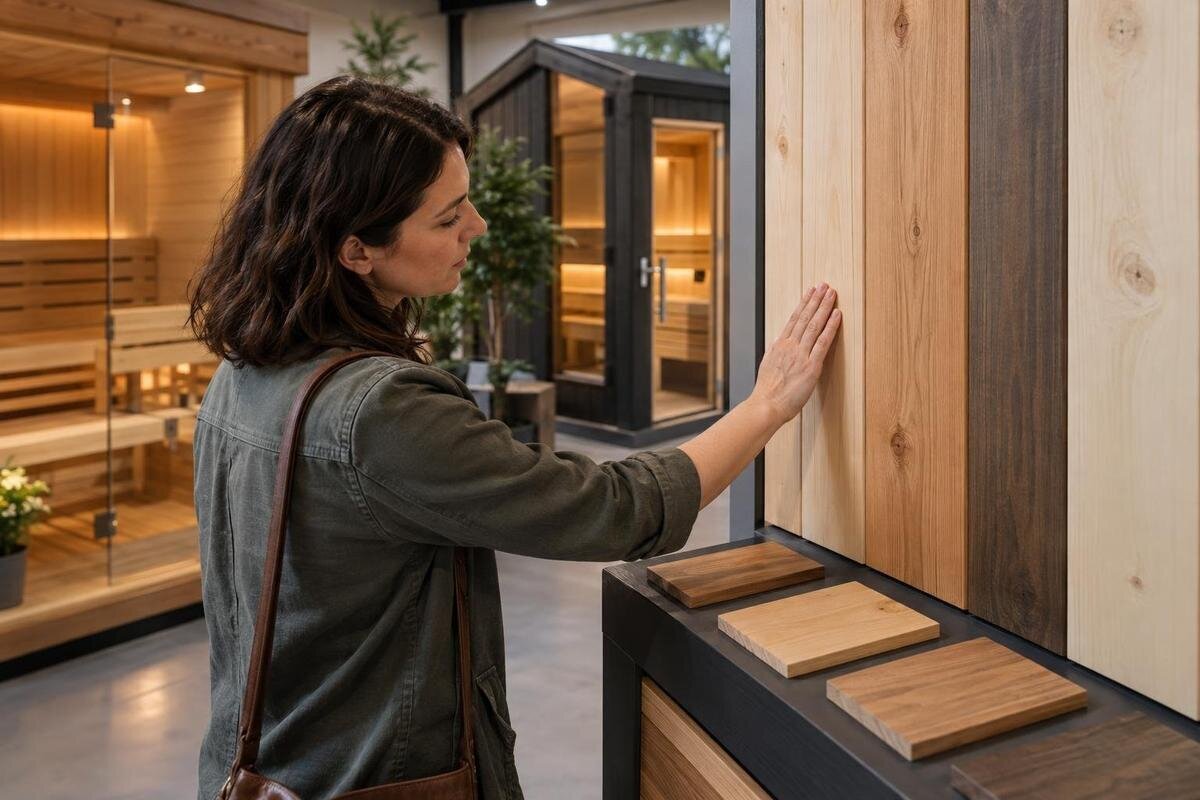
Look over the parts you can see at both a normal viewing distance and close range. Note any rough edges, visible gaps, marks, uneven-looking joints or differences in finish, and ask staff whether these relate to display wear or are typical of the product. If you want to touch a surface, ask first. Check the areas you will regularly handle or sit against, as well as visible door fittings and bench connections. Your observations are useful prompts for questions, but a display alone cannot establish how a finish will look after installation or what variation the manufacturer considers acceptable.
Ask which materials and finishes are used on the exterior, interior and seating surfaces, and request the relevant care instructions. The answer may need to cover more than one surface: do not assume that an exterior description explains the treatment of benches or other areas people touch. When viewing the Thermowood Barrel Sauna N-210, organise your care questions by surface so that the answers are easy to follow later. Ask what cleaning and maintenance the instructions specify, and whether any visible display treatment is part of the supplied configuration. If a mark or finish concerns you, identify its location precisely and ask how the care guidance addresses it. Keep that answer separate from your assessment of its appearance; liking a finish and understanding its upkeep are different buying considerations.
04
Assess sightlines, light and privacy
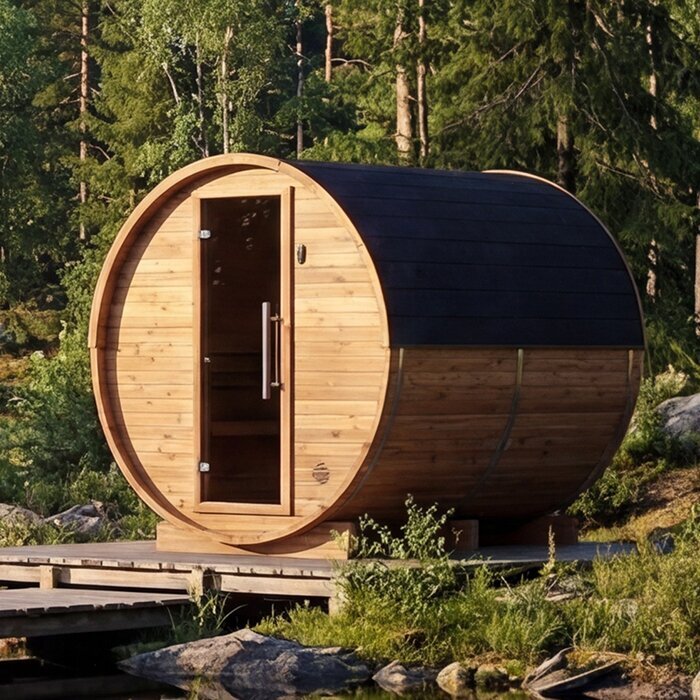
Think about what you would see from inside the sauna and who might see in. The display’s position in a showroom may bear little resemblance to the view from your planned site, so picture the windows and door facing the direction you have measured. Consider neighbouring windows, paths and other places where people may pass. If privacy matters to you, ask which parts of the layout can be changed and whether a particular window position or covering is available for the exact model. Do not assume that a display’s setting, or a photograph of a product, proves how it will look in your garden.
If the display has lighting, look at its position and ask whether it is included in the configuration being quoted. Operate a switch only with staff permission, and note whether the arrangement you see is standard or an option. If the Thermowood Barrel Sauna N-250 is on your shortlist, ask which window and lighting arrangements are available for that version. On your site sketch, mark the direction you would face when seated and the views through the proposed glazed areas. Keep privacy preferences separate from lighting preferences: you may like the display’s interior light but want a different outlook at home. Where the showroom cannot reproduce your setting, record the question rather than treating the display as a test of privacy at your site.
Request model-specific documents
Ask for documents that match the full model code and the configuration you are considering. Useful items include a current dimensioned drawing, the manufacturer’s assembly and installation instructions, an equipment specification, operating guidance and care instructions. If a heater is part of the proposed setup, ask for its own relevant documentation as well. Check that the model name on each file matches the display or quotation and ask whether the document is current. A general brochure can introduce a product range, but it may not answer questions about the exact version you tried.
Ask for a written list of what the quotation includes and excludes, including any options or equipment you discussed at the display. For the Thermowood Barrel Sauna LC-260, keep this list with the documents for the quoted configuration. Check that any alternatives discussed are clearly distinguished from the version priced, so you do not compare one model’s drawing with another configuration’s inclusions. If a site condition, clearance or connection needs professional review, note the specific question and which instruction addresses it. Ask who will provide any outstanding answer and how you will receive it. You do not need to resolve every technical point on the showroom floor, but you should leave knowing which questions remain open and which information is needed to answer them.
05
Record observations so you can compare fairly
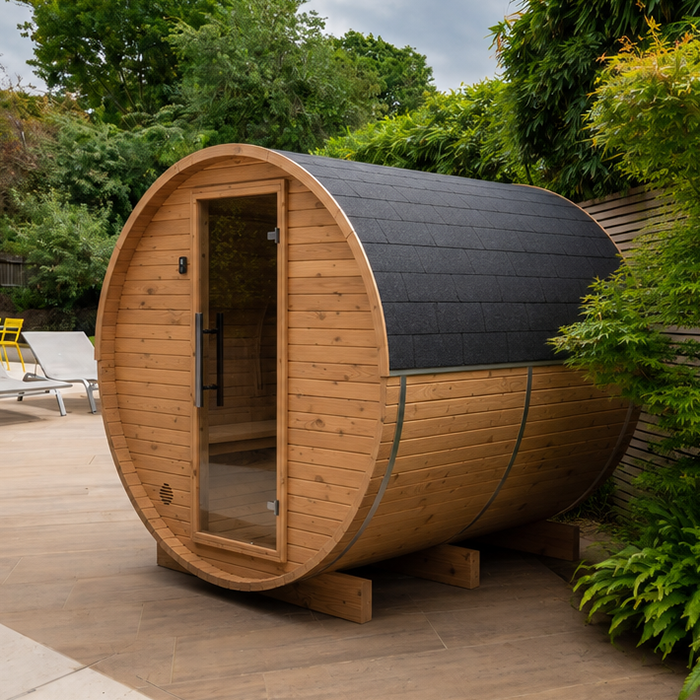
Make a short record while you are still at the display. Note the date, exact model code, visible options, door and bench layout, and anything you actually tried. Keep observations separate from what a representative told you and from details you still need to verify. If photographs are permitted, take them from a few useful angles and label them with the model code; images help with memory but cannot replace dimensions. Record the name or title of any document you receive, so you can tell a current drawing from an older brochure or a photograph of a different display.
Use the same checks at each display you visit. A simple comparison in your notes can distinguish essentials from preferences: entry that works for the intended users, seating that fits the way you plan to use it, dimensions that suit the site, and documents that answer the technical questions. Add a separate list of unresolved items rather than letting them disappear among positive impressions. If two listings or displays have similar names, copy the full model code each time. This gives you a fairer comparison and makes it easier to ask a precise follow-up question.
Decide whether the display matches your planned use
A display can feel different from a sauna in its intended setting. The room around it may be more open, brighter or quieter than your site, and the display may not include the same people, belongings or access route you have in mind. Compare what you tried with your measured plan: the doorway route, space to open the door, seating positions and the outside area needed to approach it. Use the manufacturer’s instructions and a professional site assessment for installation conditions. A showroom visit can help you judge practical fit, but it is not a site inspection.
Separate essential requirements from preferences before weighing up the display as a whole. An entrance that works for the intended users may be essential, while a particular appearance or lighting option may be negotiable. For each essential requirement, record whether you assessed it in person, confirmed it in the relevant documents or still need an answer. Then consider any compromises explicitly: would a different seating arrangement suit your household, or would it undermine the reason for choosing that model? Avoid allowing one appealing feature to outweigh an unresolved practical concern. Your decision should reflect the version you would actually order and the way you intend to use it, rather than the overall appeal of the showroom setting.
Frequently asked questions
Can a product photograph tell me whether a sauna will feel spacious?
Not reliably. A photograph can suggest the broad layout, but camera angle and the display setting can make proportions difficult to judge. Ask for a current drawing with internal and external dimensions, then try the seating and entry in a matching display if one is available.
What should I bring to a sauna showroom?
Take a tape measure, a sketch of the intended site, your own measurements of the access route, and a list of the people who will use the sauna. Keep questions and notes on your phone, and ask before taking photographs. The model code and options on the display are worth recording too.
Which measurements matter most?
Check the overall external dimensions, internal usable space, clear doorway opening and bench dimensions. Also ask what clearance and access the manufacturer specifies for the selected configuration. A floor-area figure alone does not establish those measurements; use the current dimensioned drawing and have site requirements reviewed by the appropriate professional.
Should I test a sauna while it is operating?
Only if showroom staff confirm that the display is operating and explain what visitors may safely do. Do not touch a heater, electrical covers or controls without permission. You can still assess entry, seating and layout when the sauna is not running; ask for the relevant operating documents separately.
What if the display and the quotation do not match?
Ask the representative to identify the quoted model and list its selected options and inclusions in writing. Request the drawing and documents for that exact configuration, and note any differences from the display. Do not treat a showroom feature as included until the written details confirm it.
A useful showroom visit leaves you with more than a first impression. You should know which exact model you tried, what felt comfortable or awkward, which measurements matter at your site and which questions still need written answers. The display helps you judge the parts a drawing cannot; the drawing and manufacturer’s documents help confirm the parts a display cannot.
