
How to Assess Scratches in Greenhouse Powder Coating
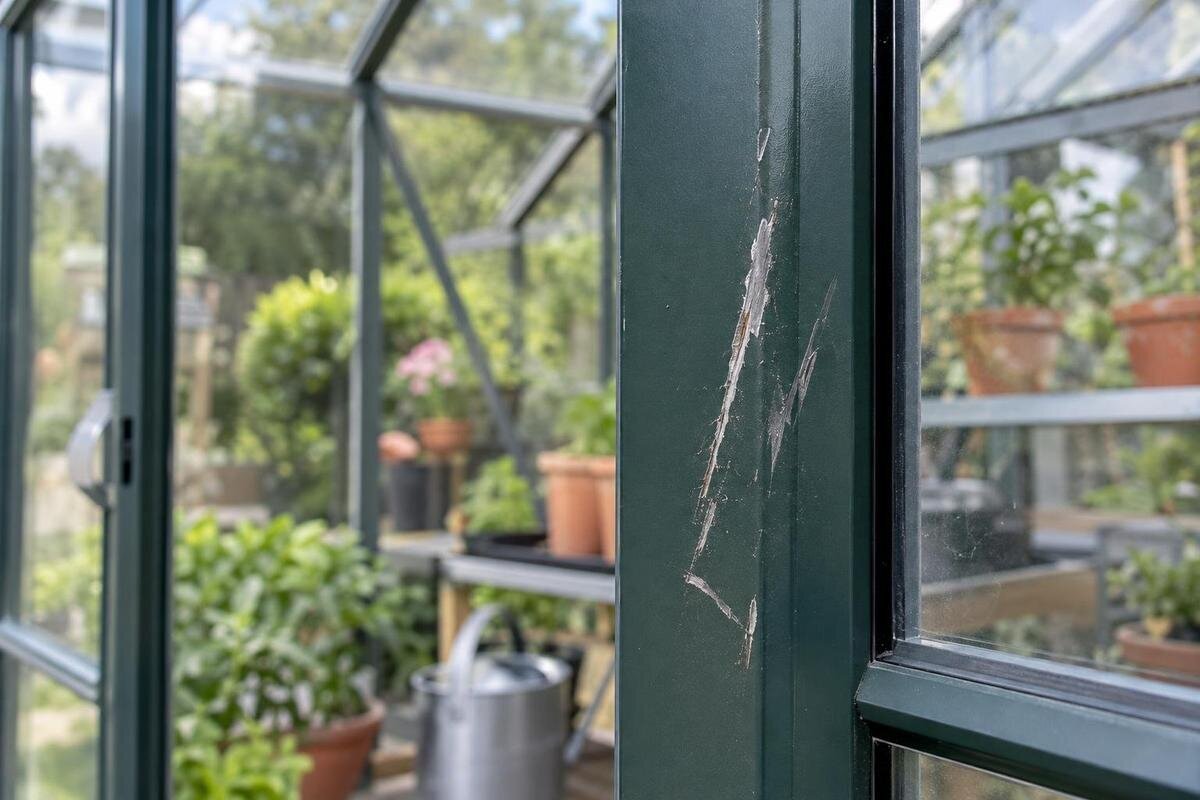
Greenhouse repair guide
Powder-coated greenhouse frames can pick up marks during assembly, routine cleaning or everyday contact, but a visible line does not automatically mean the coating has been cut through. Dirt transfer, abrasion, a change in sheen and exposed metal call for different responses. Before applying paint—or trying to rub a mark away—work out what can be established without damaging the surrounding finish. Then verify the greenhouse’s exact model and the manufacturer’s repair guidance. This guide explains how to assess the mark, record useful details and decide whether approved touch-up, professional advice or a parts enquiry is appropriate.

Identify the greenhouse before choosing a repair
Before considering a coating product, identify the greenhouse as precisely as possible. Record the maker, model or product family, any serial or component number, and the approximate purchase date from the order record or manual. A broad description such as “green aluminum greenhouse” rarely gives enough information to match a finish or repair instruction. A catalogue page for the Bloomcabin Prestige Greenhouse can help you recognize a family name; it does not confirm that an older unit has the same finish, colour or frame revision.
Check the original order confirmation, instruction manual, product label or earlier service email for a model name, finish code, serial reference or part identifier. Photograph any label while it remains in place; do not remove trim or disturb glazing to search for it. Keep the original wording in your notes, even if a current catalogue uses a different title. Separate information taken from your own records from details found on a current product page, so a catalogue comparison does not become an assumed identification. If the order lists several components or finish options, note which description belongs to the affected frame rather than copying the entire order without explanation. If no identifier survives, send support a whole-frame view and a close-up before ordering anything. State which details are unknown, and do not guess a manufacture date from the frame’s appearance.
Clean the area only as the manual allows
Take a photo before cleaning. Dust, potting mix, plant residue, adhesive or transferred material can look like a line in the finish, while grit caught under a cloth can add fresh abrasion. Check the greenhouse’s care instructions for a permitted cleaner and method. If they allow a gentle wipe, follow the stated approach and stop if the mark remains. A close-up and a wider view will record both the surface and its location before any debris moves. After the permitted cleaning, compare the area with the first photo and describe what changed: did the line disappear, become less obvious or remain unchanged? Keep cleaning observations separate from your conclusion about the coating. For example, “some residue came away, but a dull line remains” is more useful than simply calling the area repaired. If you have already used a cleaning product, record its name and the method used rather than repeating the treatment for a clearer result.
Do not reach for steel wool, abrasive pads, sandpaper, blades, metal brushes, solvents, polish or household cleaners unless the manufacturer approves them. A product marketed for aluminum is not automatically suitable for every coated finish; some methods can change the colour or sheen and make the original mark harder to assess. Do not use a pressure washer or strong stream to test whether a line is dirt. If the manual does not cover a cleaner you are considering, leave the surface alone and ask which cleaning method is approved.
Distinguish a scuff from coating loss
A surface transfer may have irregular edges, sit on top of the finish or change after an approved gentle clean. A scuff can leave a dull patch or a slightly shinier streak where the surface has been rubbed, even when no metal is visible. Neither appearance proves what happened: dirt can be stubborn, and a shallow abrasion can catch the light. Describe the visible features before assigning a label. Note whether the mark looks raised, appears to be a groove or is mainly a change in sheen, and whether its edges are clearly defined. These observations give the person reviewing your photos more to work with than the word “scratch” alone. More than one feature may be present in the same area, so do not force an uncertain mark into a single category. If residue will not lift easily, treat the mark as uncertain rather than escalating to stronger cleaners.
Coating loss is more likely when you see a distinct groove, a sharply different colour, a lifted edge, flaking or a bare-looking patch that does not blend with the surrounding finish. A silver or grey glint can suggest visible aluminum, but reflections and shadows complicate a visual diagnosis. Inspect a clean, dry area under even daylight from more than one angle; a phone close-up can help document the edges. Do not probe with a nail, pin or blade, or deliberately enlarge the line. If you are unsure, note that coating loss is possible and ask for guidance.
Map the mark to a specific frame member
Record the mark’s position using a fixed reference, such as its distance from a corner or its position relative to the entrance. Note which frame member appears affected, if you can identify it, and whether there is one line, several spots or a chip. Estimate its length and width so you can compare later; do not treat a particular measurement as a pass-or-fail threshold. A ruler placed beside the mark, rather than on it, can give scale in a photo. For several marks, give each one a simple reference in your notes and use that reference in the photo filenames. Describe the side of the greenhouse and whether the mark is on an inward- or outward-facing surface. A wider photo showing the entrance or a recognizable corner helps someone else locate the same area. This is especially useful when similar-looking frame members appear in several places and a close-up alone gives no indication of which one is affected.
Note whether the mark is near a joint, fastener, door track, glazing edge or another frame member. Do not remove fittings or glazing just to see beneath it. Use the family wording from your paperwork; a current listing, for example, uses the name Aluminum Lean-to Greenhouse. Include that label alongside the member’s location and any part code, since a product-family name alone is not an exact part identifier. Record when you first noticed the mark and whether it has changed.

Record the finish and take useful photos
Look for a finish name, colour code or other coating reference in the original order details, manual or product documentation. Write down the exact wording rather than relying on a visual guess: two finishes that look similar in a photo may not use the same product or colour reference. An aged frame may also look different from a new sample. Ask the manufacturer which identifier applies to your unit before looking for a touch-up product. If your records include both a descriptive colour name and a code, provide both instead of choosing whichever seems more familiar. Include any wording about the finish’s appearance, such as its sheen, if that wording is actually in the records. Do not add a finish description borrowed from a current listing unless it has been confirmed for your greenhouse. When the original colour reference is missing, make that uncertainty clear rather than presenting a photo-based guess as an exact match.
Take one close-up of the mark and another image showing the affected area in context. Use even light where possible, avoid filters, and include a scale beside the scratch without touching it. Keep the date and model details with the pictures. If your paperwork identifies a Limited Edition Aluminum Greenhouse, retain the complete model wording when asking for help. A current product-family listing can help with the name, but it is not a colour chart or confirmation of the finish on an earlier unit.
Check the manual and warranty before repair
Before attempting touch-up, read the owner’s manual, care guidance and warranty document for information about finish damage, cleaning and self-repair. Check whether the instructions ask you to report damage or seek approval before making a change. Requirements vary by product and document, so do not assume a scratch is either covered or excluded. Make a note of any cleaning or treatment already done, including when it happened.
Contact the manufacturer or seller with the model details, finish reference, photos and the mark’s location. Ask whether a touch-up is approved for that exact finish, what product or part number to use, and whether an installer should handle it. Keep the response with your records. A current page for a Classic Aluminium Greenhouse may help you compare a family name, but it does not replace the manual or other documentation supplied with your own unit.
What approved touch-up instructions should cover
Ask for instructions tied to the greenhouse’s exact model and finish, not just a paint colour that looks close. Confirm that the proposed product is approved for the type of mark you have and ask what preparation, tools and application method are permitted. The instructions should also explain any relevant drying or curing conditions and how to protect nearby materials. Those details depend on the approved product; there is no universal preparation sequence or application window for every greenhouse coating. Before starting, read the instructions as a complete procedure rather than treating the product name as sufficient guidance. If a preparation step or application term is unclear, ask what it means for your particular mark instead of substituting a familiar painting method. Also ask what appearance to expect after touch-up and whether any difference in colour or sheen is anticipated. This separates the question of an approved repair from the question of how closely it will resemble the surrounding finish.
Before ordering, confirm the product name or identifier, the matching finish reference and whether the instructions cover your particular damage. Ask whether a small touch-up is appropriate or whether the manufacturer recommends a different remedy. In your enquiry, give the full model name—for example, the paperwork may identify a T-Shaped Orangery Greenhouse—rather than asking for generic greenhouse paint. Do not substitute spray paint, automotive touch-up or a primer unless the manufacturer approves it for your finish.
When an installer should assess the frame
Ask the manufacturer or an installer to assess a mark if you see flaking, blistering, corrosion, several areas of coating loss or a scratch that is getting larger. Also report a dent, bend, movement or other change in the frame, especially near a joint or glazing channel. These signs do not prove structural damage, but they are reasons not to treat the issue as a simple cosmetic touch-up without further review.
Do not sand, grind, drill or reshape a frame member, and do not remove glazing to reach a scratch. If safe access would require handling glass or dismantling part of the greenhouse, ask a qualified installer to review it. Include the exact model wording in that request; if your records name a Bloomcabin Oasis Pyramid Greenhouse, provide that title as well as the damaged member’s location. The product name helps identify the family but does not establish whether a particular part can be repaired.

When a spare part or replacement is worth discussing
A small, isolated surface scuff and confirmed coating loss are different repair questions. For a scuff, establish whether any coating repair is needed rather than assuming every visible mark needs paint. For confirmed coating loss, ask whether an approved touch-up is suitable for that specific area. If the assessment points to a component problem, discuss the component itself before considering replacement of the whole greenhouse. Keep these options separate when requesting advice: leaving an intact finish alone, touching up an approved area and replacing an affected part are not interchangeable remedies. Ask what each proposed option is intended to address, whether it concerns appearance, the affected coating or the component’s condition. The appearance of the finish alone cannot tell you whether a component needs attention or whether a broader repair is appropriate. A clear explanation of the recommended remedy helps you decide what to order without turning a minor finish enquiry into an unnecessary replacement purchase.
For a parts enquiry, request the exact spare-part identifier and ask whether it matches your model and version. Do not assume that a frame member is available separately, that an old and current part are interchangeable, or that replacement can be done without an installer. If the manufacturer or installer says repair is not a suitable route, you can compare replacement options; a page such as Bloomcabin Orangerie Spacious Greenhouse is a current catalogue reference, not confirmation of fit or suitability for your site.
Prevent new scratches during care and use
Reduce avoidable contact with the frame during routine greenhouse work. Keep hand tools, pots, ladders and other hard items from rubbing along the rails, and avoid dragging equipment against the finish. Do not attach a support or clamp to a frame member unless the manufacturer’s instructions allow it. When cleaning, use only the approved method and avoid abrasive materials that could create fresh marks while you are checking an older one.
Keep a simple record of the model, finish reference, any approved repair and the date it was completed. At later inspections, compare photos taken from a similar angle and note any change rather than repeatedly rubbing the spot. Keep the original assessment photos alongside the repair record so you can distinguish the earlier mark from a new one. If touch-up was used, retain its product identifier and the instructions followed; this avoids having to reconstruct the repair from memory during a later enquiry. If your paperwork names a Limited Edition Aluminium Greenhouse with Built-In Storage, retain that full designation with the care record. Use the matching manual for cleaning and maintenance instructions. When passing the greenhouse on to another owner, include these records with its documentation so the model, finish and repair history remain available rather than being reduced to an uncertain colour description.
Frequently asked questions
Can I use automotive touch-up paint on a greenhouse frame?
Only if the manufacturer confirms that it is suitable for the exact finish on your greenhouse. A colour match alone does not establish compatibility, and a liquid paint may not match the original coating. Ask for the approved product name or part number and instructions before ordering or applying anything.
How can I tell if the coating has been scratched through?
A distinct groove, flaking edge or bare-looking patch can suggest coating loss, but reflections and lighting can make visual diagnosis difficult. Photograph the area after any cleaning permitted by the manual. Do not scratch or probe it to test; ask the manufacturer or an installer if you are unsure.
Should I sand or prime an exposed-looking area?
Do not sand or prime unless instructions for your exact greenhouse and finish specifically call for it. Abrasion can alter the surrounding coating, and a general-purpose primer may not be approved. Ask the manufacturer for the correct preparation method before attempting a repair.
Does a small scratch mean I need a new greenhouse?
No. A finish mark by itself does not establish structural damage or mean the greenhouse needs replacing. If the coating is flaking, the mark is spreading, or there is nearby bending, movement or damage, ask an installer to assess it and advise whether a touch-up, part or broader repair is appropriate.
Can I match the colour from a photo or online image?
Use the finish name or colour code in your original paperwork and ask the manufacturer to confirm the match. Screen settings, lighting and the age of the existing finish can affect how colours appear in photos. Images help show the damage and its location, but are not enough on their own to choose a touch-up.
A scratch’s appearance can guide your next check, but it cannot identify the greenhouse, confirm a breached coating or establish that a particular repair is compatible. Preserve the evidence, record the model and finish, and follow the manufacturer’s approved procedure. A superficial mark may need no coating repair; confirmed coating loss may call for approved touch-up, a matched component or installer assessment. Keeping those distinctions clear makes the repair decision—and any parts enquiry—more reliable.
