
Heated Propagator or Heated Greenhouse for Seed Starting?
SEED STARTING
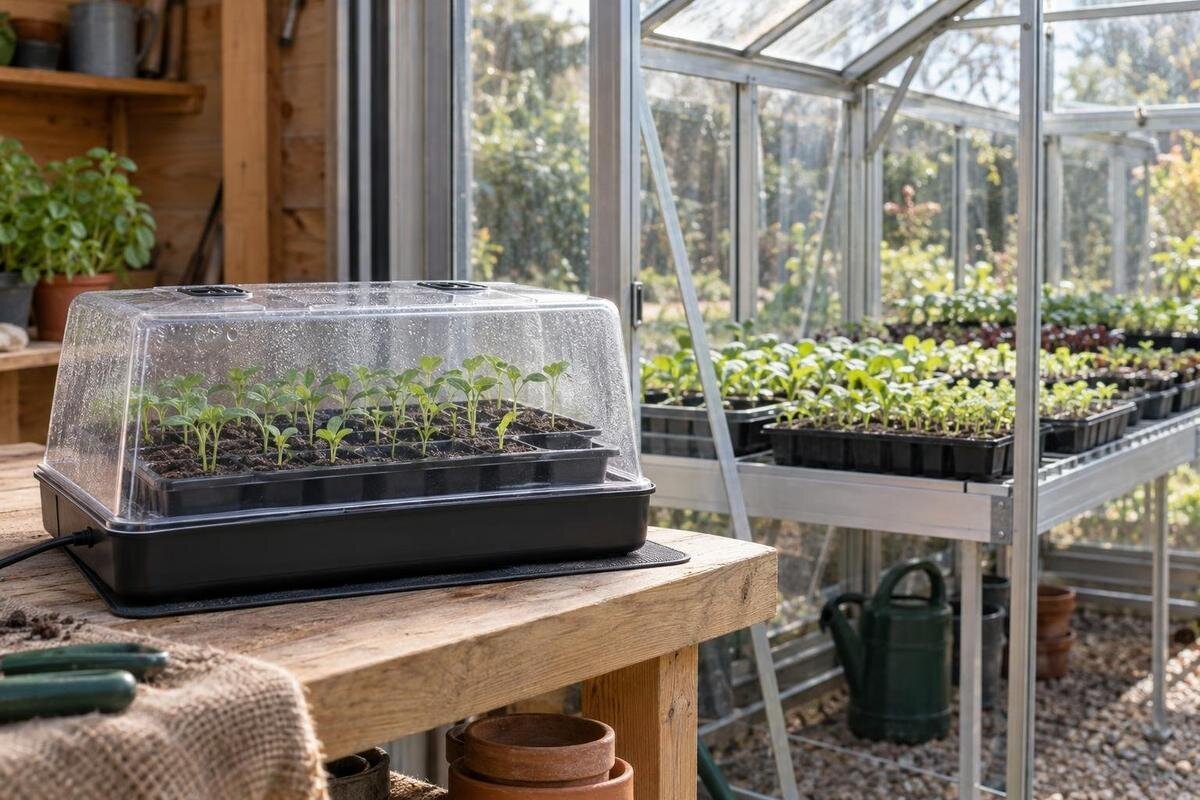
Starting seeds calls for warmth at the seed zone, but that does not automatically mean heating a whole greenhouse. A heated propagator confines warmth to one or a few trays; a heated greenhouse manages a much larger space and may also provide the environment for growing on. The better fit depends on how many batches overlap, what each crop needs after germination, and how much heat the surrounding space loses. Compare usable tray capacity, controls, likely operating time and the space seedlings need next. A greenhouse structure by itself does not establish that a heater, thermostat or propagation bench is included.

Heated trays versus a heated greenhouse
A heated propagator warms a small, defined area around seed trays. Depending on the design, heat may come from a base or a separate mat, and a cover may help retain warmth and moisture. A heated greenhouse is a room-scale approach: a heater is used to manage air temperature across the structure rather than only the growing medium in one tray. Both may use a thermostat, but the size of the warmed zone is the key distinction. Neither supplies every growing condition; seeds still need suitable moisture, and seedlings need appropriate light, airflow and care.
Use the temperature guidance for each crop to decide where warmth is needed. If a few trays need a warm start and can later move to a bright, suitable spot, heating only those trays avoids warming unused greenhouse space. If many batches must stay in the greenhouse, heating the whole space may support both germination and subsequent growth. Some growers use both: local heat for germination, then a heated greenhouse for seedlings whose needs match the conditions there. Compare the area that needs warmth and how long it will be occupied, rather than choosing whichever device sounds more powerful.
When a heated propagator is enough
A propagator is often the straightforward choice when the batch is small, the required warmth is localized and there is a suitable place for the unit. It keeps the heated zone close to the trays, so you do not need to bring an entire greenhouse to a germination temperature for a handful of seeds. Keeping trays together can also make it easier to check moisture and emergence. The limit is physical capacity: once the heated base is full, extra trays need another suitable warm area or a different arrangement. Check the unit’s instructions if it will be used in a particularly cool room or greenhouse.
Do not judge fit from cell count alone. Measure each tray’s outside dimensions, confirm that it fits on the heated surface, and check whether a lid, thermostat or temperature sensor is included or sold separately. A control may measure the base rather than the growing medium, so follow its instructions and verify conditions at the tray. Compare complete setups: a unit that needs separate controls should not be assessed as though those controls were already included. If a greenhouse is your alternative, the Lean-To Greenhouses range is listed in sizes from 3.69 m² to 14.34 m². Use that range to compare the scale of the enclosure with the small area occupied by your trays. Usable bench space and heated capacity still depend on the layout, access and other planned uses.
When heating the greenhouse makes sense
Heating the whole greenhouse becomes more plausible when several sowings run at once, the number of trays exceeds a compact propagator’s footprint, or young plants need to remain in that protected space after germinating. It may support a broader growing schedule rather than one short germination window. Before treating the greenhouse as one warm room, consider whether every part needs the same conditions. An aisle, an empty end or a storage area still sits within the enclosure, and a thermostat near the heater may not describe the temperature at every bench.
Listed greenhouse area can help frame the scale, but it cannot predict how many trays will fit or how much heat the structure needs. The Limited Edition Aluminum Greenhouses listing spans 3.77 m² to 28.08 m². Compare the space your crops will occupy with the full enclosure you would heat, including areas used for access or other tasks. Then consider how consistently that growing space will be occupied: several overlapping sowings make a different case from one tray used briefly. The listed sizes do not specify benches, heating equipment or temperature uniformity. Whole-greenhouse heating is easier to justify when several batches or other planned uses benefit from the managed conditions, rather than when most of the warmed space would remain unused.
What greenhouse heating needs to control
Work out whether the goal is to warm the growing medium, the greenhouse air, or both. Localized base heat warms a tray zone, while a greenhouse heater acts on a much larger air volume; those temperatures can differ. Sunlight may raise daytime air temperature, while the structure can cool after dark. Conditions can also vary between a bench near a door and a more sheltered position. Check the temperature at seedling height, and use a thermometer that suits the air or growing medium you need to monitor. A thermostat display may show only the conditions at its sensor.
Temperature guidance should come from the seed supplier or a reliable, species-specific growing guide; there is no single germination temperature for every crop. If you are comparing structures, the T-Shaped Orangery Greenhouse range is listed from 16.52 m² to 30 m². Assess the structure and heating equipment separately, since these area figures do not establish heat retention or heater size. Follow the thermostat maker’s directions for sensor placement, and monitor during both bright daytime periods and cold nights. Keep air and growing-medium readings clearly labelled when recording them, so you compare like with like. Note where each reading was taken as well: a measurement beside the heater answers a different question from one at a seed tray. This helps distinguish the thermostat’s reading from the conditions your crops actually experience.

Compare energy use, not just wattage
Heating a smaller zone will often use less energy than heating a whole greenhouse, but actual consumption depends on how cold the space is, its heat loss, the target temperature, the controls and how long the heater runs. A propagator with a modest rating can still operate for many hours; a larger heater may cycle rather than run continuously. For that reason, comparing maximum wattage alone can mislead. The difference between rated input and real operating time matters, as does whether the equipment is maintaining warmth overnight or only during a short spell.
Use a compatible energy monitor where the equipment is suitable for that kind of monitoring, or compare meter readings over similar periods. Do not assume a heater draws its full rated power every hour. Estimate cost from observed kilowatt-hours and your own electricity rate rather than a generic rate. Record the duration of each comparison, the target temperature and whether you were heating trays or the whole enclosure. Otherwise, a short germination trial and a longer seedling-growing period are not equivalent comparisons. The Pyramid Greenhouse catalogue lists area options from 5.53 m² to 18.9 m², but area alone cannot produce an energy estimate. You also need actual heater use under the intended conditions; readings from a mild, sunny day may not represent a colder stretch.
Check tray capacity against the heated area
Capacity means the number of trays that can receive suitable warmth at the same time, not the headline area of a greenhouse. For a propagator, compare tray dimensions with the heated base and any covered space. For a greenhouse, measure usable bench surface and consider where the heating system can maintain suitable conditions. A large floor plan does not become propagation space if much of it is needed for access, storage or other tasks. Leave room to check and water trays without making the heated area difficult to reach.
Plan for the busiest overlap in your sowing schedule rather than the number of trays on the first day. An earlier batch may still need warmth when the next one is sown, and emerged seedlings can occupy bench space after they no longer need a covered propagator. Keep those two demands separate in your comparison: space on a heated base and space for growing seedlings are not interchangeable. A tray leaving the propagator frees its heated surface, but it still needs somewhere suitable to go. The Limited-Edition Aluminum Greenhouses with Storage listing covers 5.52 m² to 28.08 m². These figures describe greenhouse area, not tray capacity. Assess the intended storage, work surfaces and aisles alongside the benches rather than counting the entire enclosure as available growing space.
Seedlings need different care after germination
Conditions that help a seed germinate are not automatically right for the seedling that follows. After emergence, plants need enough light and suitable airflow, and their temperature preferences depend on the crop. A covered propagator can retain humidity, so follow the seed guidance for ventilating or removing the cover rather than leaving it sealed indefinitely. Review plants as they develop: if they have emerged, they may not need the same warmth as they did before. A heater will not fix inadequate light, and a bright greenhouse can still become cold overnight.
Plan the destination before sowing: will trays move to an indoor shelf, an unheated part of the greenhouse or a separately heated growing area? Make that move according to crop needs and measured conditions, not just the date of emergence. Compare the destination with the propagator in terms of temperature, light, airflow and space, rather than warmth alone. This also clarifies what the greenhouse is expected to provide: a place for germination, a place for subsequent growth, or both. The Bloomcabin Prestige Greenhouse is listed in sizes from 3.77 m² to 28.08 m². Its usable growing area depends on the interior layout and benches; the listing does not establish lighting, heating or bench specifications. Include those requirements in the comparison rather than treating the structure as a complete seedling-growing setup.
Plan around your sowing season and local conditions
A single sowing calendar will not suit every location or crop. Work back from the conditions a seedling can tolerate when it is planted, then consider how long each batch is likely to occupy the warm area. Use the seed packet and trusted local growing guidance for sowing and planting timing. A greenhouse may heat up in sunlight and cool overnight, so a mild afternoon reading is not enough evidence that it can maintain suitable conditions. Check the space at the times when the trays will actually be there.
Decide whether heat is needed for germination alone, for overnight protection, or for a longer growing-on period; these jobs may call for different equipment and schedules. Mark the expected start and end of each heating period alongside your sowing dates. This makes it easier to see whether the greenhouse would be heated for one brief batch or used throughout a longer stretch of seedling care. A large structure is not automatically economical to heat for a few trays. For scale, the Spacious Greenhouse listing ranges from 47 m² to 70 m². That area does not indicate heating performance, but it highlights the importance of comparing the duration and extent of heating with the growing space you will actually use.

Check what the heating equipment includes
Read the equipment specifications as closely as the greenhouse listing. For a propagator, confirm whether a heated base, clear cover, trays, thermostat and temperature sensor are included, and whether separately purchased parts are compatible. Check the maximum tray dimensions and the control method; do not assume a basic heat mat has the same function as a thermostatically controlled propagator. For whole-space heating, identify the heater, controls, power input and the conditions it is intended to operate in. A greenhouse structure alone does not establish that any of these items are supplied.
Check that equipment is intended for the greenhouse environment and use it according to the manufacturer’s directions. Do not treat an ordinary room heater as greenhouse-ready simply because it produces heat; moisture and temperature swings matter. Permanent wiring or changes to an electrical circuit should be assessed and completed by a qualified professional, not improvised from an online guide. When comparing purchases, separate the structure, heating equipment, controls and monitoring equipment so that missing components are easy to identify. The Aluminum Greenhouses listing spans 3.77 m² to 28.08 m², but these size options do not establish a heater’s electrical requirements or show that heating equipment is included. Compare what each proposed setup actually contains, not just its headline size or heater rating.
Choose the setup that fits your batch size
Before choosing, write down how many trays need warmth at the same time, the crops’ germination and post-emergence requirements, the space available after sprouting, and the likely duration of heating. Compare those needs with the propagator’s actual heated footprint or the greenhouse area that would need to be kept warm. If you already have a greenhouse, check conditions where trays will sit during cold nights and bright daytime periods. That gives you a better baseline than the structure’s outside dimensions alone.
Choose a heated propagator for a small batch when its trays fit the heated surface and a suitable growing-on spot is available. Consider greenhouse heating when multiple trays need a shared, managed environment and the space being heated will be useful. Use both when local germination heat and greenhouse conditions serve different stages of your growing plan. For some setups, a propagator on a greenhouse bench may be more practical than heating the full structure. The crop, schedule and measured conditions determine which option makes sense.
Frequently asked questions
Can I use a heated propagator inside an unheated greenhouse?
Yes, provided the propagator is intended for that location and can operate within the surrounding conditions specified by its manufacturer. It heats a limited area around the trays; it does not warm the greenhouse itself. Check conditions at the growing medium, including overnight, rather than assuming a warm afternoon is enough.
Is a heated greenhouse always more expensive to run?
Heating a larger enclosure can use more energy, but the difference depends on outdoor temperatures, heat loss, the target conditions, controls and operating time. Compare actual energy use over similar weather periods where possible. A heater’s wattage rating alone does not tell you its running cost.
Do I need a thermostat for seed starting?
Check whether the propagator has an integral thermostat or needs a separate compatible control. For greenhouse heating, a thermostat can help manage the target air conditions, but one reading may not represent every bench. Use crop-specific guidance and check the temperature where the trays will sit.
Should seedlings stay on propagator heat after they sprout?
Not automatically. Germination and seedling growth can call for different temperatures, and emerged plants need suitable light and airflow. Follow crop-specific guidance on reducing heat and ventilating or removing a cover. Do not leave the propagator at its germination setting simply because seedlings are still in the tray.
How do I compare propagator capacity with greenhouse capacity?
Count the trays likely to need warmth at the same time, measure their outside dimensions, and compare them with the propagator’s heated surface or the greenhouse’s usable bench area. Include overlapping batches and seedlings that remain after germination. Listed greenhouse area is not the same as bench capacity or uniform heating.
Choose the smallest heated zone that can reliably serve the full batch and its next stage. A propagator can start a few trays without warming a greenhouse; whole-space heat becomes more compelling when many trays share that area and need managed conditions. In either case, use crop-specific guidance, check temperatures where the seedlings sit, and compare energy use from real operating conditions rather than a heater’s headline rating.
