
What Does It Cost to Heat a Greenhouse in Canada?
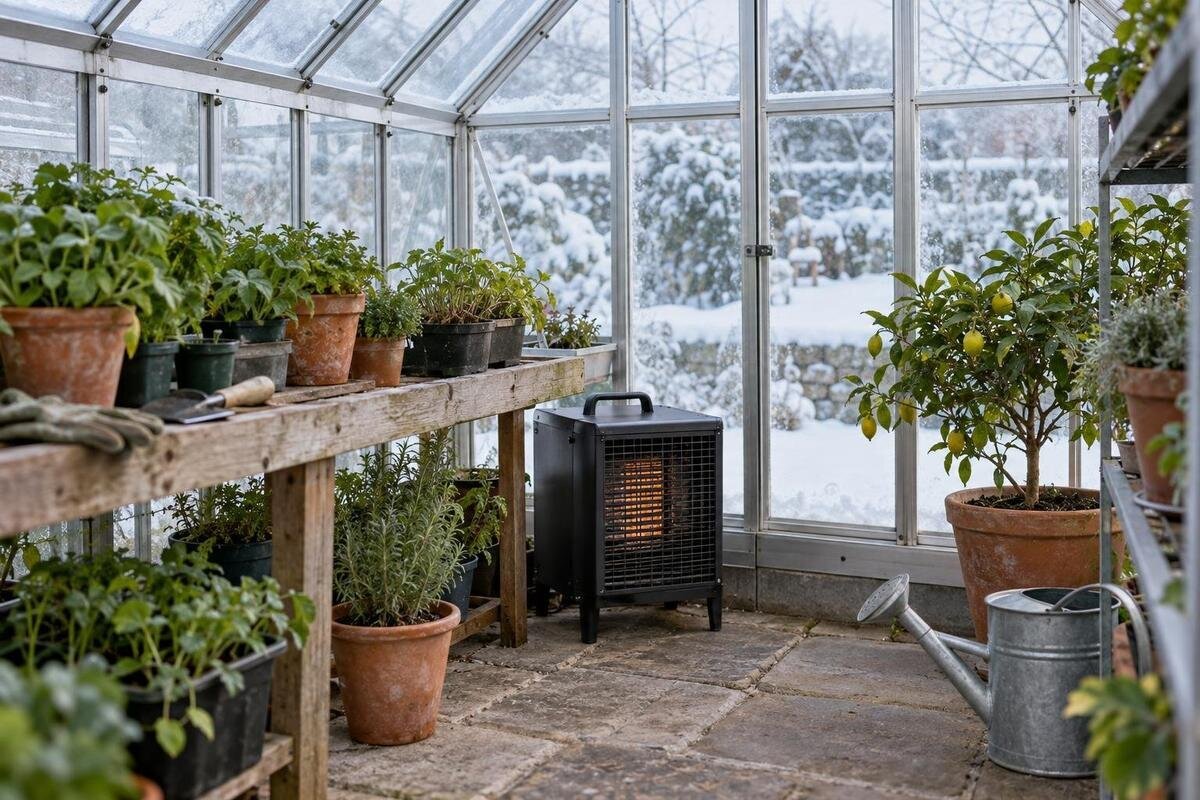
Greenhouse heating costs
Greenhouse heating costs in Canada are not a single monthly figure: local winter weather, indoor target, the greenhouse’s heat loss, heater performance and your electricity plan all change the result. A useful budget makes each input visible. Estimate the heat escaping from the actual heated envelope, apply local temperature differences over time, convert heat demand into purchased energy, and use the variable rate on your own bill. The worked example below is deliberately hypothetical, so you can replace its assumptions instead of mistaking it for a quote.

What determines a greenhouse heating bill?
A greenhouse heating bill is the cost of replacing heat that escapes over time. Its main inputs are the difference between the indoor target and outdoor temperature, the hours that difference persists, exposed envelope area and heat-transfer performance, air leakage, and any relevant floor or ground losses. Wind, open vents, door traffic and sunlight can shift actual use away from a simple monthly average. Two structures with the same floor area can therefore have different heat demands. The heater determines how much purchased energy is needed for each unit of useful heat, while the electricity or fuel tariff determines the dollar cost. Floor area is a scale clue, not a cost estimate.
Set the time window before calculating: a cold night, a representative month or the whole heating season. Count energy for greenhouse heating and any controls or circulation equipment you intend to include, keeping unrelated household loads separate where possible. Apply the variable charge for each additional kilowatt-hour, including per-kWh delivery charges and applicable taxes. Include fixed charges only if the greenhouse triggers a new charge, and budget separately for equipment and installation. If household use cannot be separated, describe the result as a modelled estimate rather than a bill-confirmed cost. A seasonal energy estimate does not establish whether the heater can maintain the target during the coldest hour.
Estimate heat loss from the greenhouse envelope
Use a heat-loss coefficient, H, in watts per kelvin (W/K), to summarize the greenhouse envelope in a steady estimate. The transmission term is the sum of U × A for each roof, wall, door and other surface, where U is the relevant heat-transfer value in W/(m²·K) and A is area in m². Add allowances for frames, junctions and other thermal bridges, and treat ground loss separately if it matters for the actual base. A rough air-exchange term is 0.33 × air changes per hour × enclosed volume in m³, also in W/K. The 0.33 factor is approximate; use an air-change assumption only if it has a defensible basis. Keep H separate from the temperature difference: it represents heat loss per degree, not the load for a particular hour.
Request dimensions and thermal information for the exact configuration instead of using a model name or footprint as a proxy. The Bloomcabin Prestige Greenhouse range is listed from 3.77 m² to 28.08 m²; those catalogue areas identify the available scale, not H for one selected structure. A useful calculation still needs the chosen roof and wall areas, height, cover data, doors, joints, vents and a defensible air-exchange assumption. If reliable values are missing, carry low and high H cases through the rest of the model. State which assumptions differ between them. An interval built from named inputs is more useful than a precise-looking total based on guessed glazing or leakage.
Use the actual shape and heated boundary
Use the outside surface area and enclosed volume, not only the floor dimensions. A tall structure may have more wall area and air volume than a low one with the same footprint; gables, returns and projections also change exposed area. Transmission loss follows surface area, while the air-exchange term depends partly on volume, so a cost-per-square-metre shortcut can hide both. The T-Shaped Orangery Greenhouse range is listed from 16.52 m² to 30 m², but floor-area figures alone do not give the selected configuration’s roof and wall area or heat-loss coefficient. Use its actual dimensions and outline for the estimate rather than assuming shape or area gives a thermal rating.
Define the heated boundary before counting surfaces. The temperature beyond a wall depends on whether it faces winter air, a heated house, an unheated garage or another greenhouse. For a shared wall, use a suitable heat-transfer value and the adjacent temperature rather than treating it as either fully exposed or perfectly insulated. Where zones have different targets, account for heat moving between them as well as outward loss. Decide whether connecting doors stay open and whether a vestibule is heated. Include storage or work space according to its actual temperature and air connection.
Use documented cover values and leakage assumptions
Treat the cover assembly as a measured input, not a guess based on a material label. Use a heat-transfer value that matches the surface and assembly being modelled; a centre-of-panel glazing value may not include frames, seals, doors or junctions. Where documentation gives separate values, apply each to the matching area instead of using one number for the entire greenhouse. Air leakage is another term and is not automatically included in a glazing value. Open vents, frequent door access and worn seals can make use differ from a steady-state calculation. Keep normal ventilation needed for growing distinct from accidental leakage in your assumptions. Do not count an open vent both as a covered surface and as a separate opening without checking how the calculation treats it.
Product names and frame materials are not thermal specifications. The Aluminum Greenhouses range is listed from 3.77 m² to 28.08 m², but that footprint does not establish a U-value, cover configuration, airtightness or seasonal energy use. Check thermal data for the exact version and options, including what each value covers. Compare complete envelope details rather than assuming similar frame materials mean similar performance. If values are unavailable, identify the missing inputs in your estimate and show how different assumptions affect the result.

Calculate temperature-difference hours for your location
Use temperatures for the greenhouse’s location and the period you are pricing, not a Canada-wide winter number. Environment and Climate Change Canada climate normals can supply a representative monthly average for a first pass; local hourly or daily records are better for cold spells, night-time heating and a particular billing period. Keep the weather station and period consistent when comparing candidate setups. Monthly averages simplify the pattern: a sunny afternoon can lift the mean even though heating is needed through colder nights. If the target changes overnight or on weekends, record that schedule instead of applying one setpoint to every hour.
For hourly data, add max(Tset − Tout, 0) × the number of hours in each interval; call the result temperature-difference hours. Tset is the chosen indoor target and Tout is outdoor temperature. A one-degree difference in °C equals one kelvin. Multiply that total by H and divide by 1,000 for gross heat demand in kWh. With a monthly mean below the setpoint, a quick approximation is (setpoint − monthly outdoor mean) × hours in the month, but it can miss cold-night heating when daily variation is large. If the monthly mean is above the target, the shortcut may return zero even when colder nights need heat, so use hourly data. The Spacious Greenhouse size range is listed from 47 to 70 m²: use the same local weather series for any size, but calculate H for the selected configuration.
Choose the setpoint and the area you heat
Set the indoor target from the plants or activity you intend to protect. Dormant overwintering, active growth and propagation can require different conditions, so there is no universal greenhouse setpoint for Canada; use reliable guidance for the crop or species. This cost model describes energy at a chosen target, not whether that temperature is suitable for a particular plant. If you reduce the target at night, use a schedule in the temperature-hours calculation. A one-degree reduction across a period cuts the simplified gross heat estimate by roughly H × hours ÷ 1,000 kWh, provided the target remains above the outdoor temperature throughout that period. Use the thermostat’s actual target, not an aspirational temperature, as the input.
Choose the heated zone as well as the temperature. Warming only the area that must stay above a threshold may reduce the volume and surfaces in the model, but only if the partition really limits heat transfer and airflow. The Lean-To Greenhouses listing covers 3.69 m² to 14.34 m²; that category name and floor-area range do not establish how an adjoining wall is built or whether it is part of the heated boundary. Verify the selected layout, wall construction and seals before treating a house wall as a buffer. Also account for an open connection between a warm growing area and a cooler section; an unsealed curtain or partition will not behave like a fully separated zone.
Worked example: one 30-day winter month
Suppose, only to show the arithmetic, that H is 180 W/K, your chosen target is 8°C, the outdoor monthly mean is −4°C, and the period is 30 days, or 720 hours. The mean difference is 12 K, so estimated gross heat is 180 × 12 × 720 ÷ 1,000 = 1,555.2 kWh. For a simple electric-resistance estimate that assumes one purchased kWh supplies one kWh of heat in the greenhouse, use 1,555.2 kWh of electricity. At an illustrative variable rate of C$0.15/kWh, the calculation is 1,555.2 × C$0.15 = C$233.28 for that month. At these sample inputs, a 1 K change in average difference across all 720 hours changes gross heat by 129.6 kWh, or C$19.44 at that illustrative rate.
These are hypothetical inputs, not recommended plant temperatures, Canadian climate figures, documented heater performance or current tariffs. The Limited Edition Aluminum Greenhouse range is listed from 3.77 m² to 28.08 m², but floor area alone cannot establish H = 180 W/K. The monthly-mean method also omits solar and internal heat gains, wind-driven leakage changes, thermal storage, controls and uneven indoor temperatures. Those effects can make actual use lower or higher. Recalculate with the low and high H values in your estimate; C$233.28 illustrates the arithmetic, not a quoted cost.
Convert heat demand into electricity use
Heat demand and electricity use are not interchangeable for every heater. For a basic electric-resistance estimate, assume purchased electricity and heat delivered to the space are close to one-to-one at the point of use; use documented input or measured consumption to refine it. For a heat pump, electricity in kWh is approximately useful heat in kWh divided by COP, using performance data for the relevant outdoor temperatures and operating conditions. A rating from a different condition may not describe winter consumption. For fuel-burning equipment, price fuel input using its own billing unit and account separately for appliance efficiency plus fan or control electricity; do not multiply useful heat directly by the electricity rate. Include control or circulation energy only if it belongs in the cost you are estimating.
Do not assume a heater runs at its nameplate power for every hour of a month. Rated kW multiplied by 720 hours describes continuous operation, not ordinary thermostat-controlled use unless it actually stays on. If you know electrical input and logged on-time, kW × hours gives kWh; otherwise use documented performance or measured energy. The Pyramid Greenhouse options are listed from 5.53 m² to 18.9 m², but floor area alone cannot establish heater input, duty cycle or seasonal efficiency. Check the specific heater manual or nameplate, and ask a qualified electrician to assess electrical suitability and installation requirements. The greenhouse-cost calculation is separate from choosing heater size.

Apply your electricity rate month by month
Use the marginal price that applies when the heater runs. Check your current plan for time-of-use periods, tiers and other variable charges, including per-kWh delivery charges and applicable taxes. Count fixed charges only if the greenhouse triggers a new one. Dividing the whole household bill by total kWh can give a misleading rate because it includes fixed fees. If tiers depend on total monthly consumption, additional greenhouse kWh may fall into a different tier; follow your account’s rate rules. For time-of-use pricing, estimate greenhouse kWh in each period, multiply by the corresponding rate, and add the costs.
To estimate winter spending, repeat the heat and electricity calculation month by month with local weather, target schedule and applicable price, then sum the months. Do not multiply a single cold-month result across the season unless weather and billing conditions are genuinely similar. If the design includes storage, establish whether it shares heated air before counting it: the Limited-Edition Aluminum Greenhouses with Storage listing identifies a built-in-storage version and a range from 5.52 m² to 28.08 m², but the model name and floor area alone do not show which space is held warm. Use the chosen configuration’s verified layout and boundary, not an assumption based on its name.
Check the estimate against actual energy use
Compare decisions by changing one supported input at a time: the setpoint, heated zone, cover or seals, or documented heater performance. Model what will actually be installed and how it will operate; do not assign savings percentages to product labels. Solar gain varies with season, cloud, shade and orientation. Without suitable measured or modelled data, leave it out rather than subtracting a fixed credit. Any change must still suit plant needs and normal ventilation.
After a representative cold period, compare the estimate with observed greenhouse energy. Utility interval data, a separate meter installed by a qualified person, or recorded heater run time can help isolate the load. Record the indoor target and outdoor conditions alongside the kWh. A household total cannot isolate greenhouse use, and a warm week cannot validate a severe-winter forecast. If the heater cannot maintain the target, record the actual indoor temperature as well. Compare periods with similar weather and targets before revising H or other assumptions; a documented professional assessment can also help explain discrepancies.
Frequently asked questions
Can I use a Canada-wide average electricity rate?
Not for a dependable estimate of your bill. Use the per-kWh charges on your own utility plan for the hours the heater operates, and account for time-of-use or tiered pricing if applicable. The C$0.15/kWh in the example is an arithmetic input, not a published Canadian average.
Is a monthly average outdoor temperature enough?
It can provide a first-pass estimate when the monthly mean is below your setpoint, but it smooths out warm afternoons and cold nights. If the mean is above your target, heating may still be needed during colder hours. Local hourly data gives a clearer estimate.
Does greenhouse floor area determine heating cost?
No. Floor area indicates scale, but heat loss also depends on exposed roof and wall areas, cover values, leakage, volume, boundaries and temperature difference. Use dimensions for the chosen configuration and a heat-loss estimate; a product’s area range is not an energy rating.
Will lowering the setpoint reduce my bill?
A lower setpoint generally reduces the modelled heat loss while outdoor temperatures are lower, but it must suit the plants and anything else you need to protect. Use a scheduled target and crop-specific guidance rather than assuming one temperature works for every greenhouse.
Should I include fixed charges?
Usually not when estimating the extra cost of running a heater, if the charge stays the same either way. Include charges that vary with consumption and any new connection or demand charge actually triggered by the greenhouse. Keep equipment purchase and installation costs separate from energy use.
A useful greenhouse heating budget connects the selected envelope, local winter weather, growing target, heater energy use and electricity rate. In the worked example, C$233.28 is an arithmetic result, not a Canadian benchmark. Keep low and high estimates visible until measured use helps narrow the range. Revisit the calculation when setpoints, equipment or pricing change, and use monthly results to build a seasonal budget rather than extending one cold month across the winter.
