
Why Greenhouse Seedlings Become Long and Leggy
GREENHOUSE GROWING GUIDE
A greenhouse can protect a sowing from some outdoor conditions, but it cannot make daylight stronger or keep every bench at an even temperature. When seedlings become tall, thin or tilted, look at usable light, warmth and spacing before reaching for fertilizer or moving every plant. Their stage matters too: recent emergence, established true leaves and damaged stems call for different responses.

What leggy growth looks like
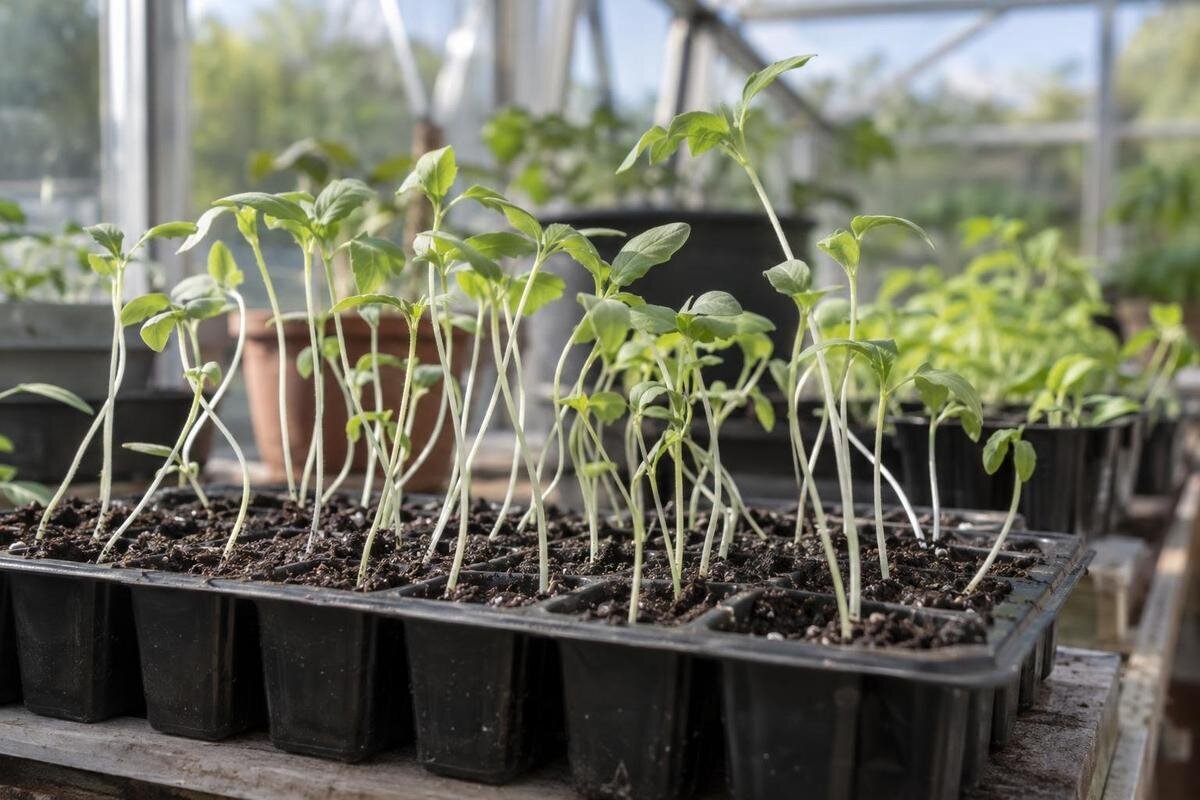
Leggy seedlings usually have an unusually long, thin stem below the seed leaves, called cotyledons, or long stretches between successive true leaves. The stem may bend under the plant’s weight or lean to one side. Compare plants of the same species and sowing date: a tomato, a lettuce and a flower seedling will not share one ideal height. Some stem extension is part of normal emergence, so judge the shape after the cotyledons open and note whether the next leaves and stem sections stay compact. The stem sections between successive leaves are called internodes. When comparing seedlings, look at where the extra length occurs rather than total height alone; a plant with more developed leaves is not necessarily stretching.
Colour and firmness add context but do not identify the cause on their own. Low light can lead to pale, drawn-out growth, but a seedling may stay green while stretching. Excess warmth can lengthen stems without yellowing the leaves. Note whether the whole tray is affected or just a few cells: a pattern across a batch points to shared conditions, while isolated weak plants may have emerged unevenly or been damaged. A seedling that remains upright with a long stem is different from one that suddenly folds at soil level. Compare its growth over several days rather than relying on a single look.
Check how much light reaches the tray
Light is usually the first condition to investigate. A greenhouse can feel warm while seedlings receive limited daylight, especially during short days or prolonged cloudy spells. Nearby trees or buildings, dirty glazing, overhanging shelves and taller plants can also shade a tray. A bright patch at midday does not show how much light reaches the seedlings through the rest of the day. Check the tray at different times and look for even illumination. Plants leaning in one direction may be following a stronger light source; a whole batch with long stems can point to insufficient light overall. Look from the tray’s position, not just from the doorway: a space that seems bright to you may still have an obstruction directly above the seedlings. Note whether a shadow covers the whole tray or only one edge, and whether taller plants have begun shading it since the seeds emerged.
Move trays to a brighter, more evenly lit position where the crop can tolerate the change. If seedlings are going from a dim spot into strong direct sun, make that transition gradually. Turning a tray may encourage later growth to face another direction, but it does not add light or make an already stretched stem compact. Clean glazing where practical and remove avoidable shadows. When planning a new growing space, compare potential bench positions as well as greenhouse size. The Limited-Edition Aluminum Greenhouses with Storage listing gives floor-area options from 5.52 to 28.08 m². Use those dimensions to begin a layout, then consider whether stored supplies, shelves or mature plants would obstruct daylight around the seedling trays.
Warm conditions can speed up stem growth
Warmth helps many seeds germinate, but persistently warm conditions after emergence can speed stem extension, particularly when light is limited. Greenhouses may heat quickly in sunshine and cool later, so one comfortable afternoon does not describe the seedlings’ full day. Check temperature near the tray rather than relying on an outdoor forecast or a reading near the roof. A min/max thermometer placed at seedling height can help reveal sunny peaks and cooler nights. Follow crop-specific guidance, because suitable temperatures vary between plants and stages. Record whether you are assessing seeds awaiting germination or seedlings whose cotyledons have already opened. If a tray contains both, do not assume the conditions chosen for the remaining seeds are also the best conditions for the emerged plants. Consider that mixed stage when deciding whether to move a tray or adjust germination heat.
After emergence, adjust or stop using germination heat only when the crop’s instructions allow; do not chill tender seedlings to force compact growth. Ventilation can help limit daytime overheating, but avoid exposing young plants suddenly to cold drafts. Leave room to observe trays and reach the controls you will use, rather than filling every accessible surface with seedlings. The Bloomcabin Prestige Greenhouse page lists floor-area options from 3.77 to 28.08 m² for comparing layouts. In your planned propagation area, identify where a thermometer could sit at seedling height and remain easy to read. The temperature there, rather than the overall size of the structure, is what matters when investigating stretching.
Crowded seedlings compete for space and light
Closely sown seedlings can shade one another as their first leaves expand. Some stretch upward through gaps; others lean toward open space or grow unevenly across a cell. Look for leaves overlapping, not just stems growing close together. If seedlings were sown thickly, thin or transplant them at a crop-appropriate stage rather than waiting until foliage forms a continuous canopy. Use the seed packet or trusted crop-specific guidance for sowing density. A tray that looks well filled at emergence can become crowded as the plants develop. Distinguish crowding within a cell from crowding between containers: separating trays will not resolve several seedlings competing in one small cell. Conversely, individually potted plants may still shade each other when their pots are packed together. Identify which arrangement is causing the overlap before deciding whether to thin seedlings, transplant them or simply spread the containers farther apart.
When transplanting, handle a seedling by a leaf rather than squeezing its delicate stem, and keep its roots from drying out. Allow for the space plants will need after transplanting, not just the footprint of the original seed tray. For larger layout comparisons, the Spacious Greenhouse listing gives floor-area options from 47 to 70 m². Estimate propagation capacity from the bench layout, tray footprints and room to reach each plant; counting how many trays fit on the floor is less useful. Include space for the individual pots that will replace densely sown trays, so relieving crowding does not simply move the same problem to another bench.

Water and feeding are secondary clues
Water and nutrients affect overall seedling health, but they are less useful as the first explanation for long internodes. Growing mix that stays saturated can deprive roots of air, while repeated drying can interrupt leaf growth. Check moisture in the root zone and make sure cells can drain; do not rely on a calendar or leave trays sitting in water for long periods. Aim for appropriately moist mix, using crop-specific advice for the plant and growing medium. Deliberately drying seedlings to control stem length will not solve low light or excessive warmth.
A pale seedling is not automatically hungry. Young plants use seed reserves, and a strong feed applied too early may stress roots rather than correct a light problem. Once true leaves appear, follow advice suited to the crop and growing medium. If growth stalls or leaves change colour, consider moisture, roots, temperature and light as well as nutrition; appearance alone is not a reliable diagnosis. When comparing the Aluminum Greenhouses range, which lists area options from 3.77 to 28.08 m², include access for routine tray checks in your bench plan. You should be able to lift a tray, examine drainage and return it without disturbing neighbouring seedlings. That access makes root-zone checks more practical than judging moisture only from the surface.
Choose a recovery step that suits the seedling’s stage
For seedlings that have just emerged, improve the conditions before handling them: provide suitable, even light, check warmth and address crowding if it is already apparent. Stems and roots are fragile at the cotyledon stage, so avoid moving very small plants without a good reason. Once seedlings have true leaves and are sturdy enough to handle, potting them into individual cells or containers may give them room to develop. Keep the root ball from drying during the move, and correct the original light or temperature issue at the same time. Potting up is not a substitute for improving the growing conditions; a larger container in the same dim position leaves the main cause unresolved. Before moving a batch, prepare the destination and containers so the plants can be placed promptly. If only a few seedlings are stretched, assess those individually rather than automatically disturbing every healthy plant in the tray.
Some crops tolerate deeper planting and can form roots along a buried stem; tomatoes are a familiar example, but the practice does not suit every seedling. Check crop-specific guidance, and keep leaves clear of the growing mix. A small support may stop a viable plant from falling, but it will not correct stretched new growth. If you are comparing a compact work area, the Lean-To Greenhouses listing gives floor-area options from 3.69 to 14.34 m². Check the actual layout and access details before assigning a potting bench. Allow somewhere to set both the original tray and the new containers during the move, without using the fragile seedlings themselves to make room.
When a grow light may help
Supplemental lighting can help when daylight is not enough for the seedlings you are growing, including when you start seeds before a naturally bright growing space is available. Choose a plant-growing fixture suited to the crop and area, and follow its instructions for placement and daily use. Fixtures differ in output and coverage, so a universal hanging distance or number of hours can mislead. Aim for even coverage across the tray and adjust the position as plants grow, following the manufacturer’s directions. Ordinary room lighting is generally not a substitute for a fixture intended for plant growth.
Watch new growth after changing the light. Older elongated stems will not shorten, but later leaves and stem sections can develop more compactly if conditions improve. If plants at the tray’s edges stretch while those in the centre do not, check coverage rather than assuming every seedling needs a longer lighting period. Also watch for heat around the leaves and for mix drying more quickly. When comparing the Limited Edition Aluminum Greenhouses range, with listed floor-area options from 3.77 to 28.08 m², plan the lighting area around the trays you intend to illuminate. Check bench height and available clearance against the fixture’s placement directions; the greenhouse’s overall area does not establish how many trays a lamp can cover.
Measure conditions where the seedlings sit
Different parts of a greenhouse can offer different growing conditions. A tray beside a wall, under a shelf, near a door or in direct midday sun may receive different light and warmth from one on another bench. Make observations at seedling height rather than only where it is convenient to stand. A simple record can note the sowing and emergence dates, tray position, shade, temperature range, moisture checks and which plants are stretching. Photographs of a few marked cells every couple of days can help show when growth changed.
If only part of a batch is affected, compare it with similar seedlings elsewhere before changing several conditions at once. Where practical, move one tray to a brighter, more even position and keep another as a reference. Focus on how fresh growth develops; existing stems may not straighten. Label the trays and note what changed so you can distinguish the response from differences in sowing date or variety. For a layout comparison, the T-Shaped Orangery Greenhouse listing gives floor-area options from 16.52 to 30 m². Sketch bench positions and walking routes, including access to the trays you will monitor. Choose observation points where you can see the same marked plants without repeatedly rearranging the batch.

Plan sowing around available light and space
Work back from the intended planting time using the sowing instructions for each crop, rather than starting seeds as early as possible. Seedlings kept too long in a dim or crowded area can stretch while waiting for suitable conditions or more room. Sow only what you can provide with appropriate light and temperature control. Staggering small batches may be easier to manage than raising one large, crowded tray. Recheck the timing each season: a fixed calendar date cannot account for every crop, local conditions or the light available in your greenhouse.
At sowing, follow the crop’s recommended depth and spacing, and label varieties so different growth habits are not mistaken for a problem. Estimate capacity using actual tray footprints, usable bench space and how long each batch will occupy it. Include the period when an earlier batch will still be growing while a later one emerges. The Pyramid Greenhouse listing gives floor-area options from 5.53 to 18.9 m² for comparing possible layouts, but it does not state tray capacity or light at bench level. Sketch the growing layout before increasing the number of seedlings, and consider a small test batch if you are unsure how your setup will support compact growth.
Judge recovery by new growth
After correcting light, warmth or spacing, look at the growing tip and the leaves and stems that develop next. Existing internodes remain long, so a stretched seedling will not shrink or thicken overnight. If it is still growing and its roots are sound, it may remain a usable transplant; follow crop-specific planting advice before moving it. Compare the length of new stem sections with the earlier stretched sections, rather than expecting total plant height to decrease. Also consider whether the plant can remain supported during normal handling. A severely elongated plant with a kinked or damaged stem may be difficult to save. Starting a replacement batch can be more practical than keeping every seedling, especially if saving weak plants would leave too little well-lit space for healthier ones.
Do not confuse a seedling that stays upright but grows long and thin with one that suddenly collapses. A narrowed, dark or water-soaked patch at soil level may indicate damping-off or other damage, not simple stretching. Remove collapsed plants, use clean trays and fresh growing mix for another sowing, and review airflow and watering so surfaces are not persistently wet. If many plants collapse or symptoms spread, seek a diagnosis from a local horticultural resource; extra light cannot repair damaged tissue.
Frequently asked questions
Can a leggy seedling become sturdy again?
Its stretched stem will not shrink, but the plant may make sturdier new growth after you improve light, temperature or spacing. Check the growing tip and roots, and judge whether the seedling is still progressing. Severely bent, pinched or damaged plants may be better replaced.
Should I bury a leggy seedling deeper?
Only if the crop tolerates deeper planting. Tomatoes are a familiar example, but this is not a rule for every seedling. Check crop-specific planting guidance, keep leaves clear of the growing mix and avoid burying a fragile stem simply to hide its length.
Will watering more often prevent leggy growth?
No. Watering cannot make up for low light or excessive warmth, and persistently wet growing mix can weaken roots. Check moisture in the root zone, let excess drain and adjust watering to the crop and mix rather than following a fixed calendar.
Do greenhouse seedlings always need a grow light?
No. It depends on the season, shading, glazing and where the trays sit. If natural light is inadequate, choose a plant-growing fixture and follow its instructions for placement and daily use. A grow light should cover the tray evenly without overheating plants.
How is leggy growth different from damping-off?
A leggy seedling usually stays upright, though its stem is long and thin. Damping-off can cause a seedling to collapse at soil level, sometimes with a dark, narrowed or water-soaked patch. More light will not repair damaged tissue; remove collapsed plants and review growing conditions.
Leggy seedlings are a sign to review the conditions around the tray, not an automatic reason to discard every plant. Check light first, then consider warmth, crowding and root-zone care. Make a suitable change and assess the leaves and stems that grow next; that is the clearest indication that the seedlings are responding.
